
 Italy’s seemingly unending chamber of wonders never ceases to amaze me.
From running along the farmland banks of the Tiber river outside Rome to devouring castraure artichokes of Venice paired with some natty macerated white wine… Italy always gives of herself effortlessly and tirelessly.
It’s no wonder that there are so many tourists here this summer — from all over. In Rome they were saying that they are expecting three times the number of people who actually live there. Out of the way hotels have been key to keeping cost down. But man, don’t ask about the rental car!
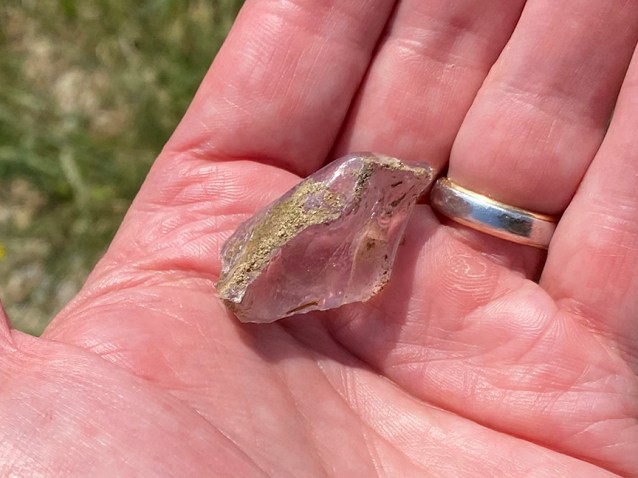
That’s a chunk of quartz, above, that I found in a vineyard high atop the Valpolicella valley. The soil types in Valpolicella are so variegated and distinctive. I had the most amazing day there yesterday.
Today is Festa della Repubblica, a national holiday that celebrates the founding of the Republic of Italy in 1946. But I still managed to get a winery visit in. Tasted some amazing Cabernet Franc in Piave this morning.
After I finish my week of teaching at Slow Food U next week, I’ll be sharing tales of my trips to Italian wine country at three events in the U.S. later this month.
Long Beach
Friday, June 16
register
On Friday, June 16, I’ll be in Long Beach, California with the Dugans, America’s grooviest wine family (I’m so not exaggerating about that either!). Jeremy and I will be pouring some favorite Italian naturals as we try not to one up each other with Mel Brooks quotes. Seriously, we’ll be pouring some super compelling wines and the crowd and community at their shop is super lovely.
Miami
Wedsnesday, June 21
register
On Wednesday, June 21, in Miami I’ll be pouring and speaking about Barbera and Nizza, including two wines by my client and friends at Amistà. I’ll be hosted by the amazing and inimitable Allegra Angelo at her super fun store Vinya in Key Biscayne. The vibe of her store is so cool and we’re going to be opening some truly benchmark wines that night.
Houston
Monday, June 26
DM me
I’m super psyched about a dinner I’m hosting at Davanti in Houston where chef Roberto Crescini is creating an Abruzzo menu especially for us. It’s part of a new gig I’m doing with super sweet folks at the Abruzzo consortium. It’s only open to trade and media. But I might be able to snag a spot or two for you if we have space. Please email me if you’d like to attend.
Thank you for the support and solidarity! Hope to see you later this month!
 Above: Silvia Angelozzi, winner of the “best wine shop professional” for the category “wine shop with restaurant service.”
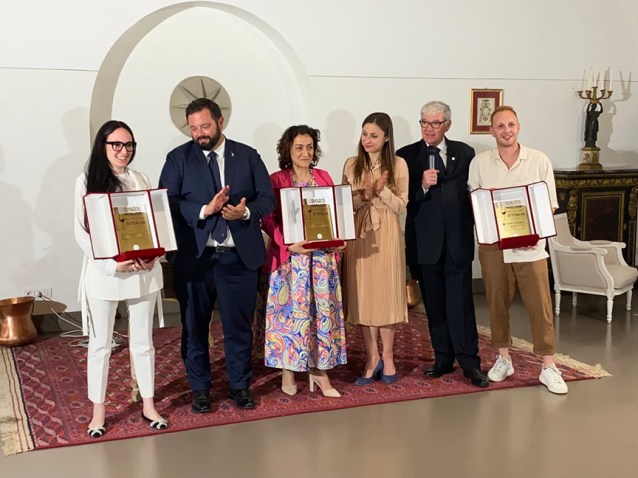 The three winners were Silvia Angelozzi (above, far left, for “wine shop with restaurant service”), Loredana Santagati (center, for “bottle shop”), and Matteo Bertelà (right, for “best wine shop professional under 30”).
 Today was my first full day on the ground in Italy.
 Both were visiting Houston for the first time and both are on what will surely be an epic journey to “build” their families’ brands in the U.S.
 Labor ipse voluptas.
 After searching in vain for a decent translation of the Nizza DOCG appellation regulations, I finally rolled up my sleeves and rendered the text into English myself.
  As my buddy Doug and I enjoyed one of the best meals of my 2023 at Chambers in lower Manhattan earlier this month, I couldn’t help but be reminded of what Susan Sontag once wrote of the 20th-century critical theorist and activist
  As at least one critic has written, Sontag “yearned to be identical to her ideas, to display the punishing consistency of Weil, but her ideas jostled and sparked, exploding her sense of what she was, or wanted to be.”
 If there were one person in the wine trade who has made a career of being identical to her ideas, it must be
  Over the course of a career where she has created an entirely new and profoundly impactful role in the world of wine, she is at once a sommelier and activist, a restaurateur and a philosopher. But she hasn’t achieved this through high-browed essays, articles, books, or speeches. No, she has accomplished this feat through her sheer indomitable will to be identical to her ideas.
 I could feel it in the way that the servers interacted with our party.
 Congratulations to my longtime friend Laura Castelletti on her win as the new mayor of Brescia!
 Frasca in Boulder and Vetri in Philadelphia have long been at the top of many informed gourmets’ list of best destination Italian restaurants in the U.S.
  The word lucciola means firefly in Italian. It’s pronounced with the emphasis on the first syllable: LOO-choh-lah.
  Alberto also told me about an upcoming sold-out dinner that will feature the winemaker and a vertical flight of wines from the storied Champagne house Billecart-Salmon.
 During my decade in the city, a number of then newly opened restaurants helped to redefine the Italian culinary dialectic in the U.S.
