Mad World 2000 Brunello

il poggione

Above: The 2000 Brunello di Montalcino by Il Poggione rocked my world last night at Jaynes Gastropub in San Diego.

It’s been a mad, mad week already, between travel, wedding planning, business meetings with a California client, and catching up with old friends.

Last night, to celebrate Jaynes Gastropub family-member Nicholas George’s successful level 2 sommelier certification exam, Jayne and Jon treated the extended-family crew assembled at the bar to a bottle of 2000 Brunello di Montalcino by one of my favorite (and one of Tom Hyland’s favorite) producers, Il Poggione. 2000 was such a warm vintage in Tuscany (and throughout Italy) and many of the wines have that stewed tomato thing going on. But not this bottling: it was powerfully tannic and it rocked with bright acidity and plum and cherry fruit. I’m sure that winemakers Fabrizio and his son Alessandro Bindocci would tell me that their higher elevation in Sant’Angelo in Colle and their 40-plus-year-old vines allowed them to make great wine in a not-so classic vintage.

Congratulations, Nicholas! Chapeau bas!

mad world

Above: The famous upright piano featured in my buddy Mike’s version of “Mad World.”

Earlier in the day, I took time out to catch up with my good friend Mike Andrews and to visit his studio in Glendale. He loves to tease me that I was voted “most likely to have a successful career in music” by our high school graduating class: since launching his career as a film composer in 1999, Mike has scored countless hit movies. Mike let me take the above photo of the piano he used on his 2003 British number-one-Christmas-hit single version of Tears for Fears’s “Mad World.” He swore me to secrecy: I cannot reveal the technique he used to achieve the instrument’s unique sound on the recording (and had to photograph it obliquely). But it was a thrill to feel its aura, as Walter Benjamin might have said.

Check it out… The opening lines still give me goosebumps!

Today is another mad schedule of work and travel… More later on the California adventures of Tracie B and Jeremy P. Stay tuned…

Best Tuscan wines? Life beyond Tignanello…

In the wake of BrooklynGuy’s post on 1990 Tignanello and my subsequent response, a couple of readers wrote me asking me to create a list of currently available, interesting wines from Tuscany. In turn, I asked you to submit some top recommendations. Here’s what you had to say…

Tuscany

Top wine blogger (and dude whose musical and literary tastes always turn me on) David McDuff’s pics were “nothing cutting edge; all are just old friends.”

Isole e Olena Chianti Classico: Always a pure and elegant expression of Chianti (and Sangiovese.

Fattoria di Palazzo Vecchio Vino Nobile di Montepulciano: Honest vintage expression of the sun-baked Tuscan hills. (They also produce an excellent Riserva.)

Corzano e Paterno Chianti Colli Fiorentini: Proof that great farming can elevate mediocre terroir.

Tuscany

Sommelier to the stars David Rosoff didn’t “have a bunch of time to rack my brain on this today but…”

Castell’in Villa: Has to be there.

Caprili: I’m loving Caprili a lot these days.

Salvioni: Is it trite to say Salvioni?

Tuscany

Wine writer and veteran Italian wine traveler and educator Tom Hyland got right to the point.

Il Poggione Brunello di Montalcino: Classic, elegant, great ageworthiness.

Rocca di Montegrossi Vin Santo: Incredibly concentrated, remarkable.

Ornellaia: Superb fruit, superb winemaking.

And he added, “3 exciting new wines from Tuscany.”

Enrico Santini Montepergoli: Bolgheri red, one of that zone’s best.

Castelvecchio Numero Otto:100% Ciliegiolo, very sexy!

Guado al Melo Jassarte: Blend of 30 varieties combining Italian and Eastern viticulture.

Tuscany

Elaine Trigiani took time out from tasting and teaching olive oil in Tuscany to pen this dispatch.

Fattoria Ispoli Chianti Classico: Well-mannered combo of clarity and mighty persistence.

Podere Le Boncie Le Trame: Quiet yet profound as Giovanna herself.

Santa Maria Rosso di Castiglione d’Orcia: Fermenty.

Tuscany

Guitar player extraordinaire and owner of the coolest wine shop in Central Texas, John Roenigk took time out from the Christmas rush to weigh in.

Selvapiana Chianti Rufina: All the textural suppleness and tenderness I might ever have expected of Sangiovese all the while being completely flavorful and satisfying.

Antinori Chianti Classico Riserva: Fine and complex, always been a personal fave.

Fèlsina Chianti Classico Riserva Rancia: Superb Tuscan estate, really dedicated to Sangiovese. Superb wine.

Tuscan dirt

Brit wine educator and Tuscanophile, author of a newly minted wine blog, David Way loves “the Sangiovese of Chianti and Montalcino as much as anyone, but rather more off the beaten track are…”

Sassotondo Maremma Toscana San Lorenzo: Sassotondo’s top Ciliegiolo, aromas of cherries and pepper, distinctive cru from the Maremma’s deep south.

Rocca di Frassinello Rosso Maremma Toscana: Elegant product of French-Italian collaboration, 60% Sangiovese, beefed up with 20% each Merlot and Cabernet Sauvignon, finely judged new oak above super ripe fruit. Rothschild collaboration.

Massa Vecchia Vermentino di Maremma Toscana: Hyper-natural “white” wine made as a red, i.e. 20 days maceration on the skins, orange tinge, dense herby fruit smells, orange peel, extraordinary.

Tuscany

The Italian Wine Guy by antonomasia Alfonso likes winemakers who are “small and live in as well as on their land and are fully grounded.”

Querciavalle Chianti Classico Riserva: They age beautifully, are fabulous values and have given me as much pleasure as Brunello or Super Tuscan wines have.

Capezzana Carmignano: The blend of Sangiovese and Cabernet (part of the appellation) make for a mouthwatering and delicious lip-smacking red.

Angelo Sassetti Brunello di Montalcino: Yes, his brother Livio is next door and has gotten better press and p.r. But my heart and soul is with Angelo, whose wine is still simple and direct and not obfuscated by modernity of success.

Tuscany

I was really excited to see Massa Vecchia in David Way’s contribution. I love those wines and they stink to holy heaven. I don’t think they’re available yet in this country.

I have to second David Rosoff’s pick, Castell’in Villa. As Franco likes to say, it’s one of those wines in which I always find “emotion” and “poetry.”

I’m also dying to try Tom Hyland’s “very sexy” 100% Ciliegiolo by Castelvecchio.

There are a lot of others I would add, like Sanguineto in Montepulciano, also one of Elaine’s favorites. And I was was thrilled to see her include a wine from the Orcia River Valley. I have tasted some great wines from the Orcia river valley (outside of Montalcino), and, in my view, Orcia will be the next appellation to emerge as a producer of great wine from Tuscany (nothing I’ve tasted from Montecucco has really knocked my socks off).

Thanks, everyone, for weighing in. There are so many interesting wines from Tuscany to reach for these days. This polyglot hypertextual list is rife and ripe with trusted classics, a few surprises, and the heart and soul of Tuscany when you scrape off the patina of marketese. Nothing wrong with Tignanello, of course (BrooklynGuy’s post has inspired Alfonso to “stand upright” a bottle of 1990 Tignanello to taste with me and Tracie B when we get together next weekend). So many great bottles and so little time…

Best airport food? Guess where…

Tracie B and I love to travel. No matter where we’re going, as long as we’re together, the trip to the airport is always a fun one for the two of us.

But the one thing that really sucks about traveling is the awful food options in airports. Even with all of today’s fancy concessions, the food is nearly always a smorgasbord of Sysco-kissed processed foods. Well, friends, I am here to tell ya that there is at least one airport in our country where there’s a local and very tasty food option. It may not look pretty but, man, I was so hungry yesterday by the time my lady and I got to the airport!

Salt Lick BBQ at the Austin airport:

bbq

The real thing (when I took Mama Judy there the other day while she was visiting us in Texas):

bbq

Hungry?

Amphora-aged Primitivo, pozoles and old Rioja, and a Texas wine I liked

Above: This week, Tracie B and I attended our first holiday party of the year at the home of Texas “natural treasure,” author, radio personality, blogger and all-around delightful host, Mary Gordon Spence.

Man, has it been a crazy week — between work, Tignanello triage, the new Amarone DOCG, and the holidays upon us!

Above: Everyone who knows me knows that I rarely eat sweets. But homemade flan? Mary Gordon found my weakness!

Tracie B and I are headed to La Jolla for the weekend, a good thing since snow is expected today in Central Texas!

I’m working on my “interesting wines coming out of Tuscany these days” post and I received a lot of great recommendations from a bunch of Italian wine professionals and bloggers. Thank you, all. I’ll post them next week.

Above: George O brought this bottle of what I’m guessing is a dried-grape red wine from the Texas Hill Country made by Tony Coturri at the La Cruz de Comal winery. It was a great pairing for the flan.

If you haven’t seen it already, please check out this wonderful post authored by Franco (and translated by yours truly) on the amphora wines made by Vittorio Pichierri in Sava (Manduria, Apulia). Amphora wine is all the rage these days. Gravner started making wine in amphora in the late 1990s? Pichierri has been aging his wines in interred amphora since the 1970s and beyond (he uses an ancient format called capasone).

Above: We were joined by the inimitable Bill Head, whose tall Texas tales alone are worth the price of admission (seated next to Tracie B), his lovely SO Patricia, and George O. Jackson (right), photographer and author of a photo collection I am dying to see, Essence of Mexico 1990-2002, images of folklore he captured traveling through rural Mexico.

Dinner at Mary Gordon’s was just the excuse I’d been waiting for to open some older López de Heredia that a client gave me. The 1990 Tondonia white was stunning, as was the 1991 Bosconia. We opened both bottles as we sat in Mary Gordon’s living room and munched on jícama and chips and salsa: I couldn’t help but think about how great these oxidative wines are with food. The 2000 Bosconia Reserva was great with Mary Gordon’s excellent pozoles.

The conversation turned from tales of larger-than-life Charlie Wilson from Bill’s years in Washington to Mary Gordon’s memories of working for President Lyndon B. Johnson, to George O’s adventures in rural Mexico. I spent the whole evening on the edge of my seat. Maybe it’s because I live here now but it always impresses me how Texas often finds itself at the center of the American collective consciousness and American iconography.

Thanks again, Mary Gordon, for such a wonderful evening! And happy holidays to all ya’ll!

Reaction to news of the new Amarone DOCG

jeremy parzen

Above: One of these things is not like the other things. One of these things just doesn’t belong here. Photo by Tracie B.

In the wake of the post by Franco and me yesterday at VinoWire reporting the Italian government’s approval of the new Amarone della Valpolicella and Recioto della Valpolicella DOCGs, the enoblogosphere is reeling with tweets, retweets, pings, and posts.

First and foremost, Italian Wine Guy reacted quickly with an update of his Best Italian DOCG List post.

I also saw a lot of responses to a group message I did from the VinoWire Facebook group: it seems there are a lot of people out there, studying for their Master Sommelier exams, who find this info extremely useful.

There were also a number of retweets from top sommeliers like Jonathan Honefenger of Tony’s in Houston and Master Sommelier Jesse Becker of Wine to Match.

Those of you who follow the Italian enoblogosphere may have noted an absence of reaction. It’s my sense that the move to create the DOCGs for Amarone and Recioto was more a gesture of vanity by producers than a marketing coup and really just the result of political back scratching by the inimitable agriculture minister Luca Zaia.

As wine writer Tom Hyland noted in his comment to our VinoWire post: “Let’s face it, Amarone is so famous that it doesn’t even need it. But given how many wines are now DOCG, it probably would have been embarrassing if it had never received this classification.”

You would think that Zaia and those who market Italian wines in the U.S. would wake up and smell the coffee: a definitive, officially sanctioned list of Italian appellations and detailed descriptions of regulations and production standards would be a no-brainer at this point. Americans love precision and they love technical details (California producers often write exact percentages of blends on the labels of their wines, for example). As it stands, Alfonso aka Italian Wine Guy’s list is the most comprehensive if not exhaustive list.

I understand why Italians don’t really care about the DOC and DOCG classification system at this point — especially in light of the recently implemented Common Market Organisation reforms. But in terms of marketing Italian wines to consumers in the U.S., an official list of DOCs and DOCGs would be an excellent tool for wine educators and wine professionals in this country (and would certainly help sales).

Dear minister Zaia, if you’re looking for a translator, I’m your man! (I even speak Trevigiano dialect!)

In other news…

There has also been a lot of reaction to my Tignanello post on Monday. I wanted to thank everyone for the comments: in the next day or so, I’ll do a post on what I think are the most interesting wines coming out of Tuscany these days. Please send me your comments, favorite appellations, thoughts, suggestions, by emailing me here.

In the comment section to the post, Cristiano pointed out rightly that “the father of the Tignanello is Giacomo Tachis, and not Renzo Cotarella.” (Renzo has overseen winemaking at Antinori for more than a quarter of a decade and was recently called the “father of Tignanello” by L’espresso writer Laura Rangoni.)

In other other news…

The photo above? Just for fun…

The ultimate (authentic) wine pairing for pizza

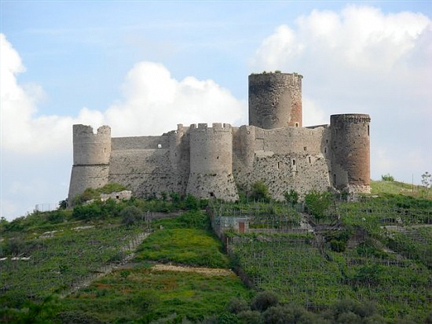
Above: It’s easy to understand why they can make fresh, clean wines in the Commune of Lettere (Naples), where vines are tended atop the peaks of the Lattari mountain chain.

It’s another busy day over here at Do Bianchi Editorial and I really shouldn’t be posting. But when a lovely lady sends me an etymological quaestio, the chivalrous in me trumps my otherwise unflagging work ethic (hah!).

Over at My Life Italian, Tracie B has produced a truly wonderful and thoroughly delightful post on a wine we shared just over a week ago in New York: a sparkling red blend of indigenous grape varieties from the township of Lettere (province of Naples). You’ll have to click through to read about this wine and why it — together with Gragnano — is one of Neapolitans’s favorite pairings for pizza.

But as far as toponomastic matters are concerned, I poked around the web and found an answer to her query as to the origins of the name Lettere.

The most likely etymon I found was that Lettere is a corruption of Lattari (pronounced laht-TAH-ree, if I’m not mistaken), the name of the mountain chain where the township is located. The beautiful (and fruitful) mountains take their name, most believe, from the Latin mons lactarius, literally the suckling mountain (from the Latin lac meaning milk) because the mountain chain was known in antiquity as an excellent site for sheep to pasture.

Tracie B and I will be heading to central and northern Italy in early 2010 but we are hoping to head south next fall. We’ll be sure to take a print out of this listing of pizzerie in Lettere (click on “Dove Alloggiare e Mangiare”)!

And in the meantime, I’ll reiterate Tracie B’s advice: head to Kesté Pizza e Vino in New York and order some Lettere (or Gragnano) with your pizza!

Emergency post: Tignanello, there’s nothing wrong with liking it

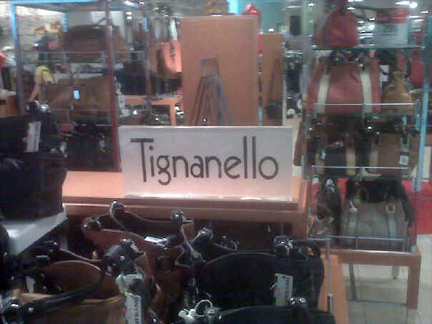
Above: As if by some sort of cosmic connection, Tignanello was on my mind this weekend after I learned about a hand bag line called Tignanello while shopping with Tracie B at a local mall in Austin. (I guess the hand bag line has been around for a while but I just learned about it this weekend.)

It’s been a crazy Monday (after the holiday weekend) and I really don’t have time to post today but extreme situations call for drastic measures!

In his post yesterday, one of my all-time favorite wine bloggers and palates and all-around good guy, BrooklynGuy, asked his readers: “Does my Favorite Thanksgiving Wine make me a Bad Person?” The wine in question was a bottle of 1990 Tignanello, one of Italy’s (and Tuscany’s) most famous labels and vineyards and one of the original Super Tuscans — in fact, a Super Tuscan ante litteram. Evidently, his friend brought the bottle to BrooklynFamily’s Thanksgiving celebration and in the words of BrooklynGuy, “Yes, I drank a Super-Tuscan, and I loved it. And I love the fact that I loved it.”

Of course, there’s nothing wrong with liking that wine or wines like it (do you like my chiasmus?): especially when the new wood has integrated with the other components of the wine, as I imagine was the case in this nearly twenty-year-old bottling, these wines can be the source of immense pleasure. In another lifetime, when I lived in New York and worked at the top of the Italian wine circuit, I had the opportunity to taste a number of older vintages of the historic Super Tuscans, like Sassicaia (notably, 1985) and Tignanello (notably, 1990, 1995, and 1997). The wines can be very, very good.

I can’t say that I like the wines but I certainly don’t think there’s anything wrong with liking them. In fact, I showed 2005 Tignanello in my recent seminar on Tuscan wines (participants loved it, btw).

Why don’t I like them? And more importantly, why don’t I like the categorically? In the case of Tignanello, it’s not that I don’t like it but rather that there are so many other wines I’d rather drink — wines that, in my view, are more indicative of the place and the people who make wine there.

Having said that, I bet that the 1990 Tignanello — first produced in 1971 as Tignanello and the first Sangiovese to be aged in new French oak, according to the producer — showed gorgeously that night (and my deep respect for BrooklynGuy’s palate leads me to believe that it did, indeed, show well).

Above: To barrique or not to barrique? The answer is almost categorically “no” on my palate, especially when it comes to noble expressions of Sangiovese.

Frankly, I feel like I owe BrooklynGuy an apology and I feel terrible that he felt obligated to apologize — however jokingly — for liking a wine that is not a “hipster wine,” as he put it. After all, I have been known to patently dismiss barriqued Italian wines and Super Tuscans in general. The truth is I would have loved to try that wine myself!

It’s important to note that the designation Super Tuscan is generally not used by Italians. I’ve read that James Suckling claims he coined the term but I believe that Nicolas Belfrage actually created it in the 1980s. (Coincidentally, I’m reading Belfrage’s new book, The Finest Wines of Tuscany, and will review it soon. He doesn’t discuss his relation to the term although he does hyphenate it.) It’s also important to note that, whatever its origins, the designation is used purely in an marketing capacity and has no official weight or significance.

And while Tignanello is often called “one of the original Super Tuscans” (together with Sassicaia and Ornellaia), it’s important to note that its creators did not call it a Super Tuscan. In 1971, they declassified the wine from Chianti Classico with the vineyard designation to simply Tignanello, the vineyard designation. Why did they do this? Probably because they’re marketing sense led them to believe — rightly — that by shedding the then-tarnished Chianti label, they could command higher prices for the wine.

Lastly, it’s important to note that the declassification wasn’t the only element that Antinori and the “father of Tignanello,” Renzo Cotarella, introduced in its effort to conquer a greater piece of the foreign market: they introduced new-French-oak-small-cask aging, lower-than-required yields, and — I would imagine — Californian practices in the cellar (I don’t know but am guessing they began using cultured yeasts and other forms of manipulation through technology).

The most interesting tidbit of BrooklynGuy’s post, in my view, is the fact that he points out (and in many ways he’s right on): “Antinori’s Tignanello was a big part of the beginning of the Super-Tuscan craze that ultimately ended with the huge Brunello scandal.” Tignanello has always been made mostly from Sangiovese with smaller amounts of Cabernet Sauvignon and Cabernet Franc (to give color, weight, and tannin). The oaky, beefy (as it were) style of wine ultimately conquered the American market in what is surely to be remembered as one of the greatest coups in the history of wine marketing.

BrooklynGuy asks:

Is this wine partly to blame for the bastardization of Tuscan wine?

No, it’s not the wine. The blame lies with winemakers who have abandoned the flavors and aromas of their land for the sake of avarice.

Is Tignanello bad? And if it is bad, can it still taste good?

Tignanello isn’t bad. But there are so many other, greater expressions of Sangiovese that achieve much, much more at a much lower price point.

The 1990 tasted great, that much I can tell you.

I would have loved to taste it with you, BrooklynGuy! But then again, I know that it’s always a great experience to taste any wine with you!

Chapeau bas, for keeping it real in Brooklyn.

Thanksgiving vine

It’s that time of year again and the holiday season is upon us…

A recent post by Vinogirl on the ubiquitous Vitis californica of my home state got me thinking about the miracle of the vine and its fruit.

Not so long ago, in a comment to my post on grapes under an earlier Tuscan Sun, Vinogirl noted sagaciously that the vine provided “food, drink and firewood for man, leaves for oxen and seeds for pigeons…”

This morning, as Tracie B and I sit around as we do on most Sundays, sipping coffee, surfing the internet, and listening to This American Life, my Sunday New York Times tells me that today the U.S. food stamp program helps feed “one in eight Americans and one in four children.”

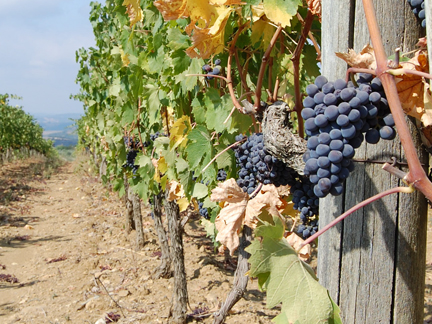
It made me think about what winemaker Dora Forsoni (below right, with her partner Patrizia) told me last year when I visited her and she brought out table grapes for us to munch on as we tasted her wine. “My father was so poor,” said the Tuscan native Dora, “that he couldn’t afford fruit for us kids to eat. So he planted a vine so that we’d always have fruit.” Even without tending, the vine will naturally render fruit. The grapes tasted sweet and juicy.

vino nobile

For Tracie B and me, finances are tight (as we try to put away some money for our upcoming wedding) and the business of wine sales continues to be an uphill battle. But the miracle of the vine continues to give us a livelihood, even in the tough economic climate.

The Thanksgiving weekend is almost over and tomorrow we’ll pick it up again after taking the weekend off (a rarity for us these days). In these tough times, when a lot of folks in our country and across the world are struggling, we sure have a lot to be thankful for: love, health, and the miracle of the vine.

An East Texas Thanksgiving (a marriage of Sangiovese and down-home fixings)

jeremy parzen

Way back when, in the late 19th century, did the “Iron Baron” Bettino Ricasoli know that Sangiovese would make for such a great Thanksgiving wine?

thanksgiving

Uncle Tim’s brined and roasted turkey. Brining is the secret to keeping the breast and dark meat moist and flavorful when roasted. Aunt Ida Jean and Uncle Tim hosted all 31 of us!

jeremy parzen

Uncle Tim’s cornbread dressing, including chopped hard-boiled eggs.

thanksgiving

Aunt Gladys’s homemade biscuits.

thanksgiving

Aunt Ida Jean’s sweet potato pie (I was surprised at how well the Chianti Rufina paired with this dish).

thanksgiving

Mrs. B’s eight layer salad. (For those of ya’ll who don’t know what an eight layer salad is, have a look at this Wikipedia entry.)

thanksgiving

Tracie B’s green beans sautéed with onion and garlic and seasoned with nutmeg.

Thank you, Family B, for making me and Mama Judy part of your Thanksgiving celebration! :-)

Happy Thanksgiving (and some culinary anamorphism)

ginger bread

Details from the Ginger Bread Charity Diorama at the Four Seasons Hotel, Austin, Texas. Photos by Tracie B.

Maybe it’s the little boy in me… I’ve always been fascinated with culinary anamorphism — a cultural phenomenon whereby food is refashioned to resemble something else, edible or otherwise.

ginger bread

The tradition of fashioning food to look like buildings stretches back to the Renaissance. One of the most famous examples is torrone nougat: on the occasion of the wedding of Bianca Maria Visconti to Francesco Sforza, October 25, 1441, the bride and groom were presented with a nougat replica of the city’s church bell tower, the so-called Torrione (today known as the Torrazzo) from which the sweet derived its name.

ginger bread

Another such example from recent memory is Abe Lebewohl’s depiction of Manhattan’s Twin Towers, fashioned out of chopped liver from the Second Avenue Deli.

ginger bread

The Art of Cooking by fifteenth-century Italian chef Maestro Martino (which I translated for UC Press, 2005) offers many examples of culinary anamorphism, mostly for the sake of recreating milk and eggs on days when they were forbidden by the Catholic church.

ginger bread

Last night Tracie B had to drag me away from the ginger bread diorama in the lobby of the Four Seasons Hotel in downtown Austin. Our good friend chef Todd Duplechan oversees the creation and construction of this wondrous little city. Each edifice is auctioned off for charity (last year, a celebrity loved it so much, she paid for it to be recreated and reassembled in Las Vegas, “just so she could show how cool Austin is,” said chef Todd).

Happy Thanksgiving, ya’ll!