Better than the Da Vinci Code: more Santorini sleuthing!

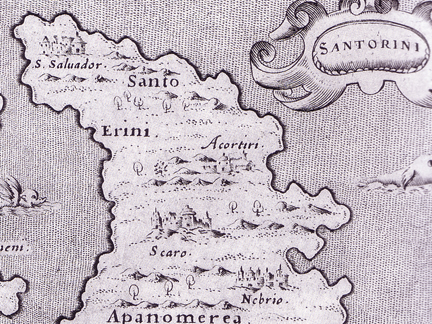
Posting in a hurry today but just had to get this up on the blog. After I posted the other day debunking the myth that Italian Vin Santo and Greek Vinsanto are related in any other way beyond a homonymical coincidence, the chief enologist at Boutari (whose social media project is managed by me), Yannis Voyatzis, express-mailed me a wonderful volume on the wines of Santorini, which (literally) just arrived. In it, I found this wonderful reproduction of a map, printed in 1576 by a Venetian printer. As you can see above and in the detail below, in late 16th-century Venice, the Venetian name of the island Santorini was already well-established.

But more importantly, you can see that the name Santo Erini was still prevalent.

I believe that this supports my theory that the Greek appellation name Vinsanto comes from Vin[o di] Santo[erini].

I’ll have a great deal to say about this in an upcoming post. Early Venetian printing was one of the subjects of my doctoral thesis and I think I’ll have some interesting insights for the philologically inclined among us.

I’m super slammed with work today but just had to share this find asap.

Is this better than the Da Vinci Code OR WHAT???!!!! :-)

Natural wine matters

Above: The wines produced in the Sierra Foothills of California by Hank Beckmeyer and his wife Caroline are among those recommended by Eric in his blog post yesterday on Natural Wine. (I’m offering two bottlings by Hank in my wine club six-pack this month.)

With all the trimmings of a lustful post-modernist dialectic on the semiotic implications of “the other” intrinsically expressed through the exile of “self” in the production of wine, the debate over what is and what is not Natural Wine (with a capital N word) is gearing up like a Hollywood summer box office block buster.

Joking aside, the Solomon of wine blogging, Eric, has opened the flood gates with a torrent of strength equal to a Texas summer flash flood.

We’re all gearing up for Cory’s 32 Days of Natural wines, which begins in a few days (I’ll be posting, as will Jaynes Gastropub, as will Hank above, and a lot of other friends of mine).

In the meantime, I can’t recommend Lou’s posts strongly enough: while Eric is our Solomon, Lou is our Rebi Akiva.

Why I love Italian wine in flyover country (my Palate Press post)

Above: I was pleasantly surprised to discover that Gaia Gaja, Angelo Gaja’s daughter, was super fun to hang out with. I interviewed her over Chicago redhots for my PalatePress piece on my encounters with 3 iconic Italian winemakers in “second-tier” American cities.

Alfonso likes to call it “flyover” country: that glorious swath of land, that sweep of the scythe, those amber waves of grain that span from Chicago to the Rio Grande, the Middle West, Mittelamerika, the Third Coast, the Second Cities. In other words, the America that the Left and Right banks often ignore when it comes to the purveyance of fine wine and dining.

I’ll concede that I probably drank more old wine, thanks to the generosity of collectors, when I lived in cities like New York and Los Angeles. But, honestly, my food and wine life has only become more stimulating and rewarding since I moved to Austin, Texas. (Well, everything has become more stimulating and rewarding since Tracie P née B came into my life.)

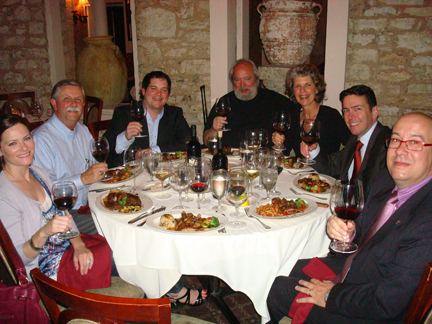
Above, at dinner in Austin, from left clockwise: Tracie P, Dave Meyer (Banfi, Texas), Mark Sayre (my super good buddy and wine director Trio, Austin), Wes Marshall (The Austin Chronicle) and wife Emily, Lars Leicht (Banfi, whom I’ve known forever), and Rudy Buratti (winemaker, Banfi).

When I realized that I would be having dinner and tasting with 3 iconic Italian winemakers in 3 different “flyover” cities, over the course of just 5 days, I thought it would make a good piece for PalatePress (and thankfully so did the editors!).

Gaia Gaja of Gaja in Chicago, Rudy Buratti of Banfi (and newly elected member of the Brunello producers association 15-person advisory council) in Austin, and Giampiero Bea of Paolo Bea in Houston.

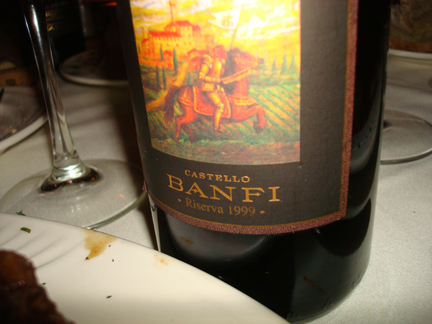
Above: Another pleasant surprise was the 1999 Banfi Brunello (top vineyard) Poggio all’Oro, a wine I would not typically reach for (nor could afford). It was honest and delicious and it tasted like Montalcino. Great wine.

The fact is that top Italian winemakers are traveling more frequently to markets they’ve neglected in the past. I recently found out that Giorgio Rivetti (producer of the infamously created-just-for-the-American-market, jammy, syrupy, ridiculously concentrated Spinetta wines) visited Austin last month. “It’s not often enough that a true gentlemen like Giorgio spends time in Texas,” wrote one wine blogger/merchant.

This is certainly one of the reasons I’ve been lucky enough to have some interesting wine encounters lately.

But then again, as the jingle for the ol’ So Cal franchise Love’s Wood Pit BBQ used to go, when you’re in Love’s, the whole world’s delicious.

Special thanks to Palate Press editor Meg Houston Maker for believing in the piece and eagle-eye editor Becky Sue Epstein for whipping my piece into shape! :-)

Tracie P’s sfincione was amazing

Above: Last night we hosted the first couple of the Austin wine scene, Craig and April Wright Collins. Tracie P truly outdid herself with her cooking.

To borrow a phrase from friend and colleague Charles Scicolone, whose wife Michele is one of the best cooks I know, “I am truly blessed.”

Tracie P simply outdid herself last night with the dishes she prepared for a dinner party we threw.

Ever since cherished family friend Mrs. Reynolds (above) made us a sfincione to celebrate our then upcoming wedding (back in December), Tracie P has wanted to make this classic savory pie from Sicily.

That’s Tracie P’s, above, on the pizza stone we received for our wedding (thanks, Aunt Holly and Uncle Terry!). Did I mention that I’m blessed?

She also made a wonderful olive oil cake for dessert. Yum…

The 2005 Barolo Ca’ Mia by Brovia was stunning. (Check out Cory’s awesome post on Brovia here.)

That’s all I got time for this morning… gotta run… thanks for reading!

BBQ Capital of Texas ERGO THE WORLD

Yesterday, I finally made it down to Lockhart, Texas, historic Texas small town and the barbecue capital of Texas, “ergo the world,” as my buddy Josh Cross put it. Chef Josh is a Texan through and through but he’s also lived and worked in New York and traveled and eaten his way through Europe. I’d been angling for some time to do a ‘cue crawl with him.

Now, let me tell you, people, when the folks in Lockhart say they reside in the barbecue capital of Texas, they ain’t kidding…

First stop was the legendary Smitty’s Market, just one of the triad Black’s, Kreuz, and Smitty’s. It never ceases to amaze me how idiosyncratic Texas barbecue is: even though everyone is working with the same basic ingredients (brisket, beef rib, pork rib and loin, pork sausage) and cooking techniques (“low and slow” smoking), the expressions of the Texas bbq canon vary as widely as the people who do the cooking. In other words, everyone and every venue offers a distinctly personalized interpretation (the only thing consistent at each eatery is the swagger!).

Smitty’s is known for the juicy, untrimmed fat of its brisket. The smoked brisket and smoked prime rib were unbelievably good but the sausage… o the sausage… perfection…

Of all the bbq joints I’ve visited, Smitty’s is the most impressive for its atmosphere. On the weekend, folks wait hours on line in the smoking room itself, an “inferno,” where the raging fires are literally a span’s length from the chow line. We took our place in line at 11:30 and it took 45 minutes to reach the carving board.

The main dining room (above) is full of happy families and well-behaved children whose good manners are rewarded by the comfort food of all comfort foods (and Blue Bell ice cream for dessert).

There are plastic knives and spoons in the Smitty’s dining room but no forks: you eat the beans and other sides (potato salad, cole slaw, etc.) with the spoon but everything else is consumed religiously with one’s fingers.

I took this photo of chopped Live Oak in the Smitty’s wood pile. Josh explained how Live Oak is essential to central Texas bbq because it burns very hot but without releasing a lot of oil as Mesquite does. 90% Live Oak and 10% Mesquite, he said, is the ideal blend of wood types.

Over the weekend, Austin (about 45 minutes northwest from Lockhart) played host to the Republic of Texas Biker Rally 2010 and so there were bikers everywhere, from every walk of life, like this couple Marc and Kat, who sat next to us at Black’s. (For the record, whenever I photograph strangers for the blog, I always ask permission, just in case they’re wanted by the law.)

The beef rib at Black’s was simply amazing. The smokiness and dry rub had gently penetrated the meat, giving it a wonderful savoriness and spice, and it was so tender that you could cut it easily with a plastic nice (look how even the plastic sliced it!).

But the brisket at Black’s… o my goodness, the brisket… Here, the brisket has been smoked for so long that the smoke ring is entirely black and the meat is so tender that it literally melts in your mouth. Of all the truly delicious things I ate yesterday, the brisket at Black’s was the dish that really blew me away… amazing stuff…

We never did make it to Kreuz Market yesterday but I promise I will before summer’s end in a gesture of purely selfless altruism in order to satisfy your insatiable culinary curiosity.

I’m sure that BrooklynGuy would approve of my self-sacrifice for your gastronomic well-being!

Buona domenica, ya’ll! (That means, “enjoy your Sunday,” for those of you who don’t speak eyetalian.)

Happy birthday Giorgio Grai!

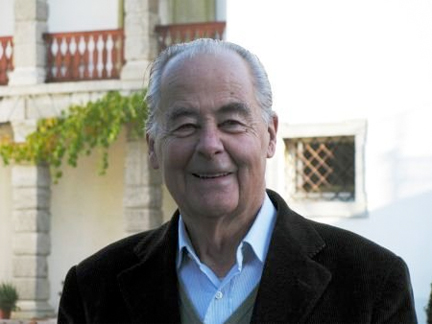
Above: Legendary and most beloved Italian winemaker Giorgio Grai turns 80 today. Photo by Franco Ziliani.

From Friuli to Trentino, from Piedmont to Tuscany, and even as far south as Apulia, there is perhaps no one more respected and beloved by Italian winemakers than Giorgio Grai, who turns 80 years old today.

Check out what Mr. Franco Ziliani had to say about Giorgio in this post over at VinoWire today.

I only met Giorgio once, introduced to him by my good friend Charles Scicolone, many years ago in the library at the old Le Cirque in the Palace Hotel in Manhattan. Before introducing me, Charles, who seemingly knows everyone in the business, turned to Giorgio and said famously, “It’s always a pleasure.”

Debunking the [Greek] Vinsanto and [Italian] Vin Santo myth

Map thanks to the Wiki.

Ok, so since I began working on the Boutari Social Media Project, I’ve been spending a lot of time thinking about Greek wine and trolling the internets for Greek wine tidbits. In the light of this and the fact that I am a self-proclaimed lover of Italian wine and a moonlighting Italian wine historiographer, I feel compelled today to address the forgivable yet undeniably erroneous assumption that the grand traditions of Vin Santo in Italy and Vinsanto in Santorini (Greece) are related in any other way than the homonymical resemblance of their respective designations.

In other words, I’m here today to tell you that the Italian wine is called Vin Santo and the Greek wine is called Vinsanto but the wines are highly distinct from one another in style and substance and history and their relation is purely linguistic. The names sound similar (and there’s a reason for that) but it has nothing to do with the wines themselves, ok?

Exhibit A is the map above. By 1450 The Most Serene Republic of Venice controlled areas highlighted in bright green in what is now modern-day Greece. (I could go on for hours on the Venetian control of Greece and its cultural implications at the time but that’s besides the point.)

Exhibit B is the name of the island of Santorini. The Venetians gave it this name when they controlled the island and its trade during the Renaissance and beyond. The toponym arises from a corruption of the expression agia eirini, ultimately Santa Irene, and subsequently Santorini in the parlance of the Venetian merchants of that era (up until when the Sultan came knocking again, but that’s another story).

(Nota bene: I could find no philologically credible source that pointed to xantos as the origin of the island’s name [as per the Bessarione myth]. All reliable sources point to a [pseudo] Santa Irene as the origin of the Venetians’s name and the contemporary name [Σαντορίνη in contemporary Greek] for the island.)

Above: In a politically aligned marriage that helped the Republic of Venice to secure trade routes in Greece, Venetian noblewoman Caterina Cornaro reigned as the queen of Cyprus in the late 15th century. Photo via Asolo.it.

The most likely explanation for the confusion is that Venetian merchants and perhaps their customers once called the wines they found on Santorini (as the island of Thera was known then and is known today) Vinsanto, an abbreviation of vin[o] santo[rini] (Italian readers of my blog will immediately recognize the important role that the term santo plays in the Venetians’s weakness for blasphemy and related wordplay [paranomasia]).

I don’t have time to document properly the sources I’ve consulted today and I can only beg your patience to trust that I’ve done the legwork (and I have, btw).

I will close today’s post, written in haste, with a passage from the inimitable Kostantinos Lazarakis’s The Wines of Greece (Mitchell Beazley Classic Wine Library series):

    It is difficult to compare vinsanto with Tuscany’s vin santo, especially since the latter can vary from fino sherry-like dryness to highly oxidized sweetness. Most of the volatility in vin santo comes from the barrel-ageing, while vinsanto develops it mainly through sun-drying. Vin santo is dried in the shade, more gently, but for longer. (p. 381)

In fact, the Vinsanto of Santorini is made from Assyrtico and Aidani grapes that “are left on the vine to reach high levels of ripeness… After drying, the grapes are crushed and fermented, mostly on their skins.” Vin Santo from Tuscany, the Veneto, and Trentino is made from grapes dried on mats in the attic of a farmhouse. (There are a number of other elements that make Vin Santo different: the Easter week vinficiation tradition — after the wines have dried slowly on the mats over the winter — and the use of a mother yeast culled from previously used aging cask, for example.)

And I’ll also share the following passage, a little nugget I found in my research, translated slavishly (by me), from the Dizionario del dialetto veneto [Dictionary of Venetian Dialect], compiled by Giuseppe Boerio and published by Giuseppe Cecchini in Venice in 1867, p. 527.

    Vin santo, noi chiamiamo quel vino, che in qualche luogo dello Stato ex Veneto si fa la settimana santa coll’uva appassita, ed è un eccellente liquore che chiamasi Vino santo per esser appunto fatto ne’ giorni prossimi alla Santa Pasqua.

    Vin santo [is what] we call the wine, which, in certain places of the Ex-Veneto State, is produced during Holy Week with dried grapes. And it is an excellent liquor that is called Vin santo for the very fact that it is made during the days close to Holy Easter.

This is the first credible source I’ve found so far where the name of the Italian wine is attributed to the tradition of vinification during Holy Week.

I’ll provide all the footnotes for wine geeks and the philologically inclined, I promise, soon! One lazy Sunday afternoon when Tracie P is busy in the kitchen. Thanks for reading!

When this man is not writing screenplays, he’s wine blogging

When our friend Howard isn’t writing screenplays or composing poems to recite at our wedding (glass of Bolly rosé in hand), you can often find him tasting and discussing wine at his (and my) favorite wine bar in LA, where he and I have spent many an eve discussing the epistemological implications in the nuanced semiosis of a bottle of Cascina Francia by Giacomo Conterno (1998 was the last one we opened together).

He’s even been known to wine blog now and then, like this wonderful post he did today for a film promotion (click on the images to read his wine and cinema pairings).

Chapeau bas, comrade Howard! I will raise a glass to you tonight as I quote my favorite passage from Gramsci!

Sicilian food porn (via Brooklyn): Focacceria di Ferdinando

From the “favorite places on planet earth” department…

Above: The potato croquettes at the Focacceria di Ferdinando in Carroll Gardens, Brooklyn — a sine qua non of the classic Sicilian focacceria (see note on usage and meaning of the designation focacceria below).

Saturday morning in New York City found me and Tracie P on the F train to Carroll Gardens, where we had a date with one of my childhood friends (since our bar mitzvah days), Noah (the German professor as he is known on his wife’s blog) and his lovely wife, Melanie (whom we also adore), mother to the Cheese-Hater and author of the recently published Eating for Beginners.

rice ball

Above: The arancino or rice ball, served in this instance as the rice ball “special.” The arancino is a rice ball stuffed with ground meet and cheese, dredged in breadcrumbs and then fried, and in this case, dressed with tomato sauce and ricotta and sprinkled with grated Pecorino Romano.

Our destination? The Focacceria di Ferdinando, one of my favorite restaurants in the world and one of those places that brings nearly all of my favorite palates together — like Anthony and BrooklynGuy. (In one of our insanely close degrees of separation, Anthony wrote me to tell me how much he loves the Focacceria and to hip me to the fact that awesome Brooklyn songwriter Jesse Harris used to have a band called “the Ferdinandos” in homage to this storied joint.)

chickpea fritter

Above: The pièce de résistance, the “panelle special” sandwich. A panella (pl. panelle), pronounced pah-NEHL-lah, is a fried chickpea fritter, a classic of Sicilian street food.

The Focacceria di Ferdinando opened its doors in 1904, when it catered to Sicilian longshoremen who worked the dockyards in Brooklyn. The current owner, Francesco Buffa, took over from the second owner in the 1970s, and very little has changed there. (Francesco is one of the most interesting characters I’ve encountered in New York, a true vitellone as he describes himself in Fellinian terms, an ex-Carabiniere and judo instructor who fell in love with the owner’s daughter when he visited the city in the 70s, still sporting a Mark Spitz mustache.)

chickpea fritter

Above: The vasteddu (or vastedda), slowly braised spleen, served on a roll with ricotta and Pecorino. Alfonso’s post on vasteddu in Palermo is not to be missed.

Long before Batali and Psilakis made offal fashionable again in New York, Francesco served vasteddu (the Sicilian classic slow-braised spleen) in the same way it was served to proletarians who could have as easily stepped out of a De Sica film in the 50s or a Pasolini film in the 60s. This remarkable dish is a trace of another era and a Freudian red thread that ties our culinary heritage to the fiefdoms of pre-Lampedusian insular life.

cannoli

Above: Still life with cannolo.

One might ask: Where is the focaccia? In fact, the terms focaccia and focacceria (foh-KACH-eh-REE-ah) come from the late Latin focaciam, from focus, meaning fire or hearth. A focacceria is not necessarily a place where focaccia (i.e., the savory flatbread made with olive oil) is baked and sold (although in Liguria or Tuscany, you would most certainly find focaccia at a focacceria). It means simply an eatery or bakery of some sort and as such is applied in Sicilian parlance (again, see Alfonso’s post on his recent trip to Palermo).

Also highly recommended at the Focacceria di Ferdinando: the Caponatina (made in the style of Carini, the town near Palermo where Francesco is from), the Pasta con le Sarde (long noodles with sardines, another Sicilian classic), and — when it’s available — Francesco’s marinated tuna steak with celery sauce.

An INCREDIBLE flight with the Philip Marlowe of wine

It was about 8 o’clock in the evening, end of May, with the Manhattan moon rising above midtown and a look of hard wet rain in the distance of New Jersey. I was wearing my pinstripe blue suit, with a light checkered shirt and an orange square tie. I was neat, clean, shaved and sober, and I didn’t care who knew it. I was everything the well-dressed sommelier ought to be. I was about to pour an 1971 Produttori del Barbaresco.

Words cannot begin to describe the sensations Tracie P and I experienced a few weeks ago in New York, when our dear friend Mary Anne treated us to dinner at Alto in midtown Manhattan, where Levi Dalton — the Philip Marlowe of the New York wine scene — had created a special flight just for us.

There a lot of talented wine professionals in New York but none is sharper than Levi, and man, he’s at the top of his game right now, really and truly in the zone. And I’m sure that anyone who knows Levi will concur: the dude’s dry wit and deftness at wordplay are matched only by the acuity of his palate. Raymond Chandler couldn’t have written a more perfect Philip Marlowe of wine.

I needed a drink, I needed a lot of life insurance, I needed a vacation, I needed a home in the country. What I had was a wine key and a serviette.

Like a mind-reader, Levi couldn’t have thrilled us more than by opening the flight with this Saignée de Sorbée by Vouette et Sorbée. Incredible freshness, sumptuous aroma, sexy but not overly generous fruit flavor.

Next came the 2005 Arbois Pupillon by Overnoy. I’d only ever tasted this wine in Québec, where it seems to be easier to find. To me, wines like this are the “unbearable lightness of being.” They are so light in body yet so rich in mouthfeel, delicately fragrant on the nose yet muscular in the palate. Perhaps only in Barbaresco do I find that same counter-intuitive, ineffable sensory experience. The same equine metaphors apply.

The whole restaurant turned around to see what the fuss was about when Tracie P and I gasped in delight at the appearance of this wine. 1974 not the greatest vintage for this wine but showing admirably. Little did we know what was about to come…

Dreams do come true. Awesome vintage (older than Tracie P!), beautifully cellared bottle. One of the great wine experiences of my lifetime (up there with 1989 Barbaresco Santo Stefano by Bruno Giacosa).

Angiolino Maule’s wines were a discovery for me on this recent trip to New York. Later in the trip, I tasted his declassified Soave. Fantastic wines. Great acidity even in this recioto di Soave. A true connoisseur’s wine.

And not to be outdone in the brandy department… The above photo needs no caption.

“How do you like your brandy?” asked General Sternwood. “In a glass,” said Marlowe.

From Levi Dalton to Romano Levi… what a night! What an amazing flight of wines.

Thanks again, Mary Anne for treating me and Tracie P to such an unforgettable evening in celebration of our wedding. And thanks, Levi, for being such a great friend (however from afar) and for creating such a special flight of wines just for us. I’ll never forget it.