The Babbo effect and a visit to the Bastianich winery in Colli Orientali del Friuli

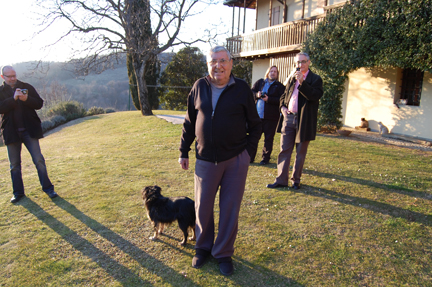
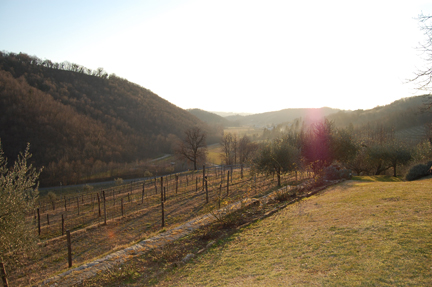
Above: My friend Wayne Young, whom I met in 1998 in New York when he had already been working within the then-expanding Bastianich empire for three years. In the photo, Wayne is standing atop the amphitheater growing site where the top wines for the Bastianich winery are grown in the Colli Orientali del Friuli.

Babbo changed everything. It was “a fine-dining Italian à la carte restaurant below 14th St.,” as Joe Bastianich put it when I first met him in 1998 (when I was working as an editor at La Cucina Italiana in the City).

Ruth Reichl’s watershed New York Times review of the place in April 1998, “A Radical Departure with Sure Footing,” marked a point of no return for pseudo-Italian restaurateurship in the U.S.

I remember that Wednesday in August 1998 well: it was the day that Italian gastronomic irony died and the newly minted craze of Italian regional cuisine took firm hold in North America. Whether you liked Babbo or not (and who didn’t want to get a table at Babbo?), from that day forward, if you cooked Italian food in the U.S., you had to do it earnestly: your food was only as good as the authenticity that stood behind it.
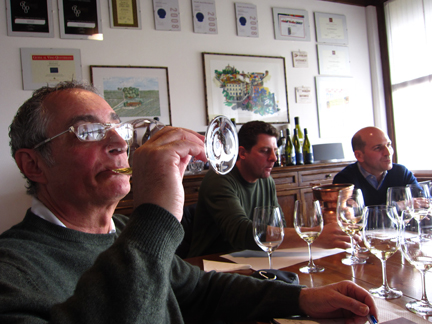
Above: Alfonso tasting with the COF2011 blogger team and winemaker Emilio del Medico and winery GM Dennis Lepore.

Wayne Young and I first met back in those heady days of New York’s Italian food scene. We all knew a revolution was taking place even though, from the eye of the storm, we didn’t realize its portent. Today, Wayne — who has worked as a sommelier at Bastianich outposts Becco and Babbo — serves as the Bastianich winery’s “special ops” man on the ground in the Colli Orientali del Friuli (the blogger project there was his idea). He is involved in every aspect of the operation, from winemaking (a wasp in his pants is what gave him the idea to call the winery’s flagship white “Vespa”!) to sales (ask him what it’s like to sell wine in Serbia!) and marketing (he is the only Friulian winemaker to author a winery blog).

Wayne is a remarkable man, with great generosity of heart and a warm gentleness. I’ve never heard him say a nasty word about anyone and I admire him for the way he lives his life perfectly integrated into Friulian society where he is welcomed and beloved by all we met. Despite his nordic locks, everyone calls him “a local” up there in northeasternmost Italy.
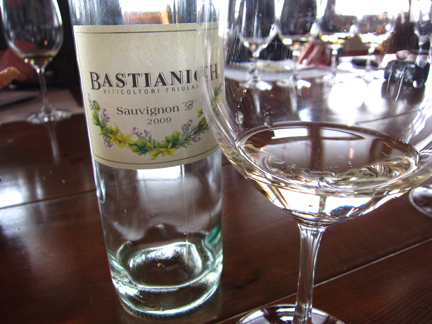
Above: In our tasting last week at the winery, my favorite wine was the 2009 Sauvignon Bianco. Fresh and clean, with balanced aromatic character and that bright acidity that I want (and need), it should retail for under $20 in the U.S. The Bastianich Sauvignon has a screw cap, a feature that allows the winemaker to add a smaller amount of sulfite to the wine, because the screw cap allows less oxidation (where a cork, an organic substance, would allow more).

Like Wayne, the Bastianich family has been welcomed in the Colli Orientali del Friuli as winemakers. President of the COF consortium Pierluigi Comelli told us the story of how Joe and mother Lidia came to him asking for advice on where to buy property and set up their facility. Ultimately, on his advice, they revived a winery that had abandoned after the owner’s untimely passing. And they bought uncultivated growing sites where they cleared the woods themselves to make way for vineyards. After a week in the COF, I had a clear sense that winemakers there appreciate the expanded exposure and bandwidth that the Bastianich brand brings with it. “Everyone rises with the tide” seemed to be the consensus.

Above: On Friday evening, the last of our trip in the COF, we took time out to celebrate with a beer in Cividale del Friuli. You can’t really help but smile when you’re around Wayne — it’s contagious. That’s Nicolas, David, and Alfonso to the right.

Spending the week tasting and comparing notes with Wayne (who, as a local winemaker, shared a lot of interesting insights with the group), I couldn’t help but think back to 1998, when we first met and none of us really understood what was about to happen. As Eric the Red recently pointed out to me, it was a time of Italian gastronomic “innocence” (it is Eric whom Mario Batali’s father Armandino credits for having “discovered” his son’s talent in 1993).

I’m glad to know that the fame and the celebrity hasn’t changed my old friend Wayne.

Breaking news: Brunello producers postpone vote to change appellation

In a victory for traditionalists and defenders of Sangiovese and Brunello, the Brunello producers association has postponed its vote on whether or not to allow grapes other than Sangiovese in Rosso di Montalcino.

Franco and I just reported on the breaking news at VinoWire.

We lovers of Brunello can sleep soundly tonight, knowing that the appellation is safe — at least for another 3 months. Check out the post here.

Campari e Soda: time for a break

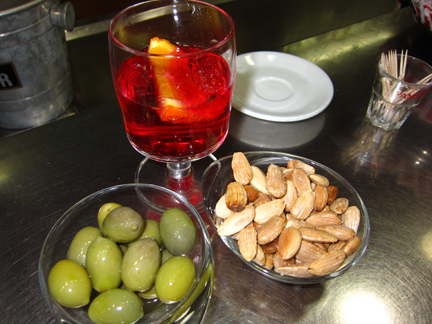
Man, I’m tired and it’s time for a break. Yesterday, before meeting friends for dinner after a long day of tasting and business meetings, I took time out for a Campari e Soda at the Bar Commercio (you can imagine the 1950s-era neon sign) on the outskirts of Lecce (yes, Lecce!) where I’ve spent the last two nights.

The bitterness of the Campari was tempered by a sweet, tangy slice of blood orange and the briny olives and lightly salted toasted almonds rolled around my tongue enveloped in the bright red bitters — an earthly however immensely rewarding pairing for one tired dude.

Today I head back to Venice and tomorrow to Austin. Alfonso was right when he told me, more than two years ago, that I would miss Texas more than I could imagine: more than ever, I wanna go home with the armadillo.

I’ve been on the road for nearly two and half weeks and I’ve been away from Tracie P for way too long. I can’t wait to wrap my arms around her and hold her tight again… One more longest night before I will see her again but one day closer to her sweet lips and loving embrace…

Thanks to everyone for following along here and at COF2011.com: your visits and comments and encouragement have meant the world to me. I hope you enjoyed the ride.

There’s lot more to tell and there will be time for that, too. But now it’s time for a break…

See you in a few days…

A Natural wine ante litteram: Ronchi di Cialla

Long before anyone ever dared to utter the N word on a blog or in dogmatic marketese, there was a bookish Olivetti typewriter salesman who decided to give up his comfortable job shilling macchine da scrivere, opting instead to make wine from native grape varieties, native yeasts, and chemical-free integrated farming in the Colli Orientali del Friuli. That man was Paolo Rapuzzi (above) whose winery, Ronchi di Cialla, began producing Schioppettino, Refosco, Picolit, and Verduzzo — four of the native grapes of Friuli — in the village of Cialla in the early 1970s.

Of the quindecemvirate of wineries we visited during the blogger team’s stay in the Colli Orientali del Friuli, there was none in situ that I was more excited about. I first began to frequent the wines of this historic estate in the late 1990s in New York, where I happened to stumble upon a forgotten allocation of its wines at Vino. Stretching back to the 1980s, the wines were impressively fresh and they had that classic juiciness and spicy note that makes Schioppettino such a fantastic food-pairing wine.

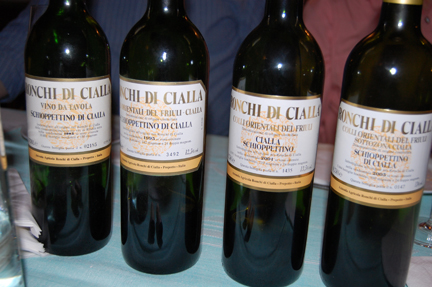
Founder Paolo and his sons Ivan and Pier Paolo walked us through a remarkable tasting, including 2005, 2001, 1995, and 1985 (all of which are current releases, btw). The 2005 was very generous with its fruit, while the 2001 and 1995 were more closed and tannic. The 1985 sang gloriously in the classic tulip-shaped glasses that the Rapuzzi family recommends for service of their wines.

Over the course of my stay in Friuli, no fewer than three persons told me that their respective families were the authors of the revival of native grape varieties in Friuli. I’m sure there’s a grain of truth in each of their hagiographies. But no family is more closely associated with the revival of Friulian native rootstock than the Rapuzzi. In fact, some of the rootstock offered by the hegemonic Italian nursery Rauscedo is surnamed by Rapuzzi, like the “floral abortion” Picolit that Paolo resuscitated.

By the 1970s, when he began making wine, most producers had started using a newly developed clone of Picolit that did not “abort its flowers.” While the newly developed clone delivered much higher yields (and lowered the cost of making Picolit), the traditional “biotype” was ideal for making dried-grape Picolit, he explained, because its natural floral abortion led to less buds and more naturally concentrated fruit. He planted and cultivated his Picolit for 10 years before it produced fruit and then he applied what could essentially be called a massal selection to the plants that ultimately were chosen for the Rauscedo rootstock and that are still used today to make Paolo’s Picolit (50% dried grape vinification, 50% classic vinification).

Cialla is one of the three sub-zones of the Colli Orientali del Friuli and is a monopole, owned by the Rapuzzi family. It is blessed with immense beauty and idyllic tranquility. Our visit with Paolo — a colorful and warm personage, who rests his hand on yours when he speaks to you — was probably my favorite of the trip. In the hour we spent with him (with me interpreting for the group), he never once used the word “natural.”

“We grow are grapes without pesticides or herbicides,” he told us, “and then we try to intervene as little as possible, letting the land of Cialla express itself in the wines.”

No need, in fact, to call this wine “natural”: res ipsa loquitur.

Playing guitar in Padua…

All work and no play makes the Jar a dull boy…

After a week of Colli Orientali del Friuli with the “Magnificent 6,” I took time out yesterday to catch up with some of my oldest and best friends in Padua — both of them extraordinary musicians in their own right and genre.

That’s Ruggero Robin (above) in his studio. Ruggero’s played with ’em all: Zucchero, Pavarotti, Andrea Bocelli, and B.B. King, among many others. And his cerebral, dense style of jazz, jazz fusion, and jazz rock has made him one of Italy’s most admired musical artists (no shit). Ruggero was my “first friend” in Italy back in 1987: we met on the night of my first gig in Italy. And I learned from winemaker Angiolino Maule that Ruggero plays every year at VinNatur. Who knew? We listened to some of Ruggero’s mind-blowing tracks and he also played some tracks by his daughter Sara: she is going to be a huge star… I can just feel it… amazing chops, amazing (and remarkably mature) voice at 20 years old, and SO MUCH soul in her songwriting…

Later in the evening, I caught up with Gabriele “Elvis” Inglesi (above), one of the best friends anyone could ever wish for. The first time I made a real living playing music was with Gabriele (whom we used to call Elvis because of his obsession with life and work of Elvis Presley). We remembered how we played 28 gigs in February 1991 (I was 24 years old): 100,000 vecchie lire (about 60 bucks) per man per night and all the beer and food you could drink and eat… Man, we must have a played a thousand gigs together when I lived in Italy…

Elvis has an amazing voice and since those early days in both of our musical careers, he has become a virtuoso chicken picker, basing his style and technique on the category’s inventor and innovator, James Burton. Just ask McDuff, Nicolas, or Alfonso, who all got to meet Elvis and hear him play… he’s a phenomenal guitar player… we even got to hear a few of Elivs’s legendary jokes!

But dulcis in fundo

I finally got to meet Elvis’s son Ettore (above)… what a great kid…

Looking back on it all, I remembered how music got me through some of the most trying and difficult times of my life and how many rewards it delivered in happy times, too. And most of all, I thought, it brought so many wonderful people into my life, people I wouldn’t have met otherwise, love and friendship, solidarity and camaraderie… I wouldn’t trade any of those memories for all the gold in the world… they’re worth much, much more…

Don’t let the farmer know…

Don’t let the farmer know how good cheese is with pears…

So goes a bourgeois Italian expression: don’t let the proletariat know how good it is to be a member of the ruling class

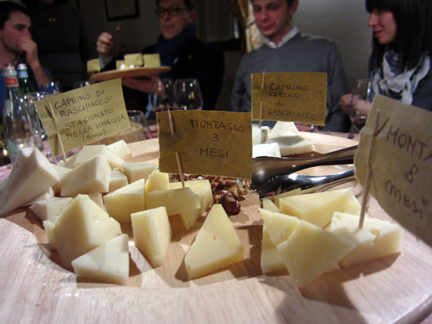
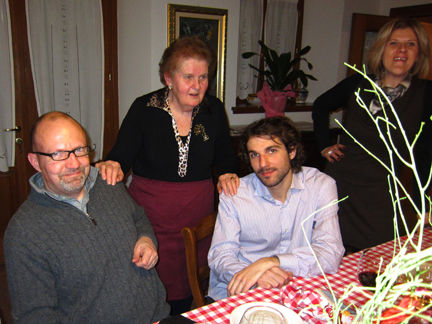
Julienned pears and shredded Montasio cheese over winter greens, served with a lightly fried pancetta rasher and drizzled with olive oil, were delicious last night in the home of Daniela and Pigi Comelli.

Montasio is Friuli’s flagship cheese.

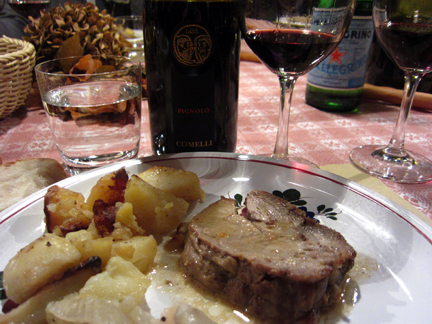
Comelli’s Pignolo (2007) was my favorite of the trip so far… Pignolo is a wildly tannic however noble grape. While most seem to vinify it in a “massive” and “muscular” style, Comelli’s was more judicious and showed nice fruit, especially when paired with roast pork loin and potatoes. Good stuff…

So much more to tell but gotta run… Follow along at COF2011.com

Fascist-era Berkel slicer with Fascist faggot

Evidently, Mussolini didn’t care for the fact that Dutch-made Berkel slicers were painted red. And so he had them painted black and added the Fascist victory emblem with the Fascist faggot (the fascio, above).

When he’s not busy growing native grape varieties and making wine, Friulian winemaker Michele Moschioni reconditions vintage Berkel slicers.

Follow along at COF2011.com.

She stole my heart…

And so did her grandfather’s Picolit…

Together with grandma’s crostoli at the AMAZING Ronchi di Cialla

So much to tell… so many flavors and aromas to convey… there will be time for that, too… but in the meantime, follow along at COF2011.com

Words of wisdom from a fine lady: eat less…

Photo by Alfonso.

After dinner last night at Zorzettig, signora Zorzettig joked (with me translating for her) joked that polenta, goulash, and brovada (fermented turnips) were actually “light food”… when people had less to eat…

“We didn’t have to worry about cholesterol in our day,” she said. It must be remarkable for someone from her generation to hear folks complain about all the problems they have from overeating. She joked: “They should eat less!” She’s right… mangje di mancul

What a sweet lady and what a wonderful feeling to experience the warmth of holding her hand as she spoke to me — the way ladies of her generation express hospitality with guests in their homes. That’s David to the left of her and Nicolas to the right and daughter Annalisa.

Magical tasting with Ronco del Gnemiz

Alfonso captured a magical moment yesterday at Ronco del Gnemiz with his Flip.

Serena and Christian have such an awesome record collection: we couldn’t resist asking them to pair their wines with some music (in this case Cassandra Wilson with the 2004 Chardonnay Sol in magnum).