Very psyched to work my first night @sottoLA my good friend steve samson’s (above) new restaurant sotto where I wrote the list. If ur in LA come by and see me!


Very psyched to work my first night @sottoLA my good friend steve samson’s (above) new restaurant sotto where I wrote the list. If ur in LA come by and see me!
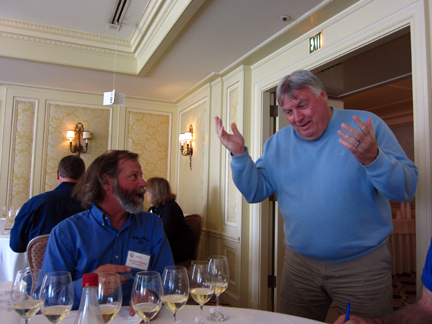
Above: Organizer of the San Diego International Wine Competition Robert Whitley (right) is a “larger than life” kinda guy. The best part of the event was his telling the story of almost getting his lights punched out by Joe Namath in 1969 at Broadway Joe’s NYC bar Bachelor III in 1969. Duncan Williams (left) is the senior winemaker at Fallbrook Winery in northeastern San Diego. He makes an awesome Sangiovese Rosé (no kidding, I tasted it with him a few years ago), writes a column for the San Diego Union-Tribune, and I was stoked to be on the same panel as he.
What does a guy like me feel like at the San Diego International Wine Competition? Like an Italian werewolf.
As flattered as I was to be asked to sit as a judge and as curious as I was to taste such a far-reaching sampling of American wines, I was probably the most unlikely candidate for the job. But I tried to embrace my duties with an open mind and heart: as I judged the wines with my tasting group — Duncan Williams (above) and Ron Rawilson of Ortman Wines (super cool dude) — I tried to evaluate them for the intention of the winemaker and the category for which they were created.
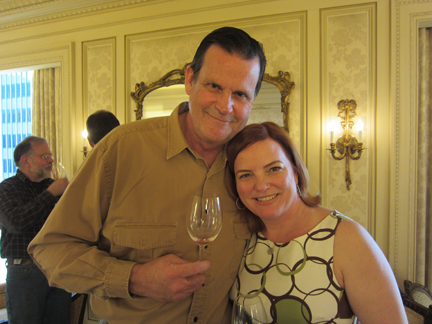
Above: I was psyched to catch up with fellow judges GlobalPatriot (left, author of an awesome geopolitical food and wine blog) and SF publicist extraordinaire Kimberly Charles whom I’ve known since my earliest days of food and wine writing back in NYC more than a decade ago. Nice folks…
Of the 191 Chardonnays submitted to the competition (the largest category), I was faced with the onerous task of tasting 32 of them — all of them barriqued. In the wake of the tasting, I needed a toothpick to extract the oak chips from my tongue.
I regret to report that Chardonnay and Merlot represented the two top categories submitted by the mostly American winemakers. Are we stuck in the 80s? Oops, I forgot to take down the Nagel from my living room.
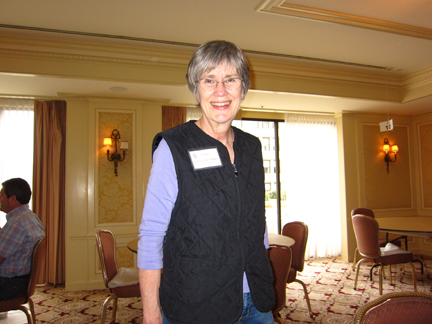
Above: Linda McKee is a winemaker in Pennsylvania and very simpatica lady. It was really cool to hear her talk about Elmer Swenson, a legendary grape breeder who developed hybrids for American viticulture.
The pleasant-surprise wine for me was a Seyval Blanc (yeah, you’ve never heard of it either) grown in New York and vinified in Wisconsin: Prairie Fumé (ha!) from the Wollersheim winery in Prairie du Sac, WI.
The wine, which happened to land in one of our flights, tied for “best in show white.” It was delicious, with bright (clean, not acidified) acidity, good fruit, and balanced alcohol (11%, yes!, according to the fact sheet on the wine). I was thoroughly impressed and I am evermore convinced that hybrid grapes (Blanc du Bois in Texas, for example) are the key to making good, honest wine (that doesn’t need to be “corrected” in the cellar) in our country.
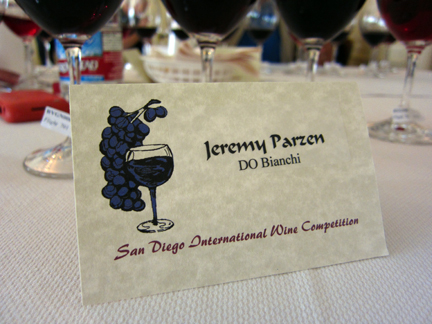
Above: Was it a sort of contrapasso that I had to taste 32 barriqued Chardonnays and 19 barriqued Merlots? And don’t forget the 17%+ Zinfandels. I think I’ve paid my dues at this point!
All in all it was a great experience — if only for the schmooze factor — and I was geeked to finally get to meet and taste with Robert, whose palate and schtick I greatly admire.
The moment that sticks out the most in my mind was when Duncan asked rhetorically, why do winemakers still make Chardonnay like this? It’s really such a neutral grape that doesn’t perform well in this style.
It led me to coin a neologism: ChardonNO!
This week’s episode of the Italian Grape Name Pronunciation Project is devoted to Sangiovese Grosso as spoken by my friend Federico Marconi who was born in Castelnuovo dell’Abate (a subzone of Montalcino) and general manager of the small estate Le Presi (click here for my post on Le Presi and a great photo IMHO of the strata of volcanic soil that define the wines raised in Castelnuovo).
Sangiovese is relatively easy to pronounce for Anglophones. But for the record, it is pronounced here by a bona fide toscano and ilcinese (ilcinese or montalcinese is the ethnonym used to denote an inhabitant of Montalcino).
Also, for the record, please see my post on the Origins of the Grape Name Sangiovese, which most probably does not mean the blood of Jove — a folkloric etymology too often repeated by wine writers who don’t do their homework (I cover all of the current theories of its origins in the post).
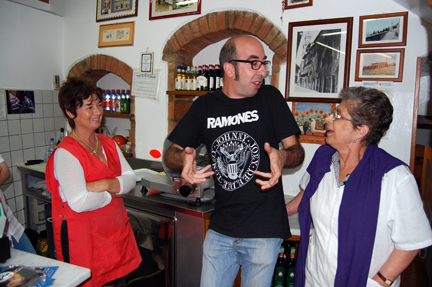
Above: “Due palle così!” My good friend Federico entertained the nice ladies at the famous food shop Nannetti e Bernardini in Pienza (HIGHLY recommended, especially for its legendary porchetta).
Federico is one of the most colorful and lovely people I know in Montalcino and his Ramones t-shirt is his de rigueur uniform (as you can see above). He’s one of those people, to borrow an observation by the great Montalcino winemaker Fabrizio Bindocci, who makes you smile when he walks into the room.
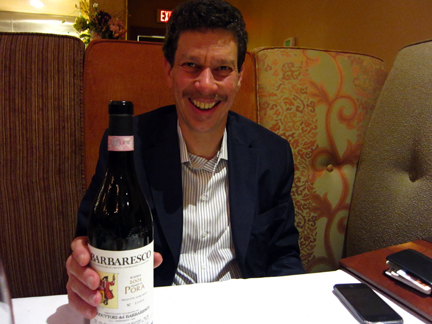
Every five years or so, I get an email from Professor Wilkins (above) and before email, I’d get a letter or a phone call. “I want to know how you’re doing and what’s going on in your life,” he’d say. A million happy questions would follow, with him wanting to know every detail of the vicissitudes of my life, studies, work, etc.
You see Professor Wilkins — David — was the best friend of my eldest brother, ten years my senior, Aaron Louis Parzen, who died in 1972 when he was fifteen in a car accident not long after my family moved to San Diego from Chicago, where he and Aaron both attended middle school at the University of Chicago Laboratory School. Today, David — Professor Wilkins (here’s the Wiki entry devoted to him) — is one of the leading law scholars in the country, with a chair at Harvard, and he moves and works within some of the most rarefied circles of our country (“the first lady was a student of mine,” he told me last night). A celebrity in his field, he was in San Diego last night to give a private lecture to a law firm.
I hadn’t traded messages with David for some time and although I began writing about wine more than 13 years ago, he and I never made the connection to his interest in wine until he stumbled upon my blog. As it turns out, David began collecting wine in the mid-1980s, before the crush of wine culture seethed in the U.S. in the mid-1990s. “I read [Robert Parker’s] Wine Advocate when it was still a photocopied report,” he joked.
Wanting to share a special bottle with him, I reached deep into my San Diego wine locker yesterday and grabbed a bottle of 2001 Pora by Produttori del Barbaresco (above). The wine was remarkably tight for this regularly more generous cru but as it opened up and began to reveal its fruit, it sang stupendously in the glass. As much as I oppose the fetishization of old wine (and those who cry “infanticide!” when you open “young” Nebbiolo), I have to say that the wines of Produttori del Barbaresco only get better over time and this wine was still extremely youthful — like a teenager full of energy and promise and brilliance and power — however cut short by life’s vicissitudes.
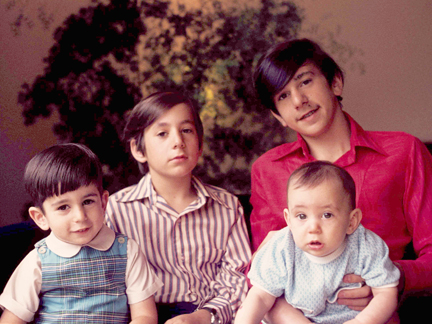
My memories of Aaron are fleeting and distant. I was five when he died. I believe that I see Aaron in David the same way that David sees Aaron in me. Not that I’m as brilliant or handsome or athletic as Aaron was (and he was): we see Aaron in each other because that’s where he lives — in our memories, in our hearts, and in our dreams. When he died, I became the “middle child” and as cliché as it sounds, I have followed the path of the middle child, pursuing music and writing, while my brothers have enjoyed immensely successful careers as lawyers and now in public service. However unlikely our bond, Aaron’s memory links me to David and as it turns out, the vicissitudes of life have formed an unexpected and equally happy bond between us — through wine.
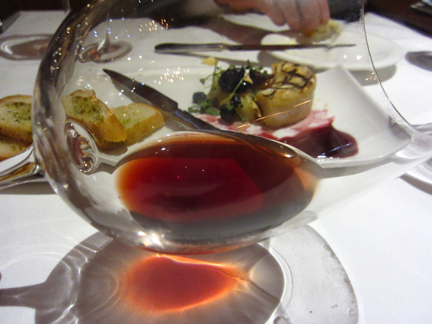
As we chatted last night over dinner and ten-year-old Nebbiolo, David told me the same stories about Aaron that he tells me every time we connect. And like every time, they brought tears to my eyes and laughter to my heart as the bitterness of the tannin and the sweetness of the fruit danced in our glasses.

Rolled in early this morning to San Diego where I’ve been asked to sit as one of the judges of the San Diego International Wine Competition (and ya’ll thought I was kidding about drinking oaky “Napa Cab” on Facebook!).
Made a beeline to Super Cocina (above) where brother Tad hooked me up with the goods. Man, anyone who comes to San Diego and doesn’t check this place out might as well just stay home… I love it that much… The chicharrònes were super tender and swam deliciously in their tomatillo sauce.
In other news…

I just finished translating Franco’s editorial on the “Italian Unity Bottle Project.” Click here to see what he had to say.
As you all know, I LOVE Merlot, especially when produced in Piedmont!
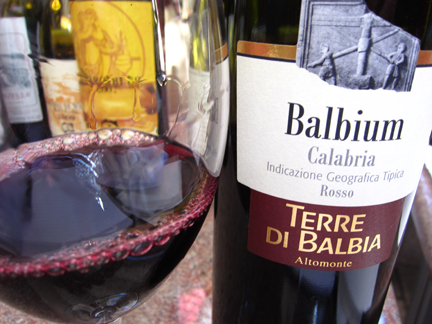
Above: My friend Giampaolo Venica’s Balbium — 100% Magliocco from Calabria — is one of my favorite wines on the list at Sotto in Los Angeles.
When one of my best friends from my college days, Steve Samson, wrote me a few months ago and asked me to author the wine list for his new restaurant in Los Angeles, I jumped at the chance. I’ve always been a fan of Steve’s cooking — his mother is from Bologna and so it runs in his veins — and I’ve followed his career since the beginning, dining at the restaurants where he’s worked (Valentino in LA is one of them).
There was just one catch (two actually): the list had to be ALL southern Italian wine with a handlist of California. I immediately set out sourcing some of the best and best-priced southern Italian wines available in the Golden State and the resulting list is a flight of roughly 50 wines from Campania, Apulia, Calabria, Sicily, Abruzzo, Molise, and Sardinia (including some of my favs like Dettori, Gulfi, Cos, and Venica’s Balbium). And for the California wines, I told Steve and his partners that I was only willing to write the list if we only allowed Natural and chemical-free wines on the list: Donkey & Goat, Coturri, Clarine Farms, etc. — the only Californian wines I’ll drink.
I’m very proud of the list — partly because of our aggressively patron-friendly pricing — and the extreme value that you find in these wines. But mainly I’m excited because southern Italian wine is super sexy and delicious.
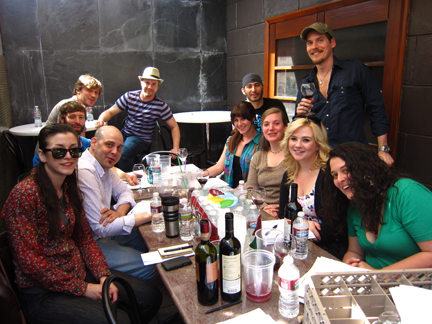
Above: The staff at Sotto and I have been tasting and training together during my recent visits to Los Angeles. A fantastic group of restaurant professionals. Right now their favorite wine is the Cerasuolo di Vittoria by Gulfi.
On Tuesday and Wednesday nights next week, I’ll be working the floor and pouring wines by-the-glass for a special wine pairing tasting menu that we’re working on right now.
Here’s the info and reservation link for Sotto (which just opened this week). I’d love to see you there! (And I’ll do a post on the food and the space once I have chance to dine there next week.)

Above: Savio, Ottavio, Alessandro, and Alessandra (first names only, please) of the Valli Unite cooperative and agriturismo in Piedmont.
There are so many great wines from Italy available today in the U.S. Nearly every week I taste with this or that importer or distributor and discover a wine that I didn’t know about. Such was the case when I tasted a few weeks ago with my friend Amy Atwood in Los Angeles, who always has killer wines in her bag. She turned me on to a biodynamic cooperative — a hippie commune, really — called Valli Unite. Here’s how the Valli Unite (united valleys) describe themselves:
And when you taste their wines, you taste the freshness and purity of fruit that only chemical-free winemaking (freed of the yoke of industrial winemaking) can deliver.
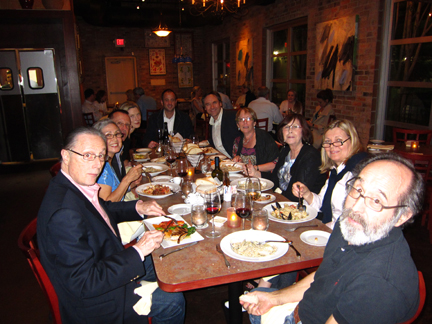
You can only imagine my thrill at seeing Cousins Joanne and Marty — front and center — last night at my wine seminar at Caffè Bello in Houston. That’s Marty in the foreground at dinner, together with friends Mary Ellen and Dr. Don, FoodPrincess, Delia and VintageTexas, and Tamara and Houston Foodie (Houston Foodie has just relaunched his excellent food blog with a superb post on Neapolitan pizza, btw).
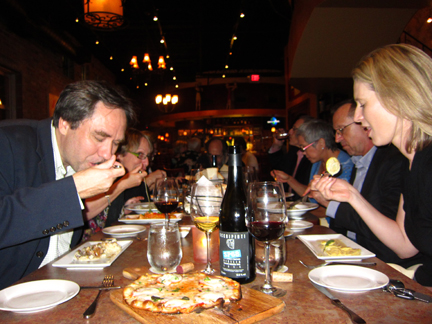
The pizza at Caffè Bello was delicious and I am always geeked to drink Arianna Occhipinti’s SP68 — “Strada Proviniciale 68,” an impeccably Natural, reclassified Cerasuolo di Vittoria (Nero d’Avola and Frappato), named after provincial road 68 where it is raised in the province of Ragusa, Sicily.
Marty’s still got a ways to go before he turns the corner on this mean ol’ cancer… but it’s looking good and, man, this dude still runs circles around me… Me and Tracie P love him a lot…

Above: the frontespiece of Giambattista della Porta’s “Villae” or “On Country Houses” (Frankfurt, 1592) in the rare books collection at the Brooklyn Botanical Garden Library.
As an appendix to the Aglianico: Italian Grape Name Pronunciation Project post, I thought I’d repost one of my favorite (and earliest) posts here, on the origins of the grape name Aglianico and the fact that it does not come from Hellenic.
Does the grape name Aglianico come from ellenico or Hellenic as so many claim? A look at the earliest references leads me to believe that it probably doesn’t. May the philologically curious please read on… Click here…
In other news…
I’ll be pouring some Aglianico tomorrow among other wines in Houston for the first of my Italian wine seminars at Caffè Bello.
I’d love to see you at the tasting and its should be fun (Cousin Marty will be there, btw).
 Do Bianchi