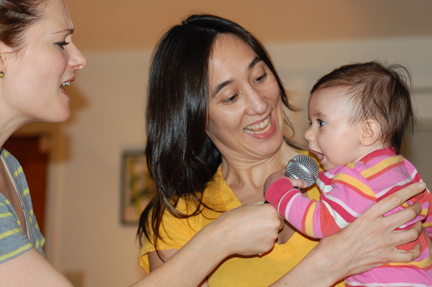
Georgia on the mic (and heading to California)

Georgia P got to stay up past her bedtime last night after Céline and I finished our recording session and Giovanni arrived from Brescia.

After a dinner of chicken tacos with chipotle, Georgia P had fun doing karaoke to her mommy’s favorite, Xanadu by ELO.

Giovanni and I are heading today to California where we’ll be spending the night in La Jolla and then driving up to LA, where I’ll be working at Sotto tomorrow and Thursday.

Winemaker Jared Brandt of Donkey & Goat will be at the restaurant tomorrow night and we’ll be pouring a flight of three of his wines.

Stay tuned… lots of cool stuff to come… :)

A Frittata and a Glass of Wine

Tracie P’s superb frittata inspired my post today for the Houston Press. We paired it late Saturday night with a bottle of 2008 Fixin by Mongeard-Mugneret, which I had picked up — literally — for a song for $26 in San Antonio (where I spoke at a wine dinner earlier in the evening).

I’ve posted these passages — one probably known already to you and one that may surprise and delight you (I hope) — over at the Houston Press as well. But I just had to post them here, too.

From “An Omelette and a Glass of Wine”

“If it were true that wine and eggs are bad partners, then a good many dishes, and in particular, such sauces as mayonnaise, Hollandaise and Béarnaise would have to be banished form meals designed round a good bottle, and that would surely be absurd. But we are not in any case considering the great occasion menu but the almost primitive and elemental meal evoked by the words: ‘Let’s just have an omelette and a glass of wine.'”

Elizabeth David, T.B. Layton’s Besides, 1959

Omelette

“Of all French dishes, the omelette is perhaps, the most thoroughly representative. The French omelette is known far and wide, by reputation, at all events, and various are the parodies of the great French dish that are to be met with in the different corners of the world. In some places, omelettes are served up in a liquid melting mass; in other places they take the form of solid custard-like composition; elsewhere they take a leathery shape, and are altogether as unpalatable as they are unlike the real thing. An omelette, moreover, is a dish which most Frenchmen, whether he cooks or not, declare that they are adepts [sic] at concocting. The French poet, the painter, the dramatist, the statesman, the aristocrat — all will tell you that had it pleased Providence to place them in the classes from which, as a rule, cooks spring, they would have won renown by the excellence of their omelettes alone. No saying is more true than that which declares every French man to be a born cook; and the foremost dish on the execution of which he prides himself, is the omelette.”

—Charles Dickens (ed.), Household Words, 1882

Cannonau, Italian Grape Name Pronunciation Project (with Alessandro Dettori)

Lately, there has been a lot of positive response to the Italian Grape Name and Appellation Pronunciation Project. Nothing could make me more happy: I created the project to encourage people to speak Italian grapes. After all, one of the things that fascinates us about Italian wines is the ampelonyms and the stories behind them (or in many cases, the lack of information about their etymons). This week’s installment comes via David Weitzenhoffer, who runs a great little importing operation out of New York, Acid Inc. Although at Sotto, we buy Alessandro Dettori’s wines through his Southern Californian importer, we do carry a handful of David’s wines at the restaurant (Scala Cirò and Schola Sarmenti Negroamaro) and I love what he’s doing with his portfolio.

Dettori? The wines that Alessandro produces on his family’s estate in Sardinia are among my favorite wines of all time. We sell them at Sotto, Tracie P and I collect them (they’re not out of reach for middle-class collectors like us), and they changed my life — there’s no other way to say it — when I first tasted and began following the wines back in 2005 in New York.

I met Alessandro — an electric character, for his personality and the crowds that gather around him at the fair — for the first time this year at Vinitaly. I’ve included here a clip in which he explains the etymology of Cannonau.

Great stuff… thanks to David and Alessandro for taking the time for this and sharing this wonderful ampelonym with us. And thank you, if you’re reading this, for speaking Italian grapes!

luckiest daddy in the world…

Georgia P and mommy made me this montage for my first father’s day (click the image for the high-res version)…

I know I’m not the only father to feel this way today but I’m the luckiest daddy in the world…

Tracie P also made me the sweetest blogication… Couldn’t hold back the tears when I got to the line, Because of you, she will love old movies, speak Latin, excel at math but have a musical soul, get exited about Hebrew National hotdogs, get to grow up vacationing in La Jolla, talk about her pancia, love Petrarch, say gazuntite instead of bless you, laugh at Mel Brooks, and be able to sing every song in A Chorus Line.

I love them so much… what a week it’s been! so many blessings, too many to count…

happy father’s day, yall…

Texas wine industry exposed (our cover story for the Houston Press)

When food editor Katharine Shilcutt and I first began working on our cover story for this week’s edition of the Houston Press, “Texas Wines: Behind the Cellar Door,” our focus was on the heavy-handed use of chemicals in the cellar, a foregone conclusion for the majority of Texas winemakers.

But as we began to speak to winemakers and ask them some tough questions, it became clear that most of the wine bottled here in Texas is grown beyond the state’s borders — mostly in California but in some cases as far away as Spain and Chile.

As one winemaker put it, the amount of Texas fruit bottled here is “just a drop in the bucket,” even though, across the board, Texas wineries market their products as “Texas wines.”

Click here to read the piece.

Angelo Gaja’s cherry trees (and the legacy of global warming)

Angelo Gaja is simply one of wine world’s most fascinating personages. On the four occasions I’ve had the chance to sit down and taste or chat with him, I’ve always been wholly impressed by the scope and breadth of his interests and his humanity. And when you sit down with Angelo Gaja, you never know where the conversation will lead you… or rather, where he will lead you in conversation. At every meeting, I’ve always come away with my mind churning over an anecdote or insight that he shared.

I won’t conceal that I planned my recent trip to New York around his visit, knowing that I would get the chance to have breakfast with Angelo at the Soho Trump. He was in town to speak at the 92nd Street Y Tribeca, where he gave a lecture on the evolution of the fine wine world and his role in it.

I was curious to ask him about his recent “open letter,” published in March of this year. In it, he wrote about the many challenges that Italian winemakers face in the wine trade “reset” (my term, not his).

But the day we met for breakfast last week, Angelo wanted to talk about cherry trees, perhaps inspired by the beautiful June day in the city.

“I remember when I was boy,” he began, “every summer, in June, my grandmother [Clotilde Rey] would send me a bag of cherries. They were the best cherries I’d ever had. These cherries were fantastic. But they were smaller than most cherries. They were black and they had a little bit of bitter taste. I thought that she had bought them at a fruit store.”

It was many years later, he explained, that he realized that the cherries actually came from a lone wild cherry tree — balin (bah-LEEN) in Piedmontese dialect, a Mahaleb cherry tree in English.

These trees, which blossom all over central and northern Italy in springtime, are ungrafted cherry trees and in their youth produce bitter fruit. But “after sixty or seventy years,” he said, their berries become fewer but larger in size and they deliver one of Langa’s greatest delicacies.

But in the summer of 1955, Clotilde didn’t send the teenage Angelo his cherries. “I thought that my grandmother bought the cherries in a food shop and so I asked my mother to ask her to send the cherries.” But they never arrived. And it would take six years before he would learn the reason why she stopped sending them.

A terrible hailstorm, he recounted, had devastated Barbaresco’s vineyards that spring. “It destroyed seventy percent of the vineyards in Barbaresco.” It was so violent that it ripped the bark from Clotilde’s beloved balin.

“For years, our vineyard manager Gino Cavallo had asked my father to cut down that tree,” remembered Angelo, “because it was planted in a field that was perfect for Nebbiolo. But my grandmother would not let them because she loved that tree so much. In 1961, when I joined the winery, he told me the story.”

It was only after the terrible storm of 1955 that she acquiesced and allowed them to cut it down. And today, that field is planted to Nebbiolo, one of the fourteen vineyards that provide fruit for Gaja’s classic Barbaresco.

Over the last few years, said Angelo, he’s had nearly eighty wild cherry trees planted across the Gaja family’s Piedmont estate.

“I’ll never get to taste those cherries,” he said wistfully, “because it will take sixty or seventy years for them to produce the cherries that we eat. But it’s something that I have done for future generations. Farmers must do this.”

“Before the 1990s,” and the epic string of bountiful crops that began in 1995, “we used to have to wait a decade for a good vintage. Today, with global warming, that has all changed… When I was a boy, the fog [could be] as thick as milk, five to ten meters thick. But nowadays, it’s not like that. The weather conditions have changed.”

Barbaresco growers have certainly benefited from the warming trend. Hail storms are never as severe as the storm of 1955 and they haven’t had a “disastrous” vintage for a decade now — a far cry from the 60s, 70s, and even the 80s, when they were lucky to have one good vintage in the arc of ten years. And I don’t know a single grape grower in Barbaresco who doesn’t believe in global warming.

But I can’t help but wonder: will those cherries, planted by Gaja for our children, taste as sweet as they did to a teenage Angelo?

Thanks for reading…

Taste Mascarello & Quintarelli with me on July 19 in Houston

I never had the fortune to meet Bartolo Mascarello before he passed. But over the years, I’ve become friends with Maria Teresa Mascarello, his daughter (above). We’ve visited at the winery and I taste with her every chance I get (and a few years ago I was thrilled to buy a single-edition collection of Arabic poetry on wine that she and Baldo Cappellano had had translated from the original into Italian, a wonderful book that I cherish).

I love the wines and I love the family and I love all that they stand for — the wines and the people. There is perhaps no winery where ideology and winemaking align so perfectly, delivering wines that truly express the land and the people who grow and vinify the grapes while remaining true to the ideological purity of the people who sacrificed their lives to keep Italy free in the face of fascism (before, during, and after the war).

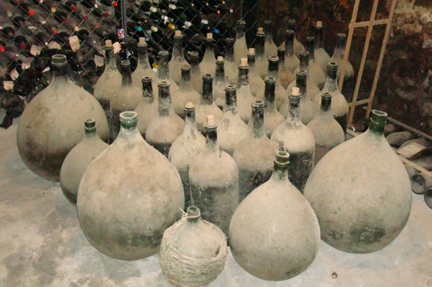
Above: Large format bottles in the Bartolo Mascarello cellar.

My friend Tony in Houston knows how much I appreciate these life-changing wines and so whenever Tracie P and I visit him together, he always opens something from his deep cellar and picks something special from his ample stash of Bartolo Mascarello wines.

Tony has asked me to host a dinner at his restaurant in Houston on July 19, where we’ll be opening a few wines by Bartolo Mascarello as well as a 1990 Recioto della Valpolicella by Quintarelli (another one of my personal favorites).

The price of admission isn’t cheap but it’s worth every penny considering the flight of wines we’ll be enjoying. And of course, I’ll be speaking about my experiences at Mascarello and Quintarelli.

Here are the details…

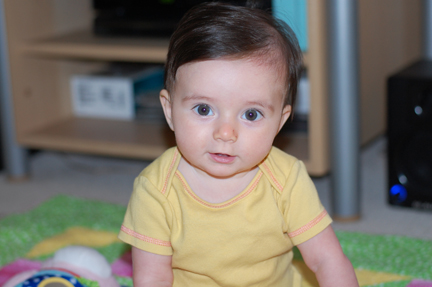
Georgia P, six months old

She’s been sitting up for a few days now…

We’re going to start feeding her solid foods this evening… just a test run, probably with avocado…

And it’s nearly time to start baby proofing our house!

We love her sooooo much…

Ezio Rivella, contrapasso, and the Triumph of Time (fugacity)

From the department of “I read the news today o boy”…

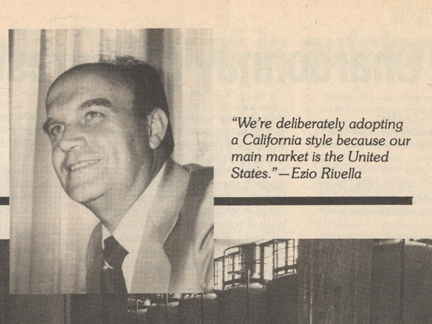
Above: Rivella in a 1982 profile by Wine Spectator.

Not a bad PR move, eh? Announce your long-awaited resignation on a Friday at the beginning of summer.

On Friday, the controversial and much loathed toad of Montalcino, Ezio Rivella, resigned from his position as president of the Brunello producers association. The news was announced by WineNews.it, in its weekly PDF (the fact that it still sends out PDFs is indicative of the great minds behind this pseudo-journal, an advertorial affair produced by a PR machine that serves as Montalcino’s in-house media outlet).

According to the press release — and yes, let’s call it what it is and stop pretending that WineNews.it represents any form of serious, self-respecting editorial coverage — Rivella resigned solely because of personal reasons pertaining to family.

In the end, Rivella did not succeed in gerrymandering changes in Brunello appellation regulations. At every step, he campaigned tirelessly in his quest to allow international grape varieties. And at every turn, even when he called votes at the peak of harvest when he knew the hardship it would cause for producers, the popular voice of Brunello growers managed to drown his.

In reading the news, I couldn’t help but think of Rivella’s Dantean contrapasso: I can see him cast in the fourth circle (greed), forced to drink endless amounts of chemical tannin and tartaric acid.

But in the end, it wasn’t the Commedia that came to mind but rather another cycle of Italian poems written in terza rima, Petrarch’s Trionfi (Triumphs). In it, Petrarch envisions triumphal processions of the forces that inform and ultimately vanquish the human condition: Love, Chastity, Death, Fame, Time, Eternity.

From what I’ve been told by industry insiders, Rivella sought to lay claim to Brunello’s throne (the regal metaphor is his not mine) in an attempt to refashion a legacy that was sullied when Banfi dismissed him (against his wishes) in 1999 after a career that spanned more than three decades. Rivella may have curated Brunello’s meteoric rise in fame but the spoils of the battle were denied him. And in a last flourish, he had hoped to beat time by once again redefining (literally) what Brunello was and could be.

But fame and time were greater forces than he.

Historically (as we have seen in recent weeks here), winemaking in Brunello has always been shaped by big business interests. And it will continue to be so (now more than ever, sadly).

Over the last two decades, those interests have moved farther and farther away from the ideals that informed Brunello’s pioneers (massal selection of a Sangiovese clone, excellent growing sites, and easy railway access). Instead, they have shifted their approach to appeal to globalized tastes and they have over-cropped their farms to deliver the quantities demanded by a globalized market.

We can only hope that Brunello’s new captain will guide its ship back to Tuscan shores and hear the ancient cadence of Tuscany’s great poets.

In other (sadder) news…

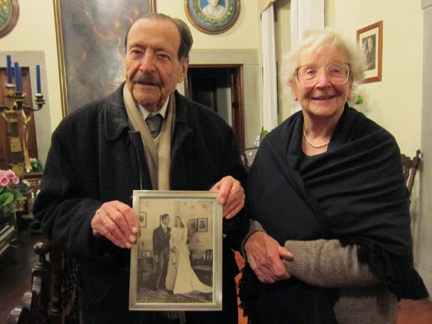
In an uncanny twist of fate, Rivella’s retirement eclipsed the sad news that Count Bonacossi, historic producer of Carmignano (above with his wife Lisa), transpired on May 24, 2012. Bonacossi’s farm produced superb Cabernet Sauvignon long before Tenuta San Guido ever released its Sassicaia. He and his wines were Super Tuscans ante litteram. A press release, issued by the winery, follows…

Continue reading

An awesome flight at Terroir in Tribeca last night

There’s no two ways about it: New York is simply the greatest “wine” destination in our country. On any given night, whether its old Nebbiolo or funky skin-contact Natural wines you crave, Ask, and it shall be given you; seek, and ye shall find; knock, and it shall be opened unto you.

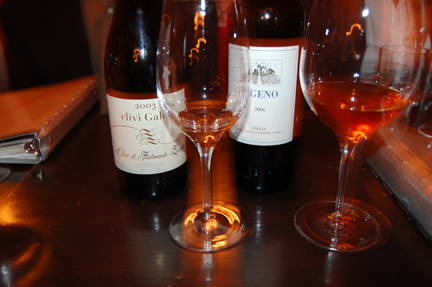
Last night I connected with good friends at Terroir in Tribeca where I got to taste two of my all-time favorite wines, the Galea (2003!) by I Clivi (Colli Orientali del Friuli) and Ageno by La Stoppa (Piacenza), one of those life-changers.

And there were so many other cool wines, at reasonable prices, that would have quenched my thirst for wine that could speak to me in lyrical tones.

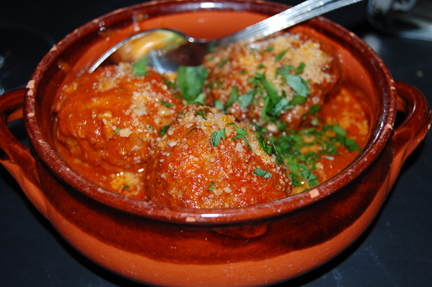
Marco Canora’s meatballs are as good as when I first tasted them at the original location on East 12th in 2008.

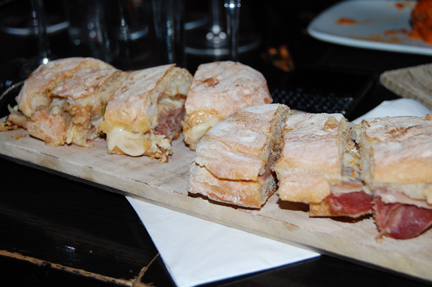
Speck and fontina sandwich rocked.

And a special thanks to sommelier Will Piper, who was always one step ahead of our table, offering just the right wine in perfect synch with the rhythm of our evening. The dude really knows his stuff and he was right on at every turn… loved it…

In other news…

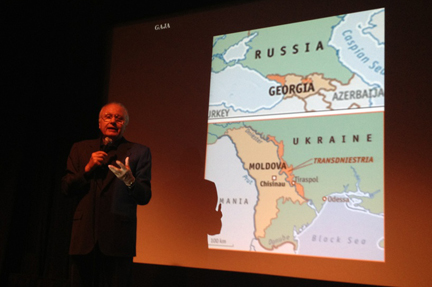
Why is Angelo Gaja lecturing on Russia? Stay tuned to find out…