Yesterday, we had our 35-week sonogram and our doctor is really pleased with how things are going. Mommy and baby, I am thrilled to report, are both doing well.
Technically, we have five weeks to go, although everyone (including mommy) believes that Baby P 2013 will arrive early (partly because second births generally come early; “your body already knows what to do,” said the doctor yesterday).
For a few moments during yesterday’s sonogram, you could see the baby’s face and her hair. The most amazing feeling in the world to see our new baby girl! :)
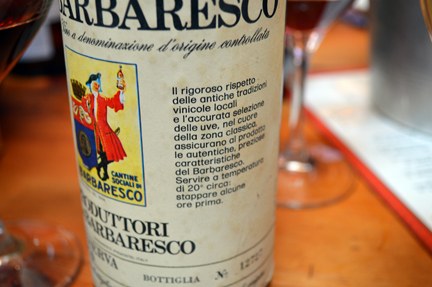
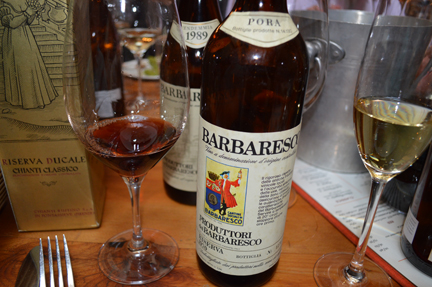
Above: One of the most beautiful wines at our lunch was the 1970 Barbaresco Pora by Produttori del Barbaresco.
Tom Petty once asked Roy Orbinson if he ever wrote down his music as he was songwriting.
The answer was no.
“If I don’t remember it,” he responded, “no one else will.”
Sometimes, I feel the same way about wine tasting: note-taking can be cumbersome when you’re tasting and enjoying fine wine. And after all, when the wines are truly great, you won’t forget them.
Above: I was expecting the 70 Pora to be light in body but it was fresh and vibrant. What a wine! I’ll never forget it.
But the science and art of tasting notes are vital to the wine world we inhabit. And few can rival the ability, insight, experience, and acumen of Ken Vastola.
There are a handful of white wines from Friuli that I like to call my “guilty pleasure” bottles: high-end, international-styled expressions of bacca bianca viticulture from some of the region’s most manicured and pedigreed estates.
I’m talking about labels like Vie de Romans, Jermann, Miani… These producers often deliver bottles that step outside the parameters of strictly traditional Friulian winemaking, leaning toward a richer and more opulent style.
After dinner on Friday night at Tony’s in Houston (where I curate the restaurant group’s media), I’m adding a new winemaker to that list: Vignai da Duline.
I have known and followed these wines and I love their more traditional labels.
But this gently maloed Chardonnay blew me away with its depth and stunning balance of minerality and fruit.
It was so thrilling that our party of six ordered a second bottle.
The wine’s not cheap (importer David of AI Selections told me this morning that srp is $50) but worth every penny.
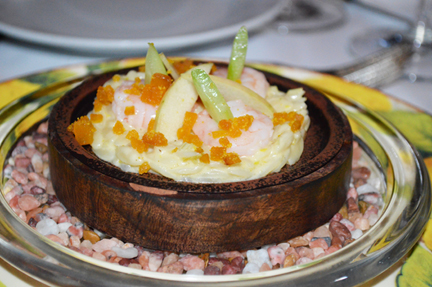
The wine was an ideal pairing for the Laughing Bird Shrimp topped with red-mullet (Sicilian) bottarga, one of the delightful “fusion” dishes that my friend Tony has been featuring on his tasting menu.
But the dish I can’t stop thinking about three days later was the Valdostana, stuffed with Fontina and Prosciutto di San Daniele. The veal melted in my mouth…
I love the way that Tony uses the Italian culinary canon as a paradigm. He constricts his chef de cuisine, the extraordinarily talented Grant Gordon, within Italian tradition. But then he hands him the keys to a Maserati loaded with the best materia prima available.
This dish was transcendent… Paired with a Monsecco 2006 Gattinara, a new addition to the Rosenthal book…
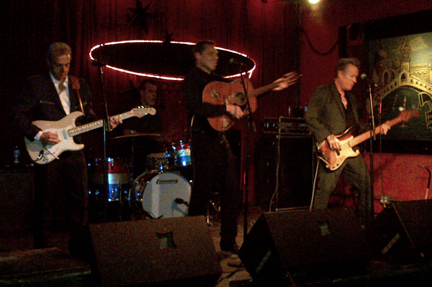
Sugaroo, the agency that represents my music in film and television, also represents the alt-country americana legends the Wagoneers, who are now in Sunday-evening residence at the Continental Club here in Austin (one of our favorite honkytonks).
Sugaroo’s founder/owner and my very old and dear friend, Michael, was in Texas this weekend for meetings and he and I caught the show last night.
It was pretty amazing: they played their first record (1988, a landmark release that launched alt-country in the U.S.) in its entirety, in sequence, and then played their new as-of-yet unreleased record in its entirety. What a show!
Michael told me that he hopes to see the new disk out sometime in 2014.
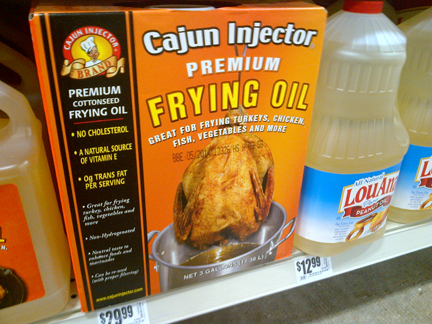
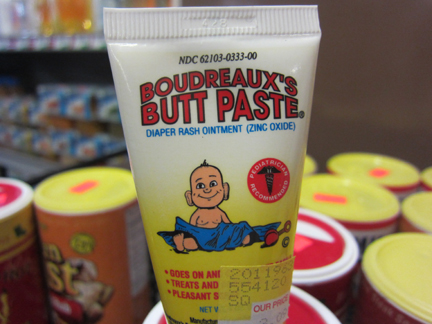
Food shopping in Texas is as commercialized and homogenized as anywhere else in the U.S. But “regional” brands still appear in mainstream supermarkets.
The Houston food and wine scene continues to amaze me. In part because of how disappointing, uninformed, and naive it can be at times. In part because of the unbridled talent and the extreme value that you find there in the most unlikely places.
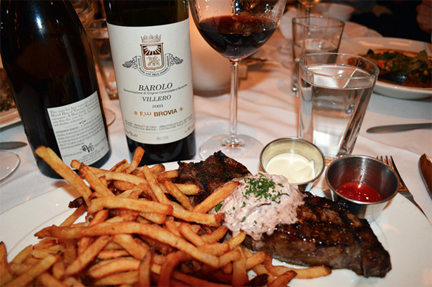
A few weeks ago, I had a superb bottle of wine from one of my favorite producers, the 2003 Barolo Villero by Brovia, one of the few growers who released their crus from the 2003 vintage. The wine was simply stunning.
But the most incredible thing about the experience was that I paid less than retail for it. Even more more unbelievable was how difficult it was to navigate the restaurant’s tablet-based wine list, out of date and poorly organized.
There are some Houston restaurateurs and wine professionals who never seem to leave the Houston bubble and they sadly remain unaware of what’s going on in the world beyond.
And then there’s my friend and client Tony.
Above: Tony Vallone is one of the most dynamic Italian restaurateurs in the country imho. I’m so proud to call him my friend and client.
In the words of one Houston food critic, he’s the dude who “virtually defined” fine dining in Houston over the last four decades (his first Tony’s opened in 1965).
Tony’s half Sicilian and half Neapolitan and he travels to Italy every year (he just got back from a trip to Chicago for the Fancy Food festival, Sicily, and Paris).
I’ve spoken about Italian wine at a number of dinners in Tony’s restaurants but we’ve never presented together. I couldn’t be more thrilled.
Above: Tracey Brandt of Donkey & Goat recently came to Austin to present her family’s wines.
Another event I’d like to bring to your attention is a wine dinner at Sotto in Los Angeles where I co-curate the wine list.
I’m super bummed that I won’t be able to be there (I’m grounded until Baby P 2013 gets here in mid-July).
But I highly recommend the dinner and the wines to you. Donkey & Goat is one of the Parzen family’s official wines: we drink them regularly at home, mamma Judy (my mom) drinks them in La Jolla (the rosé is her favorite), and Rev. B (my father-in-law) loves him some Donkey & Goat Helluva Pinot Noir.
I’m very proud that we feature the wines at Sotto.
That’s all the news that fits today… Have a great weekend, yall! Buon weekend!
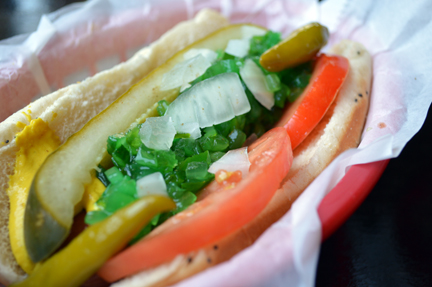
Is there any dish that embodies the American culinary spirit more than the hot dog?
Even the French love hot dogs…
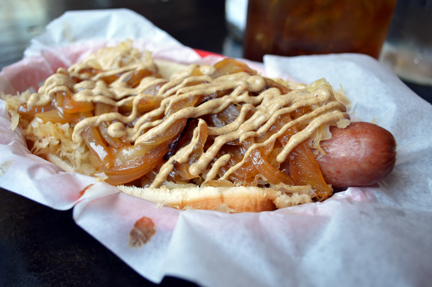
Above: Polish sausage with the works.
Yesterday, I finally made it to Frank, Austin’s local temple to hot dog and hipsterdom.
If ever there were an asylum run by the inmates, it would be Frank.
I got there mid-afternoon and every seat at the bar was occupied by handlebar mustaches, pierced nostrils, tattoo sleeves, and Pabst Blue Ribbon beer. The scene was a mirror reflection, minus the beer cans, of the bar staff.
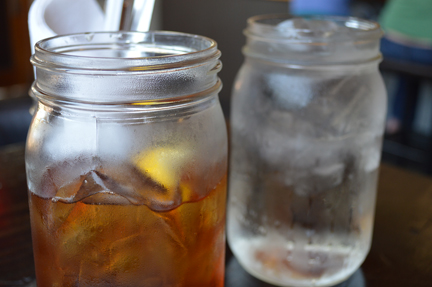
Above: Drinks are served in ball jars.
I loved Frank. I loved its Austinite originality. I loved its unabashed embrace of americana. I loved its affordability and approachability. AND Frank is both family- and hipster-friendly.
And who doesn’t like a hot dog?
To not love the hot dog would just be flat-out, downright unAmerican!
For this dish, I washed Listada de Gandia eggplant and sliced into rounds.
Then I tossed them in a light dust of kosher salt and let them purge their liquid for about 30 minutes in a colander.
Then I grilled them on our cast-iron stove-top grill with a brush of olive oil and a sprinkling of salt.
After they had cooled, I tossed them with extra-virgin olive oil, a pinch of freshly cracked black pepper and chili flakes, and a “kiss” of vinegar.
After the eggplant had marinated overnight in the refrigerator, I puréed them, adding a thin drizzle of olive oil.
Before folding in the slightly undercooked spaghetti, I added about 3 tablespoons of the pasta’s well-salted cooking water to the sauce.
After folding in the spaghetti and allowing them to absorb the flavor of the sauce as they finished cooking through, I folded in a generous handful of freshly grated Parmigiano Reggiano.
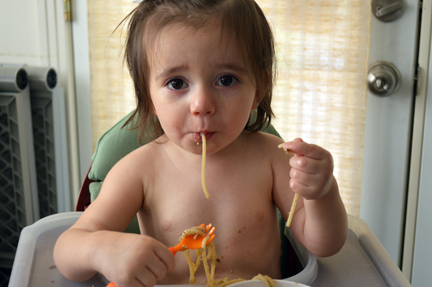
Georgia P’s has been insisting on eating with her fork these days. She still has a little bit of trouble getting the food to her mouth.
But what a thrill to watch her eat spaghetti with a fork for the first time!
Above: We took Georgia P to Proseccoland for the first time in September 2012 when she was about nine months old. The grapes were still on the vines and about to be harvested. She loved playing in the vineyards and Tracie P and I felt good about it because the two vineyards we visted — Bele Casel and Zanotto — are both organically farmed.
On Friday of last week, a friend of ours from mainland Venice, Paola, alerted me to a report in Oggi Treviso (Treviso Today) about daycare mothers protesting the use of pesticides and herbicides in Proseccoland.
According to the author of the article, the local chapter of the WWF has helped them to organize an assembly (this coming Friday) to address their concerns about chemicals being sprayed in vineyards that lie adjacent to a preschool daycare center.
Above: During the “Prosecchissima” festival in the village of Miane in April of this year, the WWF Altamarca displayed signs calling for the abolition of chemical-based farming in the Prosecco DOCG appellation (source: PDQNews.it). The signs were removed by thieves.
But this morning, as I poked around the internets looking for more info about the situation “on the ground” in Proseccoland, I learned that similar protests, assemblies, and impassioned calls for a chemical-free Prosecco DOCG have been going on since 2011 when the WWF opened a local chapter, WWF Altamarca (no website).
I also discovered a video feed by European parliament deputy Andrea Zanoni, a Treviso resident and native, who has been documenting his battle with “big Prosecco” to curb the use of chemicals and to stop the deforesting of woods in the appellation.
Here’s a video from his YouTube page:
The video was shot in the township of Tarzo, not far from the preschool where mothers first raised concerns about pesticides being sprayed.
Like the WWF Altamarca, Zanoni has also called for a halt to helicopter spraying.
In another of his videos, he notes that restaurant-diners were recently affected by pesticide-spraying aircraft. Such spraying, he says, is only allowed in extreme cases and he believes that recent airborne spraying is in direct violation of EU regulation.
I first traveled to Proseccoland in 1989 (playing music) and I think it’s safe to say that no other Italian appellation has been transformed so radically by “big wine.”
The Prosecco boom of the last two and half decades and the ever growing demand for grapes are so enticing that chemical-farming and the clearing of land has become a way of life there.
I’ll be following these stories and will continue to report on them here and on the Bele Casel blog.
Please tweet or share this on Facebook if you feel so inclined.










 Do Bianchi