Ciao Kyle, you will be missed and remembered fondly

Amice sit tibi terra levis.

kyle phillips wineIt’s with a heavy heart that I report the news that our friend, wine writer, and Italian wine and culture blogger Kyle Phillips has left this world for a better one.

I had the opportunity to taste with Kyle on a few occasions in Italy (where he lived with his family) but our friendship and my deep respect for him grew out of our correspondence on email and social media.

He was a superbly talented taster and had a profound mastery and knowledge of Italian wine and its myriad designations, the result of decades of traveling and tasting wines throughout Italy.

But he was also a prolific English-language ambassador for Italian culture and gastronomy: his pioneering work at About.com was a model and inspiration for my blog.

May the earth rest lightly on you, friend. You will be sorely missed. As Angelo Peretti wrote on his blog today, the next glass is for you…

Ciao fioi!! @NinoFranco1919 enjoy my hometown #SanDiego!

marco barat

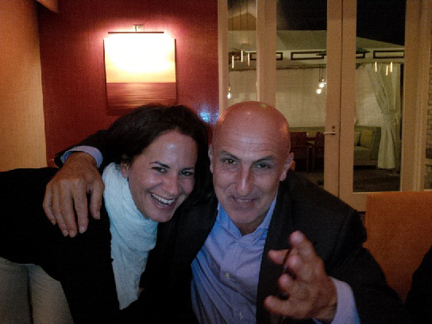
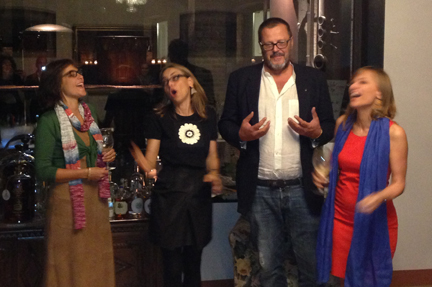
How could I not post this photo, sent to me last night by my good friend Marco Barat (right), who lives and sells Italian wine in my hometown, San Diego, and Silvia Franco, who works for her family’s winery, Nino Franco?

Silvia’s family recently had me for dinner at their home in Valdobbiadene and of course, we made the “Barat connection.”

They were “working the market” together yesterday in Southern California and they sent me their snapshot.

I’ll never forget the first time I met Marco at Vinitaly in 2006. As soon as he heard my padovano cadence in Italian, he pulled up a chair and we became fast friends.

His knowledge of Italian wines is rivaled only by the depth of his palate.

I’ll never forget that night in Cerea (Verona), at a Vias dinner, seven years ago. He told me about a strange producer on Mt. Etna who was making a wine called “Magma.” The world had yet to discover the wines of Frank Cornelissen, but Marco, like always, was way ahead of the curve.

Ciao fioi! Thanks for sending the photo and letting me know that you were thinking of me. It’s been a rough time over the last week here in Texas and it means the world to me that my friends are with me no matter how far away…

*****

Ciao fioi is Veneto dialect for ciao ragazzi (literally, ciao figli or ciao daughter[s] and son[s]. When using the now universal salutation ciao, most don’t realize that it’s actually a Venetian word, from the Latin sclavus, meaning slave or servant. In sixteenth-century Venice, it was common to say [s]ciao, in other words, I am your servant.

Here’s a link to a note that I wrote about its origins and the difference between Italian and Veneto pronunciations.

Vinous aromas of yesteryear: Italy’s 2013 vintage reminds many of a pre-climate change era

grape pomace grappa marc

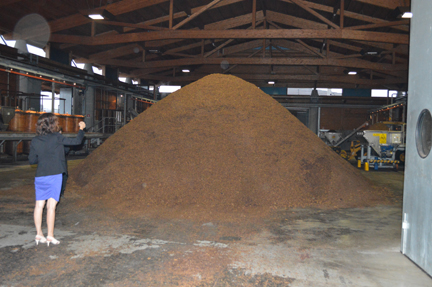
Above: That’s Hawk Wakawaka, one of my favorite people on the wine blogging scene. She’s dwarfed (and she’s not a short person) by a hill of grape pomace at the Nonino distillery in Udine province in Friuli.

Borrowing a line from my wife, Tracie P, who couldn’t have said it more brilliantly, grappa is the ultimate expression of the grape.

In other words, the grape’s very last gasp is its distillation into a spirit.

When I visited the Nonino distillery in Udine province a few weeks ago, it occurred to me that pomace brandy is also the ultimate expression of the vintage.

Unlike the overwhelming majority of Italian distillers, the Noninos only distill once a year — during harvest.

As Elisabetta explained to the group of writers with whom I was traveling, one of her parents’ great innovations was that they were the first to work directly with growers to ensure the freshness of the pomace that arrived at the distillery and to distill as quickly as possible in order to retain that freshness.

The Noninos — one of the great Italian success stories of the 1990s and one of the most recognizable “made-in-Italy” brands — need no introduction or endorsement from me. In Italy and abroad, their products are considered benchmarks for the category. And they essentially created the category when they launched their distinctive bottles and monovarietal grapps in the early 1980s. And they are largely responsible for grappa mania in the U.S. in the 1990s.

I always have a blast and learn something new when I visit with them. And I know my wife will forgive me for the huge crush that I have on matriarch Giannola. She — one of the most glamorous women in Italian viticulture and a genius marketer — always has me on the edge of my seat with her tales of Marcello Mastroianni kneeling before her in a theater in Rome in the 1960s.

But the thing that I couldn’t get out of my head as we visited over a day and a half was what one of their vineyard managers, Denis Cociancig, said to me when toured their famous Picolit and Fragolino vineyards (where they grow their own grapes destined to become Nonino monovarietal grappas).

“The vinous aromas that are coming out of the cellars” across Friuli, he said, reminded him “of the harvests of another era.”

The “aromas of the courtyard,” as he put it, “are like the ones I remember from my childhood.”
nonino sisters

Above: It’s not a stretch to say that the Noninos are the nuttiest people I’ve ever met in the wine and food trade. Those are sisters, from left, Elisabetta, Cristina, and Antonella Nonino, with Cristina’s husband Tony. They are always so sweet and energetic. Every time I visit, I learn something new…

Across Italy, yields are lower than they have been in recent years but that “courtyard aroma” has returned.

And he wasn’t the only grower/winemaker who told me that. In the Veneto and Tuscany, I heard cellar masters say exactly the same thing.

And you could smell it everywhere we went. It’s a brilliant aroma of fresh, young wine that literally seduces you.

Most attribute those aromas to the fact that the vintage was a “classic” one: the late spring rains and cooler temperatures made for a more balanced vegetative cycle and pushed back harvest by roughly two weeks. More than one grower noted that she/he hadn’t harvested this late since the 1980s, an era before climate change — whatever its cause — delivered a nearly uninterrupted string of warm, bountiful crops.

Like their winemaking counterparts, the Noninos are expecting to produce less this year but they are thrilled by the quality of the materia prima that arrived at their distillery with this harvest.

When we began to see the 2013 wines in the market, it will be interesting to taste them and remember the aromas of my recent trip. And when I sip a Nonino grappa from Fragolino (my personal favorite) after dinner, I’ll remember that visit to the Nonino vineyards where the yields were low but offset by the rewards of the “courtyard aromas of yesteryear.”

In unrelated news…

One of the winners of the prestigious Nonino prize for the arts and sciences in 2013, physicist Peter Higgs, also became a Nobel laureate this year.

Those crazy Noninos: I don’t know how they do it, but they always seem to be one step ahead of the rest of us.

Everyone should have my job: lunch @TonyVallone

From the department of “everyone should have my job”…

vitello tonnato recipe

Fascinating conversation today on bread, bread baking, mother and starter yeasts with my friend and client Tony Vallone in Houston at his flagship Tony’s.

halibut fennel

These photos are from the lunch he served me…

meringue recipe

Tony, thank you!

My piece in @LCI_Magazine & upcoming events where I’ll be speaking

cucina italiana wineWhen the editors of La Cucina Italiana contacted me last year and asked me to write for the magazine, I was thrilled: it’s Italy’s “National Geographic” of gastronomy and it’s also where I got my start as a wine writer way back in 1998 when I worked as the wine editor for the Manhattan office that launched not long after I moved to New York City.

It’s incredible to remember that when I began to work in commercial publishing, email was still new and I had a fax machine (remember those?) in my cubicle that spewed out press releases.

The current issue (November 2013) includes a piece I wrote on Natural wine in Italy today.

In other news…

I’ve got a number of fun tastings coming up. Here they are…

Friday, November 1: Paolo Cantele and I will be presenting his family’s wines at Sotto in Los Angeles, California.

Saturday, November 2: Paolo and I will present the wines at Jaynes Gastropub in San Diego, California.

Tuesday, November 5: I’ve been asked to speak at sommelier Michael Garofola’s “second annual Orange Wine Dinner” to be held at Genoa in Portland, Oregon.

If you happen to be in any or all of those cities on those dates, I’d love to taste with you!

Cinque Terre: Walter de Battè’s impossible harvest at Prima Terra (& other harvest news)

walter batte prima terra cinque terre

The photos in this post were sent to me last week by a reader and Italian wine lover, Renzo Carmine, a dude from Tuscany who works selling commercial electrical equipment and visits wineries and vineyards as he travels around the country hawking his wares.

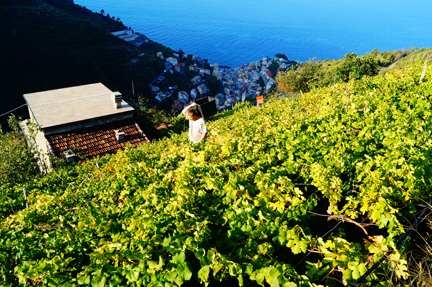
That’s Ligurian winemaker Walter de Battè (above), one of the owners of the Prima Terra winery, harvesting his “impossible” grapes on the unforgiving slopes of the Cinque Terre (Riomaggiore).

harvest cinque terre

This photo gives a better idea of how difficult it is to harvest there.

You can see the village at the bottom of the hillside.

The vineyards in the photos are pergola bassa (low pergola)-trained and are planted to Bosco, Vermentino, and Albarola (and some other grape varieties as well).

And note the mechanized trolley they use (below) to ferry the grapes down to the sorting tables.

harvest 2013 cinque terre rossese

As in other parts of Italy, harvest was delayed by a cool spring and the recent rainfall that affected most of the country. Picking began 10-15 days later than in recent years, wrote Renzo, a datum that aligns with harvest reports from many other Italian appellations.

I like Walter’s wines a lot and am thrilled to post the photos here.

His winery and its landscape reclamation program are part of a bigger campaign led by the FAI (the Italian Foundation for the Environment).

One of my favorite Italian wine bloggers, Luciano Ferraro (wine editor for the Corriere della Sera), recently posted on their work to restore the natural landscape by reviving viticulture in the Cinque Terre.

Thanks again, Renzo, for sending the updates!

Read more about Prima Terra on Walter’s site (with a lot of English-language info) and the U.S. importer’s site.

In other news…

val orcia tuscany wine

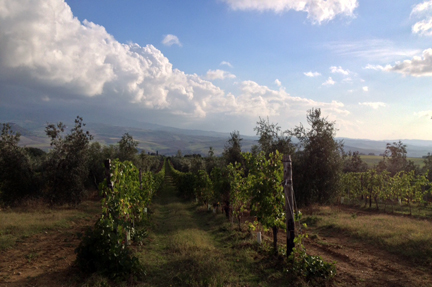
Alessandro Bindocci posted this breathtaking photo on his blog last week to mark the end of the Brunello harvest at the Tenuta Il Poggione.

Predictions of an superlative harvest were dampened (excuse the pun) although not dissolved by rains that struck as they were picking the last rows.

Across Italy, grape growers have been disappointed by the rainfall that came just as many were still picking or were just about to pick red grapes.

Ale’s coming to Texas this week and I’ll be attending his seminar at the Houston Sommelier Association on Wednesday. I’ll be curious to see what he has to say about the 2013 harvest.

à la recherche d’objets perdus (thanks for the many notes, wishes, and solidarity)

jewelry thieves austin texas

Thanks to everyone for the tide of condolences, notes of courage!, solidarity, and warm wishes.

The thieves violated our home on Wednesday. Thanks to the support of our community, we had a new front door by dinnertime Thursday. By Saturday, the contractor had completed the finishing touches. And by dinnertime Saturday, our security system was back online.

On Sunday, we were still “discovering” stolen possessions and the talk of the burglary continued to dominate phone calls from loved ones and our conversation at the dinner table.

The photo of the pendant above comes from our jeweler, Monte Franzetti, whose office graciously sent it over with a bill of sale (for me to submit in our insurance claim).

It’s green agate and wasn’t terribly expensive. I gave it to Tracie P the day we came home after she gave birth to Lila Jane, our second daughter, in July.

Continue reading

Picking up pieces after burglary, no one can diminish our love

burglary austin texas

Above: Yesterday afternoon, in broad daylight, thieves busted our front door down and burglarized our house. Today, a piece of plywood covers the entrance to our home.

Our house was burglarized yesterday by two men who brazenly busted down our front door in broad daylight.

Continue reading

Chef @PQui delivers SUPERB dining @QuiAustin where @JuneRodil’s focused list overdelivers

cutest little girl ever

Culling from his à la carte menu, Chef Paul Qui — Top Chef winner, Uchi alumnus, etc. — created a superb tasting menu for us last night at his eponymous Qui in Austin.

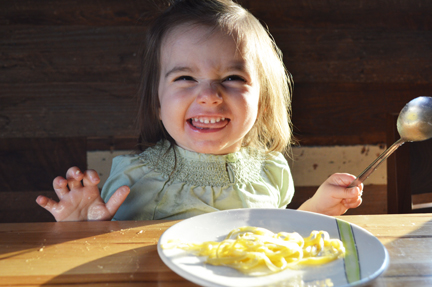
But the best dish — for reasons that are wholly self-explanatory (see above) — was the chitarra-shaped long noodles that he prepared for our daughter Georgia P and tossed with freshly grated Parmigiano Reggiano.

You wouldn’t think that Chef Qui — a nationally acclaimed chef who knows the heat of the celebrity kitchen and the bright, glaring lights of reality television — would care about the “little people” who dine in his restaurant.

But this dish alone, which Tracie P and I both slurped down as well, was enough to make our experience there one of the best dinners in recent memory (and I have had some pretty extraordinary meals this year).

The way we were greeted and treated, with a toddler and newborn in tow, was just the first indication of the humanity and brilliance of his hospitality, a first taste of the wholesome and delicious food that would follow.

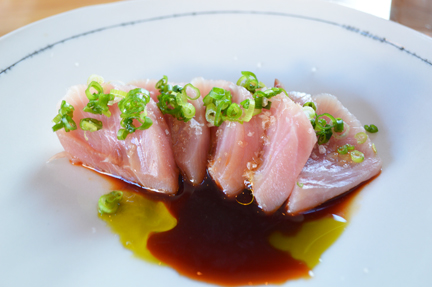
best sushi austin texas

After dinner I asked Chef Qui about how he achieves the freshness and avoids the freeze-dried flavor in the raw fish he serves.

“It has a lot to do with the way the fishermen handle the fish,” he said. And simply put, “it has a lot to do with how much you’re willing to pay.”

The quality of the yellowtail sashimi was simply thrilling.

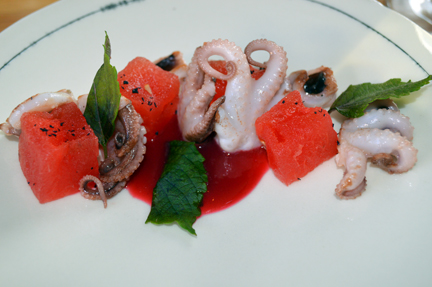
octopus candy

The texture of the baby octopus was like a gummy bear. In this dish, the quality of the materia prima was rivaled only by Chef Qui’s deft hand in how he delicately sautéed the cephalopod. Compressed, intensely flavored watermelon played counterpoint to its gentle saltiness.

foureau vouvray chenin blanc

Wine director and general manager June Rodil needs no introduction from me: she’s one of the brightest stars of the Texas wine scene and she’s one of the few Austin-based wine professionals who lands in the national wine media on a regular basis.

With every one of her lists, she’s impressed me with her ability be au courant with the international wine dialogue despite the obstacles that the Texas wine industry can pose for buyers like her.

Tracie P and I LOVED the 2006 Foreau Vouvray Sec (June knows how much we love classic Chenin Blanc) and the seven-year-old wine had just the right balance of freshness and muscularity to go with the sea- and landfood that appeared before us.

Skimming through her focused, tight list, I found so many wines that I would have loved to have drunk: López de Heredia, Scarbolo Pinot Grigio Ramato (this is what I’ll drink next time), and Gaudio Barbera del Monferrato Bricco Mondalino (I DIG that wine).

curried noodles eggplant

The noodles appeared again in the “pasta curry style,” with fresh herbs and Thai eggplant. This dish was stunning and the Chenin Blanc made for a dreamlike pairing.

dinuguan pork blood

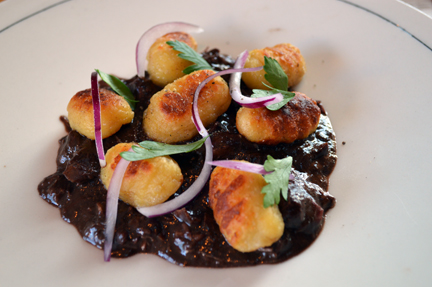
The plat de résistance was the Dinuguan, pork offal and pork blood braised until melt-in-your-mouth. I was blown away by the lightness and elegant flavor of this traditional dish from June and Paul’s childhood (they’re both Filipino-American). And once again, the Chenin Blanc delivered its delightful freshness with just enough umpf to work well with the richness.

The gnocchi were tender, with delicate but consistent texture. I couldn’t talk Georgia P into eating any Dinuguan but she loved the dumpling.

chef paul qui

Chef Qui (above) and sommelier June, we love your restaurant. Thank you for a truly wonderful evening!

Barolo Cannubi: growers lose legal battle for authentic labeling

mascarello barolo cannubi

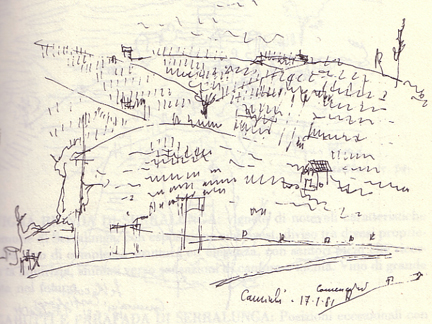
Above: A drawing of “La collina dei Cannubi” (“Cannubi Hill”) by Eugenio Comenicini, 1981 (reproduced from Martinelli’s monograph Il Barolo come lo sento io, 1993). Ruling in the favor of one of the appellation’s largest wineries, the Italian government has overturned a sentence that prohibited misleading labeling of wines produced from grapes grown in adjacent vineyards.

According to a post published today by Luciano Ferraro, wine editor for the Italian national daily Corriere della Sera, eleven Piedmontese grape growers have lost their battle to maintain authenticity in the labeling of wines produced in Barolo.

Since 2009, the behemoth Marchesi di Barolo winery has lobbied and petitioned Italian regional administration officials to allow for an expansion in the labeling of wines made from grapes grown in vineyards adjacent to the famous Cannubi vineyard, one of Italy’s most prestigious growing sites.

In June 2012, Italy’s Regional Administrative Court (TAR) ruled against Marchesi di Barolo and in favor of the eleven producers who had contested the expansion.

Marchesi di Barolo owner Ernesto Abbona subsequently appealed the sentence to the Italian agriculture ministry.

According to Ferraro’s post today, based on a statement released by Abbona, the Italian Council of State has overturned the ruling.

(Read Walter Speller’s reporting of the events that led up to the decision [on Jancis Robinson’s blog, August 2012] and read my post from November 2012 here.)

In the wake of the Italian government’s decision, grapes grown in the vineyards known as Cannubi-Boschis, Cannubi-San Lorenzo, Cannubi-Muscatel, and Cannubi-Valletta can now be used in wines labeled simply “Cannubi.”

“This sentence delivers justice to the lavish efforts of my family,” said Abbona in his statement. “Since the end of the nineteenth century, we have grown and vinified Barolo grapes that were produced by estate-owned vineyards in Cannubi and my family has been the artist behind the promotion of this extraordinary hill” (translation mine).

In 2010, as Abbona was mounting his efforts to expand labeling and to include the adjacent vineyards, David Berry Green (scion of historic British wine merchants Berry Brothers & Rudd) wrote the following on his blog:

“Ernesto Abbona, President of heavyweight Barolo producer Marchesi di Barolo (1.6million bts), is cast in the Machiavellian role making a final desperate grab for vineyard rights. Pitted against him are a band of small growers – let’s call them partisans! – defending the honour of an historical site, Cannubi, row by row, bunch by bunch.”

The eleven growers who had tried to block Abbona’s expansion efforts were the following: B. Mascarello, Serio, Brezza, Camerano, Drocco, Damilano, Einaudi, Fontana, Sandrone, Scarzello, and Carretta.