How do you open a bottle of wine? @EatingOurWords @HoustonPress

best cork screw

Above: the lovely Tracie P was my “hand model.”

Like the ability to tie a bow tie or mastery of Latin, knowing how to open a bottle of wine correctly is one of those skills that can set you apart from the crowd (especially at dinner parties).

It will also lead to greater enjoyment of the wine: In part because extracting a cork from a bottle of wine can be stressful for people who don’t have experience in serving wine; and in part because the aromas and flavors of wine can been affected negatively by improper handling of the bottle.

My post today for the Houston Press addresses one of the most banal but most important elements of wine appreciation…

Barolo geology: Serravallian should be used instead of Helvetian

From the department of “so much to tell, so little time”…

best barbaresco

Above: looking north-northwest toward the Alps from the Cascina delle Rose in the village of Tre Stelle (Barbaresco), just north of Alba (see map below). I took that photo nearly four years ago on our honeymoon, the first week of February 2010.

As I was writing some copy for a client in the months that led up to the winter break, I set about researching something that had troubled me for a long time: even though wine writers commonly and widely (however erroneously) refer to the “Tortonian” and “Helvetian” subsoils of the Barolo appellation, geologists use the terms “Tortonian” and “Serravallian” to denote the two classifications.

Pick up any nearly any wine encyclopedia, guide or atlas to the wines of Langa, and you will find that they nearly unanimously point to the younger, “more compact” and “more fertile” Tortonian subsoils to the west of the road that leads from Barolo to Alba (see map below) and the older, “less compact” and “less fertile” Helvetian subsoils to the east.

Generally speaking, the wines from the west are more approachable in their youth and more generous with their fruit flavors while the wines from the east take longer to evolve and can be more austere and earthy in nature.

“The first soil type, calcareous marls of the Tortonian epoch which are relatively compact, fresher, and more fertile,” write the authors of the Barolo entry in Jancis Robinson’s excellent Oxford Companion to Wine, “characterizes the vineyards of the townships of La Morra and Barolo and produce softer, fruitier, aromatic wines which age relatively rapidly for a Barolo. The second soil type, from the Helvetian epoch, with a higher proportion of compressed sandstone, is less compact, poorer, and less fertile, with the result that the townships of Monforte d’Alba and Serralunga d’Alba yield more intense, structured wines that mature more slowly.”

Why, I’ve always wondered, do wine writers use the term Helvetian — from the ancient name of Switzerland — when the term Serravallian actually refers to a village in the Barolo appellation?

Continue reading

Tough times in Southern Italy “when the sky forgets to be blue”

vico equense

Above: the marina at Vico Equense, Naples province (image via Dave Does the Blog’s Flickr, Creative Commons).

Doing some research for a writing project over the weekend, I became obsessed with Vico Equense, a small town with roughly 21k inhabitants on the Gulf of Naples.

A Google search had swiftly led me Vico Equense Online, a blog devoted to the township and the people who live there. Yesterday, when I set about searching for info on the town, the day’s blog post was devoted to an interview with 36-year-old Maurizio Cinque, an independent politician who just finished serving his first year as the town council’s president.

I was so moved by what he had to say that I decided to translate an excerpt from his reflections on 2013.

According to the most recent data I could find, unemployment in Italy is currently 12.5 percent. Youth unemployment (15-24 years) is a staggering 41.2 percent (in the U.S., youth unemployment is 16 percent and overall unemployment has fallen to 7 percent).

As I return to work and begin blogging about Italy and Italian wines again, I feel it’s important to remember that Italians — grape growers and winemakers among them — are facing some serious and seemingly insurmountable challenges on their road to recovery. I hope you’ll find this young politician’s view of the world from the fiords of Naples province as moving as I did…

*****

There’s no doubt that 2013 was a very difficult year for all of us. In many ways, it was a “very unusual” year for the world and for Vico Equense.

In 2013, we saw two Popes in the Vatican.

We saw how a political party [the Five Star Movement] can become the top party simply by means of vaffanculo [saying f&*% off].

We saw how one can “rise” and one can “fall” rapidly in politics.

We saw how the right and the left can govern together even after years of insulting one another.

We saw how you can “lose” by winning elections.

For the first time, the President of the Italian Republic was re-elected [Giorgio Napolitano].

After 25 years, Berlusconi orchestrated the birth of a pacification government, was convicted [of tax fraud], and then was expelled from the senate.

Suddenly in 2013, the political parties nearly simultaneously elected “young secretaries.”

In 2013, Nelson Mandela died, Andreotti died, and Vico Equense elected a 36-year-old township council president.

But there’s no doubt that these times of financial crisis and economic difficulties affect many of us in different ways, including here in Vico Equense.

We’re trying to offer support to families with numerous initiatives. We’re trying to help small businesses and merchants who are living in terrible times. We’re there for artisans and we’re ready to work with them and hear their ideas. We’re there for the many young people who can’t find work and the workers who have lost their jobs…

In 2014, I’m appealing to young people, asking them not to lose hope and not to give up. I’m asking them to keep on fighting for their dreams even when it seems that “the sky has forgotten to be blue.”

Maurizio Cinque
Vico Equense Township Council President

#BestMeals2013: @marcvetri @VetriCucina @sommillionaire @PaoloCantele @1WineDude

This meal, back in November of this year, was simply one of the best of my life. 1WineDude blogged about the wines we drank here.THANK YOU, again, Paolo! I love you, man!

doggy bone

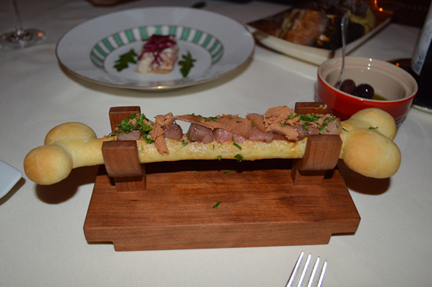
Above: Marrow served atop a bread “bone” and sprinkled with bottarga.

The food at Vetri in Philadelphia is simply breathtaking. I had the great fortune to dine there last night with my great friend and client Paolo Cantele (and I’ve just posted food photos on his blog CanteleUSA).

bonci verdicchio

There were many extraordinary wines poured last night but the one I can’t stop thinking about was the Bonci 1998 Verdicchio dei Castelli di Jesi, selected by my friend Steve Wildy, the restaurant’s wine director (one of the sweetest and most gifted people in the trade).

This fifteen-year-old expression of Verdicchio seems to be drinking at its peak (and perhaps has more years ahead of it): rich and complex, it was such a great example of an indigenous Italian grape (one of the few) that benefits from small-cask aging. It was a brilliant choice by our sommelier and I loved its unctuous mouthfeel.

adam leonti chef

But the most extraordinary thing was how the staff — front and back of the house — literally danced around us.

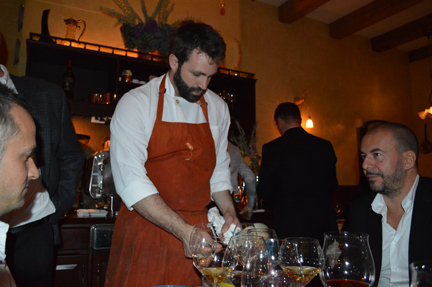
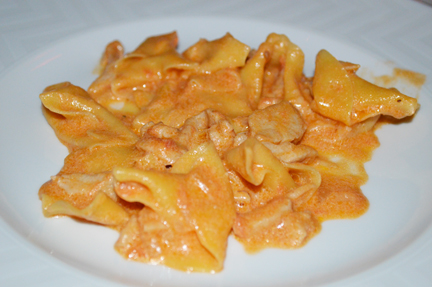
That’s chef de cuisine Adam Leonti (above). When he saw that we tasted a Lazio wine (among the many wines we were served), he whipped up some pajata, a dish in which the digested mother’s milk of a calf is cooked in its small intestines, a classic of Roman cookery (he didn’t know that I am a huge fan of the dish and have written about it on many occasions).

Here’s the dish…

pajata

One of the best meals of my life…

Check out the other food photos on Paolo’s blog.

And a heartfelt thanks to Marc Vetri, Adam Leonti, and Steve Wildy for opening the doors of your wonderful restaurant to us. A truly sublime meal that I will never forget…

#BestMeals2013: an exquisite lunch with @TonyVallone

Click here for my Houston Press Champagne and sparkling New Year’s eve recommendations.

I had so many extraordinary meals this year at my friend and client Tony’s restaurants this year. But this repast at his flagship Tony’s in October was a poetica of elegant and thoughtful cookery and it’s one of my #BestMeals2013.

Tony had me at the deconstructed vitello tonnato

vitello tonnato recipe

The “tonnato”: thinly sliced roast veal breast garnished with caviar, raw tuna, fried capers and an ethereal aioli.

halibut fennel

Atlantic halibut with braised fennel and orange and fennel “confit” over a Barolo reduction.

meringue recipe

Meringue stuffed with fresh raspberries.

Buon weekend…

Prosecco col fondo and Christmas Eve gumbo east Texas style

best gumbo recipe houston

Bele Casel Prosecco Colfòndo isn’t “officially” available in Texas, but we managed to sneak some in for Christmas eve on the bayou and paired it with Uncle Tim’s east Texas gumbo.

For those of you who’ve never had gumbo, it’s a stew made with roux, filé (finely ground sassafras), and meat and/or seafood, and often served over steamed rice.

Uncle Tim makes his Christmas eve gumbo with chicken and deer sausage. In classic east Texas fashion, he recommends folding in a generous dollop of his potato salad (made with hard-boiled eggs).

Happy holidays, yall!

#BestMeals2013: a mother of Nebbiolo flights with @FineWineGeek

Back in May, the inimitable Ken Vastola — Nebbiolo collector and Italian wine blogger extraordinaire — organized this unforgettable flight of Nebbiolo for his tasting group. He graciously invited me to attend…
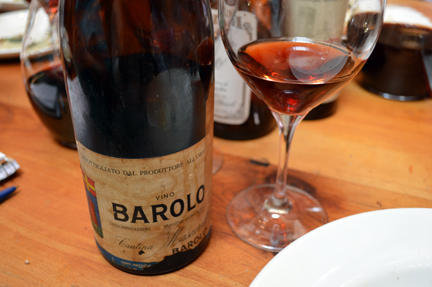
1958 bartolo mascarello bis

Bartolo Mascarello 1958 Barolo, a holy grail of wines for me. If ever there were a wine that embodied the “unbearable lightness” of Nebbiolo, this would be it. A wine from an extraordinary vintage in Langa and an apotheosis of Barolo. One of the most remarkable wines I have ever tasted — perhaps the greatest.

fetish, “an inanimate object worshipped by preliterate peoples on account of its supposed inherent magical powers, or as being animated by a spirit [Oxford English Dictionary],” from the Latin factīcĭus meaning factitious (made by or resulting from art).
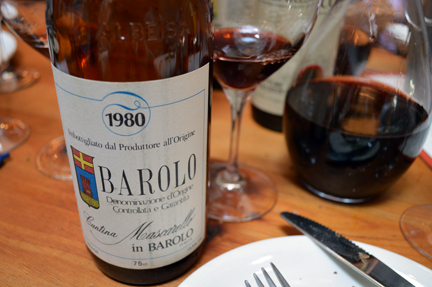
bartolo mascarello 1980

Everyone agreed that the Bartolo Mascarello 1980 Barolo was a standout in the flight. It had that electric vibrancy and magnetic focus in its rich, dark fruit. Wow, what a wine this was… 1980 is regarded as a fair to poor vintage in Langa and this wine was a great example of how great winemakers can deliver outstanding wines even in challenging vintages.

Dayenu! If only just one of the bottles in the flight had been opened over lunch at Il Buco Alimentari e Vineria in lower Manhattan, it would have sufficed to satiate our Nebbiolo fetish!

On Friday, I had the immense fortune to be invited to a meal and tasting by Nebbiolo connoisseur and Langa chronicler Ken Vastola (check out his amazing blog).

Even though we’d never met in person, I’ve known Ken for many years virtually: we follow each other on social media and often exchange notes and information about the winemakers we both follow (remember this post on the origins of the term piè franco that I wrote a few weeks ago inspired by Ken?).
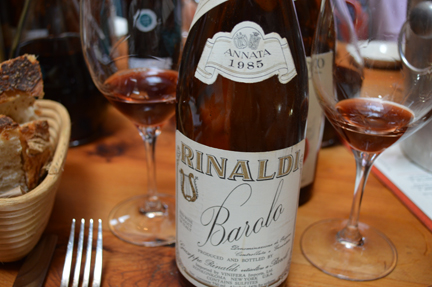
rinaldi barolo 1985

The Giuseppe Rinaldi 1985 Barolo was another standout for me personally. Like the 1980 Bartolo Mascarello, it seemed to be at the peak of its evolution, a “great wine” on a “great day.”

We’d been trying to get together for some time now. But the fact that I no longer live in NYC and he lives outside the city have made it tricky to make our schedules and travels align.

But on Friday, the stars smiled upon me: Ken invited me to join him and his regular group of collectors and Nebbiolo fetishists.

rinaldi barolo 1974

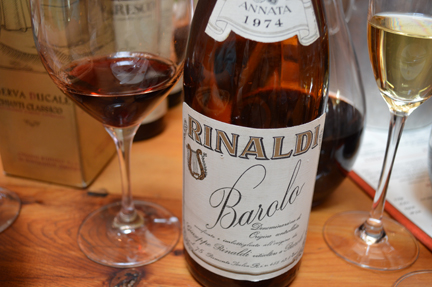
A great wine from a good (but not great) vintage, the Giuseppe Rinaldi 1974 Barolo was in the late fall of its evolution, with an ethereal lightness of nuanced fruit. One of my personal favorites, although not the best of the best.

Fetishists, you ask? No, I’m not referring to the colloquial usage of the term fetish. There was nothing sexual or otherwise titillating about our lunch and tasting.

I’m talking about the way that Nebbiolo from Langa often assumes a a cultish and even spiritual significance among collectors and connoisseurs (the same way high-profile restaurateurs and top-spending diners often fetishize beef in our country).

produttori barbaresco pora 1970

Like the 1980 Mascarello Barolo, this wine was stunning for its vibrancy and richness. The Pora cru tends to be generous with its fruit in the wine’s early years. And this was a illustrative example of how Pora retains that brilliance of fruit even as it evolves. I think that all agreed that this, the 80 Mascarello, and the 58 Mascarello were the top wines in the flight.

After all, between the eight persons in attendance, we could have never consumed all the superb wine on the table before us. Much of the wine was left over — a libatio, a drink-offering, a “pouring out of wine or other liquid in honour of a god” (OED).

In fact, the purpose of the gathering wasn’t to nourish ourselves or to employ or apply the wines as they had been conceived — as nutrients themselves, an accompaniment and complement to food.

Instead, we were there to worship these wonderful, wonderful wines. And before us, my generous hosts had erected a temple that literally overflowed with rare treasure and religious artifacts.

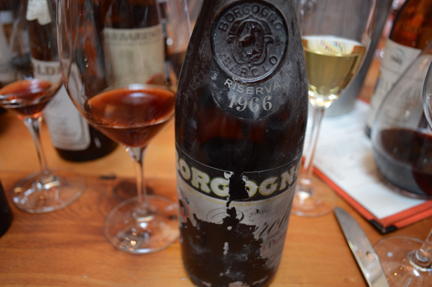
borgogno barolo 1966

Over the last decade, shiny library-release bottles of old-vintage (topped-off?) Borgogno have made their way to the U.S. market. I was thrilled to taste an original release from the 1966 vintage and was impressed by how fresh and lively this wine was. A personal stand-out for me.

For me, such an opportunity is golden. Although I do collect wine and have a nice library of twenty or so cases of Nebbiolo, I rarely get to taste old vintages of top wines like this.

And I am humbly and eternally grateful to the whole group — Marc, Frank, Jamie, Carl, Joe, and Ken (in the order that they sat at the table) — for its extreme generosity.

Guys, I can’t thank you enough for inviting me to “pray” with you.

And Ken, as much as the wine thrilled my senses and my mind, the best part was gleaning your insights on Nebbiolo, Langa, and the people who produce (and who have historically produced) these wines.

You are a rabbi in my world and anytime you need me for a minyan, I am available to daven on the bema of the Langa hills.

money shot nebbiolo

One of the most remarkable flights of wine I’ve ever seen before me. Other highlights were Taittinger 1995 Comtes de Champagne, Mastroberardino 1968 Taurasi (classic, not single-vineyard designate), and Ruffino 1961 Chianti Classic Riserva (gold label).

#BestMeals2013: Dispensa Pani e Vini (Franciacorta)

The Dispensa in Franciacorta is one of my all-time favorite restaurants. This spring, I took Tracie P and Georgia P (and Lila Jane in Tracie P’s belly) to eat there not once but twice…

italian grissini

Above: Grissini — bread sticks — are one of Italy’s great gifts to humankind. I’m not talking about the hydrogenated oil-charged grissini that come in a plastic wrapper. I’m talking about the ones that chefs like the amazing Vittorio Fusari bake in-house. Georgia P couldn’t get enough!

Franciacorta Chef Vittorio Fusari and his Dispensa Pani e Vini have become a happy Parzen family obsession. Last week I wrote about the first of two meals we had there earlier this year.

Vittorio’s ability to match brilliant technique and precision with his uncanny knack for sourcing wholesome materia prima have fascinated and thrilled me. Bringing Tracie P and Georgia P to lunch there was one of the highlights of our family trip to Italy in the spring.

Here’s what we ate on the second day.

32 via dei birrai

There is so much great beer being made in Italy right now. We loved the richness of aroma and flavor in the Oppale by 32 Via dei Birrai.

raw salmon italy

The salmon wasn’t cured. It was served raw, expertly sliced and dressed with a gentle drizzle of olive oil. So simply yet ethereally satisfying.

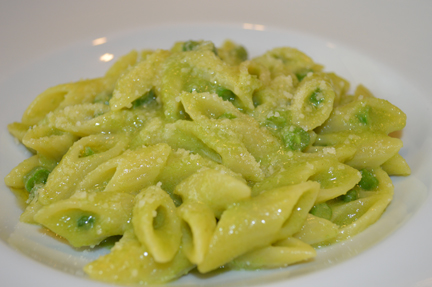
pasta asparagus

Vittorio made these penne with green beans especially for Georgia P. Mommy and daddy couldn’t help stealing a bite.

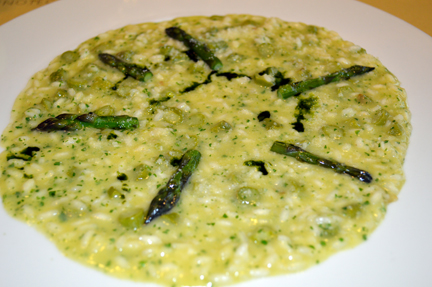
risotto asparagi asparagus

Vittorio’s risotto agli asparagi was a masterpiece. This dish left me speechless.

italian chicken salad

Poached chicken salad. That’s a lightly breaded, fried egg in the middle. It’s yolk was perfectly runny.

italian hamburger

The Bresciani (ethnonym for natives of Brescia, Lombardy, the province that claims Franciacorta) love beef. This was Vittorio’s take on the hamburger. All the bread is baked in-house at the Dispensa.

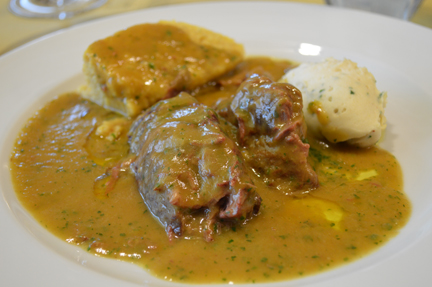
manzo olio brescia lombardy

Manzo all’olio — literally “beef cooked in oil” — is a classic dish of Bresciana cuisine. Slowly braised beef usually served with polenta and/or potatoes.

giovanni arcari eugenio signoroni

If I’m in Franciacorta, you’ll usually find me in the company of my bromance Giovanni Arcari (left), winemaker extraordinaire and grand personage of Italian wine. He met us for lunch and we bumped into Eugenio Signoroni, editor of the Slow Food beer and osteria guides. That’s the kind of place the Dispensa is. You always run into food and wine professionals and personalities there.

happy italian baby

What a joy to watch our sweet baby girl enjoy her meals at the Dispensa. Our family life is centered around eating well (and by “well,” I mean deliciously and wholesomely) and there is no chef I know who devotes more attention and passion to the wholesomeness of what he serves his guests.

Thank you, Vittorio! The Parzen family is your unabashedly and eternally devoted and grateful fan!