From the department of “you mean, they pay you to do this?”…

I’m writing a new series of posts on the Carnevale of Venice for the Bele Casel blog.
Buona lettura!

From the department of “you mean, they pay you to do this?”…
I’m writing a new series of posts on the Carnevale of Venice for the Bele Casel blog.
Buona lettura!
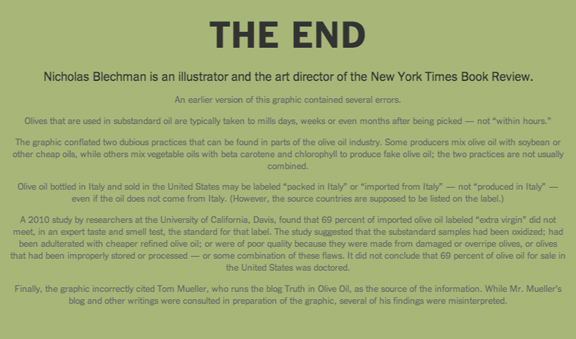
Above: a screen shot of Nicholas Blechman’s half-hearted mea culpa. I’ve copied and pasted the text below.
I’m still feeling sick over Nicholas Blechman’s sensationalist, fear-mongering olive oil cartoon, published recently by the New York Times. And I’m feeling even worse about his half-hearted mea culpa, which now appears at the very end of the cartoon (image above, complete text below).
As my friend and colleague Pete Danko pointed out yesterday on the Facebook, the retraction was longer than the original piece!
Why, on earth, did the editors of the Times op-ed page invite someone like Blechman to write about olive oil? He’s a supremely talented and wildly successful illustrator and editor, no doubt about it. But I can’t find any credential that points to his would-be authority on gastronomy.
The bottom line, as one reader pointed out, is that if a bottle of olive oil costs so little that it seems too good to be true, it probably is…
Just have a look at olive oil authority Tom Mueller’s post on a flight of olive oils he tasted from the Trader Joe’s selection.
There is plenty of adulterated olive oil out there. But high-quality bona fide olive oil is also widely available to us here in the U.S. (San Giuliano from Alghero, Sardinia is our house olive oil; it costs about $14 at our local gourmet market for a 750 ml bottle).
In other news…

Jonathan Nossiter’s new film, Natural Resistance, will debut this weekend at the Berlin Film Festival.
It chronicles the bureaucratic and political obstacles and challenges faced by four Italian grape growers and winemakers — La Stoppa (Colli Piacentini), La Distesa (Castelli di Jesi), Pacina (Chianti), and Cascina degli Ulivi (Alessandria) — as they pursue their dream of growing grapes without chemicals and making wines without additives.
In bocca al lupo, Jonathan! Or better yet, in culo alla balena!
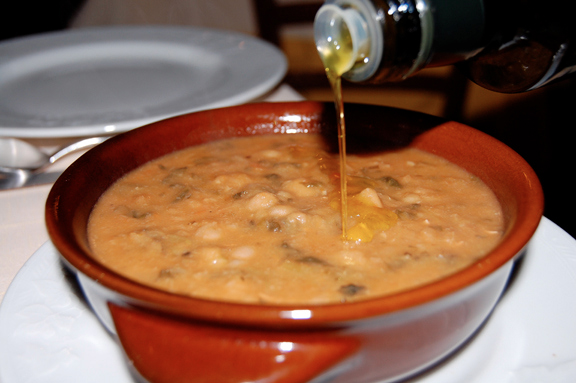
Above: ribollita, “twice-cooked” Tuscan bread soup drizzled with extra-virgin olive oil is one of life’s greatest pleasures.
Italy’s community of wine and food writers, Italian olive oil producers, and Italian politicians are still reeling in the wake of Nicholas Blechman’s sensationalist cartoon, “Extra-Virgin Suicide: the Adulteration of Italian Olive Oil,” published by the New York Times on January 24, 2014.
In an editorial published today, the editors of Il Parlamentare, a weekly magazine that covers politics in Italy, write: “This is how the New York Times ‘makes fun of Italy.'”
The cartoon erroneously reported that up to 69 percent of Italian olive oil is adulterated. And although the cartoon was later amended, it also incorrectly reported that oil from other countries could be legally labeled as “Italian” despite the provenance (see below).
[Today, the final panel of the cartoon reports that “an earlier version of this graphic contained several errors,” including those cited here.]
The cartoon was purportedly based on data gathered by journalist Tom Mueller, who authors the blog Truth in Olive Oil. He is also the author of a Extra Virginity: The Sublime and Scandalous World of Olive Oil (Norton, 2013).
On January 29, Mueller appeared before the Italian parliament’s Chamber of Deputies (akin to our House of Representative) to answer questions about his research. During his appearance, he disavowed himself of the cartoon, which made explicit reference to his work.
“There is no connection to me,” said Mueller of the cartoon, “nor is it my work.” It is made up of “humorous images that incorporate fact but also — and above all — include glaring errors. They reflect a biased approach that ignores quality and focuses only on fraud.”
According to the Italian national daily Corriere della Sera coverage of his appearance before the chamber, he expects the Times to publish a retraction.
On January 31, Italian blogger Olga Mascolo published an interview with Mueller on the popular food blog Dissapore.
The following is an excerpted translation of the interview (to my knowledge, Mueller has only made these comments in Italian and they have not been published in an English-language forum; translation mine).
*****
“There are two principal errors” in the cartoon. “The first is approximation. I wrote 200 pages on this subject documenting the problem of olive oil adulteration. But I also brought attention to those who are doing good work… The overwhelming majority does good work. There are just a few rotten apples who make life difficult for everyone.”
“In regard to the New York Times, it’s a cartoon, fifteen panels that give the impression that all of Italian olive oil is evil. But that’s not the case. The fact that such an authoritative newspaper has reported this makes it all the worse. This is not Home Simpson making silly declarations.”
“In particular, there is a vignette that claims that 69 percent of Italian olive oil is adulterated. That’s not the case. The figure is based on a California study that shows that, at most, the oil is not extra-virgin. But that doesn’t mean that it is adulterated.”
Sources: Dissapore; DiVini (Corriere della Sera).
*****
The following line in the New York Times cartoon was amended in a subsequent version:
“Bottles are labeled ‘Extra-Virgin’ and brand with the globally respected ‘Made In Italy.’ (Oddly this is legal, even if the oil does not come from Italy.)”
The current caption reads as follows:
“Bottles are labeled ‘Extra-Virgin’ and brand with the globally respected ‘Made In Italy.’ (Oddly this is legal, even if the oil does not come from Italy — although the source countries are supposed to be listed on the label.)”
Source: Intravino.
From the department of “so much to tell, so little time”…

Above: open-vat fermentation at leading Natural wine producer Radikon in Oslavia, Friuli.
My research into the origins of the enonym Negroamaro delivered a small miracle this morning: Notizie e studi intorno ai vini ed alle uve d’Italia (Wines and Grapes of Italy: News and Studies), a census of Italian wines and grape varieties commissioned and published by the Italian government (then a monarchy) in 1896, when Italy was in its fourth decade of unification.
I’ve posted my findings over at the CanteleUSA blog, which I author for my friend and client Paolo Cantele, whose family produces Negroamaro.
But one of the most interesting finds was an ante litteram definition of natural wine by means of a litotes. (As Joe Dressner used to say, there are those among us who know what a litotes is and those who don’t.)
The first chapter of this amazing almanac of Italian ampelography is devoted to the authors’ methodology and the requirements for submissions, i.e., protocols for sending them wines to analyze in future editions.
It’s fascinating to read (at least for me) because it offers remarkable insights into how wine was made, stored, and shipped in fin de siècle Italy.
The authors will not include “adulterated” wines in their census and the following is their definition for adulteration (translation mine).
As it turns out, the notion of Natural wine isn’t as young as we may think.
In other news…
In other other news…
Today is our fourth wedding anniversary!
Tracie P., I love you. Thank you for what have truly been the four most wonderful years of my life.

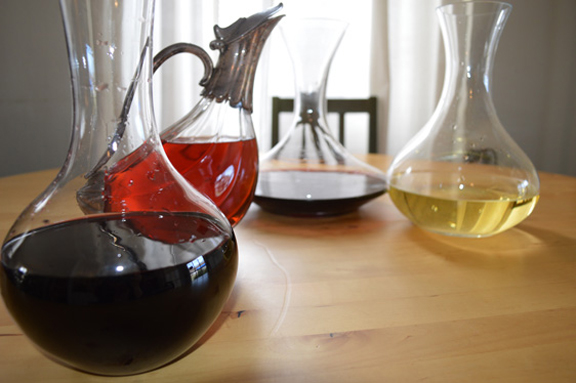
My post today for the Houston Press on my evolving views of decanting: “I am an American and I am an Anti-Decanter.”

Above: a bottle of Mastroberardino 1968 Taurasi, considered by many one of the appellation’s greatest vintages, tasted in May 2013.
Today, the world of wine mourns the loss of Antonio Mastroberardino, who died yesterday in Campania at age 86.
He was widely considered the father of fine winemaking in Campania and his decision to replant indigenous grapes after the second world war redefined the fine wine movement in his own region and beyond.
“In 1945,” wrote Neapolitan journalist and wine writer Luciano Pignataro on his blog today, “Irpinia’s great viticultural district, which quenched Italy’s thirst in the 1920s, was practically non-existent [destroyed by the arrival of phylloxera in the 1930s]. Together with his brothers Angelo and Walter, he began again to make wine. But it was he who decided the contents: Fiano, Greco, and Aglianico.
“His decision to remain faithful to the grapes of his forbearers was a stubborn one, rooted in his Irpinian mountain origins. It seemed out of fashion in the 1960s, when agricultural inspectors were pushing growers to plant more prolific Italian grapes: Trebbiano, Montepulciano, Sangiovese, and even Barbera.”
In the 1990s, Mastroberardino launched the Villa dei Misteri project, a viticultural and archeological quest to grow grapes in Pompeii using DNA culled from ancient artifacts and techniques described by the ancient agronomist Columella.
It was just one of the many initiatives that helped to reshape and revitalize Campania winemaking as we know it today.
The many fine wines now produced there — and in particular, the myriad expressions of Aglianico — are inexorably linked to his legacy and passion as a grape grower and winemaker.
Antoni sit tibi terra levis.

When Tracie P and I sat down for dinner at Bufalina in Austin on Friday night, it was as if we communicated telepathically: without uttering a word, we both knew that we were going to order the 2010 Slatnik by Radikon, a wine by Stanko Radikon’s son, Saša.
A lot of Italian wine bloggers have talked about how Saša’s wines are more “easy going” and perhaps more approachable — less tannic and more affordable — than his father’s wines.
But I found this wine to be one of the most elegant and thoughtful that I’ve ever tasted from this farm — a winery and winemakers for whom I have a quasi religious reverence.
Its stone fruit flavor was brilliant, its acidity popping, and its tannin laid back. But ensemble, all of these elements sang together to convey a gorgeous balance. In some ways, I thought, it represents the evolution of macerated wine, which can tend to be austere and aggressively tannic in its youth.
We really, really loved it. And we were thrilled to share a glass with another couple who were nonplussed by its color.

We ordered three pizzas: the classic Margherita, the creative Taleggio (below), and the whacky Brussels Sprouts (above), which was topped with surprisingly subtle serrano-scallion pesto, ham, and Brussels sprouts.
Many pizza purists can’t see beyond the Margherita cannon. And they don’t know what they’re missing.
Pizza, by its very nature, should also be creative. As my friend Tony always says, “to be authentic, Italian cooking must also be creative.” We loved all three dressings.

Like so many things in the U.S., most gauge a pizza’s quality by the toppings. But pizza is the crust, the pie, the dough…
I taste so much pizza across the U.S. and have eaten in many of the cutting-edge Neapolitan pizzerias in the country.
Bufalina owner Steven Dilley’s pizza is in my top five: perfectly soggy in the middle and with an outer crust that never becomes too chewy or heavy, always in perfect balance with the center (this last element, the cohesiveness — the “oneness” of the crust — is so important imho).
And Steven’s list continues to stand apart as my number-one wine list in Austin.
I wrote about his wine revolution when we visited about six months ago (the night before Lila Jane was born!). And more recently, when I visited with one of the most famous wine writers in the world, said wine writer noted approvingly that he had reviewed every one of Steven’s by-the-glasses in his column (we drank Foradori Manzoni Bianco that night).
Has Steven’s groovy wine list caught on in Austin? From what he told me, some of his go-to distributors have been gravitating toward Houston where they find buyers more receptive to their “esoteric” labels. The Slatnik had been on the list for a few months, he said, and we were the first to order it.
After dinner, we headed to the über cool Violet Crowne theater where we saw American Hustle paired with cocktails.
I sure am going to miss this town once we make our move eastward…
Thanks again to Mrs. and Rev. B for babysitting and for letting us sleep in the next day!

One of the things that New York wine maven Charles Scicolone and I have in common is that we are both “blessed,” as he puts it, to have spouses who excel in the kitchen.
My wife Tracie P may not be a celebrated cookery book author like Michele Scicolone, but, man, can she cook.
Last night she served the family her delicious ragù alla bolognese and we paired with a bottle of 2008 Gaja Sperss that a client had given me for Christmas 2013.
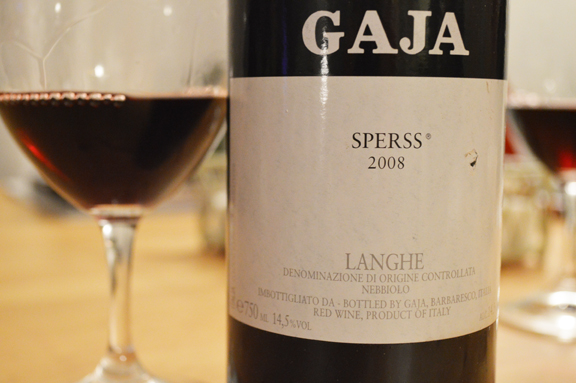
Perhaps because of my love of romance philology and my keen interest in Italian language and its history, one of the questions that I get asked more than any other is what does the designation “Sperss” mean?
Over the years, Angelo Gaja has been generous in spending time with me and it must have been five years ago or so that he explained the origin of the term.
In 1961, the winery decided to end its practice of buying grapes from outside growers. Because the family did not own land in the Barolo appellation, they were no longer able to produce a Barolo.
It was a bold move: at the time Barolo was the only “brand” that carried any weight outside the Langa hills. And ultimately, it was Angelo Gaja who would single-handedly create awareness of Barbaresco among foreign wine lovers through his tireless marketing efforts and travels.
It wasn’t until 1988, when the family purchased vineyards in the Serralunga township, that it would once again produce a Barolo.
“Sperss means nostalgia,” he told me.
It’s a Piedmontese dialectal term akin to the Italian perso (lost) from perdere (to lose). Its etymon reaches back to the Latin [dis]perdo meaning to squander or to waste.
“When we first released this wine,” he explained, “we called it Sperss to remember that time” when the winery still produced Barolo using grapes from other growers.
In 2000, with release of the 1996 vintage, Gaja “reclassified” the wine, as Angelo’s daughter Gaia likes to say, from “Barolo Sperss” to “Langhe Nebbiolo Sperss.”
Many Langa wines from the 2008 vintage are going through a phase of openness right now and the fruit of this wine emerged confidently despite its tannic nature. The more and more I taste from this harvest, the more I believe that 2008 is going to be the standout from the 06-08 harvests.
The wine was elegant in the glass, with Gaja’s signature nuanced, understated savory character and earthiness. A stunning wine that I was thrilled to share with my father-in-law, the Rev. B, who’s visiting with Mrs. B. right now.
It was an unforgettable meal on a wintry, snowy night in central Texas.
Please stay warm and safe wherever you are… Buon weekend…

Above: the view from our kitchen window this morning.
I never thought I’d live to see the day: snow in Austin, Texas!
Across the state, from Central Texas to East Texas, bridges and overpasses are closed and scores of motorists are stranded. Unbelievable…
Texans aren’t accustomed to wintry driving conditions and the Texas police don’t mess around when it comes to enforcing road closures.

I’ve been writing a fun “how-to wine” series for the Houston Press this year.
Today’s post deals with the sticky subject of the “overpour.”
Is the glass half full or half empty? The age-old conundrum…
 Do Bianchi