First kiss: Produttori del Barbaresco 2009 (and a great wine list in Atlanta)

best restaurant atlanta georgia

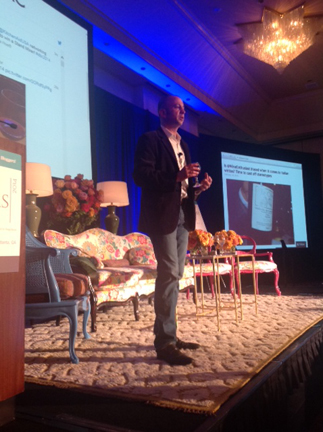
Nicolas Quinones’ Woodfire Grill in Atlanta really impressed me on Tuesday night, the last night of the Design Bloggers Conference where I gave a talk on social media.

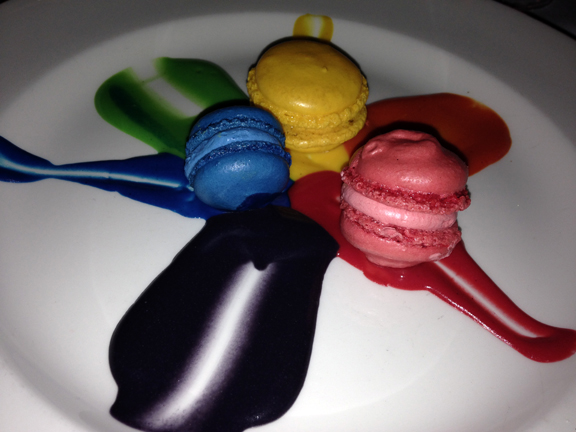
The food was beautiful and thoughtful. I loved how Chef Tyler Williams added artistic flair to each dish, as in the macarons above. And I loved the wholesomeness of his farm-to-table cooking. Georgia is, after all, a farming state, and the quality of the young chef’s materia prima was superb, as was his execution.

2009 produttori barbaresco tasting note

But what I loved the most was Nicolas’ 400-lot list and its aggressive pricing.

Continue reading

How do you translate “cordone speronato”? (and other challenging Italian wine terms)

british libraryAbove: if I were a rich man, I’d spend my days in the reference/reading room of the British Library in London, one of my favorite places on earth (image via Wiki Commons).

Last week, a client of mine asked me to prepare a shortlist of “challenging” Italian wine terms in translation.

I was unavailable for a consecutive interpreting gig for one of said client’s high-profile clients and so they ended up contracting an interpreter who, however accomplished, didn’t have a lot of experience in wine-trade interpreting.

The following list of terms and translations by no means represents a complete bilingual glossary.

Instead, it’s populated by “challenging” words that are often mistranslated.

Like the Italian Grape Name and Appellation Pronunciation Project and the Italian Winery Designations Project, I’ll continue to update it: please send me your queries (by leaving a comment)!

Continue reading

How do you tell a wine is “corked”? @EatingOurWords @HoustonPress

corked wine cork

Corkiness can be one of the quirkiest and most contentious issues in wine appreciation.

My post today for the Houston Press addresses the conundrum of how to determine the fitness of a bottle of wine.

Thanks for reading…

Italian wine tasting for 300+ #dbc2014 TY @AdamJapko

design bloggers conference atlantaAbove: a view from the stage yesterday at the Design Bloggers Conference 2014 in Atlanta where I led a guided tasting for 300+ bloggers.

Social media saved my life.

It’s thanks to social media that I reinvented myself and found a new career as a wine blogger back in 2007 when I was broke, single, and rudderless in New York City.

It’s thanks to social media that I met Tracie P in 2008, fell in love, got married in 2010, and started a family — the greatest experience of my life.

And it’s thanks to social media that I became friends with Adam Japko, one of the most extraordinary, dynamic people I know.

wine tasting atlantaAbove: wine for 300 bloggers!

Adam asked me to speak yesterday about “how to make any story a sharable story” at the Design Bloggers Conference in Atlanta (#dbc2014), a standing-room-only event that he organizes each year.

And so I told the story of how my story became a sharable one and how social media helped me reinvent myself, find the true love of my life, and launch a successful marketing consulting business.

Each of the wines we served at the tasting represented a moment in the arc of my narrative.

jeremy parzenAbove: back in 2007, as my childhood friend Irwin remembers fondly, I told him that I was going to have a career as a wine blogger. “What’s a wine blogger?” he asked me at our favorite taco shack in La Jolla. I could have never imagined where social media was going to take me.

The Bele Casel Prosecco Colfòndo, aged on its lees and undisgorged, was cloudy and savory with a sharp citrus note. Like me back in 2007, its raw, pure flavor was looking for the right pairing.

The Ka Maciné Rossese from the Ligurian riviera was bright and rich in brilliant, Technicolor red fruit and berry flavor, a wine that you might sip as you gaze into your new lover’s eyes as he/she looks out on the bay at Portofino.

In sharp focus, the Castello di Verduno Pelaverga delivered its classic white pepper note, the spice of a new love, a new life, and a new career, the fulfillment of a peripeteia that began après la guerre.

Thank you, Adam, for being such a great friend and mentor and for letting me tell my story to such a wonderful audience.

And thank you, design bloggers, for all the thoughtful comments and kind words that you’ve shared.

I’m so glad to be here and so happy that social media has brought us together.

All of the wines can be found at Ceri Smith’s Biondivino in San Francisco, one of my favorite wine merchants in the country.

Without the sadness, happiness would not be (hitting the road again @DesignBlogConf‎ #Atlanta)

mommy georgia p

Above: Georgia P and Tracie P shared “butterfly kisses” at one of our favorite Mexican restaurants in Houston on Saturday. It was so hard to say goodbye to them this morning…

In the months that led up to Lila Jane’s birth last July, I took a long and much-needed break from travel.

Now that she’s seven months old and we’re settled into our new home in Houston, it’s time for me to hit the road again.

I’ll be visiting a different U.S. city every week for the next four weeks. And then I head to Italy for nearly two weeks for the wine trade fairs.

It’s one of the hazards of the job.

Today I’m on way to Atlanta to give a talk at the Design Bloggers Conference, my friend Adam Japko’s yearly social media gathering for interior designers (the fruit of his many years as a publisher of an interior design magazine).

I’ll be pouring some of my favorite wines and talking about how I turned my story in to a brand and a successful marketing and media consulting company (you can read about the wines here).

It’s not easy to leave my family but I’m comforted by the fact that my in-laws will be coming to Houston to visit for the next few days while I’m gone. That’s the main reason we moved to Houston: to be closer to them (they’re now two hours instead of five hours away) and to my Levy cousins who live there.

Maybe because it’s the first time in a long time that I’ll be away from them: the pang of longing is sharp this early morning as I sit in a crowded airport waiting to get on a sold-out flight.

But I know that without the sadness, the happiness would not be…

Thanks for being here and sharing a little bit of that pang with me. See you on the other side…

On the origins of Primitivo, a great short on Langa, Wine Spectator Top 100 Italian & Italy’s most expensive burger

amphora primitivo puglia

Above: amphorae once used to age sun-baked Primitivo di Manduria (image via the Vinicola Savese [Vini Pichierri] Google+).

It’s been a crazy week here at Do Bianchi Editorial as we’ve settled into our new house in Houston. But that hasn’t obstructed our mission to keep the world safe for Italian wines.

Earlier this week, I posted my notes on the meaning and origins of the name Primitivo over on the CanteleUSA blog.

Because of its genetic relation to Zinfandel (one of the wine world’s most lucrative varieties), Primitivo is among the most scrutinized grapes in history.

But why was it called Primitivo by the pugliesi when its popularity began to spread through the Adriatic basin in the nineteenth century?

I hazard a probable explanation in the post.

In other news this week…

I was really impressed by this video on the wines of Barolo and Barbaresco by Geoff Kruth, Master Sommelier and chief operating officer of the Guild of Sommeliers.

The line between modernism and traditionalism can be treacherous and the director of this short does a great job of putting the dialectic into perspective without bias.

And the film is a wonderful introduction to the great wines of these appellations and the production value is fantastic.

Chapeau bas, Geoff and team!

I only wish that the langaroli would begin saying Serravallian instead of Helvetian.

In other other news…

Leading Italian wine writer Luciano Ferraro leaked the Wine Spectator Top 100 Italian Wineries list today on his blog, DiVini Corriere (published by the Italian national daily, Corriere della Sera).

I’m a big fan of Luciano’s writing and I love the quote that he culls from Philip Roth for this post: “The Italian cutter, son, is always more artistic in his outlook” (American Pastoral).

I imagine many Italians will be surprised by some of the omissions in the list but I applaud the editors of the Wine Spectator for their expanding coverage of the wines of Italy.

As Luciano notes, the list reflects not the wines that the Italians drink but rather the wines that are shipped to the U.S.

The list is now in its third year and will be presented officially at the Italian wine trade fair, Vinitaly, in April in Verona.

You can read it here.

Postscript…

I’ve written about Italy’s current burger obsession recently but was “disappointed” (those are air quotes) to learn that Italy’s “most expensive” hamburger only costs €85.

The notorious “Io sono ricco” (I’m rich) burger is served at Piazzetta San Marco 13 in Pordenone, Friuli — and not Milan, as many Italian hamburger enthusiasts would have expected (source: Scatti di Gusto).

At $200, “the world’s most expensive burger” accolade is probably owned by Houston, where we now live and where the petrochemical crowd is always a sucker for anything that glitters.

Buona lettura (happy reading) and buon weekend (have a great weekend), yall!

Lunch with Daniela Mastroberardino @TonyVallone

daniela mastroberardino

Above: Daniela Mastroberardino, one of the first ladies of Italian wine, daughter of Campanian legacy winemaker Walter Mastroberardino and export manager for her family’s Terredora winery.

Yesterday found me at Tony’s in Houston, a lunch guest of Daniela Mastroberardino, who was visiting Texas and showing her wines.

I have great admiration for Daniela: when her brother Lucio passed suddenly at age 45 in January of last year, she took over his role as export director for the family’s winery.

His were big shoes to fill. Not only was Lucio the president of the Unione Italiana Vini at the time (the Italian Wines Union, one of the most powerful lobbies in the European wine trade), but he was also widely revered for his tireless efforts as an ambassador of Campania wines.

With noble Irpinian equanimity, she broached the subject immediately after we sat down.

Continue reading

The truth about Valpolicella (and other busted myths)

Above: During my graduate years, I spent many hours at the Biblioteca Nazionale Marciana in Venice working on my dissertation on Petrarch and Bembo and early transcriptions of Petrarch’s Italian poems. It’s also where I made an important breakthrough in my inquiry into the origins of Vinsanto and Vin Santo.

A mention of the blog in today’s Boston Globe by wine writer Ellen Bhang prompted more than a few readers to ask me where to find my post on the origins of the toponym (place name) Valpolicella. It follows this note.

Originally posted in 2008, it’s just one of the many myth-busting posts I’ve done over the years. Others include:

it’s unlikely that Sangiovese means sangue di Giove or blood of Jove [Zeus];
it’s impossible that the enonym Aglianico comes from ellenico or Hellenic;
it’s improbable that puttanesca refers to prostitutes or their putative love of the recipe (this is one of the most popular).

Over the years, one of the greatest rewards in blogging has come in the form a platform where I can publish my — often arcane — research.

One of the posts of which I am most proud is the one devoted to my research on the history of Vin Santo, which originated in the Veneto and not in Tuscany, as many erroneously believe.

It was part of my investigation of the origins of Vinsanto from Santorini, Greece, and how the two wines are related.

It means so much to me that people find my work useful. And I’d like to believe that my oenophilology helps to give wine lovers a greater and richer understanding of the wines they taste. For me, wine and its history are epistemologic tools that give us unique insight into Italian historiography and western civilization.

So please help spread the logos!

My post on the true meaning the toponym Valpolicella follows… Thanks for reading and sharing.

*****
valpolicella map vineyards crus

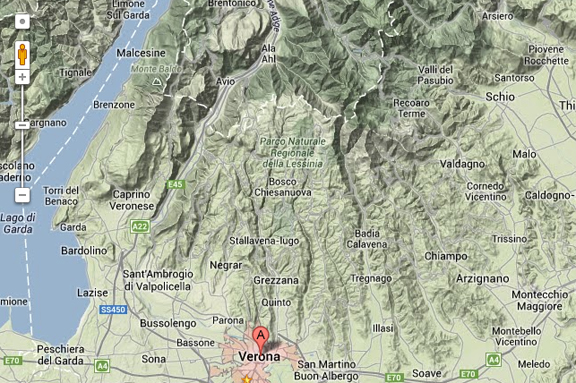
Above: Google’s “terrain” map shows the “wrinkles” of Valpolicella. The topography of the Valpolicella or “valley of alluvial deposits” is defined by a series of small rivers.

From the Greek topos or place and onoma or name, toponymy is the study of place names.

As is the case with many wine-related place names, the names themselves reflect the vine-growing practices of the place. One of my favorites is the Côte-Rôtie or the roasted slope, so-called because the slopes are “roasted” by the sun and there are countless others.

While many erroneously claim that the toponym Valpolicella comes from a hitherto undocumented Greek term for valley of many cellars, it is widely accepted that the name first appeared in the twelfth century (in a decree by Frederic I of Swabia, aka Barbarossa or Red Beard) and by the sixteenth century was widely found in Latin inscriptions as Vallis pulicellae, literally the valley of sand deposits, from the Latin pulla, a term used in classical Latin to denote to dark soil and then later to denote alluvial deposits.

In fact, Valpolicella is not a valley but rather a series of “wrinkles” defined by the Marano, Negrar, Fumane, and Nòvare torrents (streams).

If you’ve ever traveled through that part of Italy, you’ve seen how the hills roll gently across the landscape. There are other Veronese place names that reflect this tradition, like the towns Pol, Pol di Sopra, and Santa Lucia di Pol where pol denotes the presence of a stream or torrent and the pebbly, sandy deposits it forms.

There are some who point to the lass or pulzella portrayed in the device (emblem) of the town of San Pietro in Cariano as the origin of the name. But this theory seems as unlikely to me as the oft-repeated valley of many cellars (another facile faux ami or false cognate).

Valpolicella’s wines were praised highly by Latin authors, notably Virgil and Cassiodorus. Etruscan and proto-Roman winemakers recognized early on that Valpolicella’s undulating landscape was ideal for growing wine grapes.

As Virgil wrote famously, Bacchus amat colles, Bacchus loves hills.

Italy’s new agriculture minister @MauMartina & a glimmer of hope?

chinse racism italy

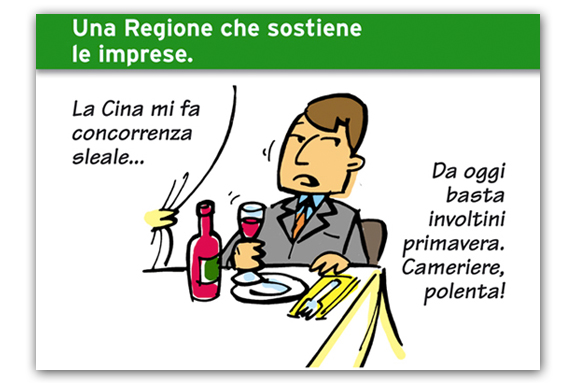
Translation: [TITLE] “A region that supports its businesses.” [LEFT CAPTION] “The competition from China is unfair.” [RIGHT CAPTION] “From now on, no more spring rolls. Waiter, bring me some polenta!” (Source: “Allegro ma non troppo” [“Happy But Not Too Happy”], newly appointed Italian agriculture minister Maurizio Martina’s comic-strip blog.)

“I was born on September 9, 1978 in Calcinate [Bergamo province, Lombardy] and I live in Mornico al Serio [also Bergamo province],” writes Italy’s new agriculture minister Maurizio Martina in the about page on his blog. “My father and mother have always been factory workers. My grandparents were farmers. I have a brother who works as an artisan and my sister is an office worker. I studied political science in college.”

At age 35, Martina, a democrat, is the youngest person ever to hold the post.

He was appointed by the youngest prime minister in Italy’s history, Matteo Renzi, who took power on Saturday after ousting his rival, forty-seven year old Enrico Letta, in a bold political coup last week.

Renzi, a democrat and former mayor of Florence who had never before held national office, has promised radical reforms, including sweeping electoral reforms brokered with ex-prime minister Silvio Berlusconi.

(Click here for yesterday’s New York Times coverage of Renzi’s inaugural speech.)

Despite optimism that Renzi’s government will be able to reverse Italy’s lingering recession and to renew hope among young people, Martina and Renzi, together with the “youngest cabinet” in Italy’s history, have many challenges to face in Italy’s well entrenched parliament, with its byzantine alliances.

Martina’s youth, proletariat roots, and folksy aphorisms (published via his blog), will surely appeal to young grape growers and winemakers in Italy.

His progressive attitudes, as expressed through his Twitter, do not seem to preclude nationalistic leanings (like that espoused in the comic above) in a country where racially charged comments about the Chinese are not uncommon in bourgeois circles.

Although there is little indication of his approach to policy beyond his association with the left-leaning Democratic Party, his appointment is viewed as a much needed break from Berlusconi’s politically driven appointments to the post.

His youthful demeanor is a welcome breath of fresh air to many in the wine industry, especially in the wake of predecessor Luca Zaia (minister in Berlusconi’s cabinet, the last appointee to drive any substantive policy changes), who openly expressed racist attitudes and who favored aggressive, however contradictory, protectionist policy.

Not easy to move with little kids but we’re settling into our new Houston home (TY @CiaoBelloHou)

i love grissini

It’s not easy to move with a toddler and newborn in tow but we’ve settled into our cozy new Houston home without any major issues.

We tried to do everything we could to make it as stress-free for the girls as possible: I moved a lot of our belongings in the weeks that led up to our transition and I even stayed in the house for four nights before they got here to make sure there were no major mishaps on the day of their arrival (last Friday).

We’re still eating a lot of take-out (unusual for our family) but Tracie P is already set up to make the girls breakfast (below). Georgia P (above) didn’t complain about pizza and grissini from my friend and client Tony Vallone’s Ciao Bello last night!

What a wonderful sight to see our girls enjoying their breakfast in our new kitchen! Thanks, everyone, for all the wishes and support.

And thanks, Tony, for a delicious dinner last night!