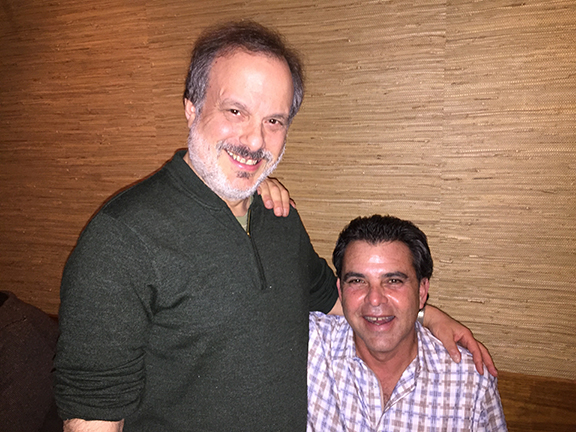
“It always makes me very happy to learn that my wines helped someone to get laid,” said importer Terry Theise when I bumped into him at the excellent Ribelle in Boston a few weeks ago.
That’s Terry (above, left) with my friend Adam Japko (with whom I’ll be leading a Design and Wine trip to Italy next year).
Terry was responding to my telling him about how Tracie P and I drank and enjoyed so many of his “grower Champagnes” during our early courtship.
Even in Austin, Texas, where we lived at the time and where wines generally cost a little more than in other major markets across the U.S., we could afford them (they fall in the $40-60 price range in our state) and they were always delicious.
That evening in New England, he tasted Adam and me on a sekt rosé from Spätburgunder by Messmer (below). It’s what what Tracie P and I — now married with children — will be drinking on Christmas day with our family in southeast Texas.
The list includes recommendations from some of our city’s leading wine professionals. You might be surprised by some of their picks (most of them recommended Italian wines!). But it also gives a good indication of the savvy that shapes the fine wine scene here.
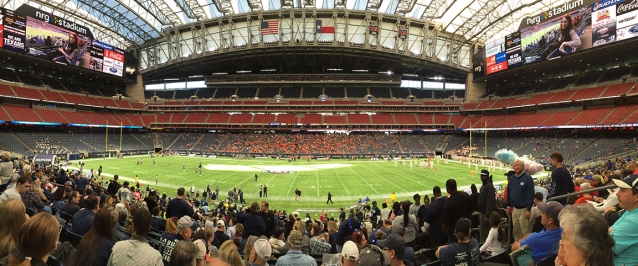
Our daughters (and their dad) got a crash course in Texas high school football yesterday when we attended the Class 4A Division II state championship, where Tracie P’s alma mater, the West Orange Stark Mustangs (14-1), beat the Celina (pronounced sah-LEE-nah) Bobcats (15-0) at Houston’s NRG stadium (where the pros play) 22-3.
That’s Georgia P (age 4), above, in the arms of her cousin Lesli (who lives in Los Angeles).
Everything you’ve ever heard about the high school football phenomenon in Texas? It’s true.
There were roughly 25 members of the Branch-Johnson side of our family in attendance, mostly from West Orange (where Tracie grew up a block away from campus) but also from Austin and Houston (and even one from California).
When I went to visit the restroom at halftime, an impromptu reunion of diaspora Mustangs alumni was taking place, with women and men and their families gleefully greeting each other and exchanging notes and hopes on the course of the game.
One thing that really impressed me about the experience was the fans’ ardent loyalty to the teams and the intensity of their cheer.
This was no mere social event or pageant intended to foster character among the young men on the field.
No, this was Texas football…
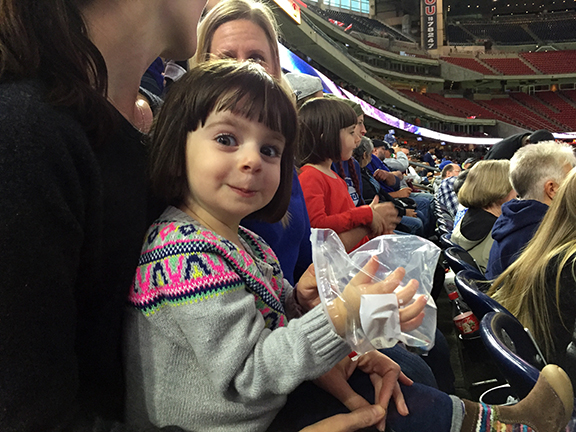
The other thing that impressed me was how nice and just downright polite everyone was.
That’s our daughter Lila Jane (2), above, btw.
As raucous as the crowd was, I didn’t hear or witness one tense exchange among the throng of people trying to reach their seats.
I ascribe the mood and air of sisterhood and brotherhood in part to the joy that Texans derive from the sporting experience.
But I also attribute it to Texans’ general attitude of friendliness and thoughtfulness when they gather.
This locus amoenus was a happy place where people — literally — from all walks of life came together to celebrate the fanfare and wholesome excitement of our state’s “national” pastime.
Congratulations to the Mustangs on a great season and a job well done!
From the department of “I hate to be a bummer the week before Christmas but”…
The photo above was published yesterday on social media by one of Italy’s leading wine professionals in a post that generated scores of comments, mostly authored by high-profile wine tradespeople who condemned and repudiated its sentiment.
Brown-colored signs like this one are part of Italy’s officially sanctioned cultural heritage system. They are used for historically significant sites like churches or works of art — the so-called segnaletica monumentale.
In this sign, posted to mark the township of Pontoglio (in Brescia province, in the region of Lombardy, not far from Milan, roughly 7,000 inhabitants according to its Wiki), the panel at the bottom reads as follows (translation mine):
“A Western-culture village with deep-rooted Christian traditions. Anyone who does not intend to respect local culture and traditions is invited to leave.”
I’ll let the reader infer whatever meaning she/her likes from this text.
But it’s abundantly clear that non-Westerners and non-Christians are not welcome in Pontoglio.
It’s an expression of life in Italy that many Americans don’t notice when they visit wine country there. But sadly, however extreme the sentiment that inspired this particular sign, cultural insensitivity like this is not uncommon there, especially in the north.
Pontoglio literally means bridge on the river Oglio. The Oglio river is one of the boundaries of the Franciacorta DOCG. The Franciacorta consortium has been one of my clients in 2015 and I travel there often.
I wonder how the residents of Pontoglio would feel about a Jewish-American wine blogger visiting their town…
I plan to find out next year when I return to Franciacorta and will report back.
But in the meantime, I wanted to write a note about the Facebook post because I applaud the Italian wine community for its repudiation of the racial and religious profiling that is becoming increasingly common and bold in Italy today.
It’s one of the ways that the wine community can and does make the world a better place.
I stand in absolute solidarity with the two wine professionals who posted this on their Facebooks.
Sorry to be a bummer the week before Christmas (which I will be celebrating in southeast Texas with my family). But I felt it was important to share this here today.
The funniest thing happened last week on my way to Boston to have dinner with a good friend and client of mine at Ribelle, one of the city’s super cool new wave restaurants, opened a few years ago.
After said friend/client emailed wine director Theresa Paopao his request to do a pasta tasting menu, she gently advised that the restaurant’s cooking was not traditional Italian.
She was happy to accommodate his request and our party, of course.
But “I just wanted to put this out there,” she wrote, “so that the only surprises are pleasant ones.”
When we sat down to eat and the first pasta arrived, I was reminded of what my friend and client Tony Vallone always says: for food to be authentically Italian, it must also be creative.
Those are the wholewheat canestri (baskets), above, with robiola due latti (sheep’s and cow’s milk) and sunchoke.
In my view, the excellent food at Ribelle had all the hallmarks of great Italian cuisine: wholesome, fresh ingredients; artisanal food products; al dente cooking times for the pasta; and the creativity and playfulness that sets contemporary Italian gastronomy apart from the rest on the world stage today.
Those are the maccheroni, above, with nori goma and uni (my favorite dish of the evening, especially because the heat was appropriately intense).
You could easily have been served this dish on the Amalfi coast (I recently read, btw, that Campania is now the Italian region with the second highest number of Michelin stars).
A poet is someone who takes the elements of a language (a finite set of words and meanings) and combines them in a new and unique way.
In my view of the enogastronomic world, the same holds for great Italian cookery.
As untraditionally Italian as Ribelle may be, this is the true tradition of authentic Italian cuisine today in my view: imaginative combinations of classic and local ingredients that create new aromas and flavors.
Those are the agnolotti (otherwise, a traditional Piedmontese stuffed pasta), above, filled with boar and served with black trumpet mushrooms.
The rigatoni, above, with octopus and fennel, were another favorite of mine.
I was really impressed by the verve and flair of Ribelle’s cooking and I left the restaurant with a belly satiated and content — I loved the food that much.
Is Ribelle a traditional Italian restaurant? No.
Is it an authentic Italian restaurant? I’ll answer that question with a hearty and al dente “yes.”
It has been dubbed the “Sauvignon Connection” by the Italian news media (who use an English-language reference to the 1971 crime thriller starring Gene Hackman in their shorthand).
The “magic potions,” as they were called by investigators, posed no health risks, they said. But they allegedly gave the wines aromas considered atypical by many Italian wine trade observers and local growers and bottlers.
Among the wines confiscated for analysis by Italian officials, some have won top awards in international wine competitions and have received top ratings from leading Italian wine reviewers.
He has also claimed that efforts by the defense to delay the examination of the wines may have attenuated the presence of the alleged unauthorized additives.
Above: the Natisone river flows through the city of Cividale del Friuli not far from the office of the Consortium of Colli Orientali del Friuli Grape Growers and Winemakers (image via Wikipedia Creative Commons).
The Parzen Family Singers’ long-awaited album “Songs from Texas” is finally here! Nine new songs about their life in Texas and beyond, written and recorded in Austin and Houston between 2008-2015.
Dindo is one of my best friends in Italy. Knowing him makes me happy, just like this song (my good buddy Nathan Smith from Houston plays killer sax on this track).
Tomorrow is your fourth birthday. Happy birthday, sweet child!
You’ve asked for a “purple birthday party” because purple is your favorite color.
You love purple dresses and purple shoes. You also adore purple butterflies and your purple butterfly necklace.
And of course, your mommy is making you a purple birthday cake.
Your love of the color purple is just one of the many things that make you such a special person. Not red, not green, not yellow or blue but only purple will do for your special day.
Over the last twelve months, we’ve watched you grow from a toddler into a “big girl.” And as you’ve grown, you’ve started to talk more and more about the things that interest you. Astronauts, ballet, cooking, and music are just a handful of the things that you are curious about.
But the most wonderful thing we’ve watched over this last year is how much you care about the people in your life. The other day, you heard me cry out in pain after I stubbed my toe in the foyer of our home: you ran to me and said, “daddy, daddy, are you okay?” And you didn’t return to playing in the living room until you were convinced that I was alright.
You’re always looking out for your sister, Lila, whom you shower with affection. And the mothers of other children at your school often tell us how much their kids like you. I know that’s because you care about other people’s feelings, not to mention the fact that you are so much fun to play with.
Of all things about you that give us so much joy, it’s that empathy that makes me the most proud. Some day I hope to teach you about some of the things I love, like music, poetry, and art. But in the meantime, you’ve shown me that caring about the ones you love is the greatest gift you can give them. Not a day goes by that you don’t amaze me by what you teach me.
I wrote you a song this year for your birthday. It’s about how you get mad at me sometimes when I have to go away for work. As cross as you get, you always run to greet me and give me a hug when I come home from a business trip. It’s the best feeling in the world.
I love you sweet girl and I can’t wait to celebrate your birthday with you tomorrow.
Georgia Ann, please take my hand
And take a walk with me girl
Georgia Ann please understand
I want to talk with you girl
I’ve been gone for way too long
And I have missed your smiling face
I can’t stand to go another day
Without the thought of your embrace (put your arms around me)
Georgia Ann, please understand
I didn’t mean to make you feel this way
Georgia Ann, your wish is my command
But there’s something that I got to say
Hear me out and please don’t pout
I know that you didn’t want me to go
Let me sing and let me shout
Because I want the world to know (how he feels about you)
Georgia Ann, please understand
It’s been so hard to be away
I have traveled the whole wide world
But I can’t wait to get back to my sweet, sweet girl
I am so glad you’re my Georgia Ann
I am so glad that I’m a family man
Georgia Ann, I’ve been a lonely man
Since I said goodbye to mommy and you
I had to go away for my workadays
But you know that’s what daddy’s do
I want you know that I will always be here
To catch you if you fall
And when you need me for anything
All you got to do is call
Georgia Ann, please understand
There is something I’ve got to say
I have traveled the whole wide world
But I can’t wait to get back to my sweet, sweet girl
I am so glad you’re my Georgia Ann
I am so very glad to be your dad
I’ve been blogging today about the epistemological implications of “vitello tonnato and the mayonnaise conundrum” for my client Tenuta Carretta…
Above: vitello tonnato at Osteria More e Macine in La Morra (Piedmont) earlier this year. My bromance Giovanni always ribs me about how little I eat when he and I are on the road together. But his grin is always as wide as a mile when he sees me devour my vitello tonnato with gusto, religiously washing it down with some young Nebbiolo.
Although the dish is commonly made with mayonnaise today, most Italian gastronomic pundits maintain that true vitello tonnato should be mayonnaise-free. And they often point to Artusi’s mayonnaiseless recipe, first published toward the end of the nineteenth century, as the original recipe (La scienza in cucina e l’arte di mangiare bene [The Science of Cooking and the Art of Eating Well], 1891). This attribution is owed in no small part to the fact that Artusi’s cookery book became wildly popular toward by the end of his lifetime. And today, it’s rare not to find a dog-eared copy on the shelves in the homes of the typical Italian family who often uses it for everyday and festive cooking (I can attest to this from my own experience in Italian homes).
It’s important to note that Artusi also included a recipe for mayonnaise in his game-changing tome.
His recipe number “126” is for “salsa maionese” (“mayonnaise sauce”), which he recommends to accompany poached fish. (You can read an English-language translation here.)
So it’s clear that he was aware of the mayonnaise but did not include it in his recipe for vitello tonnato. This fact would seem to indicate, definitively, that the use of mayonnaise was introduced much later.
Above: expertly sliced Prosciutto di Parma and gnocco fritto at the excellent Osteria La Spiga in Seattle.
Even as Italian cuisine continues to reign supreme over contemporary culinary hegemony, a gastronomic tragedy unfolds across this great of land of the United States of America: poorly sliced prosciutto.
Sadly, it happens every day and all too often in this country: an eager and hopeful gourmet or an overly optimistic gourmand orders Prosciutto di Parma or Prosciutto di San Daniele at a charcuterie counter or in a fine-dining establishment only to have her or his porcine dreams shattered when the ham arrives too thinly sliced and practically liquefied in a big gooey blob of otherwise pink and white deliciousness.
As the great anglophone chef Lachlan Mackinnon-Patterson, one of the most obsessive prosciutto slicers I have ever met on the north American continent, has explained to me, it all comes down to the breadth of the beveled rotary blade employed in the act.
When the blade is too narrow, it applies too much friction to the cured flesh and as a result of the recalescence, the pig thigh begins to melt.
This phenomenon is exacerbated by the speed at which the blade rotates. Electric slicers, he told me, revolve so rapidly that they also increase the friction and temperature applied to the rosy goodness.
That’s why he and his ilk use manual slicers with specially beveled blades like those found on the famous hand-operated Berkel slicers.
Above: a great turnout for my Franciacorta tasting yesterday evening in Seattle, where wine culture seems to be rivaled only by coffee culture.
I was happy to discover that a Berkel slicer is used exclusively at the excellent Osteria La Spiga in Seattle, where I led a Franciacorta tasting yesterday evening for roughly 30 guests who were eager to taste and chat about the 11 wines I poured.
After the tasting, when I sat down for dinner with a few Seattle-based writers, the Prosciutto di Parma that arrived on our table was superbly sliced and melted in my mouth and not on the plate.
In my view of the epicurean world, prosciutto is a gold standard of food products and the expert handling thereof and therein is an acid test for a great Italian kitchen.
As the celebrated American artist Isaac Hayes once said (I can’t remember where), if a song doesn’t win you over with the first downbeat, it’s not a great one.
The same holds in the world of restaurateurship: if the opening dish isn’t perfectly executed, why bother moving on to the next?
I’m glad to report that I didn’t go prosciuttoless in Seattle, where I enjoyed a truly fantastic meal at La Spiga. I highly recommend it to you.
Heartfelt thanks to Ezra, Pietro, Cheryl, and the team at La Spiga for making my event so lovely. And similarly fervid thanks to Clive and Madeline for their camaraderie and companionship. It was a great night in Seattle.


 “It always makes me very happy to learn that my wines helped someone to get laid,” said importer Terry Theise when I bumped into him at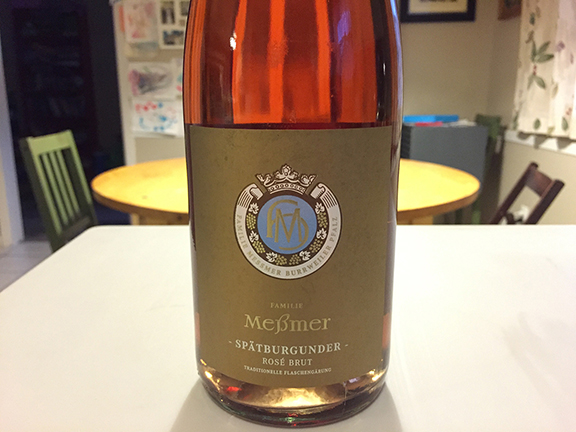
 Our daughters (and their dad) got a crash course in Texas high school football yesterday when we attended the Class 4A Division II state championship, where Tracie P’s alma mater, the West Orange Stark Mustangs (14-1), beat the Celina (pronounced sah-LEE-nah) Bobcats (15-0) at Houston’s NRG stadium (where the pros play) 22-3.
 One thing that really impressed me about the experience was the fans’ ardent loyalty to the teams and the intensity of their cheer.
 The other thing that impressed me was how nice and just downright polite everyone was.
  The photo above was
  The funniest thing happened last week on my way to Boston to have dinner with a good friend and client of mine at
  In my view, the excellent food at Ribelle had all the hallmarks of great Italian cuisine: wholesome, fresh ingredients; artisanal food products; al dente cooking times for the pasta; and the creativity and playfulness that sets contemporary Italian gastronomy apart from the rest on the world stage today.
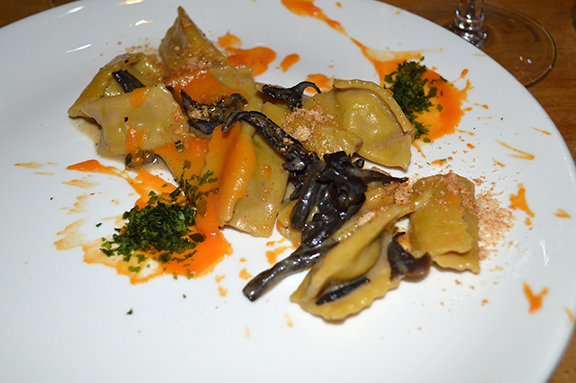 A poet is someone who takes the elements of a language (a finite set of words and meanings) and combines them in a new and unique way.
 The rigatoni, above, with octopus and fennel, were another favorite of mine.
 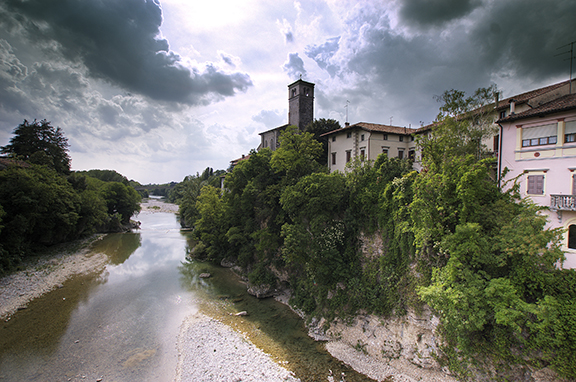 Above: the Natisone river flows through the city of Cividale del Friuli not far from the office of the Consortium of Colli Orientali del Friuli Grape Growers and Winemakers (image via


 Above: vitello tonnato at
 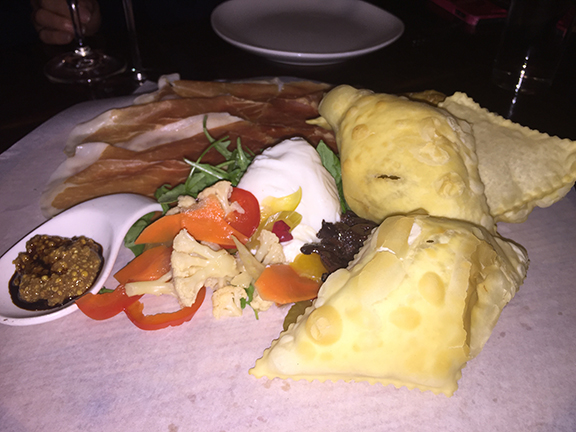 Above: expertly sliced Prosciutto di Parma and gnocco fritto at the excellent Osteria La Spiga in Seattle.
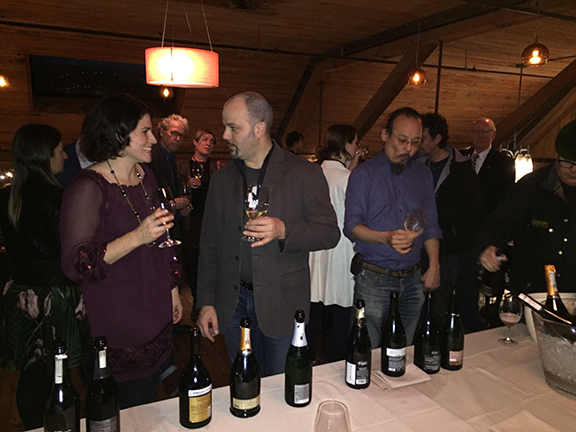 Above: a great turnout for my Franciacorta tasting yesterday evening in Seattle, where wine culture seems to be rivaled only by coffee culture.
