
 Over the weekend on social media, a lot of people asked about the photo above.
It’s a risotto al salto or riso al salto. Literally, it means a flipped or sautéed risotto and basically, it’s what you do with leftover risotto.
On Friday, I had made a risotto alla parmigiana and then on Saturday I made the “flipped” version.
For the risotto alla parmigiana, sauté some finely chopped onion in a broad pan with unsalted butter.
When the onions begin to become translucent, add the desired amount of rice and toast for a few minutes (being sure to stir constantly so that the rice doesn’t burn or stick to the pan).
Then add a few ladlefuls of chicken (or desired) stock and a half glass of white wine. Depending on the saltiness of the stock, add Kosher salt to taste (or not at all; between the stock and the Parmigiano Reggiano, you should have plenty of saltiness already).
Continue adding stock, stirring diligently all the while, until the rice has cooked through, 25-30 minutes depending on the grain.
A few minutes before the dish is ready to serve, fold in generously amounts of freshly grated Parmigiano Reggiano.
For the riso al salto, melt butter in a non-stick frying pan over medium heat and then add the leftover risotto. Gently pat and smooth it out until it’s uniformly round and flat in shape.
Brown the rice for 10 minutes or so and when ready to serve, turn it out of the pan by placing a large dish on top of the pan and flipping it over (I’ve seen professional chefs turn it out of the pan simply by flipping it, like an omelette; but it takes a deft hand for that).
Dust with freshly grated Parmigiano Reggiano.
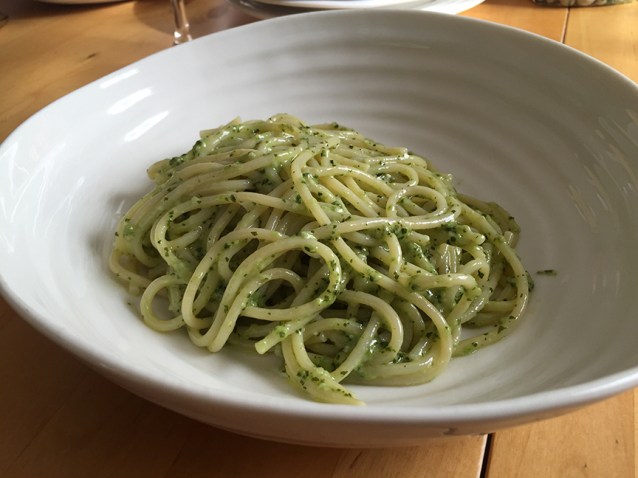
On Saturday night, I also made a pesto (below).
It drew some criticism (and some praise) on social media.
“A me spiaza ma quer li i ni é pistü!” wrote StaticStrat on Instagram. “R’pistü ga le trenete der 7, patate e fazoin!”
“I’m sorry but that there ain’t pesto. Pesto is served over trenette” and “with potatoes and green beans” on the side.
A Texas-based chef also lamented that the pesto-to-pasta ratio was weak.
My pesto is by no means traditional. In fact, I make it with Parmigiano Reggiano and not pecorino. But it’s still delicious, I swear!
Seriously, isn’t that what’s so great about Italian gastronomy? It’s a canon and a blueprint that allows for infinite idiosyncratic variations.
Hoping everyone had a culinarily rewarding weekend and wishing everyone a tasty week ahead. Thanks for being here…

 Above: I’ve followed Lewis Dickson’s wines for many years now. They’ve always been wholesome, food-friendly, and tasty. But they have really come into focus in recent vintages (photo taken in Austin, Texas in 2014).
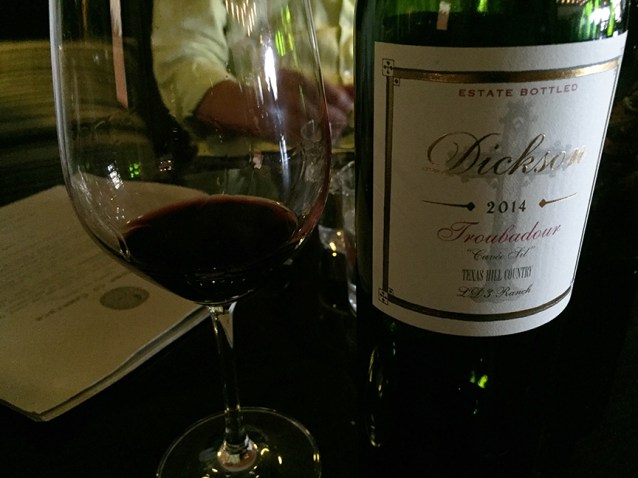 Above: Dickson’s Troubadour is made from 100 percent Black Spanish grapes. No one really knows the variety’s origins. Some believe it was developed in the New World, others contend that it came from France. Most agree that it was widely planted in Texas before the founding of the Republic of Texas in 1836. Its legacy here gives it gravitas as a “Texan” variety. Look it up under “Jacquez” in Wine Grapes (Vouillamoz et alia, Ecco).
 Above: Italian sommelier and critic Davide Oltolini in a photo dated August 2012 (via
  Above: “Chasing the fog” in Montalcino, a digital reproduction of an analog photo by London-based filmmaker
  As many Americans have headed to Italy for a summer vacation, I’ve seen a significant up-tick in views of a post I published last fall,
  I had read about
 Reader John Roenigk of the Austin Wine Merchant writes:
 Happy birthday, Lila Jane, sweet, sweet girl!
 It seems like
  Do Bianchi