
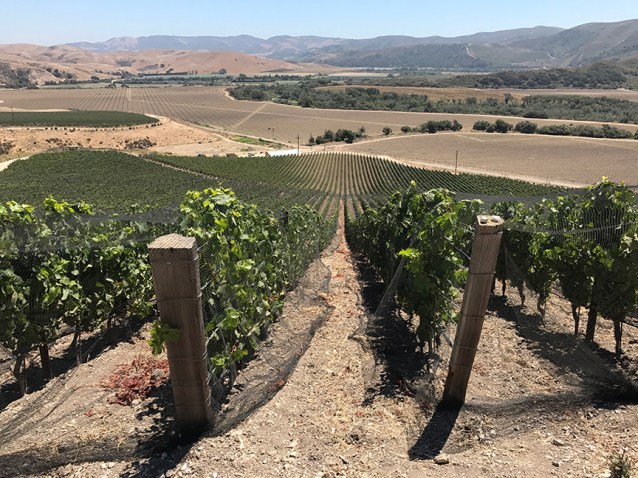
 The bunches in the photo above are from the Stolpman winery’s Angeli vineyard, where the family grows one of its top wines, the Ballard Canyon AVA Syrah (Santa Ynez Valley, Santa Barbara County). I captured that image on Tuesday of this week as I walked through the Stolpman family’s organic, dry-farmed vineyard, where sustainable farming (including sustainable employment practices) is central to this historic winery’s mission and vision.
It’s just one of the vineyards I’ve visited over the last three months this year, between Napa Valley, Sonoma Valley, Sonoma Coast, Russian River, Santa Cruz Mountains, and San Pasqual Valley.
I tasted the 2014 release from the Stolpman family’s Angeli vineyard back in June and it was utterly delicious.
California wine, I was wrong about you. Really wrong. And I’m really sorry about that. I am your native son: please forgive me.
 When the publishers of Slow Food guides, magazines, and books asked me to be the co-ordinating editor of their new guide to the wines of California (to be released in early 2018), I wasn’t sure that we would find enough wineries and wines to fill the pages of the book.
Over the last three months, I’ve tasted hundreds of wines with my fellow editors and toured throughout California wine country — from San Diego where I grew up to Sonoma Coast where I discovered one of my home state’s most beautiful and otherworldly landscapes. Along the way, I found that not only does California produce some of the best wine in the world today but it is also home to a well-established and expanding movement of sustainable farms. And many of those farms and families span generations, like Volker Eisele, one of my favorite finds, in the heart of the Napa Valley, a farm where organic practices have been employed since its inception.
That’s a top growing site for Pinot Noir owned by the Domaine de la Côte in the photo above (taken Tuesday of this week). Check out the altitude reading in my compass screenshot below.
Lompoc in Santa Barbara County, where Domaine de la Côte grows its grapes, was another one of the eye-opening discoveries for me. When I woke up on Wednesday morning in Solvang, about 30 minutes inland from Lompoc, it was so cold that I had to wear a jacket when I went out for a Danish. Fog covered the valley. It was August 8. Today, August 10, the high is predicted to be in the low 80s and the low in the mid-50s. Could you think of better conditions (diurnal shifts) for ripening wine fine grapes? In Lompoc they’re beginning to pick their Pinot Noir this week.
 In California wine country, they love to use the expression as the crow flies when talking about distance in the lay of the land (as opposed to as a human drives). I certainly have a lot of crow to eat: like so many europhile wine writers of my generation, I have been sweepingly dismissive of California wine in my nearly 20 years on the job.
California wine is hot weather wine. California wine is overly oaky, overly concentrated, jammy and overly alcoholic. California wine is about winemaking and not about grape growing. California wine was conceived historically as an exercise in marketing and has little connection to the land and the people who farm it.
All of those chestnuts are true. But they are also countless farmers, wineries, and winemakers that counter those stereotypes. And many of those farms are managed by multiple generations of the same family.
California, thank you for your grapes, thank you for your wines. Thank you for welcoming me back. I could even kiss a Sunset pig, California, now that I’m home.
 One of the most vivid memories from my childhood in San Diego, CA is my cello teacher showing me an autographed headshot of Glen Campbell. The year was 1975 and I was eight years old. And she had performed the night before in the orchestra with his band on the San Diego date of his tour.
  Emilia’s Prosciutto di Parma and Parmigiano Reggiano are counted among the world’s most renowned and most coveted foods. And they are also one of the world’s greatest examples of terroir, the unique confluence of soil and climate that delivers expression of place. No matter how hard they try (and try they do!), no one beyond the southern banks of the Po River can reproduce the delicate, sweet character of Parma’s Prosciutto and the distinct crumbly texture and gently piquant flavor of Parmigiano Reggiano.
 Last night, thanks to cousins Dana and Neil (who graciously treated us to dinner), Tracie P and I finally made it over to Chef Hugo Ortega’s new(ish) restaurant in downtown Houston,
  Infladita de Conejo — rabbit, black tortilla, raisins, almonds, tomato, and refried beans.
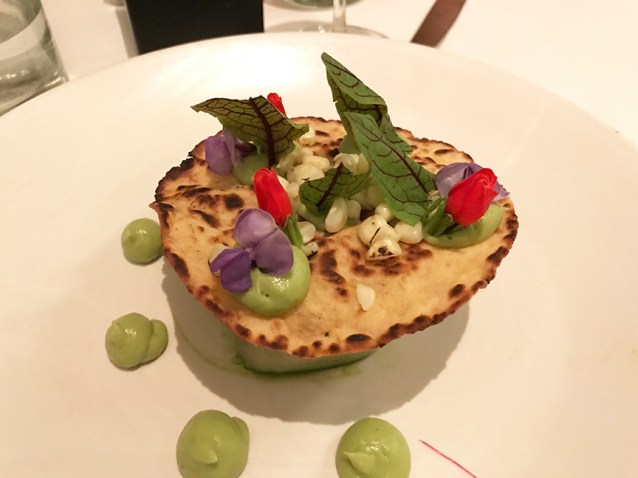 Robalo (sea bass crudo) — aguachile verde (green chile water), cilantro, parsley, lime, orange, avocado, serrano, corn, red onion, cucumber, and plantain tostada.
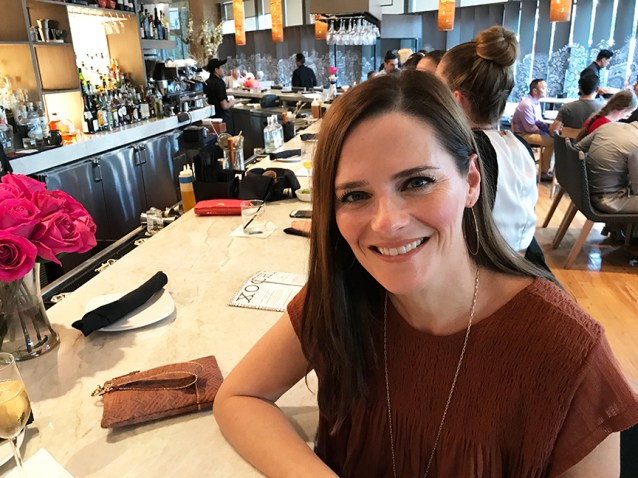 …was having a night out with my beautiful wife.
 Above: some of the labels that Shawn Virene pulled for his VIP debut party last night at Houston’s soon-to-open
  Above: the celebrated 17th-century Italian actor
  Above: image via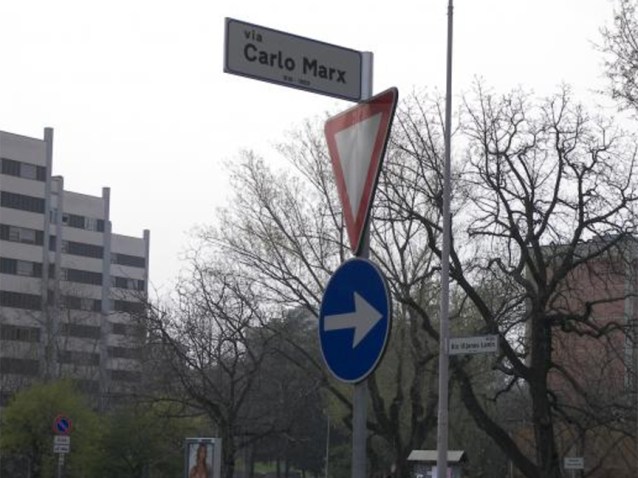
 Before the Parzen family headed to southern California for
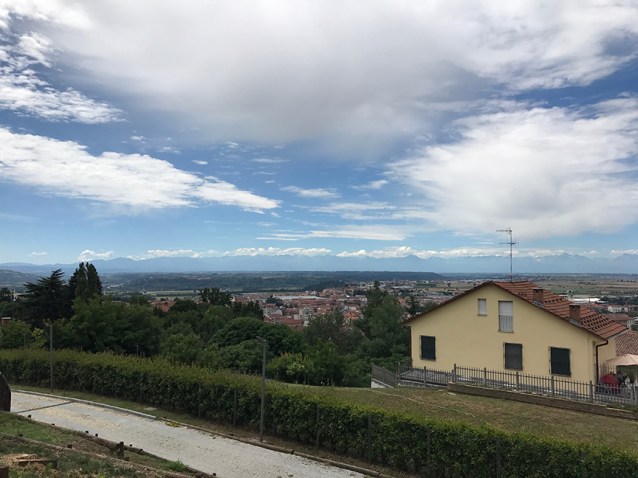
  I know a lot of people are curious about the toponym Bra (and the homonymic jokes are as predictable as they are forgivable).
 There were so many highlights from our summer vacation this year. But I’ll never forget that magical moment of finally being strapped in aboard a plane bound for California. The folks at Southwest were super nice and everyone was super cool about our car seats on the plane (I can’t say that every airline is like that!).
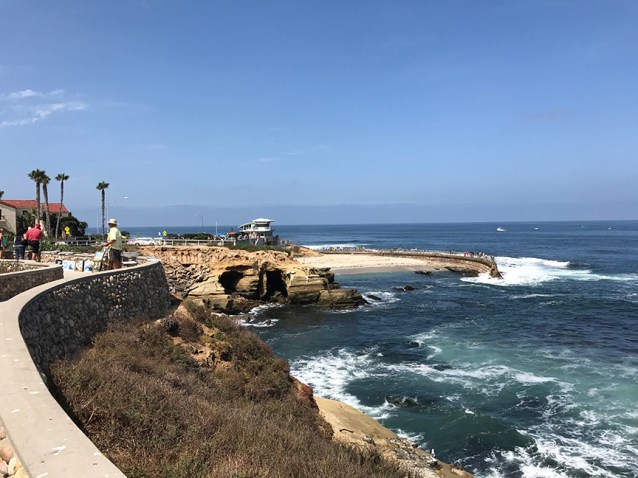 Here’s the view that awaited us on the other side. That’s the La Jolla Children’s Pool (beach), where I used to swim as a kid.
 The Children’s pool has been taken over by the seals in recent years. So I took the girls nearly every morning to search for shells at the nearby La Jolla Cove, where the seals also hang out but still leave enough room for humans.
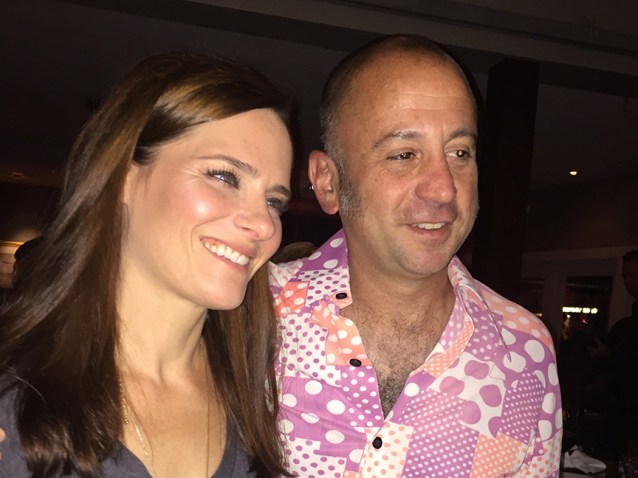 On Friday, July 14, we celebrated my 50th birthday (!!!) with an all-star hometown show at La Jolla’s sole rock club, Beaumont’s.
 For years now, there has been talk of a Lambrusco renaissance in the U.S. And while there have been many valiant attempts to hip Americans to what Lambrusco really is and why it is so great, it’s only in recent years that a confluence of factors — ranging from a new and growing wave of independent importers and distributors in the U.S. to Americans’ expanding and incessant thirst to (re)discover Italian viticulture — has made Lambrusco’s risorgimento possible.
  Do Bianchi
