Sexual harassment in the wine trade: when will the other bottle break?

If you’ve ever studied Italian as a second language, you know that you invariably encounter irregular nouns early on in your class.

In nearly every curriculum, the examples the pedagogues use are the same: amico (friend) is pluralized as amici (and not amichi as the velar-paroxytone model would suggest); greco (Greek) becomes greci; and porco (pig) becomes porci.

It’s only natural that amico would come up frequently in Italian 1 class. The word greco is not as common in rudimentary Italian but it also has a place in introductory Italian language instruction since Greek culture pervaded the fabric of ancient Italy.

But porco? Ask any Italian instructor and she or he will answer similarly and without skipping a beat: gli uomini sono porcimen are pigs (a sentence that incorporates not one but two irregular nouns!).

It’s an aphorism that evidently comes up frequently in Italian colloquialism.

I can only wonder how many times the expression has been uttered in Italy as the American and Italian media has devoted ample coverage to widespread allegations of sexual harassment among U.S. politicians and in the U.S. entertainment, news, and restaurant trades.

Any member of the U.S. wine trade would be hard-pressed to deny that sexual harassment is sadly all too common in the industry.

While I was in Italy teaching earlier this month, many Italians — consumed, like their America counterparts, by this watershed cultural moment — asked me about it. When I got home to my wife Tracie in Texas, we spent a lot of time talking about it over the holiday weekend (the allegations began to circulate before I left but they seemed to explode in their scope and reach while I was gone).

We both remembered myriad episodes of highly inappropriate behavior over the course of our careers in wine.

When I first met Tracie nine years ago, she was a sales rep for Glazer’s in Texas (now Southern Glazer’s, a major American wine distributor). I’ll never forget her telling me about having to sell wine at an adult entertainment venue (an account that was assigned to her by her superiors; she had no voice in the matter). The club’s owner regularly harassed her.

Over the course of our conversations this weekend, she also remembered a ride-with with a particularly aggressive supplier rep who was widely known in the Texas wine community to harass young women (a supplier rep[resentative] is a sales agent for a particular brand or portfolio of wines; a ride-with is typically a day of sales work, when a rep for a local distributor hosts a supplier rep and the supplier rep rides with her or him).

I remembered a 2010 trip to northern Italy with a group of leading sommeliers from across the country. There was one woman among us. During one of our daily bus rides, the conversation became so sexually charged that I insisted that it stop. We rode in silence for the rest of that day.

I also remembered a 2007 dinner in lower Manhattan with a Tuscan winemaker. It was clear to everyone at the table that he was harassing his importer’s publicist. I tried as graciously as I could to separate them. But looking back now, I am filled with regret: I should have told him, however discreetly but firmly, that he had to stop. I feel so bad about that now. I can remember the look of terror in her eyes and her inability to reach out for help.

By the time we went to bed on Saturday night, my mind was swirling with memories of similar episodes: a so-called American wine writer who asked a Neapolitan publicist to take a shower with him (sound familiar?); a celebrity wine writer who literally groped a publicist at a popular Manhattan restaurant in front of the whole table (we all hovered like flies waiting for a windshield on a freeway); a respected old-line wine writer who agreed to take a trip to Italy with a publicist and then expected her to have sexual relations with him (she broke away from the trip on the first day).

And who can forget the immensely popular wine blogger who regularly attacks women wine writers with sexually crude language? Sexual harassment also occurs in the virtual realm of the U.S. wine trade.

Following the revelations about rampant sexual harassment in the U.S. restaurant industry, many high-profile restaurant groups are taking steps to address the issue.

It’s time that wine industry leaders do the same. When is the other bottle going to break?

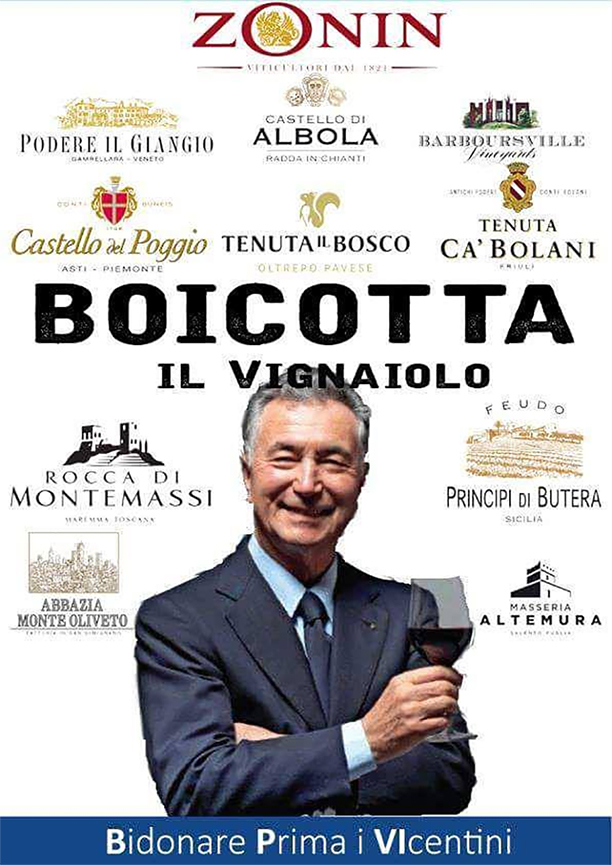
Image created using Wikipedia Creative Commons images here and here.

Taste with me and the magnetic Alicia Lini Tuesday in LA…

The magnetic Alicia Lini (above) and I will be pouring her wines at Rossoblu in downtown LA on Tuesday. Alicia’s one of my best friends in the wine business and her family’s wines are as contagious as she is.

Please join us. I’ll also be pouring in Houston and again in LA week after next.

Happy holidays everyone! I hope to see you and taste something great together before year’s end.

Alicia Lini and Lini Lambrusco at Rossoblu (Los Angeles)
Tuesday, November 28

6:30 p.m.

CLICK HERE FOR MORE INFO AND REGISTRATION DETAILS.

*****

Native Italian Grapes at Mascalzone (Houston)
Monday, December 4

6:00 p.m.

I’ll be pouring 3 wines at Mascalzone where I’ve been writing the wine list since this summer. $35 per person, including (very generous portion) light bites. I’ll also be working the floor that night at the restaurant.

PLEASE CALL (832) 328-5151 TO REGISTER.

*****

Prince Ludovisi and the wines of Fiorano at Rossoblu (Los Angeles)
Thursday, December 7

7:00 p.m.
Featuring a flight of Tenuta Fiorano reds from the 1980s.

CLICK HERE FOR MORE INFO AND REGISTRATION DETAILS.

This event will sell out for sure. Please register to ensure availability. These wines are EXTRAORDINARY, true unicorns!

Thanks for your support. Buona domenica…

Parzen family is thankful for… (Happy Thanksgiving)

The Parzen family has a lot to be thankful for this year.

We’re thankful that our house didn’t flood and we were all safe in Hurricane Harvey.

Thankful that Georgia got into the music magnet school and she is enjoying her violin lessons.

Thankful that Lila Jane is enjoying her last year of preschool as she grows into a “big girl” who loves writing songs, singing, playing “guitar” (ukulele), and dancing.

Thankful that Tracie’s business is expanding and mine continues to thrive.

Thankful that everyone in our extended family is healthy (knock on wood).

But most of all, we are thankful to have each other.

Even as we have faced personal and professional challenges this year, we always know that we can come home to each other and to the loving, wholesome home that we share together in southwest Houston.

Even in the face of our nation’s ongoing political turmoil, the seemingly unstoppable rise of ethnic and religious intolerance in our community, and the continuing decay of civil discourse in our nation, every one of us — Georgia, Lila Jane, Tracie, and daddy — has each other to count on and to love.

It’s been the worst of years, it’s been the best of years. Happy Thanksgiving, everybody. G-d bless and G-d speed in fulfilling your dreams.

Walter Massa’s Italian Grape Ale (IGA)

There’s a first time for everything and one of my firsts this week in Italy was tasting the Birrificio Montegioco Italian Grape Ale, a new category of beer that has come into the spotlight this year.

Known as IGA, after its official designation (Italian Grape Ale), it’s beer that’s been brewed with the addition of grape must.

In the case of the Open Mind IGA, must from Croatina grapes farmed by Piedmont legend Walter Massa is added. Walter is one of a small group of top winemakers who have coalesced around brewmaster Riccardo Franzosi, founder of Montegioco. They also contribute barrels for his cask-aged beers.

I like the Open Mind a lot and you could really taste the grape flavor, which gave the ale a nicely fruity and slightly sweet character.

(Thanks again to the amazing Carlo Fiorani for turning me on to this!)

In other news…

Today, I’ll teach my last wine writing seminar in the 2017 Master’s in Wine Culture at the University of Gastronomic Sciences.

That’s my class above, a great group of bright students.

We covered the history of ampelography from Columella (ancient Rome) and Andrea Bacci (Renaissance Italy) to modern-day writers like Eric Asimov and Alice Feiring and beyond. Along the way, we encountered a lot of what Eric rightly calls “wine anxiety” and we discovered that wine writing may be more about the Greek notion of aletheia or disclosure than the Latin notion of veritas or reality.

The students even coined a neologism: wine haters.

We realized (borrowing from Joseph Conrad) that the only thing we know for certain is that we see through a glass darkly.

All in all, we had a great time together.

Getting back to teaching has been really rewarding for me and I love how the Master’s program gives the instructors ample liberty in covering both practice and theory (like my colleague Armando Castagno who incorporates art history and the history of aesthetics in his wine tasting seminars).

In case you’re interested in learning more about the program, click here for the overview. As of this year, all the courses are taught in English. Enrollment for next year’s session is currently open. Thanks for reading…

I saw salumi’s future and its name is Carlo Fiorani…

Some of you may remember the famous line by John Landau, music critic and later record producer, published in 1974: “I saw rock and roll future and its name is Bruce Springsteen.”

His words sprang to mind yesterday as I left the Cremona province estate owned and managed by the amazing Carlo Fiorani (above) — rancher, farmer, pork butcher, baker, and brewmaster.

Carlo grows his own wheat and makes his own bread.

That’s his classic Pugliese olive bread in the basket above.

He raises his own pigs and makes his own salumi.

Those are his cotechini in his aging room.

He farms his own barley for his line of beers.

That’s his Belgian blonde. “Orzomio” means literally my barley.

His salame, considered one of the best artisanal salamis in Italy today, was as creamy as butter (for real).

Beyond the incredible texture and consistency, I was really impressed by how the flavors were so evenly distributed between the fat and meat.

He prepared a pork loin from one of his pigs and then seared it — without any oil, other type of fat, or salt — in a non-stick pan to show us how flavorful it is.

The pink of the meat was like sashimi in terms of its tenderness. Considering how wholesome his ranching and farming are, you could probably eat his pork raw.

He also sells preserves and eggs from his farm. Here’s his product page.

His entire estate — once a commercial corn farm owned and managed by his parents — is farmed without the use of pesticides or herbicides. No additives are used in any of his products.

Over lunch he shared his interest in Texas BBQ and BBQ in general. We’re already planning his visit to Texas: in the light of his admiration for Texas smokers, he agreed that his first stop in the U.S. has to be in the Lone Star state.

Beyond what an all-around cool and hip guy he is, Carlo has all the right stuff to continue building his brand in Italy and beyond.

Carlo’s also a graduate of the University of Gastronomic Sciences in Piedmont where I’m currently teaching (he was a member of the first graduating class). He speaks English perfectly, he’s actively engaged in social media, and au courant on international food trends etc.

Man, there’s no stopping this dude. And the world will only be better for it… Seek out his products when you’re in Italy next. You’ll thank me.

Thanksgiving wine: I’ll take the (Beaujolais) Morgon over the moron

In the fall of 2012, an older white man in a pick-up truck pulled into the parking lot of the post office in the Austin, Texas-area middle-class neighborhood where my wife Tracie and I used to live with our two young daughters.

In the back window of his cab, he had fastened a bumper sticker that read: “I’ll take the Mormon over the moron.” Taking advantage of his all-American liberty of expression, he was sharing his desire that Mitt Romney win the 2012 presidential election.

Yesterday, I read a Houston Chronicle (the city’s paper of record) account of a Houston-area sheriff who pulled over a Houston-area resident because she had a “Fuck Trump and fuck you for voting for him” bumper sticker affixed to the window of her truck’s cab. He ended up arresting her on an unrelated charge. But, according to the Chronicle report, the woman and her husband — who live not far from where Tracie and I now live in southwest Houston with our children — had already been pulled over more than once by law officers, who were unable to concoct sufficient grounds for arrest.

These parallel though incongruous episodes were on my mind when I woke up this morning to find hate email in my inbox from a Houston Press reader.

In reference to Thanksgiving wine recommendations I published one year ago today on the Houston Press website, Teddy S. wrote me to keep my politics to myself.

It was remarkable to re-read the piece this morning.

If I only knew then what I know now! But that was before the Unite the Right rally in Charlottesville this year, where Trump supporters gathered to chant “Jews will not replace us” and the president responded by noting that there were “some very fine people” among them.

I stand by my wine recommendations and my politics from November 17, 2016 — as I did then, as I do now.

I’d only like to add that (cru) Beaujolais Morgon is a wonderful wine to serve for the holiday as well: I’ll take the Morgon over the moron (available at the Houston Wine Merchant). I’m having the bumper stickers printed as I write this and I should have them in time for the holiday. I just hope my wife, daughters, and I don’t get pulled over by my local sheriff on the way to our family gathering.

“We are witnessing what happens when right-wing politics becomes untethered from morality and religion,” wrote Republican and Christian conservative Michael Gerson, one of President George W. Bush’s former chief speechwriters, in an op-ed yesterday.

A Thanksgiving pairing of morality, religion, and right-wing politics. Now wouldn’t that be something? It would be something else…

Happy holiday, everyone. Politics aside, please drink Sonoma and Napa wines this Thanksgiving to help in wine country’s recovery from the devastating October wildfires.

The unemployment factory and my gainfully employed students at the University of Gastronomic Sciences

Back in my grad school days, my dissertation advisor — the great Milanese poet Luigi Ballerini — used to boast that he would never let our department become a fabbrica dei disoccupati, a factory churning out unemployable graduates.

I can’t convey the thrill last night when I ran into three of my students last night in Bra (in Piedmont, where the University of Gastronomic Sciences is located) and learned that nearly everyone from their graduating class is gainfully employed: from left, Marco at Josetta Saffirio, Filippo at Domenico Clerico, and Valentina at Matteo Correggia (each an iconic winery in its own right).

Just yesterday, I was reading Beppe Severgnini’s New York Times op-ed wherein he reports (not that we didn’t already know) that “youth unemployment is at a record high” in Italy.

To know that nearly all of last year’s matriculated Master’s in Wine Culture students have jobs (they do!) fills my heart with gladness.

In other news…

What a meal last night at Ristorante Battaglino!

That’s the restaurant’s “Carne cruda e salsiccia di Bra,” classic Piedmontese beef tartare and raw veal sausage (the latter, a specialty unique to Bra). Music to the ears of anyone who suffers from Jewish boy stomach (like me).

The food scene in Bra (much more international than you might imagine, btw) would be worth the price of admission alone…

I’m on lunch break this afternoon following a seminar I led on Eric Asimov’s “Tyranny of the Tasting Note.” Now it’s time to dive into the enoblogosphere… Back to the factory I go! Thank you for being here.

Best carbonara recipe and dinner with one of my all-time favorite wine writers…

Last night, I had the immensely good fortune of being a guest in the home of professor Michele Antonio Fino, director of the Master’s in Wine Culture program at the University of Gastronomic Sciences in Piedmont where I’m currently teaching a seminar on wine writing.

But as if my stars hadn’t already aligned, my luck only grew: Armando Castagno, one of my all-time favorite wine writers (and my fellow professor in the Master’s in Wine program), prepared a carbonara (above) for us using pecorino romano that he had brought with him from Rome earlier that day.

Armando is the apotheosis of the Roman intellectual and one of the most entertaining and engaging dinner guests you could ever host. And he is not only an expert in wine (among many other fields) but he is also a foremost authority on Roman cuisine.

As the water was boiling for the rigatoni, the quintessential pasta for this dish (not spaghetti, Armando explained), he patiently whisked the freshly grated pecorino with the eggs until he achieved the desired consistency: he used a 3/1 ratio of yolks to whites (meaning he added two yolks for every whole egg, just to be clear).

He pointed out that he doesn’t salt water because there is sufficient saltiness owed to the cheese and the guanciale (this is extremely important, he insisted).

Before he began cooking the pasta, he sautéed the roughly one-centimeter-thick slices of guanciale in their own fat. When he achieved the desired crispiness, he strained and reserved the liquified fat.

Once he cooked the pasta (employing less than the recommended cooking time and at low heat, he noted), he strained it and returned it to the cooking pot. He then folded the reserved liquified fat from the guanciale into the pasta; added the pecorino-and-egg dressing and the crispy guanciale; and then he sprinkled with more pecorino as he had me grind the black pepper into the dish. After plating the dish, he topped with more sprinkled pecorino before serving.

One of the most important elements of the assembly, he said, was that the pasta shouldn’t be too hot when you add the cheese, eggs, and guanciale. If it’s too hot, the dressing will become lumpy, he explained.

Just feast your eyes on the dish above… and yes, you most definitely should weep. What a carbonara, people!

For the wine pairing, he told us, you need a white with enough body to stand up to the saltiness and fattiness of the dish. He highly approved of Michele’s Van Volxem 2011 Saar Riesling (above).

Beyond Armando’s skill in the kitchen and his extraordinary abilities as taster (one of the greatest tasters I’ve ever interacted with, hands down), the thing that impresses me the most about him is the breadth and the depth of his knowledge in so many fields — from art history and classical Latin to sports (he’s a huge fan of American football) and, of course, food and wine.

To hear him rattle off anagrams (one of his favorite pastimes) was as hilarious as it was exhilarating (Democrazia Cristiana = Azienda Camorristica; On. Giulio Andreotti = un gelido Totò Riina).

So many of the world’s most talented and highest-profile wine writers and tasters can quibble over whole-cluster versus de-stemmed fermentations — an unquestionably noble pursuit, no doubt. But few can parse the nuance of luminosity of color in American modernist painting.

His polymathy is an example for all of us: our knowledge of viticulture is only enriched by its contextualization within the human arts, experience, and condition.

And man, this dude can make a bad-assed carbonara!

I am so proud to call him my fellow in the Master’s in Wine program. He’s all the more reason to enroll.

Armande magister optime ubi major minor cessat. Vale.

From Houston to Roero to Los Angeles and back: taste Italy with me in November & December (includes unicorns)

From the department of “keep your butt moving and your glass full” (attrib. Dr. Frank Butler)…

I’ll be heading out tonight for the town of Bra in Piedmont, Italy, where I’ll be teaching a seminar on wine writing for the Master’s in Wine Culture program at the University of Gastronomic Sciences — the Slow Food university (enrollment for the 2018 session is now open).

If you happen to be in Roero and/or Langa over the next two weeks, drop me a line! The restaurants in Bra are really great and I’m always geeked to have colleagues join me for one of my lectures.

Angelenos and Houstonians, please join me at one or more of the below.

Thanks for your support and please wish me speed! See you on the other side…

Rossoblu (Los Angeles)
Tuesday, November 28

6:30 p.m.
Lambrusco Tasting with Alicia Lini.

CLICK HERE FOR MORE INFO AND REGISTRATION DETAILS.

Mascalzone (Houston)
Monday, December 4

6:00 p.m.
Wine Tasting: Native Italian Grapes.

I’ll be pouring 3 wines at Mascalzone where I’ve been writing the wine list since this summer. $35 per person, including (very generous portion) light bites. I’ll also be working the floor that night at the restaurant.

PLEASE CALL (832) 328-5151 TO REGISTER.

Rossoblu (Los Angeles)
Thursday, December 7

7:00 p.m.
Dinner with Prince Alessandrojacopo Boncompagni Ludovisi
featuring a flight of Tenuta Fiorano reds from the 1980s.

CLICK HERE FOR MORE INFO AND REGISTRATION DETAILS.

This event will sell out for sure. Please register to ensure availability. These wines are EXTRAORDINARY, true unicorns!

Thanks for your support. Buon weekend…

My wine blog’s bigger than your wine blog: title for a seminar next week @UniSG (2018 enrollment open).

Above: my wine writing Master’s class last year at the University of Gastronomic Sciences in Piedmont, Italy. Next week I’ll be teaching both print-media and digital-era wine writing to a new group of Master’s students there. Enrollment in next year’s Master’s Program in Wine Culture, Communication, and Management is now open. Click here to read more. If I were 20 years younger, I’d enroll just to attend the seminars with Armando Castagno, one of my teaching fellows and one of the tasters, wine writers, and wine THINKERS I admire most in the world.

“In the context of wine communications,” writes veteran wine blogger Tom Wark on his blog Fermentation this week, “wine blogs should best be understood as the minor leagues of wine journalism. If you observe the wine blogosphere as a whole, some bloggers are clear standouts and are likely to be assigned a place in the major leagues; given exposure in outlets beyond their blog where more eyes and minds are exposed to their singular voice.”

He’s not denigrating wine bloggers, he notes (he’s a wine blogger himself):

    This may come off as a view that diminishes the importance of wine blogs… [In fact, it] is the most exciting thing about the genre. It always has been. On that occasion when you discover a new, exciting voice that rises above the crowd and delivers a perspective not previously encountered, any keen observer of wine writing and wine communications should be excited or at least highly intrigued.

Tom is a leading member of the American wine community, well respected by his peers and widely read by his colleagues. I like him a lot, I read his blog religiously (one of my favorites), and I look forward to every opportunity I get to interact with him. He’s one of the most intelligent and thoughtful voices in wine writing today. Not only does he have something intriguing and compelling to say but he also says it exceedingly well.

I’m going to be sharing his post with my students next week in one of my seminars for the Master’s program in Wine Culture, Communication, and Management at the University of Gastronomic Sciences in Piedmont, Italy.

But I take issue with the intrinsic (and misguided) hierarchy that he projects on wine writing today. And more specifically, I believe he is wrong that there is an inherent dichotomy between the major leagues and minor leagues of wine writing.

Here and now is not the space or time to get into a discussion of just exactly what constitutes a blog. But I will point out that nearly all the “major leaguers” he cites (including himself, if he puts himself in the privileged category) are also wine bloggers. Master of Wine Jancis Robinson (one of my favorites) is one of the few leading wine writers who still publishes with a print-media outlet (the Financial Times). But most of her writing appears on her tasting note portal and blog JancisRobinson.com. Antonio Galloni (another favorite) may have been a minor leaguer by Tom’s standards when he published Piedmont Report, which he distributed as a PDF. But today, he and his online Vinous.com are considered top resources for wine writing, even though the media is available exclusively in digital format — a web log, updated frequently (the very definition of a blog).

The bottomline is that there is no difference between a blog and a website or a print media outlet today. Print media is dying out. And websites — even the New York Times — are consumed primarily by digital users. That’s a fact that no one can dispute. Does that mean that the Times is a blog? Or does that mean that blogs can’t be associated with former print-media brands? It doesn’t matter anymore…

Tom’s post and his emargination of those writers who don’t make the grade in his binary wine-writing hegemony (and I write this with the greatest respect for his writing) made me think of a wine blogger whom he considers a major leaguer, the HoseMaster of Wine. The title alone of this award-winning and much celebrated blog is as offensive to current sensibilities as is the hateful (however satirical) content it hosts. (My suggestion would be that he change the title to Petroleum Flex Connector of Wine.) A Harvey Winestein of wine blogging (pun intended), H——– frequently attacks other wine writers/bloggers with explicitly sexual and misogynist language (the Donald Trump of wine bloggers?).

Tom’s post also made me think of another spite-fueled wine blogger, On the Wine Trail in Italy, a devoted detractor of the “Instagram generation” of wine writers, as he calls youthful wine-focused social media users and bloggers.

The Lambrusco Twitter troll @LambruscoDay was another writer (blogger/social media user?) that came to mind. He’s the world’s leading expert on Lambrusco (in his mind) and is determined to tell you how little you know about the category, whether you like it or not.

I don’t know if Tom considers the latter two to be major leaguers but all three of these writers have something in common, something key to their whole approach to oenography: you know less about wine than me and I’m going to denigrate you for it.

The parallel I draw between Tom’s hierarchy and the prime motor behind the three bloggers (or micro-blogger in the case of the @LambruscoDay) is borne out of the malignant notion that there is nobility in disparaging those who see the world differently than you. Your major-league aspirations make you better than them and you find purpose in letting the world know you’re better than them.

I agree wholeheartedly with Tom when he writes that we “should understand the Wine Blog as the voice of a single individual.” But I also believe that the voice of every individual deserves our respect and a place in the blogosphere. After all, wine writing and the synesthetic art of describing wine culture is an expression of human subjectivity and idiosyncrasy.

There is no minor or major league in wine writing. Everyone is and deserves to be in a league of their own — just like Tom.

Thanks for reading. Please check out the Master’s program in wine culture at UniSG. Beyond my own seminars, I highly recommend it.