“Slow” awards, the Slow Wine guide’s top prizes now online (and a new urgency in our mission to help wine country)

Yesterday, after a month-long hiatus, we’ve picked up on the Slow Wine California blog where we left off before the northern California wildfires shifted our attention to wine country’s recovery.

Yesterday, we published the 2018 debut guide’s “Slow” awards. Please check out the post and the site.

In the aftermath of the fires, there was no question that it wasn’t appropriate to follow our planned editorial schedule of publishing our editors’ top picks and our producer profiles.

Instead, we decided to focus on relief efforts and how all of us can help in the wine trade’s recovery.

And the bottomline is this: the number-one thing all of us can do — every Californian winemaker I’ve interacted with says exactly the same thing — is to buy California wine.

With every “depletion” (as we call it in the wine trade), retailers and restaurateurs are prompted to re-order the wines. And with their orders, capital flows back to the region. It’s exactly what the industry needs — from farmhand and hospitality worker to vineyard and winery owner.

This devastating natural disaster has given new urgency to our mission as editors of the guide (I’m the coordinating editor and one of the contributors). Initially, we had conceived the guide as a way to raise awareness of the vibrant “slow ethos” that thrives already in California. Today, we hope the guide will become the inspiration for bottles to be purchased and wine country trips to be planned.

Please stay tuned into the Slow wine blog as we publish the final prizes and we begin to publish our producer profiles (next week).

Thanks for reading and clicking. And thanks most of all for drinking California… (Tracie and are currently drinking Bedrock Wine Co. Sauvignon Blanc.).

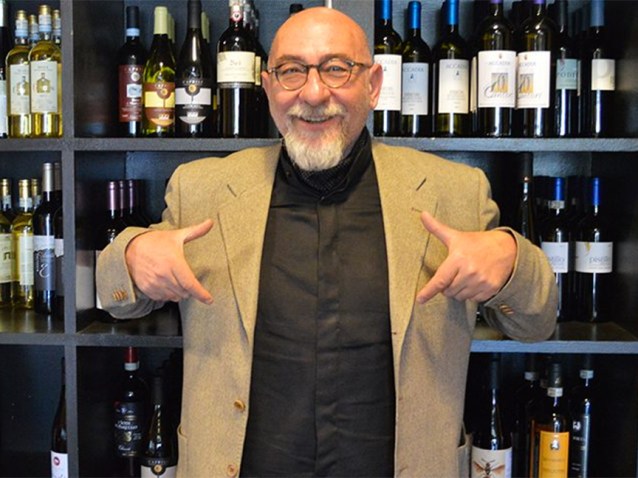
In memoriam: Pietro Cheli (1965-2017)

Photo by Giovanni Arcari.

Who Was Pietro Cheli
by Giacomo Papi
Il Post Libri
November 6, 2017
(translation mine)

At dawn on Monday, November 5, 2017, Pietro Cheli died in his bed as the rain fell over Milan.

“I’m fine,” he had told his wife Alba Solaro shortly before the moment arrived. He may not have realized that it wasn’t true.

He was born in Genoa in 1965. He was 52 years old. He often said he would pass soon. Genoa was his favorite soccer team. He was a cultural journalist, meaning that for his entire life, he had worked in publishing, reading and publishing books, appearing at presentations, speaking on the radio, on television, and editing culture columns at the newspapers where he worked.

First at Il Giornale and La Voce with Indro Montanelli; then at Glamour and Diario with Enrico Deaglio; and finally at Amica where he was the magazine’s deputy editor. He was one of the great “men-machines”: When it came time to close an edition, he had an incredible capacity to edit its pages with a level of concentration and attention that made it appear seamless and almost easy.

He was a voluminous man whose enthusiasms and aversions often overflowed. He was a generous and contrarian man who sometimes used his body — his belly mostly but also his hands — as his own language. He could use it to spark the interest of strangers, intimidate his adversaries, and embrace his friends. Going by appearances, he seemed a man unafraid of the world and a singular voice of culture. In fact, he struggled with his doubts as to whether he should join in or keep his distance.

He hid but also rallied behind the character he had created. His way of hiding was by taking up all available space.

After they met, Luis Sepúlveda put him in one of his books. He called Cheli “a portly detective nicknamed ‘the Brooklyn Bambino’ by the homicide squad.”

Even when he spoke ill or gossiped about some one — as he often did, especially when it came to those he felt had usurped a position of power they didn’t deserve — his perspective was shaped by his disappointment and his amusement at the human comedy. But he never grew angry. He wasn’t ever able to avoid fools and hangers-on because he knew that fools and hangers-on nearly always had stories to share. And I believe it was also because he didn’t want to hurt them.

He was an elegant man (years later, he still laughed about an article that appeared in a Genoa newspaper wherein the author wrote he had “the elegance of a Finollo,” an old men’s store that catered to Genoa’s upper classes). He was a man full of wit. He could lash out but he also knew how to protect.

When he liked someone, he always knew how to identify the perfect anecdote or mannerism to describe him. He would reveal it for everyone to see, whether he intended to screw that person over or make him a legend.

As he lay dead in his room, he was elegant and rotund, surrounded by his books. He was cherubic, like a peacefully slumbering adolescent’s big baby doll.

*****

See this video of Pietro speaking (in Italian) about his recent book I’m A Racist But I’m Trying To Quit.

We’ll miss you dearly, Pietro.

California wine needs us now more than ever before…

As Houstonians, we know all too well that recovery from a natural disaster is long and hard — even after media attention has shifted elsewhere. Please read my post today for the Houston Press, “California Wine Needs Us More Than Ever Before.” I was wrong about California wine and California wine needs me and you more than ever before…

Above: the selection of California wines at the Houston Wine Merchant is excellent, with a wide range of styles and price points. The Signorello winery in Napa was one of the estates destroyed in the northern California wildfires, “the most destructive wildfire in the history of California” according to the Wiki.

Last week, Sonoma resident and leading California wine writer Elaine Brown published “After the Fires” on her blog, one of the most moving posts I’ve read about the aftermath of the deadly California wildfires.

I highly recommend it to you. In it she writes: “Please help the North Coast rebuild in whatever ways you can. Keep buying California wine, especially from Napa, Sonoma, Mendocino, or Lake County, all of which were impacted by these fires. If you ever travel through the region, please consider buying gift certificates for your favorite locally owned businesses so they can get the funds now, and you can enjoy them when you next visit.”

Her call to buy California wine echoes what so many people on the ground in Sonoma and Napa have been writing in their e-blasts and blog posts: nothing helps more than purchasing and consuming California wine.

This week, I made a run to my local wine shop, the Houston Wine Merchant, for a mixed case of California wines. Tracie and I generally drink mostly Italian, some French, and the occasional Californian and Austrian. But last month, as we followed the news from the Golden State (my home state), we turned our focus to the west.

Every bottle that you or I purchase (every “depletion” as we say in the trade) delivers much needed support to the industry — from the vineyard worker to the tasting room staffer to the trucker who hauls the wine eastward. All of those people have been affected by this natural disaster. And that’s not to mention the hospitality workers (wine bars, restaurants, hotels, etc.) and the service employees who reside in Napa and Sonoma.

“I hate to say it,” said Antonio Gianola, one of the senior buyers for the Houston Wine Merchant, “but if you buy the wine directly from the wineries, you’ll help them even more.”

He was referring to the fact that direct sales deliver the best margins for the wineries.

Not all California wineries are registered in Texas and Texas has some of the most restrictive shipping regulations in the country (thank you, Texas wholesaler lobby!). But there is ample availability of great California wine in Houston: please visit Spec’s, the Houston Wine Merchant, and Vinology for nearly every style and price point.

Matthiasson, Ceritas, Bedrock are some of my favorites and they are all available at the Houston Wine Merchant. And if you want to go with a bigger-style California Cabernet Sauvignon, I recommend the Frog’s Leap (also available at the Houston Wine Merchant). I tasted the wine last summer as part of the Slow Wine Guide to the Wines of California tasting panel (I’m the guide’s coordinating editor and Elaine is our senior editor). Our panel awarded the winery one of our “best value” prizes: at around $56 a bottle (compared with $80-120 for similar pedigree and quality), it’s a steal for how good it is (organically farmed, btw).

Wherever you live, I hope you’ll join me tonight and in coming months as I pull a cork and enjoy a wine from northern California.

Thanks for reading and for enjoying Golden State wines. Please check out my post today for the Houston Press.

Taste with me in November and December: Houston, Los Angeles, and Piedmont

Thanks to everyone who came out to see/hear my new band The Go Aways this weekend at 13 Celsius. The response to the gig was so positive and the venue was so pleased that we are definitely planning on doing another show before year’s end. Thanks also to Londale and Golden Cities for making it such a great bill. Stay tuned…

Above: Prince Alessandrojacopo Boncompagni Ludovisi and I will be presenting a flight of his family’s Fiorano wines stretching back to the 1980s on December 7 at Rossoblu in Los Angeles. He’s flying in especially for the occasion. I’m so super geeked about this!

I’ll be pouring and speaking at a number of really cool events this season. Please join me in Houston and/or Los Angeles at one of the following dinners/tastings. And if you happen to be in Langa or Roero in November, I’ll be teaching at the University of Gastronomic Sciences the weeks of November 13 and 20. Shoot me a line and let’s connect and taste.

Mascalzone (Houston)
Monday, November 6

6:00 p.m.
Wine Tasting: Native Italian Grapes

I’ll be pouring 3 wines at Mascalzone where I’ve been writing the wine list since this summer. $35 per person, including light bites. I’ll also be working the floor that night at the restaurant. Call (832) 328-5151.

Rossoblu (Los Angeles)
Tuesday, November 28

6:30 p.m.
Lambrusco Tasting with Alicia Lini

The magnetic Alicia Lini is one of my best friends in the wine business and we love her wines at Rossoblu, where Christine Veys and I have been writing the wine list since the restaurant opened in the spring. $35 per person, including light bites. Registration hasn’t opened yet but please save the date.

Rossoblu (Los Angeles)
Thursday, December 7

7:00 p.m.
Dinner with Prince Alessandrojacopo Boncompagni Ludovisi
featuring a flight of Tenuta Fiorano reds from the 1980s

I’m so thrilled about this event: I’ve only had the opportunity to taste the Prince’s uncle’s red wines from the 1980s on one other occasion (thanks to a group of very generous collectors in New York). When I saw that he was making some of the wines available (directly from his cellar), I jumped at the chance to share them with our guests at Rossoblu. $195 per person, including a tasting menu created especially by Chef Steve Samson. Registration hasn’t opened yet but please save the date.

Rock out with me, Gwendolyn, and The Go Aways this Sunday in Houston!

On Sunday, October 29, my new band The Go Aways will be playing its first real show at 13 Celsius, one of my favorite wine bars in my adoptive city.

We play one set at 5 p.m. Two other Houston-based bands, Londale and Golden Cities, follow.

The Go Aways came together earlier this year when I met the new food editor at the Houston Press, Gwendolyn Knapp, a widely celebrated author of non-fiction, including the memoir After a While You Just Get Used to It: A Tale of Family Clutter. As the weekly rag’s unofficial wine writer, I made a point of greeting our new fearless leader, who moved to Houston to take the position, by taking her out for a glass of wine (go figure!).

Over conversation, she mentioned that she was also a songwriter. That led to a jam session where I discovered that she has a truly unique and utterly compelling songwriting and guitar-playing style. It didn’t take long before we decided to start a band and make a record based on her songbook (in my home studio). The Americana-psychedelic-country tracks are often dark and darkly humorous. And they all rock. We hope to release our debut album by Christmas of this year.

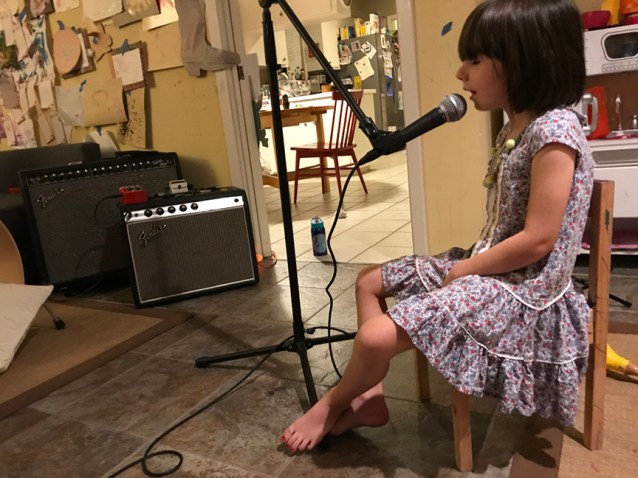
In the meantime, Gwendolyn’s become a great friend to me and to the family and our girls, ages 4 and 5, always look forward to our sessions and her songs.

We also have a couple of Christmas songs that we’re working on. I can’t wait to share them.

In another time in my life, music was a central focus for me. And in certain periods when I was much younger, it was even the way that I made a living. Performing for live audiences and hearing my songs on radio, TV, and in films has always been one of the most rewarding experiences in my life. I miss it a lot and I’m so glad to be playing and recording with someone whose music I dig so much. And I’m so glad to have found a bandmate in Gwendolyn, who is as simpatica and kind as she is talented.

Please come and check us out this Sunday, Oct. 29 at 13 Celsius, where the wine will be flowing and the tunes jamming.

Hope to see you there! Rock on!

“Consumers deserve safe access to great retailers over state borders,” writes Eric Asimov for NY Times

Above: Master of Wine Ashley Hausman Vaughters (left) greets New York Times wine critic Eric Asimov at the Boulder Burgundy Festival in mid-October.

It’s an issue and cause dear to my heart: the death-grip hold that American wine wholesalers employ (and enjoy) as they continue to stifle interstate retail sales of wine in the U.S.

I call it a “death grip” because it’s killing wine culture among young people across our nation. I’ve traveled from coast to coast over the last three years, visiting not just major markets but also budding wine communities in fly-over country and beyond. Again and again, I’ve met young wine professionals who are thirsty and eager to taste iconic Italian wines that they simply cannot get in their home cities. As the wholesale lobby has continued to tighten its grip on interstate retail sales, young sommeliers are increasingly forced to travel to other markets to taste wines otherwise unavailable to them.

It’s unfair, it’s anti-competitive (anti-capitalist) it’s un-American, and it’s downright pig-headed: not only does it hurt U.S. consumers who simply can’t buy the wines that they want, it’s putting a generation of future wine professionals and restaurateurs at a disadvantage.

I’m a wine buyer in California (where I write two lists) and Texas (where I write one). Over and over again, I see wines that are available to me and to consumers in California that are not available to me and my fellow consumers here in Texas (and in some cases, vice versa). And it’s thanks to efforts of the powerful wholesaler lobby. As farty old white men are getting rich in Texas and Florida (the states where some of the worst offenders make their home), American wine lovers are being denied a fundamental right that other Americans take for granted (it’s called the “Interstate Commerce Act”).

As New York Times wine critic Eric Asimov put it in his column this week for the paper: “In an age where you can order just about anything on the internet, including wine, consumers deserve safe access to great retailers over state borders.”

Eric writes:

    For a golden moment, motivated wine lovers could rely on high-speed internet as a sort of national wine shop. A consumer in Little Rock, Ark., for example, unable to find particular bottles locally, could order them from a shop in New York. It required only a willingness to pay shipping costs.
    Those days are no more. In the last year or so, carriers like United Parcel Service and FedEx have told retailers that they will no longer accept out-of-state shipments of alcoholic beverages unless they are bound for one of 14 states (along with Washington, D.C.) that explicitly permit such interstate commerce…
    But now, states — urged on by wine and spirits wholesalers who oppose any sort of interstate alcohol commerce that bypasses them — have stepped up enforcement efforts. Retailers say that the carriers began sending out letters to them a year ago saying they would no longer handle their shipments.

Please read Eric’s excellent piece for the Times.

And for some background and perspective, see this post by blogger and industry observer Tom Wark, who has written for years about this un-American, anti-competitive, monopolistic lobby.

California wine country wildfire updates @ Slow Wine (Slow Food). And please don’t forget the cannabis growers…

Yesterday, we posted an update on the California wine country wildfires over on the Slow Wine California blog, where I served as the coordinating editor of the guide and contributing editor to the site (image via Vino Girl’s Instagram).

We had been planning to continue publishing the 2018 debut guide prizes this month. But we took a break in order to shift coverage to the developing and ongoing crisis in northern California.

I highly recommend reading Eric Asimov’s piece “Wildfires Spared the Vineyards, but the Wines Could Suffer.” And please be sure to check out Alder Yarrow’s post on how to help with relief efforts, “Helping Northern California Wine Country After the Fires.” (“Undocumented immigrants are not eligible for federal disaster relief,” wrote Alder. “That’s why UndocuFund exists.”)

The fire may be mostly contained. But the human crisis continues. And that includes human and financial challenges for cannabis growers as well.

I visited a biodynamic cannabis farm in Sonoma earlier this year (images above and below): just as growers were investing heavily in their farms in preparation for the launch of recreational cannabis in California on January 1, their nascent industry had been literally decimated by the wildfires. Because cannabis is still considered to be illegal by the federal government, growers and other entrepreneurs are not eligible for federal aid.

It seems that states rights only matter to conservative Christians when it comes to putting down blacks and Mexicans and restricting reproductive rights and access to health services. States rights don’t matter much to them when it comes to the cultivation of one of G-d’s creations — a plant that occurs naturally — and its medicinal and recreational applications. Most conservative Christians are okay with wine (which doesn’t occur naturally). But cannabis? It’s the devil’s lettuce.

I was glad to see this excellent piece published by Washington Post (#AmazonWashingtonPost #fakenews!), “Wildfires scorched marijuana crops, possibly complicating California’s rollout of legal sales.”

And although I was surprised not to see more coverage on the excellent blog The Cannabist, the editors were among the first to repost this article by AP, “At least 31 legal cannabis farms have been destroyed in the California fires.”

What a year 2017 has been… Now, more than ever, all voting-age Americans need to look deep into their souls and reflect on what kind of country and legacy they want to leave for their (and our) children. Thanks for reading and clicking.

Rossoblu makes TOP 10 list in Jonathan Gold’s 101 Best Restaurants (Los Angeles Times)

“The tortelloni, stuffed with the traditional mixture of ricotta and chard,” wrote LA Times food critic in his review of Rossoblu, “could illustrate the concept of Italian dumplings in a textbook.” I took the above photo last week when I was at the restaurant to lead a vertical tasting of Nebbiolo stretching back to 1996.

It was back in New York in the late 1990s when my friend from college Steve Samson (we met on our junior year abroad in Italy) first talked to me about his dream to open a fine-dining restaurant devoted to the cuisine of Emilia-Romagna, where his mother was born. By the early 2000s, when I was just a few years into my wine writing career, he was already talking about the wine list he wanted me to create for it.

We used to call it “the Dream.”

I couldn’t be more thrilled to share the news: late last night, the Los Angeles Times published “Jonathan Gold’s 101 Best Restaurants,” including Steve’s Emilia-Romagna-themed Rossoblu, which landed in the top 10 (at number 10). I’ve been co-authoring the wine list there with my colleague Christine Veys since the restaurant opened this spring and I couldn’t be more proud to be part of such a great team of restaurant professionals.

Seeing Rossoblu up there with restaurants like Spago and Providence (one of my all-time favorites) was like a childhood fantasy come true.

And as proud as I am of the wine program that we’ve created there, the credit goes solely, wholly, and rightly to Chef Steve and his wife Dina, who have always stayed true to the vision that they had for this superbly unique restaurant.

Over the arc of my career in the wine and restaurant trade, I’ve been involved with many high-profile restaurant openings. A restaurant launch is always stressful, chaotic, and unpredictable. The only thing you can count on is that you can’t count on anything when it comes to opening the doors of a multi-million dollar venue.

But the thing that keeps it together is a shared vision and staying true to that vision. None of this would have been possible if it weren’t for the son of schmatta-industry drop-out from Brooklyn who studied medicine in Italy and a wonderful home cook and loving mamma from Bologna.

Mazel tov and congratulations, Steve and Dina. I couldn’t be more honored to be a part of it. Thank you for bringing me along for the ride. I love you guys. Well done and well deserved!

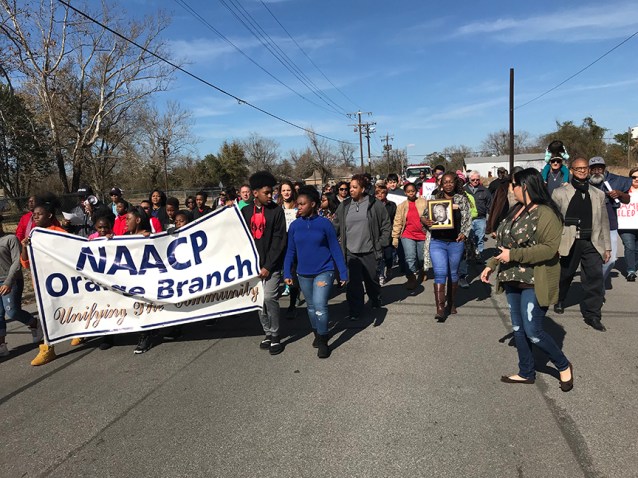
LA Times coverage of the Confederate memorial in Orange, Texas

Last night, someone texted me asking about the Los Angeles Times article “As monuments to the Confederacy are removed from public squares, new ones are quietly being erected,” which was published yesterday in the paper and appears today on the homepage of its website.

As the title reveals, the piece examines communities in the U.S. where new Confederate monuments are currently being erected, even as the controversy over the removal of memorials — mostly from the 1910s and 1920s — continues to rivet the nation.

The centerpiece of the story is the Confederate Memorial of the Wind in Orange Texas, where my wife Tracie grew up and where most of her family still resides. Over the nearly nine years that I’ve lived in Texas, I’ve visited Orange countless times. I took the above photo of the memorial in November of last year, not long after the presidential election.

Anecdotally, I can tell you that most Orange residents (at least among those I interact with) just shrug about it when asked. When I’ve brought it up, nearly everyone concedes that it’s an unfortunate eyesore. But everyone I’ve talked to points out that there’s nothing that can be done about it because it sits on private land. I’ve never met anyone in Orange who has spoken out against it publicly or done anything to have it removed.

The men behind the memorial claim that it’s a homage to their heritage as descendants of Confederate soldiers. I don’t know any of them personally but they have spoken with a number of media outlets (including, and even before, the Times coverage).

Their narrative may be partly genuine. But after nine years in Texas and nearly 10 months into the Trump presidency, I can tell you that these men know exactly what they are doing. They know full well the fear that their memorial instills in the blacks, Mexicans, Asians, Jews (like me), and Middle Easterners that live or pass through Orange. As the author of the article points out, the memorial is “visible from the interstate and loom[s] over Martin Luther King Jr. Drive.” What she doesn’t note is the fact that a church stands just down the road from it.

The overwhelming majority of people who live in Orange are self-defined Christian conservatives. Regardless of denomination, churches in the South have had a far-reaching legacy of complacency when it comes to the intimidation of minorities through the display of symbols, icons, language, and gestures. The Confederate flag is the most recognizable of these but there are many others. I used to ascribe it to ignorance. But with the advent of Trump, I’ve come to realize that it’s not stupidity. In fact, the people who live there are not stupid at all. The majority of residents in Orange have embraced Trump despite his lack of Christian values — from his assaults on women to his abusive attitude toward people who aren’t white.

With his claims that there plenty of “nice people” among the champions of Confederate memorials, Trump has laid to bare not just their complacence but their willful acceptance of a segregationist ideology whose advocates use hateful symbols to intimidate and stoke fear. The residents of Orange can ruefully shrug and say there’s nothing they can do about it. But in Trump America, it’s now painfully and tragically obvious that their interests align with the authors of the memorial.

Today, too many conversations there start with “I’m not a racist but…” or “I have no problem with the Jews but…” It simply doesn’t matter to them that blacks may have a problem with the memorial or that Jews may have a problem with the memorial. Why should it? That’s not what’s important — at least to them — in Trump America. But then again, Christ and His teachings were swiftly tossed aside by those who support Trump. The common good (as espoused by Christ’s disciples, at least in the Book I’ve read) is trumped by the good that the president is doing for our country (at least for the white people in our country). Trump supporters can’t claim ignorance anymore. They know exactly what they are doing.

The deep-seated racism that thrives there is on the rise again, just like the flags being flown over Interstate 10. And evidently, the Christians who live there are okay with that.

In fairness to the residents of Orange, I have to point out that the author of the Times piece was wrong to mock, however subtly, the city’s motto — “Small town charm, world class culture.” As hard as some may find it believe, there is world-class culture there. The Stark family campus of museum collections and botanical gardens are wonderful cultural resources. When I worked as a bibliographer at the Getty Museum (nearly two decades before I met Tracie), I catalogued scores and scores of photographs of painted Medieval and Renaissance painted books that are conserved in the museum there.

I wonder if I might bump into the authors of the Confederate Memorial of the Wind the next time I visit. Wouldn’t that be something?

Don’t cry for me Nebbiolo. The truth is I never left you…

The California wine country fires affect everyone in our industry. Please read my post today for the Slow Wine California blog.

Burgundy may be my mistress.

But Langa will always be my signora.

Last weekend, I attended the Boulder Burgundy Festival, where I not only have I served as the gathering’s official blogger for last four years but I also get to taste and drink far above my pay grade. It was a remarkable experience. Possibly the best event yet.

But as much as I loved sitting across from Bobby Stuckey as we tasted through a spectacular six-wine flight of Chambolle-Musigny, with Raj Parr and Eric Asimov leading us on our journey from the red soils at the bottom of the côte to the white soils at the top (what a seminar!), my mind and my heart always find their way back to Nebbiolo.

Last night I led a tasting of seven of my favorite expressions of Nebbiolo for 24 guests at Rossoblu, the new downtown Los Angeles Italian where my college buddy Steve Samson is chef and owner and where my colleague Christine Veys and I have been writing the wine program since it opened this spring.

We were joined by Cesare Barbero, director of one of my favorite wineries, the Barbaresco cooperative Pertinace — one of the unsung heroes of the appellation.

The flight: 13 Barbaresco, 12 Barbaresco Marcarini, 12 Barbaresco Nervo, 98 Barbaresco, 98 Barbaresco Nervo, 96 Barbaresco, and 96 Barbaresco Nervo.

My top wine of the night was the 98 (classic) Barbaresco, which we paired with the first white truffles of the season to arrive in LA (they were literally flown in the day before). What a flight of wines, what a dinner, and what at night!

Thank you to everyone who came out to support this event: our first wine dinner in the restaurant’s newly christened wine room. And thank you to the spot-on staff at Rossoblu for the seamless service and the beautifully polished stemware.

On Thursday, December 7, the restaurant and I will be hosting Prince Ludovisi (Fiorano) for a dinner and tasting of red wines made by his uncle in the 1980s. The Prince is flying in especially for the occasion and the wines are coming from the family’s personal grotto (they don’t have a cellar; they keep their wines in an ancient Roman cave). I hope you can join us (registration isn’t open yet for this event but if you’d like to reserve one of the 18 seats available, please shoot me an email so I can hold your spots for you).

Thanks, everyone, for your support. It means the world to me.

Please don’t forget our sisters and brothers in California wine country.