Sex in the vineyard: polyculture is the key to the future, says Aleš Kristančič of Movia.

Anyone who’s ever spent a significant time around the legendary grape grower and winemaker Aleš Cristančič (above) knows that he loves to talk about sex and sexuality. (I’ll never forget the time my band played a crazy wild gig at his winery, Movia, below. But that’s another story for another time.)

To some who know him only peripherally, it may seem like a cliché, not uncommon among European and American men of a certain age. But over the years of our interactions, it’s become clear to me that his obsession with sexuality is not just an expression of attenuated or hyperactive masculinity. No, Aleš has plenty of manliness and sexual confidence to go around, even beyond his sensual discourse.

When we spoke a few weeks ago, we discussed his reflections on polyculture vs. monoculture and how he is working to bolster and foster polyculture on his family’s estate in innovative and immensely thoughtful ways.

On my last trip to Italy before the lockdowns in January 2020, my visit and tasting at Movia prompted a powerfully compelling discussion of how the rise in monoculture has begun to homogenize winemaking, even at the highest levels of production.

It’s a conversation that was presaged not so many years ago in an article by Slow Food founder and essayist Carlo Petrini where he bemoaned Piedmontese growers who are grubbing up less lucrative, lesser known grape varieties and replanting their vineyards entirely to more bankable Nebbiolo.

Although they haven’t yet published on the topic, Melissa Muller, a chef turned winemaker, and her husband Fabio Sireci, a legacy grower at Feudo Montoni in Sicily, shared with me a study on their successful experimentations with polyculture, conducted over many years. It’s a work in fieri they explained. But gauging from their preliminary survey, it’s not hard to imagine that many winemakers will read it eagerly.

I recently caught up with Aleš by phone and asked him to expand on some of the observations he shared with me in 2020. That call resulted in a wonderful, if somewhat chaotic, interview published last week by my client Ethica Wines, his U.S. importer.

In our chat, he makes a really profound point about clonal selections. Nurseries may provide you with a genetically perfect clone. But where, he asks, did that clone come from originally? It’s not the result of massal selection in his vineyards, he explains. And so it’s lacking some of the local genetic information that vines acquire through massal selection and decades of growing in the same place. This means that grape farmers around the world are increasingly using the same clones and as a result they are promoting homogeneity and monoculture with adverse effects on the wines’ quality.

He also talks at length about what he calls “passion” in the vineyards. He’s referring to pollination and how the vines and other plants compete for sexual fulfillment. That tension, he believes, especially when well managed through polyculture, is key to creating wines that speak of place, of terroir to borrow a cliché. When stronger clones are introduced to a vineyard with old vines, they tend to hoard the pollen and as a result pollination isn’t equally distributed, as it were. That results in uneven ripening and diminished quality, he contends.

There are some real gems in this wild and crazy piece and I highly recommend it to you. Thanks for checking it out.

Please consider giving to Unicef’s Ukraine child refugee fund. This link takes you straight to the donation page.

Natural wine in Palm Springs? Yes, it’s true and it’s wonderful.

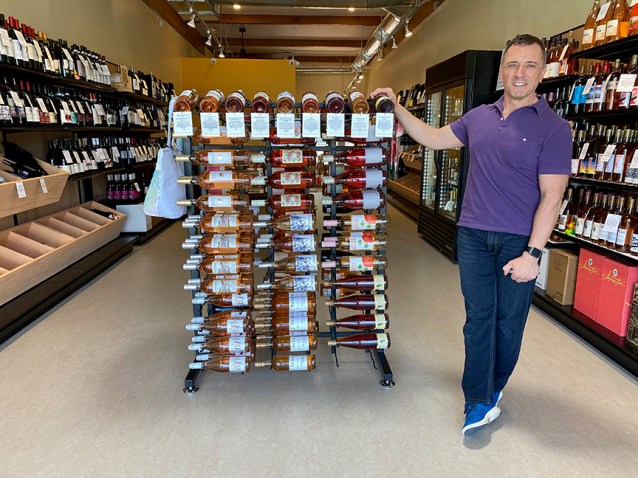
Just had to give a shout-out this week to John Libonati (above) and his awesome natural-focused wine shop Hyphen- in Palm Springs. Yes, Palm Springs!

For a lot of folks who grew up in southern California like me, Palm Springs was often a destination for visiting relatives, family get-togethers, and long weekends just a few hours away from home.

But in my adult years, those get-aways always meant bring your own wine because you’re not going to find much there. Let’s face it: beyond Sherman’s Deli, Palm Springs is not exactly known as a fomo food destination.

That’s all changed now that John, a lovely man from a storied New York restaurant family, has launched his shop. Organic is the baseline, he told me when we visited earlier this week. He wants to get his clients to get out of their “Rombauer” mind set. And it’s working.

Yesterday, during a visit with a hipster colleague in San Diego, news of natural wine in the desert was met with glee.

“I’m going there this weekend!” he exclaimed. “Where is this place?”

He was pleased to know that you’ll find it right on California State Route 111 as you drive into town.

John ran restaurants and night clubs in the city roughly around my same years in New York. It was so much fun to reminisce about some of the characters and players from that now lost era when cool bands still played at CBGB. Natural wine began to become a thing around that time as well.

It’s great to see John spreading the good word to the Golf Capital of the World. Be sure to check his shop out when you visit. You’ll thank me.

Humankind’s best friend? Saccharomyces cerevisiae. A guest post by Davide Camoni.

Please consider giving to Unicef’s Ukraine child refugee fund. This link takes you straight to the donation page.

Guest post by Davide Camoni.

Do you know who humankind’s best friend is?

Think about it for a minute before answering.

It’s a living being.

That’s right, it’s saccharomyces cerevisiae.

It’s a hundred times as small as a strand of hair. Humankind has been using it for 5,000 years. It helps us to make beer, wine, bread, cakes, and sake. It’s used in bioethanol production. It works in symbiosis with lactic bacteria as a sourdough starter for pizza, Pugliese bread, pan de San Francisco, and a thousand other uses. When it’s activated in a fruit solution, like prunes or peaches, it’s a key ingredient in kefir. And when it’s ingested on its own, it could solve world hunger because it’s so high in nutrients. It contains all of the known vitamins. When it’s dehydrated, it helps to flavor soup as a substitute for monosodium glutamate (and bouillon cubes).

It puts billions of people to work, including the undersigned.

Here it is in a photo (above) that I managed to take this morning, enlarged roughly 10,000 times.

Davide Camoni

Davide is the laboratory director at Enoconsulting in Villa Pedergnano (Franciacorta) where some of the world’s most famous wines are tested. Translation mine.

Forget Steiner! Read Crescenzi from the 13th century. Biodynamics’ ancient origins.

Please consider giving to Unicef’s Ukraine child refugee fund. This link takes you straight to the donation page.

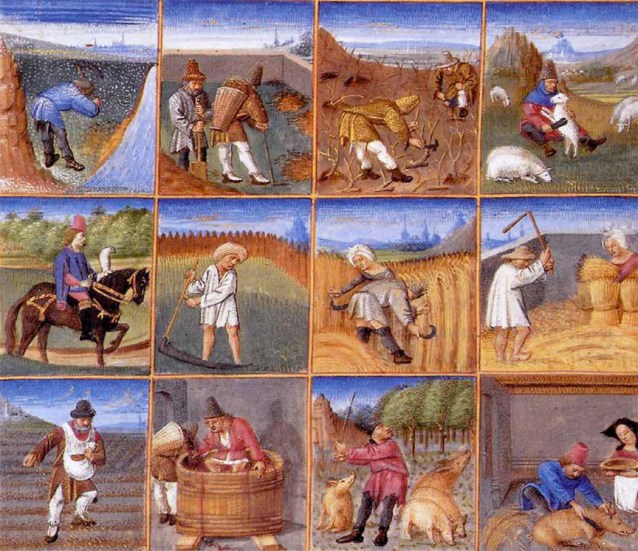
Above: an agricultural calendar from a “painted book” (circa 1309) of Pietro de Crescenzi’s treatise on farming, possibly executed in his lifetime. There numerous extant 13th and 14th century manuscripts of his book Ruralia Commoda and translations of his work became instant best sellers in the 15th and 16th centuries in Europe. Note the October panel where the figure is crushing grapes. Image via Wikipedia.
As Nietzsche famously wrote in the Twilight of the Idols (1889), the philologist must look beyond the “sacred texts.”

In today’s world of wine, the spiritually focused writings of early-20th century critical theorist Rudolf Steiner have become one of those pillars — a sacred text — of our shared “constitution of knowledge.”

But if we look beyond his writings on agriculture (which represent a small part of his critical output; just think of his many titles devoted to Christ), it doesn’t take long to realize that he was merely repackaging knowledge and know-how that had been around for a long, long time.

In my recent close reading of the 13th century Bolognese jurist and agronomist Pietro de Crescenzi, whose Ruralia Commoda was an ante litteram best seller from the time of its first circulation in the late 1200s to the height of the Italian Renaissance and beyond, I’ve discovered some important antecedents for our current understanding of biodynamics.

The most striking of these is Crescenzi’s detailed instructions on how to follow the lunar calendar for planting, sowing, and winemaking.

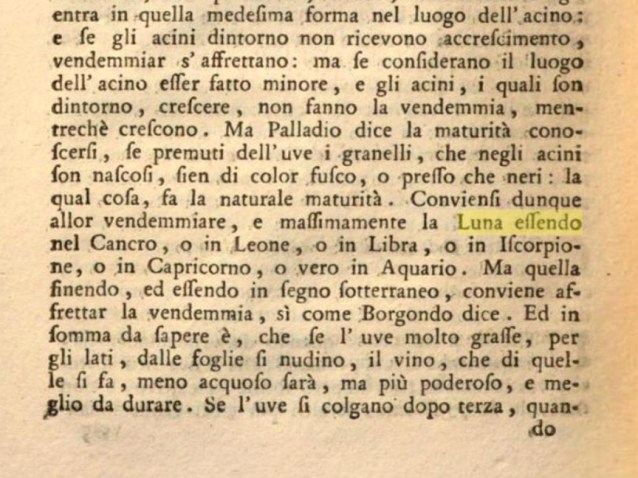
Above: a folio from a 1784 Italian translation of the Ruralia. The work’s popularity only began to wane in the modern era.
Among the descriptions of lunar cycles and the best moments to carry out work in the fields, some of the most compelling recommendations are in reference to winemaking and more specifically in reference to obtaining the highest quality in wine.

In the passage highlighted in the image immediately above, he explains the exact, ideal moment in the lunar cycle to pick. Wines made from grapes picked at the right time will be less “watery,” more “powerful” (alcoholic), and better for aging.

Wow, sound vaguely familiar? The language is different. But the concept, based on observations made during Crescenzi’s constant and extensive travels throughout Italy, is the same.

Crescenzi’s work would ultimately be neglected as farmers in the modern age began to abandon what had come to be considered outdated observational agricultural science. By the 1930s, an effort by Italian agricultural historians to revive interest in his opus would ultimately fail.

But isn’t it incredible to think that today thoughtful and highly informed people are growing grapes and making wine according to the same practices that Crescenzi prescribed in the 13th century?

Forget Steiner, let’s read Crescenzi! And when we’re done reading the Bolognese jurist, let’s reach back even further and browse the Γεωπονικά.

Week after next, I’ll be pitching a translation and critical apparatus of Crescenzi’s book on viticulture to an academic publisher. So whatever you do — poo, poo, poo! — don’t wish me luck! Seriously, thanks for being here and thanks for reading. See the Unicef link at the beginning of this post.

Thank you Gambero Rosso for the “best contemporary wine list” award.

It meant a lot to me when my longtime friend and colleague Lorenzo Ruggeri, international editor for Gambero Rosso, wrote earlier this week to let me know that my wine list at Roma in Houston was awarded the Villa Sandi Best Contemporary Wine List.
It’s an award that they give to the best Italian-focused wine lists in the cities where the Gambero Rosso tour takes place (their tasting was held yesterday in Houston at Minute Maid Park).

Over the course of more than two years, I ran virtual wine dinners for the restaurant and ultimately became its wine director. I had previously been its media manager. But when the pandemic began, I started hosting its virtual events. That led to me taking over the wine program last year.

But despite nearly five years that I had put in at the restaurant, it all ended abruptly after the owner hired a new chef. So the award, while greatly cherished, is bittersweet.

In any case, it’s great to know that the work I did there was recognized by my peers and colleagues.

Thank you Lorenzo for the shout-out and the kind words!

How Tracie and I became “Chardonnay” drinkers.

Please consider giving to Unicef’s Ukraine child refugee fund. This link takes you straight to the donation page. G-d bless our Ukrainian sisters and brothers. Thank you.

Back in the late aughts following the big bang of the enoblogosphere, there was probably no word more maligned, no term more associated with the wine establishment as “Chardonnay.”
“Oaky, buttery, California Chardonnay.” It spoke to everything we nouvelle vague wine lovers despised about the wine world hegemony.

And as Tracie and I began to date, Chardonnay avoidance with dramatic flair — à la “Sideways” — was a bona fide whereby you established your cool.

Yes, we were amenable to the grape variety if it showed up in the form of a racy blanc de blancs pas dosé or a hitherto unknown but acceptably “acidity-driven” Chablis. But the mere mention of the apelonym was enough to make you heave… well… maybe not heave but wince.

So how is that our most recent online, curbside mix-and-match order from the Houston Wine Merchant was literally replete with Chardonnay? California Chardonnay and French Chardonnay! Egads!

One of the key moments in my own personal Chardonnay sea change was my repeated visits in pre-pandemic years to northern California wine country where the opportunity to taste a broader spectrum of Chardonnay entirely reshaped my perception of the category. By my September 2019 trip for the Slow Wine guide, my third for the imprint, I had discovered so many expressions of Chardonnay that we both loved. From Santa Ynez to west Sonoma coast, there were myriad winemakers — many of them négociants — that had never found their way into our glass along our überhipster wine route.

It wasn’t that there was a “new California” that even the Times touted at the time. In fact, there was plenty of great California Chardonnay to go around. But it hadn’t been “marketed” to our emerging demographic of Gen X, would-be enlightened wine lovers.

By missed-opportunity marketing, I don’t mean that those winemakers had failed us. No, they had not, by any means. As I discovered, many of them were happily selling their entire production to their lists and to a tuned-in clientele who had appreciated the stuff for more than a generation.

The truth is we had failed them by letting them be eclipsed by the new subversive media- and social media-driven wine culture. Subversion was good. And a lot of cool stemmed from it. But it was also deeply myopic in certain fundamental instances like l’affaire Chardonnay.

Another seismic shift was also happening: we were becoming more experienced wine drinkers. As we strived for many years to birth our “cool palates,” we began to realize that a great lacuna had formed in our wine tastes. And ten years into that arc, we became aware of that gap because we had started to taste some of the great expressions of Chardonnay with more finely honed tasting chops.
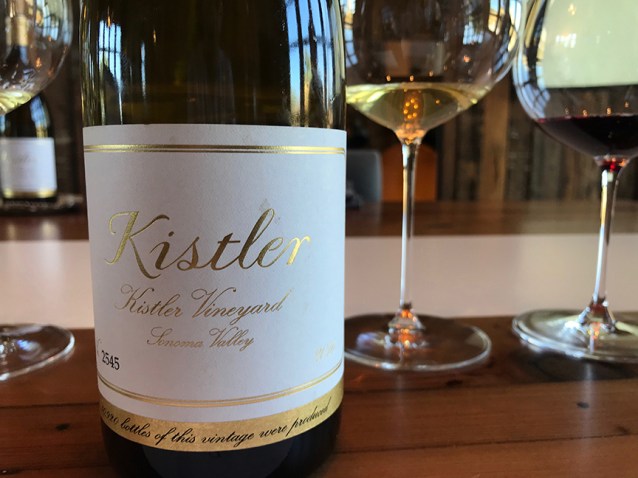
And you know what? We discovered that we loved the wines.

There were also other factors that guided the shift toward the most coveted of candid grape varieties.

We stopped being drawn to the palate-bracing acidity of some of the wines that came out the the in search of balance movement (yeah, you know what and whom I’m talking about). At the time it seemed that the winemakers were overcompensating for the “okay buttery” (and attenuated acidity) paradigm.

Another thing that has really influenced our wine buying habits has been the release of an overwhelming number of Bourgogne blanc from top producers. At our end of the Passover Seder this year, we’ll be drinking current release 2015 Bourgogne, “white Burgundy wine,” from De Montille. It’s friggin’ delicious, people. And I imagine that Étienne (yeah, you know whom I’m talking about) reclassified this lot. Gauging from the wine, you would think that he had more lofty aspirations for it.

His Bourgogne blanc is just one of the many marquee houses that are now releasing rivers of appellation-wide designate wines (i.e., “Bourgogne”).

The current lineup in our cellar is Au Bon Climat, Boillot, De Montille, and a Mâcon from Thévenet.

Dear Chardonnay, it took us a long time to make it, but we got here as quick as we could. And we’ve been loving every minute of it.

The “monstrous paradox”: Vini Veri manifesto calls out a lack of technical ability in natural wine production today.

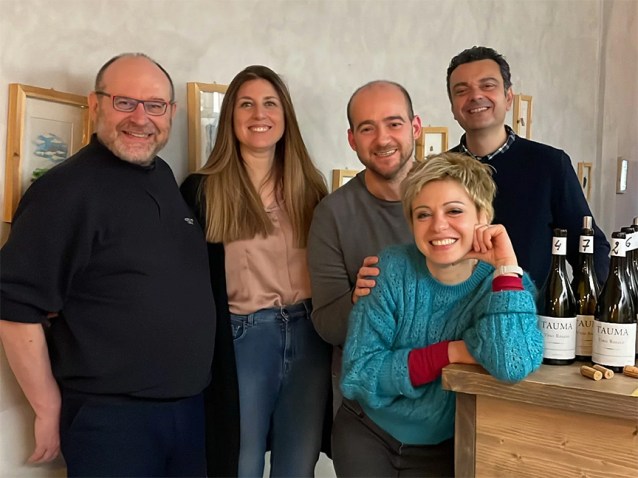
Above, far left: Sandro Sangiorgi, one of the authors of the recently published Vini Veri manifesto that squarely criticizes a new wave of natural producers who consider “technical ability an obstacle” to making their wines. A top wine writer and taster, Sangiorgi is widely considered one of Italy’s leading experts on and advocates for natural wine (image via the Porthos website).
Last week, during the Vini Veri natural wine fair in Cerea, Italy, the organizers released a new manifesto signed and presumably penned by wine writer, educator, and leading Italian taster Sandro Sangiorgi, “La forma e la sostanza, le luci e le ombre” (“Shape, substance, light, and shadow”).

In this short essay (roughly 350 words), the signatories Sangiorgi and Paolo Vodopivec, the current president of Vini Veri, criticize producers of natural wine who “consider technical ability an obstacle” to making great wine. “It’s as if [they believe that] the less one knows, the better the outcome.”

“Many producers have become perilously accustomed to technical imperfections,” they opine:

    some more grave than others, as the winemakers consider them venial sins or, even worse, characteristics of their wines and even of their colleagues’ wines. I sensed this would happen but I tried as carefully as possible not to believe it. This comes on the heels of the monstrous misunderstanding of conventional wineries that have issued appeals to underline the need for chemicals and biotechnology to call fermented grape must “wine.” Now we are shifting to a monstrous paradox of those who consider technical ability an obstacle to making aromatic liquid. It’s as if the less one knows, the better the outcome. (Translation mine.)

This “laxity” has led to the release of “undrinkable liquids” (“liquidi imbevibili” in the original).

The authors go on to encourage producers “not to fall into the trap of genuineness being the only criterion for quality.”

Besides learning how to make and age wines, they write in closing, it is important for natural winemakers to “learn how to taste so that they can develop a sense of beauty that elevates but does not compromise their efforts.”

The manifesto was published in its entirety by both WineNews.it and GamberoRosso.it. While Wine News generally tends to avoid controversy, the editors of the Gambero Rosso have been highly critical of the natural wine movement.

The wine bar of our dreams in Sonoma: Valley Bar and Bottle.

Please consider giving to Unicef’s Ukraine child refugee fund. This link takes you straight to the donation page. G-d bless our Ukrainian sisters and brothers. Thank you.

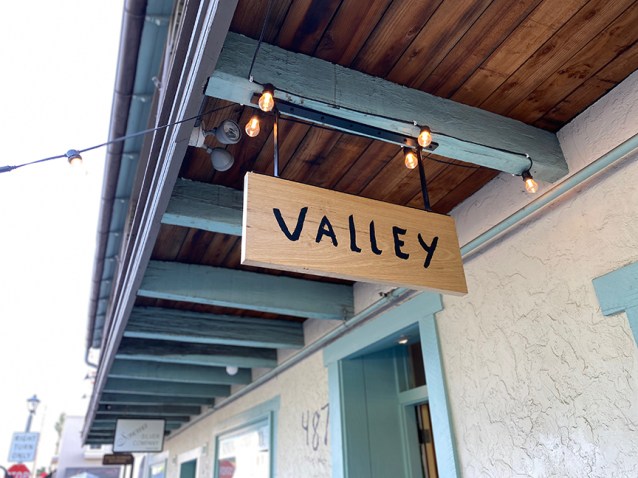
The sun shone through the trees on an unusually warm Sonoma valley early evening as kids played in the park and tourists milled about the shops and tasting rooms.
And it felt like a dream as I walked through the threshold of Valley Bar and Bottle in downtown Sonoma right on the main square.

Continue reading

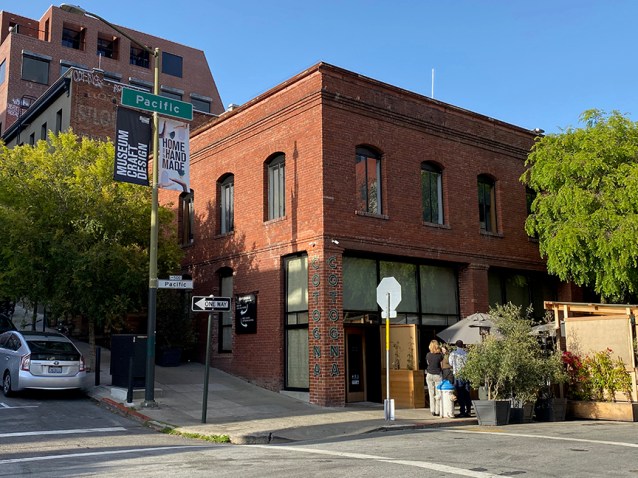
Where homage to tradition is transcendent: Cotogna in San Francisco, one of my best meals this year.

Wines for Peace: Brunello Consortium auction benefitting Ukraine, Monday, April 11, at Vinitaly. Click here to learn more.

Since the late 1980s, Italian cuisine in the U.S. has been shaped by a tension between traditional- and creative-leaning forces.
Remember the wave of “northern Italian cuisine” that came around in the Reagan years? “Sunday gravy” was out and polenta was in.

The problem was that culinary interpreters often didn’t see these dishes in historical or cultural context. The rich meat- and jus-driven sauces we ate as kids in this country were a derivative of haute Neapolitan cuisine (vis-à-vis Ippolito Cavalcanti).

Polenta, on the other hand, so popular “rustic” and “peasant” (ugh, I can’t stomach that term) movements of the late 1990s, was a dish that many older people in Italy refused to eat at the time because it reminded them of a time when there wasn’t enough to eat (the 19th-century pellagra crisis in Italy was caused in part because polenta had become a staple for economically marginalized families; in the years following WWII, many older Italians in the north will tell you, polenta was all they had to eat).

Making my way over to Cotogna from my hotel in San Francisco the other night, I couldn’t help but remember a chilly winter evening in the late 80s when I stopped a man on the street and asked him if he knew the way to a certain “trattoria,” a name for pseudo-Italian restaurants that had become popular in the second half of the decade.
He did, he responded, but he would only tell me — and I’m not kidding about this — if I pronounced it correctly.

It wasn’t traht-toh-REE-ah, as I had enunciated it. It was traht-TOH-ree’ah, with the emphasis on the second syllable, not the second to last.

It kinda says it all, right there.

In my view and experience, the greatest Italian restaurants in the U.S. have always found a precarious however brilliant balance between the traditional and creative. And my meal at Cotogna was a fantastic example of how respectful homage to tradition can be transcendent.

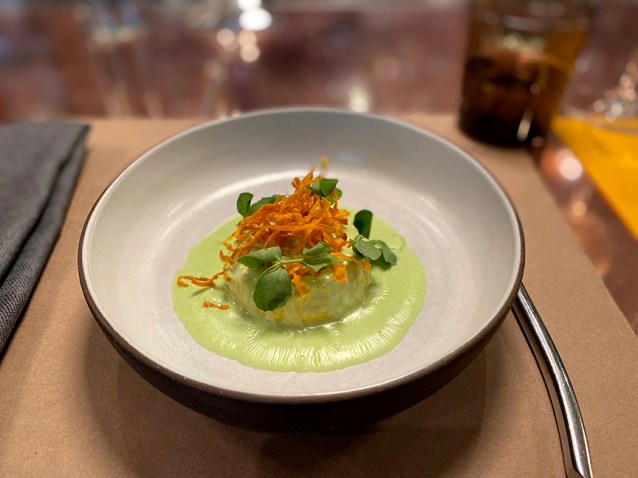
The carrot sformato (first photo) blew me away with its ethereal texture and subtle dance of bold but elegant flavors. Sformato — properly called a savory custard in English — is all about the texture. It should be firm but light, rich but buoyant. I know already from my Instagram that people agree with me: this dish was nothing short of show-stopping. I loved it.
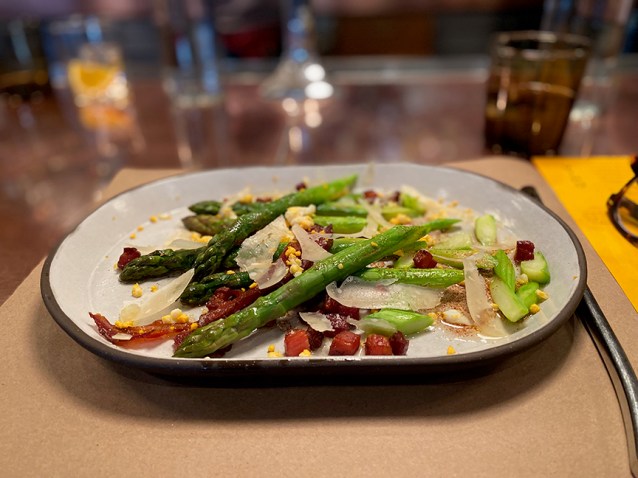
The asparagus alla fiorentina (second photo) brought to mind trips to San Francisco with my parents when I was a child in the 70s. They would slurp coffee as they inhaled “eggs Florentine” at a swank hotel restaurant on Union Square.

This truly Florentine-inspired dish sang out to me. The flavor — the bontà or goodness as we say in Italian — of the materia prima was nothing short of spectacular. And I loved the play in texture — again, texture! — between the lardons and American-style bacon (which btw is extremely popular in Italy today).

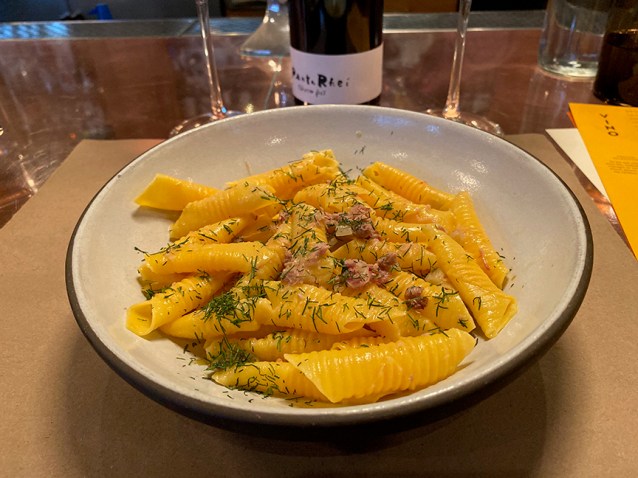
The finale, garganelli with rabbit, also played on its balance of textures and subtle flavors. I loved that the rabbit was ground, not stringy, and the richly flavored pasta was the focus of this dish, not the rabbit. I couldn’t agree or have enjoyed it more.

Paired with the delicious, spicy Ruché Panta Rhei by Valdisole (thank you, Ceri Smith!), this dish became the synecdoche for the entire dinner. For a generation who grew up complaining that there wasn’t enough sauce on the soggy over-cooked and rinsed pasta, it made me feel like we might finally have adolesced.

Thank you wine director Joseph Di Grigoli and team for taking such good care of me. Your work is as inspiring as it is delicious.