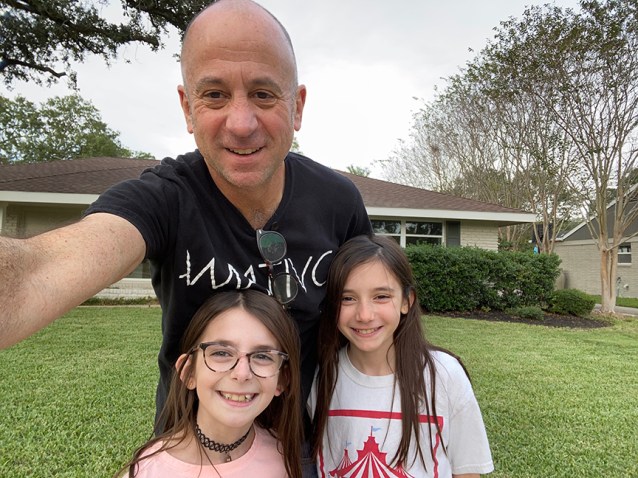
Taste Italian with me in Houston November 29 and 30.

Please join me on November 29 and 30 in Houston for a tasting of wines from Sicily, Calabria, and Abruzzo. It’s an Italy-America Chamber of Commerce gig and should be a fun time. Vinology (one of my favorite Houston wine bars) and Caracol (me and Tracie’s go-to anniversary and birthday destination, one of our favorite restaurants) are hosting. I’m sure some more bottles will be opened after each event. Hope to see you then and thank you for your support! Details follow.

On Tuesday and Wednesday, November 29-30 in Houston, the Italy-America Chamber of Commerce South Central is proud to present two wine tastings featuring three Italian producers: Cantine Bruni (Calabria), Isula di Pantelleria (Sicily), and Citra (Abruzzo).

The seminars will take place at Vinology on Tuesday, November 29, 5:30-7:30 p.m.; and Caracol on Wednesday, November 30, 5:30-7:30 p.m.

The events are open to qualified trade and food and wine-focused media members. Seating is limited and is available on a first-come-first-served basis.

Click here to sign up for the Tuesday, November 29 event at Vinology.

Click here to sign up for the Wednesday, November 30 event at Caracol.

Constrained growing cycles create unforeseen issues in Burgundy. But for families who have been growing there for centuries, it’s just another day’s work.

Thanks to everyone who came out this year to make the Boulder Burgundy Festival 2022 such a great event!

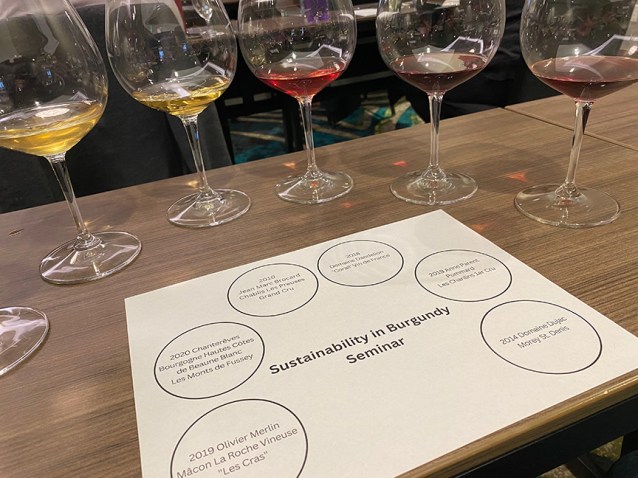
And special thanks to the gathering’s featured educators this year, Elaine Brown and Esther Mobley, who led a fantastic seminar and tasting devoted to sustainability in Burgundy today.

Click here to see a Facebook album from the event (photos by me, the festival’s official blogger and media consultant, a gig I’ve been doing for more than a decade now).

This year’s Sunday seminar, which featured producers Simon Colin and Pierrick Bouley, was partly a continuation of the Friday morning talk that Esther and Elaine gave.

One of the most interesting elements that emerged was discussion of the constrained/shortened growing cycles that growers like Simon and Pierrick (both are the current generation of historic Burgundian families) have to face as climate change accelerates.

“These vineyards have been around for more than 1,000 years,” noted the 20-something Simon, whose family is one of Burgundy’s most famous. “We are only around for 30 or 40 years of that time. And like the generations before us, we have to face different problems,” like more frequent late spring frosts and warmer summer temperatures.

Pierrick made some of the most compelling comments when he discussed the issue of the contracted vegetative cycle.

As Elaine pointed out, warmer summer temperatures mean that ripening is accelerated in the final months of the grapes’ development. And that is reshaping the tasting profile for the wines. This is ultimately a worldwide phenomenon that is impacting grape growing across Europe.

But Pierrick’s insight, the fruit of timeless generational knowledge and experience, revealed something that might not be immediately apparent to the layperson.

When late season warm temperature shorten the cycle, making for, say, an 11-month as opposed to a 12-month cycle, that means that the next growing cycle is actually expanded.

When his family would start picking in September each year, said Pierrick, the cycle would more or less follow the 12-month calendar. But when they pick as early as mid-August, like they often have had to do in recent vintages, that gives the vines an extra month of dormancy. His family has begun to address the issue by experimenting with early winter pruning. But the new normal, as it were, is radically changing the way growers like him approach their work in the vineyard.

In other words, yes, the earlier picking times — something most are aware of — are changing the way the wines taste. But the accelerated start to the vegetative cycle is having a profound effect as well. Especially when it comes to the more frequent arrival of spring frost, the now syncopated timing becomes more and more delicate.

From an educational standpoint, it was one of the best festivals to date. And the wines by Simon (Chassagne) and Pierrick (Volnay) were exceptional. And of course, the brio — lubricated by great wines and food and wonderful people — was joyfully unbridled.

If you’ve never come up to experience the gathering, I hope we’ll get to see you next year! What a great ride! Same time, next year.

Every year I have to pinch myself: the thrill of getting to be part of an event like this, with wines that clock in WAY above my pay grade, has never lost its sheen.

My heartfelt thanks goes out to my good friend Brett Zimmerman, owner of the Boulder Wine Merchant and founder of the festival, who invites me back each year. I’m truly blessed to have a friend and colleague like him.

Thanks also to the amazing Heather Dwight, owner of Calluna event planning in Boulder, for the seamless execution over the long weekend of eating, drinking, and education.

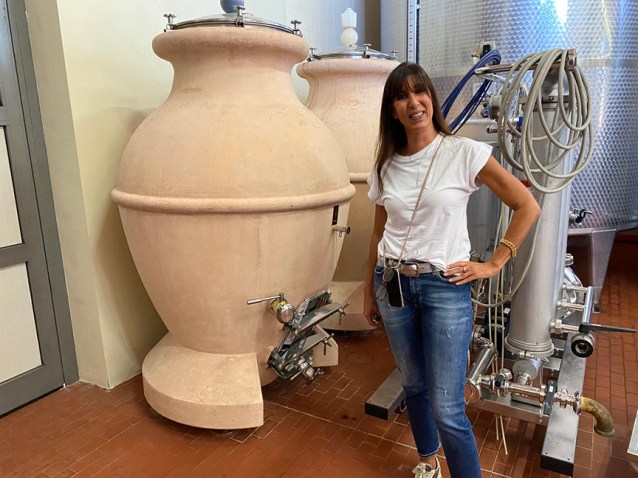
The new wave of amphora is cocciopesto. Where did I find it? In Abruzzo, of course.

When I finally found my way to the Nicodemi winery in Colline Teramane in Abruzzo in September, I cautiously descended the steep driveway in my rented 500L to discover a paradise revealed behind the bushes that obscured the view from the road.
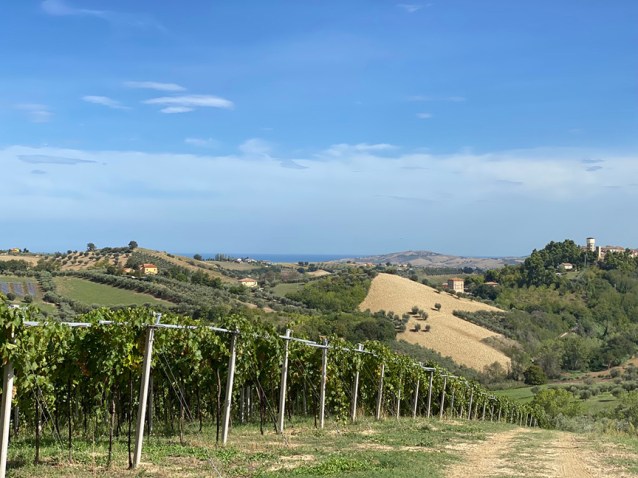
For those who have traveled for wine, it’s rare to come upon some place as breathtaking as this.

I was reminded of something Tracie once wrote on her blog: if I were a grape I would want to grow here.

As you can see in the photo above, in the Colline Teramane, the vineyards are literally located a stone’s throw from the Adriatic. It’s where some of the region’s best wines are raised.
It’s one of the magical things about Abruzzo in general: you’re close enough to the sea to reap the benefits of maritime influence (great ventilation, wider diurnal shifts, and cooler temperatures during summer); But thanks to the rapid rise in elevation as you head inland, you’re just far enough away to avoid the excessive early morning humidity that could cause mildew or rot.

The beauty and viticultural significance of the Colline Teramane were no surprise to me, of course.
And it should have come as no surprise that Elena Nicodemi (who is super cool btw) would introduce me to a new type of amphora that she and her brother have been using to make one of their top wines.

The material used to make these winemaking vessels is not the classic terracotta used by most potters. Instead, cocciopesto is used. Students of Roman architecture and interior design will recognize cocciopesto as opus signium, a material made of recycled tiles mixed with silt and mortar. If you’ve ever visited the Vatican, you’ve walked over cocciopesto floors.

From what I’ve been able to read online about these amphoras, their walls are actually more dense and less porous than their conventional terracotta counterparts. As a result, the process of micro-oxygenation is made even slower. This can make for wines that are even richer and more focused in aroma and flavor.

Some producers have found find that even during early usage, cocciopesto amphoras don’t impart any of its own “flavor” to the wines (some believe that brand new or newly used terracotta amphoras can impart their own flavor to the wine, although there doesn’t seem to be much consensus on this).

Potter Drunk Turtle first released its cocciopesto amphoras back in 2016. But this was the first time that I had seen one in use.

My visit with Elena was my last during my September harvest trip to Italy. As I wrote previously, it was another example of how everything I thought I knew about Abruzzo was wrong. Gloriously wrong.

Elena’s wines are superb and I highly recommend them to you. Especially her new Trebbiano Cocciopesto.

But more than anything else, I highly encourage you to go visit winemakers in Abruzzo. In each of my three visits, I learned something new and tasted compelling wines that thrilled and surprised me. I hope to get back there soon. Thanks for letting me share my journey with you here.

Same time, next year: meet me in Boulder this weekend for Boulder Burgundy Festival. Elaine Brown, Esther Mobley, and Carlin Karr are featured speakers.

Festival founder Brett Zimmerman presents one of the marquee dinners at last year’s Boulder Burgundy Festival at Steakhouse Number 316 in Boulder. The wines, the food, and the people at all of the festival’s events are as compelling as they are welcoming and inspiring.

I dunno, but I always feel a little guilty when I say goodbye to Tracie, the girls, and the Chihuahuas when I get on the plane for my “long weekend” of work at the Boulder Burgundy Festival each year.

I mean, it really sucks to leave your family for a three-day weekend and head to one of the most beautiful valleys in all of north American for tastings and dinners featuring some of the best and most expensive wines in the world.

It sucks even more when you consider that my gig is Italian wine. I mean, what am I thinking? Hanging out with a bunch of French wine lovers and French winemakers?

It’s a really tough job but someone has to do it. Seriously…

Please join me this weekend for the Boulder Burgundy Festival where I have been the event’s official blogger and media consultant for more than a decade (I must be doing something right if they keep inviting me back each year!).

This year, we’re looking forward to hosting Elaine Brown (whom you all already know), Esther Mobley (another wine writer celeb who needs no introduction when it comes to the wine intelligentsia of which you, reader, are undoubtedly a member), and Carlin Karr, who, beyond being one of the nicest and most brilliant people I have ever met in the wine trade, is one of the top-five wine buyers in the country today.

The only bummer is that Tracie will not be there this year. That’s because we have some big news to share soon and she needs to be here in Houston. And no, it’s not that she’s having another Parzen baby. No, no, no, it’s not that. But it’s big and it’s good (stay tuned for that).

The Paulée lunch sold out as soon as it hit the internets. But there are a few spots left for the dinners and grand tasting (Burgundy geeks and certification seekers: the Sunday walk-around is probably the best value available in the U.S. in terms of being able to taste through a wide field of Burgundy including some of the most out-of-reach stuff; just be sure to get there early!). And I ask you to keep in mind that Boulder Burgundy Festival is a non-profit whose proceeds all go to local and national charities.

I hope you will join us and I’m looking forward to tasting some exceptional wines with some exceptional people and some of the best food in the U.S. Thank you Brett and Boulder Wine Merchant for making me a part of it each year!

What’s the difference between pergola and tendone? The answer may be the key to viticulture in the age of climate change.

The notion that tendone and pergola training systems could represent one of the grand solutions for winemakers facing the wrathful challenges of climate change was first suggested to me many years ago by the writer, publisher, and in-demand vineyard manager Maurizio Gily.

The topic came up following a call he had received from a winery in Texas asking him to consult on a new vineyard planting. The ancient training technique, which can trace its origins to bronze-era trellising used by the Etruscans, could be ideal, he said, for protecting the plants and their fruit from extreme weather events including severe storms and late-spring frosts (while high temperatures are a major problem for Texas wine growers, it’s the late-spring frosts — remember the 2021 freeze? — that can cause a farmer to lose their entire crop).

But there’s a bigger element in play, I learned recently when Chiara Ciavolich, legacy grower at her family’s farm in Abruzzo, took me on a tour of her estate together with her longtime vineyard manager Guerino Pescara.

The first question they answered was what’s the difference between pergola and tendone training?

Where pergola is a patchwork of small square structures that support the vines, tendone is a continuous and seamless series of pergolas, as it were. (To better get a sense of the system, keep in mind that a tendone in Italian means big tent.)

And here’s where that difference, a seemingly small divergence but actually extremely impactful, comes into play.

Beyond protecting the vines and fruit from severe weather, the canopy formed by the tendone mitigates or facilitates solar radiation. That’s why tendone is so important: because the canopy covers the entire parcel and not just the earth where the vines have their roots.

Guerino spent the better part of an hour that day explaining to me how solar radiation, beyond being a key to photosynthesis, also determines water retention and drainage. And in years like 2022 when prolonged drought and extreme summer temperatures represented existential threats to growers, solar radiation mitigation is an increasingly important component in vineyard management.

To the layperson, the first photo above may seem like an abandoned vineyard. But professionals will discern how the vegetation between the rows and canopy vegetation create a balance in solar radiation and water retention.

The art of managing the vegetation, Guerino explained, is not only the key to making great wines (and man, are the wines of Ciavolich great!). But it also may be the key to mitigating the effects of climate change.

The wines tasted at Caivolich were among the best during my early September harvest tour of central and northern Italy.

Beyond being a keeper of one of Abruzzo’s most important flames, she is also a intellectual winemaker whose thoughtfulness and deeper sense of history and legacy are reflected in her extraordinary wines.

Her “Fosso Cancelli” line floored me with a clarity and focus of fruit that spanned the entire flight. As much as I loved the whites, including her opulent interpretation of Pecorino, it was her Montepulciano that stopped the show. The freshness, vibrant fruit, buoyancy, and nuance of this wine make it a stand-out Italian red — no matter what the appellation.

It was such a treat for me to meet Chiara and Guerino. And it didn’t take long before my conversation with Chiara veered into 20th-century and contemporary literature (my kind of winemaker!). I highly recommend her wines and if you ever get the chance to taste and interact with her, take the opportunity. I really enjoyed visiting with her and came away inspired by our chat.

I also have to give a shout-out to her village’s most popular restaurant, La Bilancia, a legendary and top wine and food destination. Those are the peppers they bring to spice up your primi. I didn’t have time for a proper meal there but I can’t wait to get back (thanks again to Aburuzzo consortium marketing director Davide Acerra for hooking everything up!).

Anxiety of influence delivers a delicious Ripasso from the most unlikely place.

According to the Wiki, the 20th-century critical theorist Harold Bloom’s “anxiety of influence” was “based primarily on [his] belief that there is no such thing as an original poem, that every new composition is simply a misreading or misinterpretation of an earlier poem and that influence is unavoidable and inescapable; all writers inevitably, to some degree, adopt, manipulate or alter and assimilate certain aspects of the content or subject matter, literary style or form from their predecessors.”

Bloom’s “anxiety” came to mind a few weeks ago when Tracie and I opened a bottle of Gino Cuneo’s 2014 Ripasso, a wine made using partially dried Corvina, Molinara, and Rodinella grapes in the style of Valpolicella. The main technical difference between his and his Veneto counterparts’ wines is that he grows his fruit in Washington State.

But unlike Bloom, who often saw the detriment of literature owed to influence, we discovered in Gino’s wine a wonderful continuity with the wines of the “precursor,” as the famous Yale scholar might have called it.

The historic reach of influence in North American viticulture is widespread and pervasive — and sometimes even invasive.

A great example of this is the planting of Francophile “international” grape varieties in Sonoma and Napa in the era that followed the repeal of Prohibition and the end of the Second World War. It’s widely accepted today that Chardonnay and Cabernet Sauvignon where not the ideal varieties to plant in Northern California’s arid climate where average temperatures of late summer generally and greatly exceed those in the grapes’ respective spiritual homelands, namely Burgundy and Bordeaux.

But the landed gentry of that era, as it were, saw French wines as the model — their anxiety of influence — for the wines they wanted to grow and drink. Prior to Prohibition, the previous generation of grape farmers there were Italophile and often Italian. The new California wine of the post-WWII epoch was conceived as an “ennoblement” of the region’s viticulture. (It’s important to remember that Italian immigrants were often considered second-class citizens in America at that time.)

By the time the enoblogopshere began to take shape in the 2000s, there was already a distinct new wave of wine lovers who decried “California Chardonnay” and “Napa Valley Cab” as mediocre, misguided, and ill-conceived imitations of their French models.

These and other transcultural questions of Bloomian influence crossed my mind the other night as we enjoyed Cuneo’s wine with a well-done porterhouse steak (that’s the way our girls like it; a parental-filial compromise).

The thing that struck me about it was how classic the wine showed, with notes of almond and black cherry that are typical of Valpolicella-grown Corvina. It also had the alcohol and the power that the ripasso method traditionally delivers. (It’s my impression that Cuneo makes this wine more like a lighter-style Amarone than a ripasso-method wine. Technically, a Ripasso is made by fermenting the new must on the solids of previously vinified Amarone. I believe that this wine, on the other hand, is made partially from dried grapes. Gino, if you are here, please share the vinification. Thank you!)

In my experience, Italian-inspired wines from the U.S. often lose their classic varietal traits. It’s rare that a California-grown Sangiovese or Barbera evokes aromas and flavors of the same grapes grown in their land of origin.

Tracie and I have a high bar for Italianate wine made in the U.S. But this one really thrilled our palates and commanded our attention with its pseudo-typicity and delicious flavors and food-friendliness.

Isn’t great when a bottle of wine gets you thinking thoughts like this? It seems the anxiety of influence isn’t so bad after all…

Thank you, Gino, for sharing this bottle of wine with us! We really enjoyed it!

Support my research through the Do Bianchi wine club. Thanksgiving offering now available.

Some folks will remember that I used to run a wine club in California where I would sell mixed six-packs from my warehouse in San Diego.

I am happy to report that I am launching the club again.

And you can help to support my work and research here at Do Bianchi by enjoying some great Italian wines selected by me.

If you’d like to receive information about my current holiday offering (perfect for Thanksgiving), please send me an email by clicking here (jparzen @ gee mail).

The offer is available exclusively to California residents (sorry, Texas, but our state doesn’t like wine unless it comes through the fat cat channels).

And I also have some higher end wines and extra party wines available for those who need them for entertaining this season.

The centerpiece of this month’s offering is the BES 2020 Barbera del Monferrato (above).

That wine is currently featured on one of California’s top Italian-focused wine lists.

It’s a gorgeous expression of a grape and wine region that deserve our attention — now more than ever because of the role Barbera is playing a climate changing world. It’s grown and vinified by a lovely couple who moved to the countryside in Monferrato some years ago because their special needs son needed a break from city life.

BES stands for bere e sognare (drink and dream) but it also stands for bisogni educativi speciali (special educational needs). It’s also an acronym for the couple’s last names.

This is Barbera at its finest imho, from honest growers who make the wine as purely and transparently as possible. I fell in love with it when I first tasted it a few years ago and I’m thrilled to be offering it to my friends through my wine club.

And it’s just one of the six wines in my Thanksgiving holiday six pack.

Hit me up if you need some wine! I’ll use the sales to keep my medieval wine lit research going. And you’ll get to drink some of my favorite wines.

Click here to email me and I’ll send you details. Thank you for the support and solidarity!

A tasting note experiment breaks new ground in my grad seminars at Slow Food U.

Above: my graduate student class at the Slow Food University of Gastronomic Sciences in Piedmont, Italy, on the last day of our seminars earlier this month.

Last week, Slow Food U grad students attended my last four lectures/seminars for this academic year.

Like nearly every year the university has invited me to teach there (the first year was 2016), our class did a wine tasting where the students are asked to write a classic tasting note, including a 100-point scale score.

After a discussion of the invention and widescale diffusion of the now ubiquitous score and tasting note in the 1980s and 1990s, we turn each year to Eric Asimov’s wonderful book How to Love Wine where we read his chapter on the “Tyranny of the Tasting Note.”

In that essay, he writes: “At best, tasting notes are a waste of time. At worst, they are pernicious.”

He then goes on to compare tasting notes and accompanying scores for the same wine from three different wine writers, each writing for a high-profile masthead.

As you can imagine, each writer delivers wildly different tasting descriptors and widely divergent scores.

This year, as in years past, our class tasted a wine and was asked to write a tasting note and score the wine.

The results — it’s only natural — ranged broadly, as predicted.

But this year for the first time, I asked my students to write a second note for the wine.

For the first one, they were tasked with writing a classic note, à la Wine Advocate or Wine Spectator.

But for the second, I asked them to write about how the wine makes them feel. In other words, I asked them to describe not the wine but the emotion that the wine evoked in them.

The outcome was remarkable. Where their classic tasting notes were predictably divergent (even to the point that their descriptors were incongruous with one another), their “emotional” notes were nearly identical across the board.

Of those who offered to read them aloud (they were not required to share), the same theme emerged again and again: this wine makes me feel like calling up my friend and organizing a meal (the wine was a wonderful Barbera from Monferrato btw). A number of them even used the same word when they said it made them feel like they would like to “organize a picnic.”

One of the things that have always struck me about tasting wine in a social setting, whether in a large group like my class or one-on-one with a person you care about, is how when two or more tasters arrive at the quasi-identical sensation in a wine, it immediately becomes an “ah ha” moment where the lonely coil of human experience seems to be cast off by sharing a sort of sensory intimacy.

It’s like when my wife Tracie and I taste a wine and we both land on the same impression: Wouldn’t this be perfect for your King Ranch Chicken recipe? Yes, for sure! Let’s have that on Saturday night!

In 2019, Eric wrote published one of his most powerful pieces (imho) for the Times, “It’s Time to Rethink Wine Criticism.”

“It’s time to re-examine the nature of American wine criticism today… And it’s time to consider a better model that might be more useful to consumers, a system that would empower them to make their own choices rather than tether them endlessly to critics’ bottle-by-bottle reviews.”

I don’t have a solution for the wine trade’s ongoing criticism conundrum.

But our experiment last week brought to mind something that wine writer (and novelist) Jay McInerney once said to me over a bottle of wine we were sharing.

Tastings notes vexed him when writing for the Wall Street Journal, he shared. He would much rather write a poem for each wine he was asked to review. Writing poetry may be easier for Jay than most.

But while I don’t have an answer to the thorny question of a post-tasting note/score world, I do think that it lies on the horizon: what if we stop asking what a wine tastes like (an exercise that requires us to use a literally figure known as synaesthesia) and instead we ask ourselves what a wine makes a feel.

Especially in the light of the joy that my students felt when discovering that their “feelings” aligned, I believe this could be the path to a more useful critical theory of wine.

As unconventional and unscientific as it sounds, emotion — not technical information — is what really brings us all together around a glass or a bottle of wine. There’s no disputing that.

Otherwise, we wouldn’t still be here, ceaselessly poring over (and pouring over and over again) a wine that we like or dislike. Poetic chops not required. Just self-awareness and honesty.

Thanks again to my students and the admin staff at Slow Food U for a great experience and stay! Looking forward to next year.

A Friuli-focused podcast you need to know (and not just because I’m on it).

Just over the course of the last month, I’ve had the great fortune to interact with a half dozen wine professionals with whom I worked (and/or drank) during the late 1990s and early aughts in New York City.

It was such a magical time to be there, especially as far as the Italian wine and food scene was concerned.

Just think how many Italian restaurants opened between 1998 and 2008 (when the financial crisis took an inestimable toll on the trade). Even following the tragedy of the two towers, New York continued to be a beacon in the global Italian gastronomic renaissance.

Looking back on it all and considering how many of those folks went on to become leaders in our industry, most would agree it was a culinary golden age. And the wines were pretty damn good, too.

One of those wine professionals with whom I came up in the trade was none other than Wayne Young. That’s me and Wayne, above, last month at the Ca’ dei Frati winery in Lugana (photo by my buddy Gianpaolo Giacobbo, Ca’ dei Frati’s media rep and super groovy dude).

Wayne and I have been tight friends since that time and we’ve also worked on some great projects together. At the tail end of that decade, we organized two epic blogger trips to Friuli. And when I say epic

I was so stoked when he asked me to join him on his podcast a few weeks ago. I really can’t stand the sound of my own voice (as hard as that is to believe). But I can’t recommend his Friuli-focused Taverna podcast to you enough.

Check it out here and thanks for listening.

He makes fantastic wine on his grandparents’ Alta Langa farm. But the DOCG won’t let him in.

It’s not every day that you get an Instagram message from someone named Fenoglio.

But that’s what happened a few months ago when a note showed up in my inbox from Matteo Fenoglio, a young and superbly talented grower and winemaker from Alta Langa and a distant relative of the celebrated Langa writer Beppe Fenoglio, a partisan and 20th-century Italian hero.

With his missive, he invited me to visit his small winery in Serravalle Langhe where his family has farmed for generations. It would be difficult for me to make the trek given my work and family responsibilities, I responded. But if he wanted to come see me in nearby Bra where I teach a few weeks each year, I would love to taste the wine.

Yesterday, he drove over to Bra from the family farm in Serravalle Langhe, where he grows Pinot Noir, and we sat down to taste at the Hotel Badellino where I stay each time I’m in town (thanks again, Mr. Giacomo for setting us up with a spot to taste!).

He farms organically, he told me. He doesn’t inoculate his wine; does the riddling by hand; uses organic sugar for the tirage; ages the wine on its lees in his family’s infernot without the use of temperature control; and he never adds a liqueur d’expedition. His total production is around 10,000 bottles. (His other gig is hazelnut farming btw.)

This compelling wine really impressed me with its gorgeous, delicate aromas of berry and bright red fruit. On the palate, the wine was fresh with the red fruits getting slightly darker. The clean finish lingered with hints of the flavors in the palate. It was delicious. I loved the nuance and clarity of the fruit as it played against the wine’s gently salty backdrop.

But despite being a legacy grower in Serravalle Langhe, a commune where Alta Langa can be produced, the growers association has refused to let him join their consortium. Admissions are currently closed, they told him. He can only watch with bewilderment as some of the big wine groups have planted vineyards and built wineries there while he is sidelined by bureaucracy.

Alta Langa, the Langa Highlands, as it were, is a name created especially for this relatively new appellation. It refers to the minimum altitude for the vineyards, 250 m.s.l.

Over about an hour we spent together, we talked about how the toponym Alta Langa really isn’t a place name at all. It was coined especially for the appellation as it was birthed. While all the new wineries being raised and vineyards being planting around him, he seems to feel like he hasn’t been invited to the party (let’s just leave it at that).

Evoking the novels of Fenoglio and his contemporary Cesare Pavese, he told the story of how his family were farmers who fled the post-war depression of their hills to work in the Ferrero factory in Alba where he was born. But they never abandoned their parents’ land. And when he came of age, he began to farm there again, including some old vines still growing there.

I found him to be as compelling as his wine. And I highly recommend both. Search them out.