Support my research through the Do Bianchi wine club. Thanksgiving offering now available.

Some folks will remember that I used to run a wine club in California where I would sell mixed six-packs from my warehouse in San Diego.

I am happy to report that I am launching the club again.

And you can help to support my work and research here at Do Bianchi by enjoying some great Italian wines selected by me.

If you’d like to receive information about my current holiday offering (perfect for Thanksgiving), please send me an email by clicking here (jparzen @ gee mail).

The offer is available exclusively to California residents (sorry, Texas, but our state doesn’t like wine unless it comes through the fat cat channels).

And I also have some higher end wines and extra party wines available for those who need them for entertaining this season.

The centerpiece of this month’s offering is the BES 2020 Barbera del Monferrato (above).

That wine is currently featured on one of California’s top Italian-focused wine lists.

It’s a gorgeous expression of a grape and wine region that deserve our attention — now more than ever because of the role Barbera is playing a climate changing world. It’s grown and vinified by a lovely couple who moved to the countryside in Monferrato some years ago because their special needs son needed a break from city life.

BES stands for bere e sognare (drink and dream) but it also stands for bisogni educativi speciali (special educational needs). It’s also an acronym for the couple’s last names.

This is Barbera at its finest imho, from honest growers who make the wine as purely and transparently as possible. I fell in love with it when I first tasted it a few years ago and I’m thrilled to be offering it to my friends through my wine club.

And it’s just one of the six wines in my Thanksgiving holiday six pack.

Hit me up if you need some wine! I’ll use the sales to keep my medieval wine lit research going. And you’ll get to drink some of my favorite wines.

Click here to email me and I’ll send you details. Thank you for the support and solidarity!

A tasting note experiment breaks new ground in my grad seminars at Slow Food U.

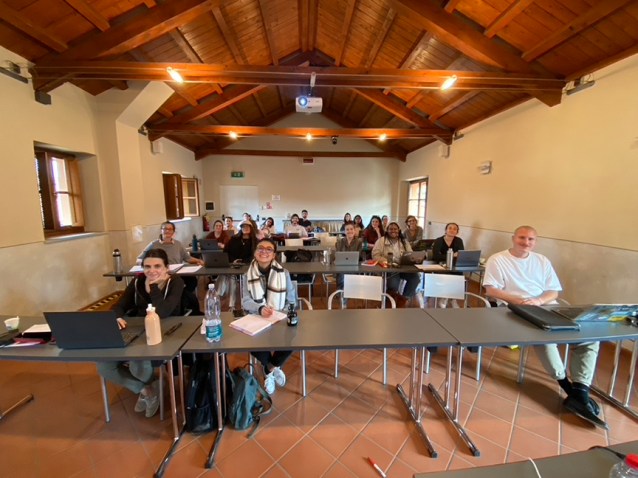
Above: my graduate student class at the Slow Food University of Gastronomic Sciences in Piedmont, Italy, on the last day of our seminars earlier this month.

Last week, Slow Food U grad students attended my last four lectures/seminars for this academic year.

Like nearly every year the university has invited me to teach there (the first year was 2016), our class did a wine tasting where the students are asked to write a classic tasting note, including a 100-point scale score.

After a discussion of the invention and widescale diffusion of the now ubiquitous score and tasting note in the 1980s and 1990s, we turn each year to Eric Asimov’s wonderful book How to Love Wine where we read his chapter on the “Tyranny of the Tasting Note.”

In that essay, he writes: “At best, tasting notes are a waste of time. At worst, they are pernicious.”

He then goes on to compare tasting notes and accompanying scores for the same wine from three different wine writers, each writing for a high-profile masthead.

As you can imagine, each writer delivers wildly different tasting descriptors and widely divergent scores.

This year, as in years past, our class tasted a wine and was asked to write a tasting note and score the wine.

The results — it’s only natural — ranged broadly, as predicted.

But this year for the first time, I asked my students to write a second note for the wine.

For the first one, they were tasked with writing a classic note, à la Wine Advocate or Wine Spectator.

But for the second, I asked them to write about how the wine makes them feel. In other words, I asked them to describe not the wine but the emotion that the wine evoked in them.

The outcome was remarkable. Where their classic tasting notes were predictably divergent (even to the point that their descriptors were incongruous with one another), their “emotional” notes were nearly identical across the board.

Of those who offered to read them aloud (they were not required to share), the same theme emerged again and again: this wine makes me feel like calling up my friend and organizing a meal (the wine was a wonderful Barbera from Monferrato btw). A number of them even used the same word when they said it made them feel like they would like to “organize a picnic.”

One of the things that have always struck me about tasting wine in a social setting, whether in a large group like my class or one-on-one with a person you care about, is how when two or more tasters arrive at the quasi-identical sensation in a wine, it immediately becomes an “ah ha” moment where the lonely coil of human experience seems to be cast off by sharing a sort of sensory intimacy.

It’s like when my wife Tracie and I taste a wine and we both land on the same impression: Wouldn’t this be perfect for your King Ranch Chicken recipe? Yes, for sure! Let’s have that on Saturday night!

In 2019, Eric wrote published one of his most powerful pieces (imho) for the Times, “It’s Time to Rethink Wine Criticism.”

“It’s time to re-examine the nature of American wine criticism today… And it’s time to consider a better model that might be more useful to consumers, a system that would empower them to make their own choices rather than tether them endlessly to critics’ bottle-by-bottle reviews.”

I don’t have a solution for the wine trade’s ongoing criticism conundrum.

But our experiment last week brought to mind something that wine writer (and novelist) Jay McInerney once said to me over a bottle of wine we were sharing.

Tastings notes vexed him when writing for the Wall Street Journal, he shared. He would much rather write a poem for each wine he was asked to review. Writing poetry may be easier for Jay than most.

But while I don’t have an answer to the thorny question of a post-tasting note/score world, I do think that it lies on the horizon: what if we stop asking what a wine tastes like (an exercise that requires us to use a literally figure known as synaesthesia) and instead we ask ourselves what a wine makes a feel.

Especially in the light of the joy that my students felt when discovering that their “feelings” aligned, I believe this could be the path to a more useful critical theory of wine.

As unconventional and unscientific as it sounds, emotion — not technical information — is what really brings us all together around a glass or a bottle of wine. There’s no disputing that.

Otherwise, we wouldn’t still be here, ceaselessly poring over (and pouring over and over again) a wine that we like or dislike. Poetic chops not required. Just self-awareness and honesty.

Thanks again to my students and the admin staff at Slow Food U for a great experience and stay! Looking forward to next year.

A Friuli-focused podcast you need to know (and not just because I’m on it).

Just over the course of the last month, I’ve had the great fortune to interact with a half dozen wine professionals with whom I worked (and/or drank) during the late 1990s and early aughts in New York City.
It was such a magical time to be there, especially as far as the Italian wine and food scene was concerned.

Just think how many Italian restaurants opened between 1998 and 2008 (when the financial crisis took an inestimable toll on the trade). Even following the tragedy of the two towers, New York continued to be a beacon in the global Italian gastronomic renaissance.

Looking back on it all and considering how many of those folks went on to become leaders in our industry, most would agree it was a culinary golden age. And the wines were pretty damn good, too.

One of those wine professionals with whom I came up in the trade was none other than Wayne Young. That’s me and Wayne, above, last month at the Ca’ dei Frati winery in Lugana (photo by my buddy Gianpaolo Giacobbo, Ca’ dei Frati’s media rep and super groovy dude).

Wayne and I have been tight friends since that time and we’ve also worked on some great projects together. At the tail end of that decade, we organized two epic blogger trips to Friuli. And when I say epic

I was so stoked when he asked me to join him on his podcast a few weeks ago. I really can’t stand the sound of my own voice (as hard as that is to believe). But I can’t recommend his Friuli-focused Taverna podcast to you enough.

Check it out here and thanks for listening.

He makes fantastic wine on his grandparents’ Alta Langa farm. But the DOCG won’t let him in.

It’s not every day that you get an Instagram message from someone named Fenoglio.
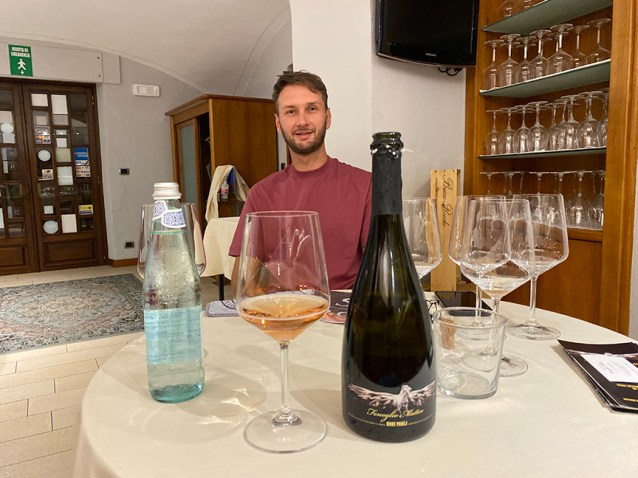
But that’s what happened a few months ago when a note showed up in my inbox from Matteo Fenoglio, a young and superbly talented grower and winemaker from Alta Langa and a distant relative of the celebrated Langa writer Beppe Fenoglio, a partisan and 20th-century Italian hero.

With his missive, he invited me to visit his small winery in Serravalle Langhe where his family has farmed for generations. It would be difficult for me to make the trek given my work and family responsibilities, I responded. But if he wanted to come see me in nearby Bra where I teach a few weeks each year, I would love to taste the wine.

Yesterday, he drove over to Bra from the family farm in Serravalle Langhe, where he grows Pinot Noir, and we sat down to taste at the Hotel Badellino where I stay each time I’m in town (thanks again, Mr. Giacomo for setting us up with a spot to taste!).

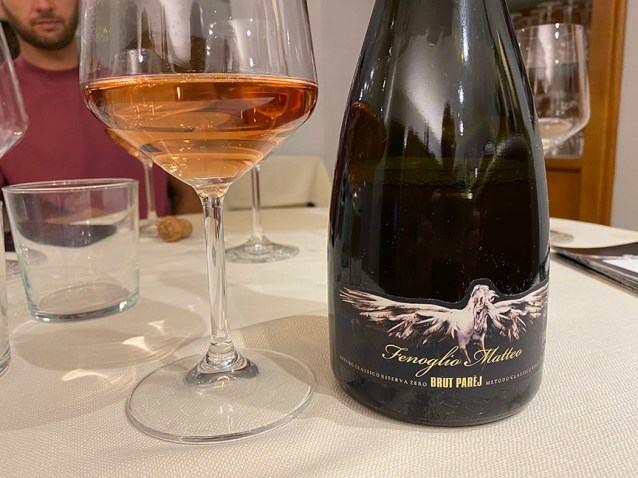
He farms organically, he told me. He doesn’t inoculate his wine; does the riddling by hand; uses organic sugar for the tirage; ages the wine on its lees in his family’s infernot without the use of temperature control; and he never adds a liqueur d’expedition. His total production is around 10,000 bottles. (His other gig is hazelnut farming btw.)

This compelling wine really impressed me with its gorgeous, delicate aromas of berry and bright red fruit. On the palate, the wine was fresh with the red fruits getting slightly darker. The clean finish lingered with hints of the flavors in the palate. It was delicious. I loved the nuance and clarity of the fruit as it played against the wine’s gently salty backdrop.

But despite being a legacy grower in Serravalle Langhe, a commune where Alta Langa can be produced, the growers association has refused to let him join their consortium. Admissions are currently closed, they told him. He can only watch with bewilderment as some of the big wine groups have planted vineyards and built wineries there while he is sidelined by bureaucracy.

Alta Langa, the Langa Highlands, as it were, is a name created especially for this relatively new appellation. It refers to the minimum altitude for the vineyards, 250 m.s.l.

Over about an hour we spent together, we talked about how the toponym Alta Langa really isn’t a place name at all. It was coined especially for the appellation as it was birthed. While all the new wineries being raised and vineyards being planting around him, he seems to feel like he hasn’t been invited to the party (let’s just leave it at that).

Evoking the novels of Fenoglio and his contemporary Cesare Pavese, he told the story of how his family were farmers who fled the post-war depression of their hills to work in the Ferrero factory in Alba where he was born. But they never abandoned their parents’ land. And when he came of age, he began to farm there again, including some old vines still growing there.

I found him to be as compelling as his wine. And I highly recommend both. Search them out.

Back at Slow Food U this week and notes from my Medieval Italian lit lecture in NYC.

It’s been a whirlwind.

On Wednesday night, for the first time since February of 2020, I made it back to New York, a city where I lived, worked, and played a ton of music for more than a decade between 1997 and 2008.

On Wednesday night, I had dinner at home with my dissertation advisor, editor, and friend, the Milanese poet Luigi Ballerini, and his wife Paola, a Lacanian psychoanalyst and writer as well.

I couldn’t tell if I was in a Fellini or Woody Allen movie (tending toward the latter given the cityscape).

It was so awesome to back in the city! Daybreak runs around the reservoir in Central Park, ubiquitous bagels, and salty Manhattan clam chowder flooded my mind with memories of my years there. I even managed to see a couple of my best friends (both drummers I used to play with and a wine writer, go figure!).

But the highlight of my trip was my talk and guided wine tasting at the extraordinary Robert Simon gallery on the Upper East Side.

For the occasion, I shared notes from my translation of Pietro Crescenzi’s 14th-century treatise on Italian viticulture (to be published, at this point, in spring 2023 by a University of Toronto press imprint). And I also spoke about the role that wine plays in Boccaccio’s Decameron.

We poured three wines that evening: a Garganega, a Schiava, and a Nebbiolo. Each of these varieties were mentioned for the first time in Crescenzi’s work.

In his entry on Garganega, he talks about how popular the wines were among the university communities in Padua and Bologna (where Europe’s oldest schools for higher learning were founded in the 13th and 12th centuries respectively).

Schiava, reports Crescenzi, was Italy’s most prolific grape in that era, grown primarily in what is today Brescia province.

And Nebbiolo, which virtually disappears from ampelographers’ vellum and incunabula after Crescenzi’s mention, only to reappear in the first half of the 19th century, was inspiration for a line in Boccaccio’s #metoo novella, “the Marchioness of Monferrato.”

We also discussed Boccaccio’s notes on “wine like fire” in the epilogue of the Decameron. Both are equally dangerous and useful, he writes of humankind’s rational distortions of nature.

It was a great event and extremely fulfilling and rewarding for me to share my research.

And dulcis in fundo, when you hang out with the Upper East Side collector crowd, they all appreciate the rich cultural resources we enjoy in Houston where my family has lived for nearly a decade. I get so much shit for being a Texan when I travel in the U.S. But on the Upper East Side, everyone swoons over our museums like Houston’s Menil Collection.

Still feeling high from the experience, I got on a plane for Italy on Friday evening. And after catching up with my best friends at their new home in downtown Brescia on Saturday night, I headed out for Piedmont wine country. I even managed to get a winery visit in as I made my way to the town of Bra and the Slow Food University of Gastronomic Sciences where I’ll be teaching wine communications in the grad program this week (my seventh year teaching here, if I’m not mistaken).

That’s my class above. A great and very motivated group of students.

I’m only halfway through my trip and it’s already been an unforgettable experience. Thanks for letting me share it with you. Now wish me luck, speed — and Nebbiolo!

Happy birthday Tracie! The girls and I love you!

Happy birthday Tracie! The girls and I love you! Our doggies love you, too!
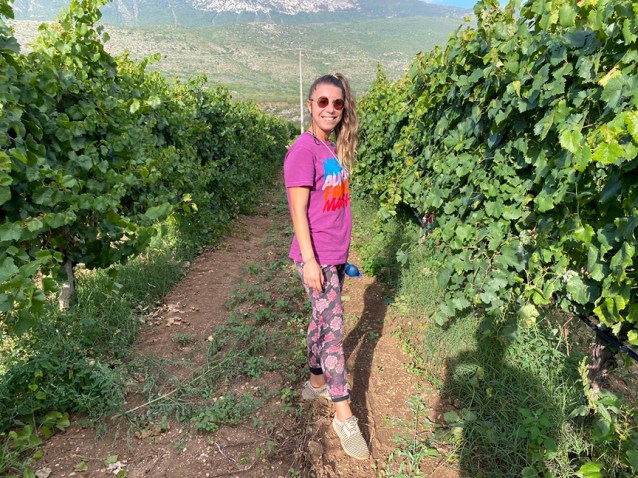
Here’s one of the three songs I wrote for you this year: “Southeast Texas Girl in Italy.”

This one is about the time of your life before we met, when you were living on the island of Ischia and writing your blog “My Life Italian.”

(I know you’ve already heard it a million times, between me writing, recording, and mixing it in our home studio. But it still sounds fresh!)

I’ll never forget when we first were in touch back in 2008. I couldn’t believe that a woman as beautiful as you would even give me the time of day!

But it turned out that we had a lot in common, including our dream of building a family together.

Who would have ever thunk it? A southeast Texan who speaks Italian with a Neapolitan accent and a southern Californian who speaks Italian with a Venetian accent.

My grandparents spoke to each other in Yiddish when they didn’t want their children and grandchildren to understand what they were saying. We speak Italian!

I love you Tracie P! Happy birthday! You are such a wonderful mother to the girls and a beautiful and caring partner to me. And you are the sexiest realtor I’ve ever met (I have a confession to make: I’m sleeping with my agent!).

The girls and I are looking forward to your birthday menu, a bottle of white Rhône, and cupcakes for birthday dessert. We love you more than words or songs could say.

Everything I thought I knew about Abruzzo was wrong. Gloriously wrong.

Above: brilliant, energetic, and super cool, Giulia Cataldi Madonna isn’t the winemaker that most people expect to find when they visit Abruzzo, one of Italy’s most undervalued wine regions. The work people like Giulia are doing there might just hold the key to the future of Italian viticulture.

Last month, I headed to Italy just as the red grape harvest was about to begin in the country’s central and Adriatic wine growing regions.

And thus began my journey in search of the 2022 harvest.

So much has already been written about this vintage: the winter drought that lasted nearly all spring and summer, combined with the record high temperatures in July and August, had a lot of people predicting genuine financial catastrophe. Even where emergency irrigation was allowed this year (and it was allowed throughout the country), there sometimes wasn’t enough water to feed the thirsty plants.

Gentle rainfall in mid-August — deus ex machina — was just enough to save this year’s harvest. But growers are coming to terms with the fact that extreme weather events are going to become more frequent and (excuse the pleonasm) more extreme.

On September 6, I landed in Milan very late, caught some shut eye in a sordid hotel near the train station, and then got on an early high speed train to Rome the next morning. From there, I picked up a rental car and headed straight to Abruzzo.

Above: Pecorino grapes at Cataldi Moadonna in Ofena commune were healthy and ready to pick despite the hot conditions. Ofena growers like Giulia have been dealing with extreme weather for generations. Their strategies offer clues into how Italian winemakers will need to face the challenges of climate change.

My first stop was Cataldi Madonna where the unstoppable Giulia Cataldi Madonna gave me a great tour of her family’s vineyards.

I’ve enjoyed her family’s wines for years and have often included them on wine lists I’ve managed. Their quality-price ratio can’t be beat.

But I had no idea how soulful and thoughtful this family is and why their wines matter so much — especially today.

And that was the first of many things I got wrong about Abruzzo. Gloriously wrong.

Above: I’m going to get into trouble for saying this but Giulia told me that she agrees with me 100 percent when I say that Cerasuolo d’Abruzzo is not a rosé wine. It’s a red wine. More on that later.

Maybe because of the way the wine has been marketed in the U.S., it was always my perception that Cataldi Madonna was just another huge producer that made extremely restaurant-friendly wines in large quantities.

What I learned was that Giulia and her family have been pioneers of organic farming and — more importantly in my view — of smart, healthy, sustainable, and forward-looking farming in their region.

The work they are doing with pergola training alone is going to have legacy impact on how Italians grow grapes in future.

Giulia like the other winemakers I met on my trip are forging a new “climate change era” path by showing how canopy management and — as I later learned — solar radiation are going to be two of the keys to dealing with increasingly warm and arid vintages.

Half way into my conversation and tour with Giulia, it was abundantly clear that everything I thought I knew about Abruzzo was wrong.

Over the next few weeks, I’ll be sharing my notes from visits to three different wineries there (and a restaurant note or two). I hope you’ll join me on my journey of discovery. Thanks for being here.

A wine for the worst kind of thieves: taste with me in New York and Dallas this month.

Next Thursday (10/13) in New York, I’ll be pouring and talking about “a wine for the worst kind of thieves”: Garganega (pictured in photo above, snapped a few weeks ago in Soave).
The wine will be one of three in a flight inspired by readings of Medieval Italian literature and proto-Italian “pomology.”

Why was Garganega known as a “wine for the worst kind of thieves”? You’ll just have to attend my tasting to find out! We’ll also be tasting a fantastic Schiava and an old-school Nebbiolo, a wine connected to Italy’s early #MeToo movement (no joke). The latter’s role in social justice will be revealed in my talk

It’s a charity event and so it’s not a cheap date. But the deal sweetener is the fact that it will be hosted at the Robert Simon gallery on the upper eastside. Yeah, Robert’s the dude the identified the last known painting by Leonardo da Vinci.

Click here for details and registration link.

Later this month, I’ll be leading an olive oil tasting and will be bopping around the Taste of Italy Dallas trade fair at Eataly on October 27.

It’s the Italy-America Chamber of Commerce’ first bona fide trade fair there. And it should be a good time, especially because the folks at Eataly Dallas do such a bang-up job.

Buyers and media, click here to register for the walk-around tasting.

Click here to register for my Calabrian olive oil tasting.

Taste Medieval grapes with me in New York, an event hosted by Robert Simon, gallerist who discovered Da Vinci’s “Salvator Mundi.”

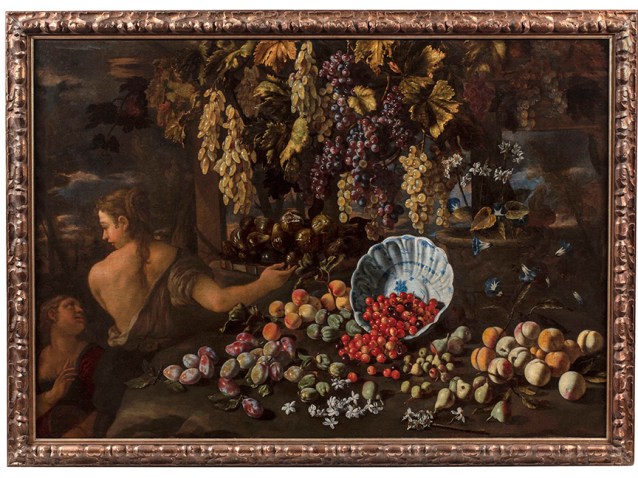
Above: “Fruit, Flowers, a Ceramic Dish and a Vase on a Stone Ledge Beneath a Grape Arbor, with Two Women Gathering the Bounty” (oil on canvas) by Giovanni Battista Ruoppolo (Naples, 1629 – 1693) and Luca Giordano (Naples, 1634 – 1705), currently on display at the Robert Simon gallery in New York.

Please join me on Thursday, October 13 in New York where I’ll be presenting readings from Italy’s oldest book on viticulture and Giovanni Boccaccio’s Decameron at the Robert Simon gallery on the Upper East Side.

Some beyond the New York art scene will remember Robert: he was the researcher who proved that the painting “Salvator Mundi” was indeed by Leonardo da Vinci. That canvas later sold for a record $450 million, a work that some have called the “world’s most expensive painting.”

The event is being organized by my friend and dissertation advisor, Italian poet and scholar Luigi Ballerini, and his wife Paola Mieli, a practicing Lacanian psychoanalyst and writer.

The readings, mostly from my translation of Pietro de’ Crescenzi’s Ruralia commoda and related passages in Boccaccio, will be accompanied by a guided tasting of three grape varieties that appear in the 14th-century works.

I am super geeked about this, in part because I haven’t been back to the city (aside for a quick business lunch) since 2019 — for reasons all too familiar.

Here are the details. It’s a benefit so it’s not a cheap date. But I promise not to disappoint. How could I when I have Robert’s gallery as the setting? I hope to see you there. And thanks for checking it out.

And btw, I’m also preparing notes on the above painting, currently on display on East 80th St. Isn’t it grand?

A Wine for the Worst Kind of Thieves

Wine Tasting and Medieval Readings with celebrated Wine Historian and Sommelier Jeremy Parzen.

Thursday, Oct 13, 2022 at 6:30 PM

Robert Simon Fine Art
22 East 80th Street • Fourth Floor
New York NY 10075

Tickets: $150

Taste three wines as Jeremy shares three colorful readings from Italy’s oldest book on wine and Boccaccio’s Decameron. The event includes a guided tasting of three native Italian grape varieties that were popular during Boccaccio’s time and are still widely enjoyed today.

Additionally, enjoy a special preview of the exhibition: “Beyond Boundaries: Historical Art By and Of People of Color.”

All proceeds from the event will be donated to Animal Zone International, a Greek-based non-profit devoted to the sustainability of the environment through the protection and control of animals.

Click here to reserve.

Are irrigation and artificial ponds the key to mitigating climate change in Italian viticulture? Rhabdomancers wanted.

Above: Colline Teramane (Abruzzo) grower Bruno Nicodemi built an artificial pond on his family’s property in the 1970s. At the time, it was intended to foster biodiversity. Today, it’s a lifeline.

As Italian grape growers faced extreme heat and prolonged drought in what could have been an existential threat for many of them in the 2022 vintage, there was ample talk across the peninsula about the need to build artificial ponds and loosen restrictions on so-called “emergency irrigation.”

In fact, emergency irrigation has become the norm, not the exception, in central and northern Italy as the wine industry comes to terms with the impact of climate change.

In the second half of the 1990s, a string of warmer and less rainy than usual vintages seemed to herald a time of more regularity and increased prosperity for Italian winemakers.

But today, the unrelenting heat of recent summers, drought that persists through the growing season, late spring frosts, and intense weather events that can wreak havoc on ripening fruit have created a “new normal” in terms of the challenges that growers face.

Above: Lake Garda as seen from the vineyards of Ca’ dei Frati in Lugana.

In northern Italy, many farms have already outfitted their vineyards with permanent irrigation systems — where they are allowed — because the authorization for emergency irrigation is no longer an exceptional event. It’s not a question of if anymore. Now, it’s a question of when the call will be made.

In central Italy, one winemaker told me that they would have irrigated if they had the means to do so. They had never irrigated before, they told me, and so they had no infrastructure in place to water their wines once the authorization arrived.

Another grower in central Italy told me that the authorization is something they have come to expect. But this year, something unexpected happened as well: there simply wasn’t enough water to go around. Authorities, they told me, only turned on the taps for a few hours each morning and grape farmers essentially had to compete with their neighbors for their allocation.

In appellations like Lugana in Italy’s Veneto region, water allocation is not an issue thanks to nearby Lake Garda (see above).

But in places like Abruzzo or Tuscany, the ongoing drought conditions are prompting winemakers to build artificial lakes, an approach that has been publicly advocated by prolific Italian winemaker Andrea Lonardi.

Even with the creation of these reservoirs (invasi, as they are called in Italian), there will still be a question of water management: who will get the water and when.

During my recent trip to Italian wine country, a number of growers told me they are planning to build such ponds and some of the country’s top consortia are working with their members to plan and authorize their construction.

Above: Pergola-trained Garganega clusters in the heart of Soave. Note permanently mounted irrigation hose.

One of the most telling moments of my trip came when I asked Roberto Anselmi when the Soave consortium had authorized emergency irrigation this year.

He laughed and reminded me that he had famously left the appellation more than 20 years ago.

Not only are his vineyards equipped with irrigation systems. He also recently hired a rhabdomancer to help him find a water source atop one of most important vineyards, thus ensuring an independent source for challenging vintages like 2022.

Thanks to this foresight, his yield will be in line with normal years and new vines that he planted have ample water to make it through their delicate early years of growth.

“Emergency irrigation is one of the few smart things they actually did in the [Soave] consortium,” he said.

But the problem now, he pointed out, is that some have natural water resources while others don’t.

Irrigation has been a dirty word in Italian viticulture for a generation. Dry farming, it has long been held, was a key element in true “terroir expression” and “sense of place.”

But as wine growers in Italy have come to discover, if they don’t loosen the regulations on irrigation — and abandon the taboo — there might no longer be a terroir to express or a place to taste.