G-d Bless America, G-d bless us all

Tracie P and I spent the Labor Day 3-day Weekend with Mrs. and Rev. B and family in Orange, Texas, on the Louisiana border, where Tropical Storm Lee kept the skies gray and the ground wet most of the weekend.

The weather didn’t stop the kids from playing football here but we mostly stayed in and visited, as they say here in the South.

Tracie P and I are six months pregnant now and it was wonderful to watch the children on Saturday night as they listened to Baby P’s heartbeat with sister Misty’s stethoscope.

On Sunday night, we ate dinner at memaw and pepaw’s (Rev. B’s parents, both in their 90s now) and they talked to us about what it was like to raise children in their day.

Over the course of the long weekend, we talked a lot about the outreach program at Rev. B’s church and the many people here in East Texas (and elsewhere, in the U.S. and all over the world) who are facing seemingly insurmountable challenges as they work (or look for work) to feed and cloth their families.

Today — on Labor Day — I wanted to share the video above: I shot it yesterday at Rev. B’s services, where Sunday prayer always begins with a tune by one of my favorite songwriters, Irving Berlin.

Happy Labor Day, everyone…

Montalcino fait accompli? New developments today…

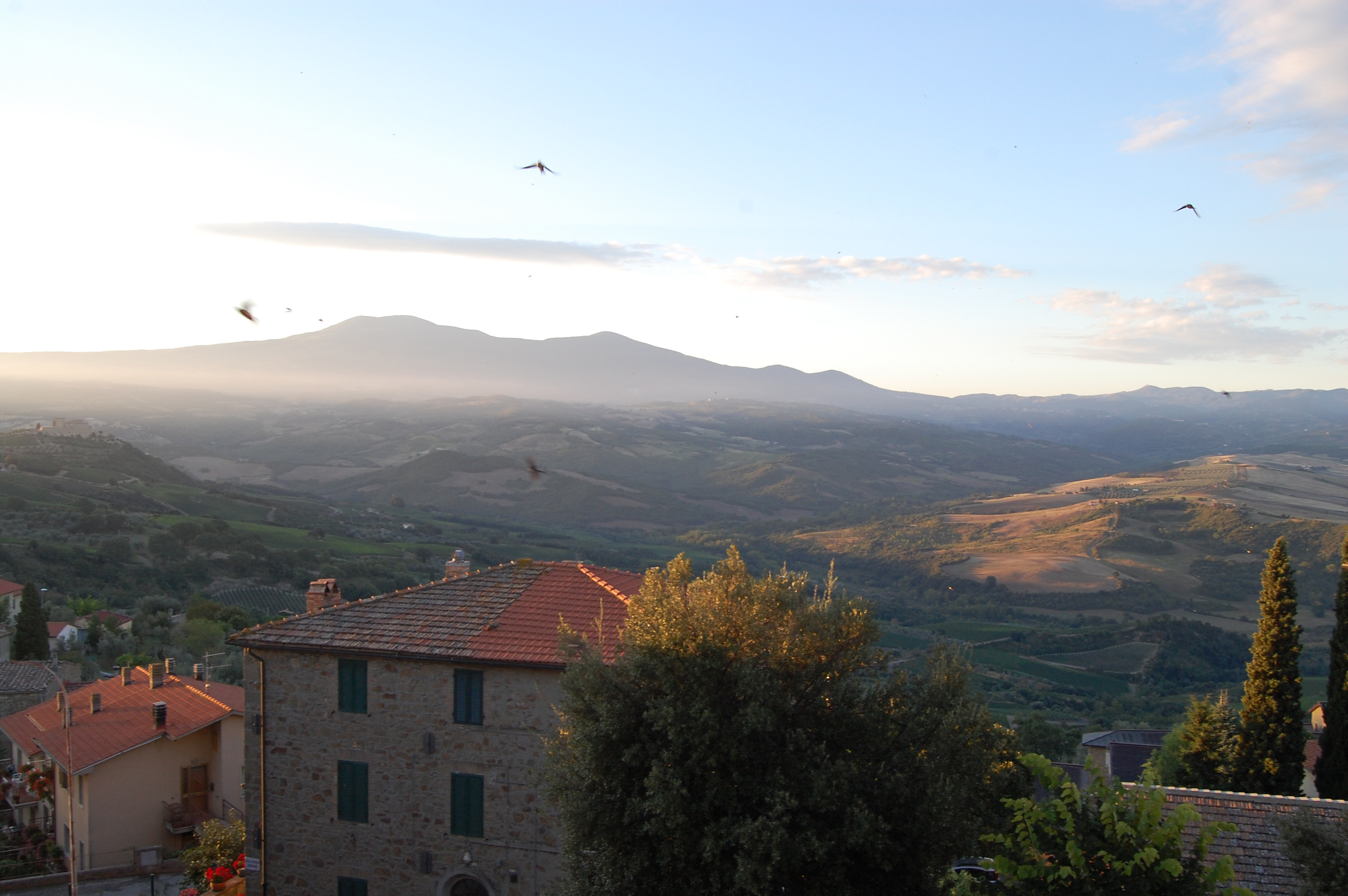
Above: Mt. Amiata as seen from Castelnuovo dell’Abate (Montalcino). I took this photograph in September 2010. Click the image for a high-resolution version of the image.

According to the chatter, it would appear that a change allowing international grape varieties in Rosso di Montalcino is a fait accompli.

Neither I nor Franco have access to the Consorzio del Vino Brunello di Montalcino charter. And so we are not privy to voting protocols.

But all words on the street indicate that the September 7 assembly of Brunello producers will be given two options to vote on: 1) Two categories of Rosso di Montalcino, including one that allows for international grape varieties; or 2) Three categories, including one that allows for international grape varieties. The option not to change the appellation regulations is not on the table, evidently. It’s also not clear what type of consensus the technical council of the consortium needs to achieve in order to pass the changes through.

Regardless of consortium president Ezio Rivella’s sprezzatura, one thing is abundantly clear: the big business interests here — Masi (Rivella’s partner), Frescobaldi, Antinori, Banfi, Zonin (?) — are going to push this change through one way or another, come hell or high water.

I cannot help but be reminded of what I heard Teobaldo “Baldo” Cappellano say in the Brunello Debate of October 2008: sometimes the battles you know you will not win are the ones you must fight for most passionately.

The only voice of reason coming from Montalcino these days seems to emanate from my friends at Il Poggione, who have stayed above the fray, avoiding any commentary on what’s happening there and containing their observations to their blog’s harvest report series.

Yesterday, they posted a detailed report on the heat spike of August. And they suggest that the problem may not be one of whether or not to add international grape varieties to the Montalcino brand wines. Emergency irrigation, they write, could help growers to produce healthier Sangiovese in hot years like 2003 and 2011:

    We believe that in the future it will be indispensable to insert in the appellation some technical parameters like emergency irrigation, a practice that would allow growers to overcome these periods unharmed, even if limited by the great heat.

It’s possible that Rivella’s urgency in modifying the appellation may be due to the fact that, as Francesco Illy pointed out, “Grapes that were ripening have been dried up in quantities that vary between 5-50% depending on the zone and the age of the vines.”

In any case, it was inevitable that the big business actors were going to push this through.

It all makes me very, very, very sad.

Yesterday, I posted an English translation of a moving vignette written by my good friend Paolo Cantele on his family’s winery’s blog.

His grandparents, post-war wine merchants, he wrote, wouldn’t recognize the Italy for which they had sacrificed so much to build.

Ain’t it the truth?

If all goes according to plan, Wednesday, September 7, will be a dark day in Montalcino’s history.

Es muss sein…

Francesco Illy asks Brunello consortium to postpone assembly

Above: Grape growers began harvesting Sangiovese today in Montalcino. Photo by Montalcino Report.

Franco and I have obtained a copy of a letter written and circulated today by Mastrojanni owner Francesco Illy. The following is my translation of the letter.

*****

Dear Mr. President and Council Members,

On August 21, a heat storm [spike] with strong winds and temperatures reaching 41° C. [106° F] struck Montalcino. Grapes that were ripening have been dried up in quantities that vary between 5-50% depending on the zone and the age of the vines.

This event will add difficult, prolonged work for producers and consortium members: we are currently harvesting and many of us are bottling. Regardless, this is the toughest time of the year and the heat damage makes it even more difficult. None of us have the time, energy, or desire to attend the meeting called by you for September 7, 2011.

Without even speculating on the reasons that lead you to call an Assembly when the greater part of those with the right to vote will be absent, I denounce your insistence on maintaining this date. Beyond the evident facts that I have listed here, it is weighty proof of your total lack of sensitivity to the interests of your producers and consortium members.

Therefore, in the name of my winery and in the name of all those who will endorse this letter, I ask that the Assembly of the Brunello di Montalcino Consortium scheduled for September 7, 2011, be changed to a later date to be determined because of the difficult conditions of the harvest.

Hoping that I have reawakened your dormant however duty-bound sensitivity, I thank you for your consideration and send you my regards.

—Francesco Illy

*****

I’d also like to bring to your attention a tweet by my friend Laura Gray who manages the Palazzone estate in Montalcino:

    How did we get from a pro-Sangiovese petition to a forced meeting to include different % int. grapes but no option to vote for status quo?

I’m posting in a hurry from the road today but will post again just as soon as I have the chance to share some insights into today’s developments.

Thanks for reading!

Nicolas Belfrage says NO to Merlot in Montalcino

The following appeal to Montalcino producers by Master of Wine Nicolas Belfrage (above) was posted today, August 29, 2011, on Franco’s blog Vino al Vino. Franco has asked me to repost it here and I was happy to oblige (photo via the Adelaide Review).

I understand that, on Wednesday Sept 7, 2011, a vote will be held in the Assemblea of Montalcino wine producers on whether to allow a small but significant percentage of other grapes, which everyone understands to mean Merlot and/or Cabernet and/or Syrah, into the blend of Rosso di Montalcino DOC, which is of course at present a 100% Sangiovese wine.

I would urge you in the strongest terms not to support this change. Rosso di Montalcino, like Brunello di Montalcino, has created for itself a strong personality on international wine markets based largely on the fact that it is a pure varietal wine.

In these days when more and more countries are climbing on the wine production bandwagon it is more important than ever to have a distinctive identity, to make wine in a way which no one else on earth can emulate. It is my belief that the strongest factor in the identity of Rosso di Montalcino (and of course Brunello di Montalcino) is the fact that it is 100% Sangiovese.

I am not disputing the fact that Merlot, Cabernet and Syrah are excellent grape varieties, but it is their very excellence, their very strength of personality, which threatens to compromise the unique character of Rosso di Montalcino.

Who could ever imagine the producers of Bordeaux voting to allow 15% of Sangiovese into the Bordeaux blend? The idea is absurd — or would be treated as such by the Bordeaux producers. There are many who think that a reverse situation, in Tuscany’s finest vine-growing area, would be equally absurd.

Yes, in many cases it may improve the wine — especially in weak vintages or where Sangiovese does not succeed every year. But it will fatally undermine the personality of the wine.

I am aware that a lot of Merlot and Cabernet are planted in the Montalcino growing zone, and that there may be a need in the short term to find a commercial use for these grapes. But there are the options of St. Antimo or IGT Toscana.

Perhaps, instead of compromising the purity of one of Montalcino’s unique wines, there should be more effort in the irection of promoting these other wine-types.

You will be aware that many of us fear that a compromise in regard to Rosso di Montalcino would constitute an opening of the door to a compromise, farther down the line, of the purity of the great Brunello — one of the world’s great wines.

Whether or not that might be the case, I am convinced that it is against the long-term interests of Montalcino to allow any other grape variety, including any Italian or Tuscan variety, into the Rosso, just as it would be fatal to great Burgundy, for example, to allow Syrah to be blended with Pinot Noir, as was once widely practised — with, one might add, some notable successes, but with the inevitable distortion of the style.

You, the Montalcino producers, hold the fate not only of your own future market in your hands. You are the representatives of all of us who will not have a vote on September 7th. We urge you, please, to vote NO.

—Nicolas Belfrage

What the hell is going on in Montalcino???!!!

In the wake of my Friday post where Franco and I revealed one of the “hypotheses” for a new Rosso di Montalcino category that would allow the use international grape varieties, a lot of folks have been asking, what the hell is going on in Montalcino, anyway???!!!

Today, on his blog, Franco asks rhetorically, is the proposed change prompted by market demand or does it reflect the interests of certain actors?

The fact of the matter is that there is an oligarchy of commercial, big-business, industrial wineries that want this change. Their baron-robber chum and ringleader Ezio Rivella — gerrymandering president of the Brunello producers association — says that before the Brunello controversy of 2008, 80% of Brunello (which by law must be made from 100% Sangiovese grapes), was blended in part using international grape varieties. (Here’s my post and translation of that story.) He and his gang claim that the market (read AMERICA) wants international grape varieties from Tuscany. What he doesn’t acknowledge is that the overwhelming majority of Brunello growers and producers — 90% by most counts — want to protect their appellation from internationalization in the name of Italian and Tuscan cultural heritage. The last time that Rivella tried to hold a vote on changing the appellation to allow other grape varieties, he had to retreat at the last minute because he knew he would lose. (Here’s the post on VinoWire.)

In the days that led up to the aborted vote, Francesco Illy — scion of the Illy coffee dynasty and owner of Montalcino estate Mastrojanni — published two open letters exhorting his peers and colleagues to protect the identity of Montalcino’s iconic wines. (Juel Mahoney posted English versions of the letters here.)

Comparing the crisis in Montalcino to the hard times faced by his father in the coffee industry, he wrote that “Experiences tell us [sic] that those who have managed to defend its identity in the end he won [sic].”

The bottom line is this:

1) The big-money, establishment producers want to make the rules more flexible so that they can make more wine, even in bad vintages, when Sangiovese is more difficult to cultivate (and Merlot and Cabernet Sauvignon are more consistent and reliable).

2) The overwhelming majority of smaller producers do not want to change the appellations because they feel a deep connection to their land and their traditions and they do not want to see their wines internationalized (Rivella is from Piedmont, btw, not Tuscany). Ultimately, they realize, if Rivella and his gang prevail, there will be no space left in the market for their products (Walmart wins again).

3) The industrialists continue to create new scenarios that would allow them to use international grape varieties through a “back door” or “loop hole”; in other words, let’s create a new category that allows us to use Merlot when we need or want to. In keeping with the current strategy, Rivella continues to water down (forgive the pun) the different scenarios, hoping that eventually one will be approved.

If Rivella prevails, everything will be lost in Montalcino. Clear some trees, build a golf course, and, hell, why not turn all of Tuscany into a Disneyland-run tourist attraction? And after we build Disneyland in Tuscany, we’ll start working on Disneyworld in Piedmont. After all, the American boom times will return and all those fat cat brokers in Manhattan are going to need more Tuscan Merlot, Cabernet Sauvignon, and Syrah to wash down those steaks. Shit, Tuscan Merlot costs less than Californian anyway!

O tempora o mores! Pasolini, Gramsci, Marx? Therein lies the answer…

Breaking news: Rosso di Montalcino proposed changes (documentation)

It is with a heavy heart that I share today’s news from Montalcino.

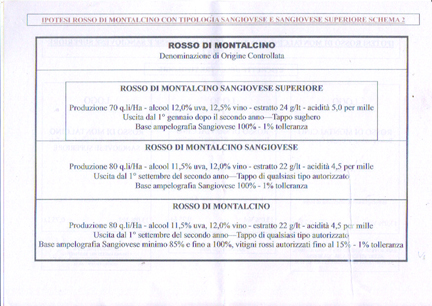
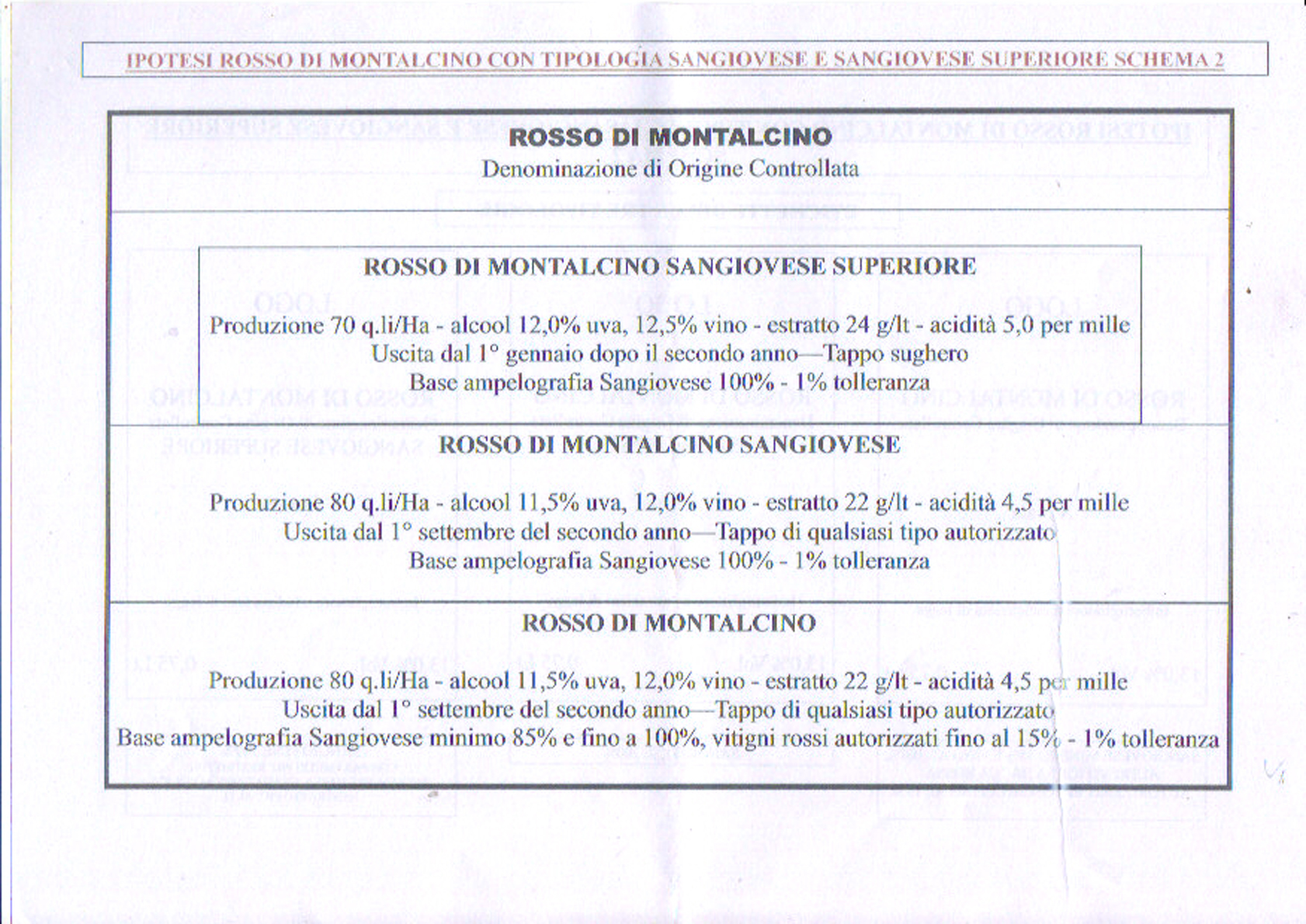
Italy’s top wine blogger Franco Ziliani (my partner in and co-editor and founder of VinoWire) has obtained a document that specifies proposed changes for the Rosso di Montalcino appellation. I haven’t had time to review them carefully but I am very alarmed by the “hypothesis for three typologies [categories] of Rosso di Montalcino”:

1) Rosso di Montalcino Sangiovese Superiore: 100% Sangiovese (with a 1% “tolerance” of other grape varieties).

2) Rosso di Montalcino Sangiovese: 100% Sangiovese (1% tolerance).

3) Rosso di Montalcino: minimum 85% and up to 100% Sangiovese, “authorized” red grape varieties up to 15% (1% tolerance).

Click here to view a full-sized version of the document.

Although it doesn’t appear that the Brunello oligarchy plans to call a vote on the proposal anytime soon, it has called for “ordinary assembly” of producers to put the modifications to the floor (September 7).

Rosso di Montalcino with up to 15% Merlot (see the third category)? Please say it ain’t so…

Anecdotally, Franco reports today on his blog that producers are “optimistic” that only 10% of them would vote to adopt the changes.

At least one producer wondered rhetorically and philosophically, “why isn’t there a proposal to not change the appellation?” It seems that the powers-that-be are hell bent on opening the floodgates of Merlot in Montalcino.

Last week, Montalcino experienced some heat spikes, as warm weather arrived from Africa. I regret that this doesn’t bode well for the 2011 vintage (although at least one producer is reporting cool evening and morning temperatures).

I’m with Franco when he says he hopes that the heatwave will pass quickly and stop “cooking the brains,” as they say in Italian, of the Montalcino establishment.

The “sheep poop theory”: Cesanese del Piglio and cacio e pepe

When it comes to food and wine pairing, one of my favorite motti is owed to New York restaurant legend Danny Meyer: if it grows with it, it goes with it…

It’s what I call the “sheep poop theory”: you want to pair the wine with the cheese made by the sheep that poop in the field next to the vineyard where the wine is raised. Now, that’s what I call terroir!

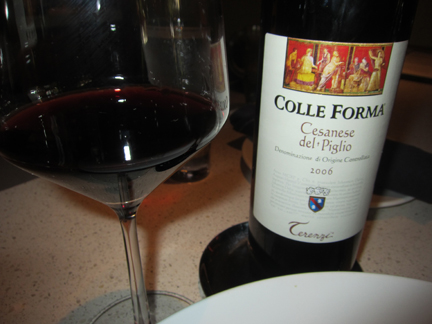
The other night, when some friends brought an excellent bottle of 2006 Terenzi Cesanese del Piglio from Latium to our favorite BYOB joint in Austin (the name of which I cannot reveal lest it cease to be our best-kept secret), we asked the chef to whip up one of the simplest and most delicious dishes in the world, classic Roman cacio e pepe, long noodles tossed with Pecorino Romano and freshly cracked pepper.

So little Cesanese makes it to the U.S. these days and sadly, none — save for that which is smuggled in — makes it to Texas.

With its classic black pepper notes, it’s as if this wine were created expressly to pair with cacio e pepe. I thought the wine showed brilliantly: red fruit on the nose and in the mouth, zinging acidity (despite its age), and pepper, pepper, pepper combined with a gently chewy mouthfeel… Delicious…

Does anyone know of a Cesanese available here? It’s such a great summer red and I drink it any chance I get!

What’s your favorite Cesanese?

Nuns and wine (Coenobium) and a report from Montalcino

Above: “Decameron” by Waterhouse (1916). The countryside outside the city of Fiesole served as diegetic backdrop in Boccaccio’s Decameron. Fiesole lies in the hills above Florence.

If you’ve visited my blog before, you probably have already tasted Coenobium, a wine raised by Cistercian sisters in the Province of Viterbo and vinified by natural winemaker and co-founder of Vini Veri, one of Italy’s leading natural wine movements, Giampiero Bea. Most Italophile wine lovers have heard the tale of this wine many times before.

But when I posted about it today over at the Houston Press food and wine blog, I couldn’t resist making an allusion to Boccaccio’s Decameron, Third Day, Novella 1, “Masetto da Lamporecchio [who] feigns to be dumb, and obtains a gardener’s place at a convent of women, who with one accord make haste to lie with him.”

The funny, sexy tale is one of those depicted by Pasolini in his 1971 filmic version of the Decameron (which we watched the other night) and I’m always looking for excuses to talk about literature when writing about wine.

    Fairest ladies, not a few there are both of men and of women, who are so foolish as blindly to believe that, so soon as a young woman has been veiled in white and cowled in black, she ceases to be a woman, and is no more subject to the cravings proper to her sex, than if, in assuming the garb and profession of a nun, she had put on the nature of a stone: and if, perchance, they hear of aught that is counter to this their faith, they are no less vehement in their censure than if some most heinous and unnatural crime had been committed; neither bethinking them of themselves, whom unrestricted liberty avails not to satisfy, nor making due allowance for the prepotent forces of idleness and solitude. And likewise not a few there are that blindly believe that, what with the hoe and the spade and coarse fare and hardship, the carnal propensities are utterly eradicated from the tillers of the soil, and therewith all nimbleness of wit and understanding. But how gross is the error of such as so suppose, I, on whom the queen has laid her commands, am minded, without deviating from the theme prescribed by her, to make manifest to you by a little story…

Here’s the link to my post.

And here’s the link to the tale. Buona lettura!

In other news…

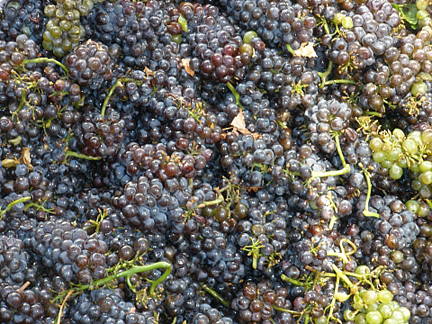
Above: My friends have begun harvesting their Pinot Grigio in Montalcino. As you can see in the image, Pinot Grigio is not a white grape.

I’ve been following my friends father and son Fabrizio and Alessandro Bindocci’s posts on the vegetative cycle and harvest 2011 over at their blog Montalcino Report.

They’ve been doing an amazing job of documenting the 2011 vintage and to my knowledge, they are the only Italian winemakers who have attempted a project like this.

Today they posted the above photo of Pinot Grigio grapes and reported “Heat Spikes But Grapes Are Healthy and Correctly Ripened.”

It takes a lot of courage to be so honest about the vintage but it also gives Italian wine enthusiasts an entirely new perspective into the vegetative cycle. It will be fascinating to taste the wines when they are released and compare our tasting notes with their documentation of the vintage.

Chapeau bas, gentlemen!