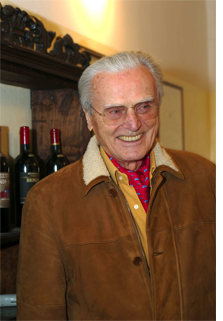
Giacosa 1999 Barbaresco (classic) and a gig tonight

From the department of “somehow, someway, I get to taste funky ass wines like every single day”…
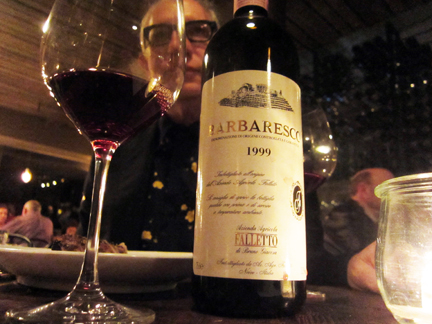
Comrades Howard and Mary Beth came to visit me on Saturday night at Sotto in Los Angeles, where I was “pouring wine on the floor,” as we say in the wine trade.

Comrade Howard graciously and generously shared the above bottle of 1999 (classic) Barbaresco by Bruno Giacosa. (Howard was elected vice president of the Writers Guild of America last week, btw. Mazel tov, comrade!)

Great Barbaresco always inspires equine metaphors in me and this wine, powerful and muscular, asserted a masculine beauty tempered by feminine grace, a young mare whose strength was still countered by its youth.

Earth and stone dominated the fruit as the wine began to reveal its nature but dark and red fruit emerged as the wine spent some time in the glass.

Barbaresco by the hand of Giacosa never fails to invoke equine wonder in those of us lucky to experience the wines and his 1999 vintage continues to thrill me, often rivaling the perhaps more graceful 2001 with a combination of power and to kalon.

Thank you again, comrades! Avanti popolo!

In other news… All work and no play would make me an otherwise dull boy…
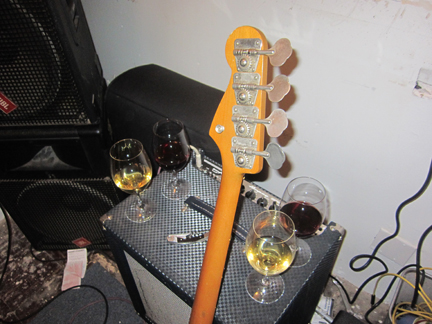
My friends at Jaynes Gastropub have asked me to sit in with them at tonight’s battle of the Chef Bands 2011 in San Diego. The charity event supports domestic violence awareness and takes place tonight. The Grapes (our band) go on around 9 p.m. Last night’s rehearsal featured some excellent 2007 Lafarge Bourgogne Passetoutgrain.
Harvest dispatches from Europe are changing the way we understand “vintage”

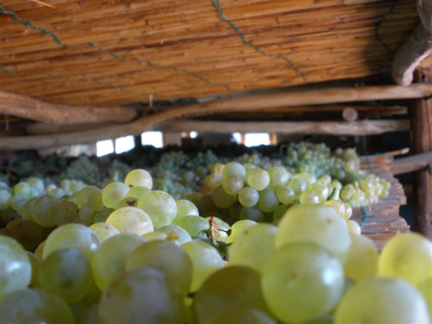
One of the coolest things about the enoblogosphere this year is the number of European wineries who are posting dispatches from the harvest. I loved the above photo of grapes for Vin Santo posted by my friend Ale at Montalcino Report (he’s been posting regularly about weather conditions and harvest progress).

My friend Laura, also in Montalcino, posted this brutally honest report about the recent heat spike there, entitled “Can someone please turn the hairdryer off?” Not everyone in Montalcino has embraced transparency but a few brave souls like Ale and Laura have.

It’s been a few weeks since he’s posted, but my buddy Wayne in Colli Orientali del Friuli has posted some great photos of harvest (like the one above), including some shots of the young Ethan Bastianich!

Back in July, Wayne did this amazing however sad post of images documenting hail damage in Collio.

Today at the Boutari blog, we posted some images and a report from the harvest in Naoussa by enologist Vasilis Georgiou. Those are Xinomavro grapes, above, waiting to be picked.

Although he doesn’t have a blog, my good friend and Pasolinian comrade Giampaolo Venica has been using social media to document the harvest in Collio. He sent me the gorgeous photo of dawn (above) to illustrate the time of day that they begin picking the grapes, when temperatures are coolest. Beautiful, no?

There’s no doubt in my mind that the 2011 harvest in Europe has been documented like no other before it… all thanks to the internets and a growing number of forward-thinking winemakers.

Know a winery that’s posting about harvest this year? Please share a URL in a comment and let’s a list going! Buona vendemmia yall!

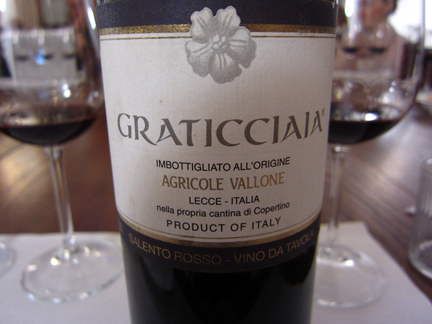
Negroamaro, a supreme expression in Graticciaia (tonight in LA)

In the Salento peninsula of Italy, the Negroamaro harvest will begin any day now, as my friend Paolo reports on his blog.

When I visited Apulia (Puglia) in June of this year as a judge in the Radici Wines festival, I had the great fortune of attending a vertical tasting of Graticciaia, a dry-style dried grape expression of Negroamaro created in 1986 by the Vallone family in Salento, a wine considered by many to be the greatest wine of Apulia. (No relation to my friend and client Tony Vallone in Houston.)

Only made in top years, the grapes for Graticciaia are late-harvested and then dried on mats (graticci in Italian, hence the enonym). They are then vinified in stainless steel and aged in large casks (similar to and inspired by the wines and winemaking of Valpolicella).

When I tasted at Vallone, they served a flight including the 2003, 1997, 1994, and 1990 and we were all impressed by the nuance that these wines attain with age. The 1994, in particular, blew me away: the fruit had emerged brilliantly, as had a wonderful sea salt note that danced with the wine’s bright acidity. The younger vintages were muscular yet elegant, with classic spicy notes accentuated by the winemaking style: think cumin and cinnamon sprinkled over ripe plums and dried cherries.

Starting tonight, I’ll be pouring a mini-vertical — 2006 and 2005 — of Graticciaia at Sotto in Los Angeles (where I’ll be pouring wine on the floor tonight, tomorrow night, and Saturday night).

Please drop by and I’ll tell you some wine tales!

Taurasi, a guest post from Naples (and a vertical of Taurasi tomorrow in LA)

I’ve been doing my homework, getting ready to present a mini-vertical of Taurasi by Struzziero tomorrow, Friday, and Saturday nights at Sotto in Los Angeles (where I curate the wine list). Yesterday, I reached out to my friend Marina Alaimo who works with top Southern Italian wine blogger and journalist Luciano Pignataro in Naples. Here’s what she sent me. Buona lettura!

Dear Jeremy,

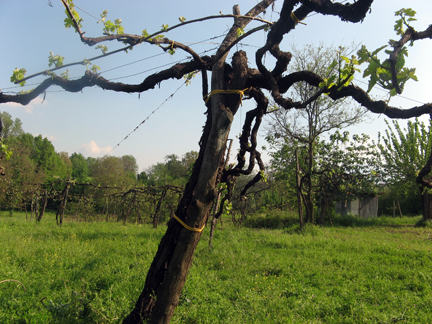
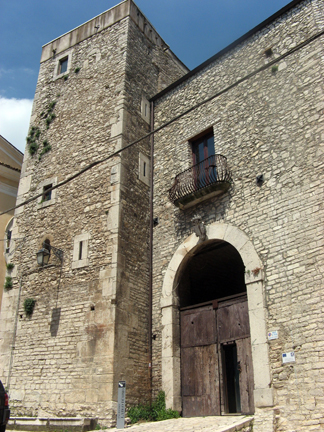
In the attached photo, you’ll see old plantings of Aglianico Taurasino. This type of training method is called starzete: it’s a type of high trellis, with four long canes. It allowed the farmers to grow vegetables and other crops below the vines and to bind the canes to trees. As a result, the farmer could use the available land to its greatest potential by employing integrated farming. Furthermore, the starzete training system guaranteed an abundant crop of grapes. As you know, in the past, grape growers aimed for quantity. I’ve also sent you a photo of the Castello di Taurasi, symbol of the appellation.

Marina

The best Italian restaurant in the U.S. (and why I was made to love her)

When Tracie P and I talked about one last “babymoon” before the last trimester of our pregnancy (when she can’t fly anymore), she expressed her desire to dine at Frasca in Boulder. And so on Saturday, we headed for the Rocky Mountains and one of the best meals we’ve ever had.

It’s so hard to get properly sliced prosciutto in this country and I have told Tracie P about Chef Lachlan Mackinnon-Patterson’s obsession with reconditioned vintage Berkel slicers and how their beveled blades make all the difference (it’s in the diffusion of the heat, Lachlan explained to me last year when we traveld in Friuli together). When our server asked us about what we wanted to eat, the first thing out of (and into) Tracie P’s mouth was: P-R-O-S-C-I-U-T-T-O!

Co-owner Master Sommelier Bobby Stuckey graciously offered to select the wines for us and it was only fitting that we start with 2010 Malvasia by Venica & Venica: Lachlan, he, and I tasted the wine together last September at the winery in Collio not long after it had been harvested. We loved the spice in this vintage of Malvasia by our good friend Giampaolo Venica.

Lachlan’s frico was off-the-charts good.

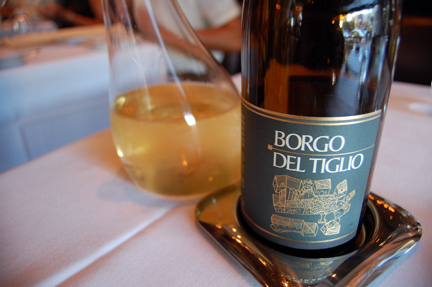
Bobby surprised us with this 09 lees-aged Sauvignon Blanc by Borgo del Tiglio, a winery I’d never tasted or seen in the U.S. I love the muscular style of Sauvignon Blanc embraced by certain Friulian producers. If ever there were an international grape variety to grow in Italy, it would be Sauvignon Blanc in Friuli, where winemakers can obtain sublime expressions of this aromatic grape. The 09 Tiglio had a crazy spearmint note on it and it was amazing to see this intense wine evolve over the course of the evening. (Note how Bobby decanted it for us.)

Lachlan’s cooking is a benchmark for Italian cuisine in the U.S. His gnocchi had that perfect balance of substance and lightness.

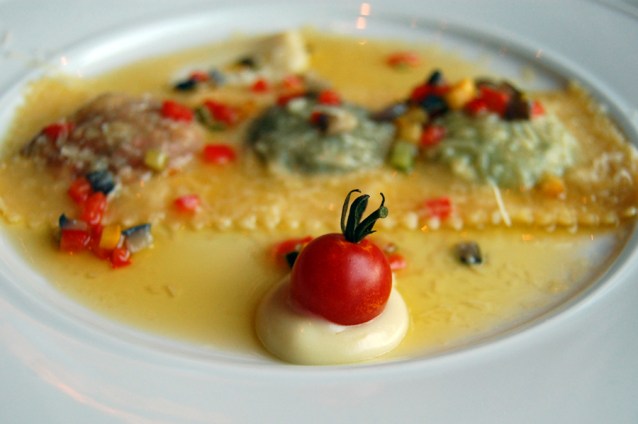
His ravioli were stuffed with a “deconstructed ratatouille,” in other words, all of the ingredients of the classic French dish, but prepared separately. Again, the quality of Lachlan’s pasta is a benchmark for Italian cuisine in the U.S. (Note the yellow color.)

1997 Schioppettino by Ronchi di Cialla was one of the most incredible wines we’ve drunk this year. Unbelievable minerality with this bright, fresh grapey note and under 13% alcohol. Simply incredible… It was gorgeous with Lachlan’s roast pork loin.

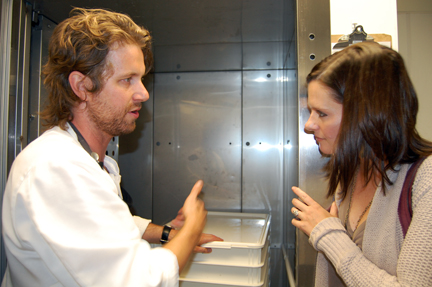
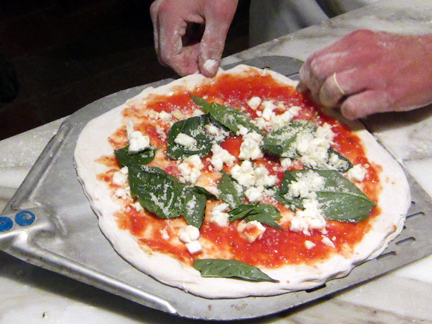
After dinner, Lachlan gave us a tour of the kitchen and revealed some of the secrets behind his Neapolitan pizza, served at their new pizzeria next door. Believe it or not, we actually went next door after our 3-hour dinner and ate again! I’ll post on the pizza later this week.

At certain point during our dinner, we were having so much fun that we were nearly overwhelmed by the joy of sharing food and together. Almost simultaneously, we looked into each other’s eyes and it was as if the same thought had just come to our minds at the same moment. I looked at Tracie P and told her I loved her and that it’s a miracle that we found each other: there’s no one else in the world that I could share an experience like this.

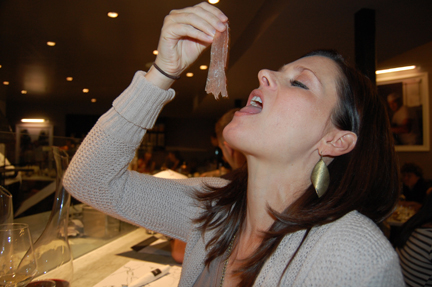
See that glimmer in her eye (as she enjoys a Sanbitter before dinner)? It makes me melt like prosciutto on her tongue…

IMHO, Frasca is the best Italian restaurant in the U.S. and you really can’t go wrong there. But it’s so much better if you go with someone you love…

There’s so much more to show and tell about our dinner in Boulder but it’ll just have to wait… Stay tuned and thanks for letting me share this special evening with you!

“If it’s a blend, I will not attend!” (And the Texas fires)

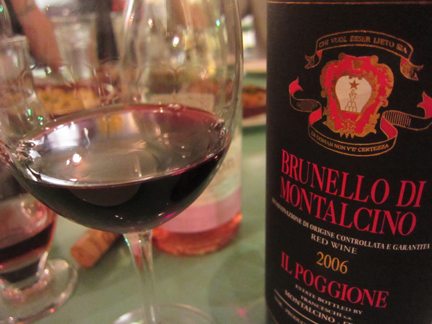
Cousin Marty had a hunch about what wine I’d be bringing to our BYOB dinner last night in Houston with friends. And when I arrived and revealed my bottle of 2006 Brunello di Montalcino by Il Poggione, he opened the evening with the line of the night: “If it’s a blend, I will not attend!”

Of course, he was referring to yesterday’s news that Montalcino producers voted NOT to allow international grape varieties in Rosso di Montalcino, a step that many of us feared would irrevocably reshape the appellation.

According to results posted by the Brunello producers association, roughly 2/3 of voting members voted not to adopt either of the two options proposed by oligarchy that controls the body’s technical council. One option would have created two categories of Rosso; the other would have created three; in either case, international grape varieties would have been allowed in wines labeled Rosso di Montalcino.

But that figure is misleading because consortium president Ezio Rivella had called for an “ordinary” assembly whereby the number of votes is allocated according to the size of the winery. In other words, larger wineries had more voting power than smaller wineries. If the voting had been based on a one-vote-per-winery basis, the results would have been a landslide against the proposal to change the appellation.

I am fully convinced that efforts by my colleague and partner in VinoWire, Franco Ziliani, played a fundamental role in shaping public awareness of the issues in question.

Chapeau bas, Franco! IF IT’S A BLEND, I WILL NOT ATTEND!

The 2006 Brunello by Il Poggione was gorgeous last night, rich in body, bright in acidity, with ripe red fruit and that wonderful horse sweat note that often distinguishes great Brunello. The wine was muscular and still very, very tight, young in its evolution. But the green notes that emerged the last time I tasted the wine about 6 months ago have disappeared. There’s no doubt in my mind that this is going to be a great vintage for Il Poggione.

In other and sadder news…

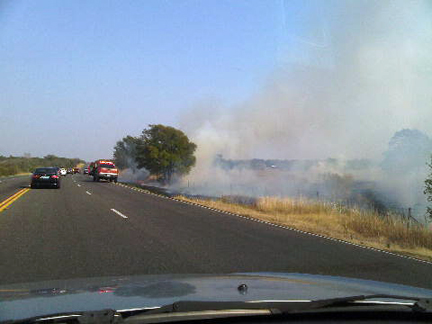
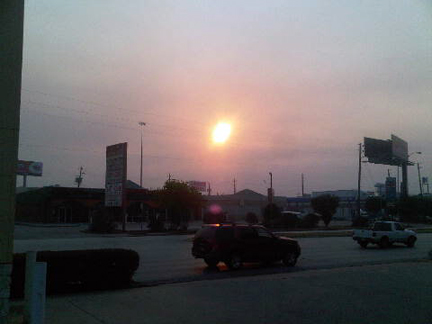
I wanted to share these photos that I took on Hwy. 290 from Austin to Houston of the Texas fires.

In the first photo, above, taken about 20 minutes west of Giddings, the fire had just started and the firefighters had just arrived. Man, it was scary and you could see the fear and the stress in the faces of the firefighters. G-d bless them.

In this second photo, you can see a plume northwest of Houston. Pretty spooky and so sad.

In this last photo, you can see the smoky haze over Houston this morning. That’s not morning mist. It’s ugly, brown smoke. My eyes are burning and my throat is itchy. It reminds me of LA during the riots when I was a grad student at U.C.L.A.

Tracie P and Baby P are fine and even though there are uncontained fires burning not far from our house in Austin, the smoke is not affecting us there.

Please say a prayer for all the folks who are suffering here… It’s so sad…

BREAKING NEWS: Secret ballot completed in Montalcino, Cignozzi threatens legal action

My friends at Il Palazzone in Montalcino have just reported that voting in the secret ballot to change the Rosso di Montalcino appellation (to allow international grape varieties) has been completed. The Consortium is currently tabulating the votes.

Producer Carlo Cignozzi has threatened legal action: as Franco reported yesterday on his blog, Cignozzi believes that Ezio Rivella was not authorized to call a vote on such a sweeping measure without calling for a full “extraordinary” assembly where all members would have equal voting power (at the “ordinary” assembly called by Rivella, the number of votes assigned to each producer is based on the size of the winery).

BREAKING NEWS: Franco Biondi Santi speaks out against proposed Montalcino changes

It would seem that the editors at Decanter and Gambero Rosso spoke too soon when they reported that Brunello di Montalcino great Franco Biondi Santi (left, photo via Weintipps) supported proposed changes to the Rosso di Montalcino appellation that would allow for blending of international grape varieties in Rosso di Montalcino (current legislation requires that Rosso di Montalcino be made with 100% Sangiovese grapes).

Last week, both publications cited him as a supporter of Brunello producers association president Ezio Rivella’s campaign to modernize the appellation. But evidently, neither contacted Biondi Santi — the grandson of the creator of Brunello di Montalcino and a towering figure in the history of the appellation — for comment.

“Three years ago I was in favor of the addition of softening wines or grapes to Sangiovese for Rosso di Montalcino,” said Biondi Santi in a phone interview today with one of Italy’s leading wine writers and top wine blogger Franco Ziliani, who quotes the signore del Brunello on his blog Vino al Vino. “Today, things have changed and my position is no to any change to the appellation.”

The proposed changes, he noted, would allow producers to transform 500 hectares of unsellable Sant’Antimo and IGT Toscana into Rosso di Montalcino.

“We would enter into the same thicket as 1966,” said Biondi Santi, “when the appellation ‘Vino Rosso dai Vigneti di Brunello’ was created.” [editor’s note: this appellation was changed to Rosso di Montalcino fifteen years later] “In the fall of 1966, Montalcino was obligated to found the Brunello Consortium, which became operative on January 1, 1967, with my father. After three months of negotiations with other producers, we decided not to enter the consortium because we strongly disapproved of how it was taking advantage of an equivocation at the time: the grape variety was also called Brunello and it was considered a subvariety of Sangiovese! Therefore, a no is indispensable in order to clarify.”