A second earthquake devastates Emilia (remembering the Emilian Renaissance)

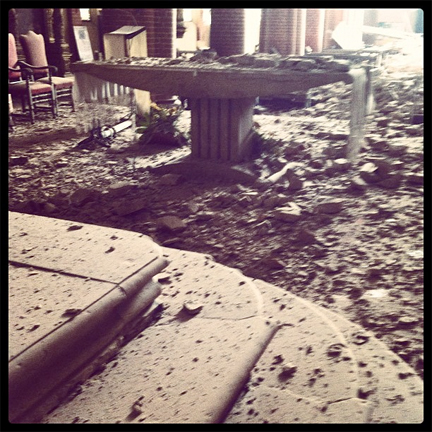
Above: The Duomo in Mirandola had withstood the earthquake of May 20 but crumbled this morning in a 5.8 magnitude earthquake. Photo by Cris Provenzano via Instagram.

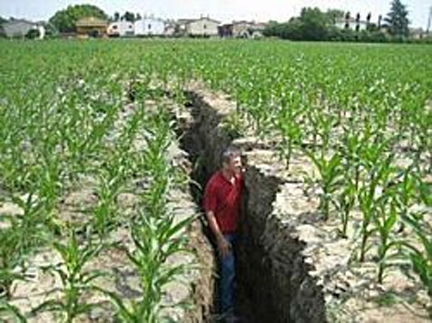
According to the reports I’ve been seeing this morning in the Italian news feed, there were at least 39 tremors in the region of Emilia this morning beginning at around 9 a.m. At 11:24 a.m., a 5.8 magnitude earthquake struck in the town of Mirandola (which lies at the center of a triangle formed by Ferrara, Modena, and Mantua).

The New York Times reports that at least eight persons died this morning. Thousands of people have been left homeless and scores of factories have collapsed or been closed because of structural damage.

Photo via AGI.it.

In an uncanny twist of fate, the township of Mirandola had planned a town hall meeting this evening with earthquake experts who had hoped to calm local residents (the Mirandola township has a great website, btw, an indication of the industriousness and uprightness of the people who live there).

Of all of Italy’s regions, Emilia and its beauty are perhaps the most challenging for foreigners to understand. Emilia is a land of intellectual and sensual pleasures and partly because it is not a producer of fine wine (aside from a few exceptions like La Stoppa in the province of Piacenza), most enogastronomic travelers tend to gloss over its cultural patrimony after they’ve dined at one of the regions many culinary meccas. (My favorites are Trattoria Bianca in Modena and Ristorante Canossa in Reggio Emilia.)

Whereas the Venetian and Florentine Renaissances produced iconic works of figurative art that continue to attract tides of tourists each year, the Emilia Renaissance delivered the great epic poems of the sixteenth century (think Ariosto and Tasso), wildly popular intellectual hits of their day but sadly forgotten in comparative literature curricula today in Anglophone countries.

To contemplate [historic] Humanism without one of its greatest voices, Giovanni Pico della Mirandola (whose family hailed from the town where the epicenter of today’s earthquake occurred) would be to disregard one of the greatest chapters in humankind’s intellectual development.

Our thoughts and prayers go out to the people of Emilia…

Prosecco polemic: Alan Tardi Responds

From the department of “par condicio”…

Last week I received the following message from Alan Tardi, one of the Italocentric wine writers I admire most. He was responding — however serotinely (no paronomasia with his name intended but if ever there were a case for the Latin adage nomina sunt consquentia rerum, this could be it) — to my post Prosecco, lies, and videotape: the real story behind the new wave Prosecco (published January 11, 2012) wherein I cited his New York Times article “Prosecco Growers Act to Guard Its Pedigree,” published that day. I have posted his message in its entirety below and recommend it to you….

*****

About a month ago I came across your piece about my article in the Times and wrote you a note but I’m afraid you might not have received it (I seem to have been having some trouble with one of my email accounts lately). Here it is:

Hi Jeremy,

Thanks for taking the time to read and comment on my article in the New York Times. I believe you posted your blog just after the article was published on January 11th but I didn’t see it until the other day when somebody sent me a copy of it. Otherwise I would have responded sooner.

One of the things I love most about wine is that there is always something to learn and discover, plus it’s always changing. With all this stuff in motion, it’s totally possible for someone to “get something wrong.” However, in this case it didn’t happen.

Continue reading →

Carlo Ferrini and me (so many great wines & so little time)

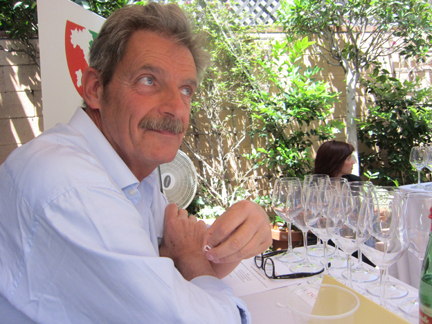
Love him or hate him, legendary and often controversial Tuscan enologist Carlo Ferrini and I sat next to each other on the Sparkling Wine panel at the Viva Vino conference yesterday in Los Angeles.

We had a chance to speak for a few minutes before the panel and he was exceedingly forthright in his answers when asked about Montalcino, his association with Casanova di Neri, and what he considers his legacy and contribution to the history of Italian wine over the last few decades.

I don’t have time to post notes from our conversation today but will offer the following nugget.

When I asked how he feels about the fact that so many in Italy and beyond associate him with Merlot (many in the industry call him “Mr. Merlot,” using the English title mockingly), he said, quite frankly, “I don’t understand why people say that of me, when, in fact, it’s Cabernet [Sauvignon] that I like so much.”

I have to say that I admired his friendliness, style, and earnestness and I plan to visit with him this fall when Tracie P, Georgia P, and I head to Tuscany.

In other news…

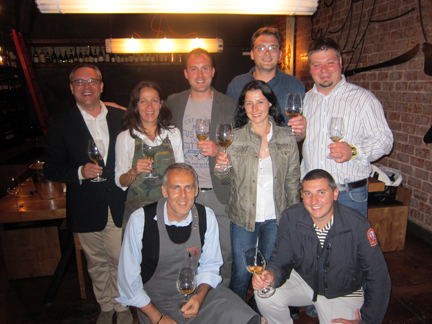
It was a blast to connect with the newly formed consortium of Oslavia (Collio, Friuli) producers who visited Los Angeles for the conference and trade events (after stopping for two days in Vegas where they partied their asses off).

That’s Max Stefanelli of Terroni (kneeling, left) and his wife Francesca behind him with six of the seven producers from the village (can you guess the single producer who didn’t come? I’m buying a glass of wine tonight at Sotto for anyone who can!).

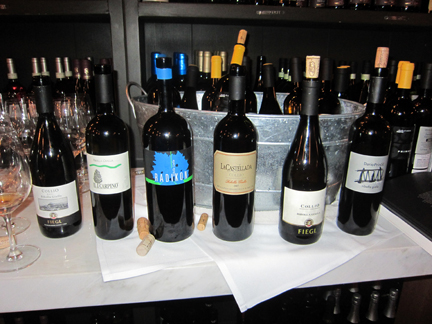
Here are the wines they poured for me and a handful of industry folks who attended a late night dinner and tasting at Terroni.

In other other news…

I connected yesterday with Lou (who needs no introduction here) and my new BFF Taylor Parsons, wine director at Osteria Mozza and Tuesday night I had dinner with Anthony and David at Mozza, where the conversation spanned an arc of Mel Brooks Hitler humor, the art of mixing (records), Anthony’s father’s incredible musical legacy (“he’s conducting better than ever at 93,” he said), burrata, anchovies, and Verdicchio.

So many great wine and so little time… So much more to tell but I have another slamming day and evening ahead of me here in Los Angeles.

If you happen to be in town, please come and see me at Sotto where I’ll be pouring wine on the floor from 6 until 9 or so…

Radikon, my visit to Oslavia

Heading to Los Angeles today where I’ll be working the floor (introducing our summer wine list) at Sotto Wednesday and Thursday nights and speaking tomorrow on a panel at the Italian wine fair for consumers and trade, Viva Vino. LA is buzzing right now with the arrival of the group of winemakers from Oslavia (Friuli) led by the young Saša Radikon, whom I’ll be meeting tonight. So I thought I’d post my photos from my visit to the winery a few years ago. Look for Saša and the Oslavia producers at DomaineLA on Thursday.

The skin-contact Ribolla of Radikon first came to my attention in the late 1990s in New York in an era long before the terms “orange wine” or “natural wine” were in vogue. Stanislao Radikon (above with wife Suzana) was the first to experiment with skin-contact starting in the mid-90s. (I highly recommend this profile from the recent Raw Wine fair in London devoted to the Radikon family and story.)

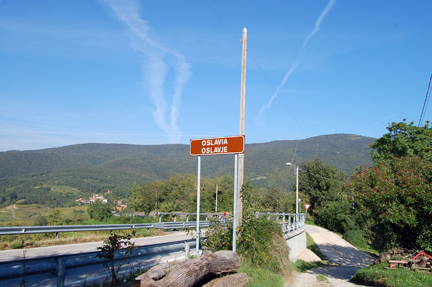
The village of Oslavia lies literally on the edge of the western world, just across the border from Slovenia in the province of Gorizia (in the Collio appellation).

One of the first things that Stanko (Stanislao) wanted to show me was the hill where then Colonel (later General) Badoglio fought the battle of Oslavia, one of the last and most bloody assaults of the First World War (just Google Badoglio and Oslavia to get a sense of the horror evoked by the toponym for a generation that came before us).

Today it is a place of immeasurable beauty, although many of the battle scars remain — topographical and emotional.

Stanko was perhaps the first to recognize the immense tannic potential of Ribolla (above), which, until that time, was used only to make light, white quaffing wine (in much of wine-making Friuli and Slovenia, it is still applied as such, although sparkling wine from Ribolla is becoming increasingly popular).

Stanko’s dense, cloudy, tannic, salty expressions of Ribolla changed the way the world viewed the variety and opened many’s eyes to the potential of “orange” (skin-contact) and “natural” wines ante litteram.

Open vat fermentation and extended skin contact are among the techniques applied to create Radikon’s long-lived, powerful, yet delicately nuanced bottlings of Ribolla.

Note the unexploded bomb from the First World War in the abandoned farmhouse where Stanko built his new cellar in 2002.

One of the things that impressed me the most was the contrast between ineffable rural beauty and the memory of carnage and senseless sacrifice that linger there. Stanko is a quietly intense man whose soulful winemaking is as much an expression of ideology as it is a pure and natural product of his land.

I’ll be meeting with Saša and his group tonight for dinner and I’m sure I’ll have much to report tomorrow… Stay tuned…

The Story Behind Nascetta (and Anascetta)

I get so many emails from folks saying how much they appreciate this post on the story behind the ampelonym Nascetta that I thought I’d repost it today. Buona lettura!

*****

Romeo, doff thy name!

Above: Valter Fissore of Elvio Cogno (Novello) single-handedly delivered the Nascetta grape from oblivion after he tasted a wine made using this once highly praised grape in 1991. The wine had been bottled in 1986.

It’s regrettable that when I tasted the Nascetta grape for the first time last year, it was served to me ice cold and was described as a “light-bodied white wine.”

While in Piedmont in March of this year, I happily learned that Nascetta is actually a noble white grape variety that can produce long-lived, structured wines. And I had the great fortune to taste Valter Fissore’s excellent 2001 bottling — a nearly decade-old expression of this grape. In my notes, I wrote “rosemary, sage, petrol,” and was blown away by the structure of the wine, its lively acidity, and most of all its gorgeous, unctuous mouthfeel.

Yesterday, in a wonderful post on drinking the last extant bottling of a vintage, Cory nudged me to fulfill a promise to explore the origins of the name. And so here it is.
First of all, a little history.

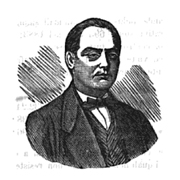
The name Nascetta was coined by 19th-century Piedmontese enologist Giovanni Gagna (left, 1833-1881), who believed erroneously that the grape was related to the Sardinian grape Nasco (from the Sardinian nuscu, from the Latin muscus, meaning moss). Remember: for the better part of the 18th and 19th centuries, Sardinia, Nice, Savoy, and Piedmont were ruled by the House of Savoy (the Kingdom of Sardinia), with its court in Turin and so commerce between Sardinia and Piedmont was fluid during that period.

In 1877, Count Giovanni di Rovasenda listed the grape using its dialectal name, Anascetta, in his landmark Saggio di una ampelografia universale (Essay on Universal Ampelography). The fact that he uses the dialectal inflection of Gagna’s name for the grape is an indication of how popular the grape was in Piedmont at that time, when it was commonly blended with Favorita (Vermentino) and Moscato. (In Piedmontese dialect, an initial a is added to certain words to compensate for syncopated, i.e., lost vowels; in this case, the acquisition of the initial a would appear hypercorrective, a phenomenon not uncommon in the morphology of Piedmontese.)

Here’s where it gets a little complicated.

Above: The confusion regarding the name of this grape was created in part by Valter’s frustration with labeling requirements. In 2001, he bottled the wine as a non-vintage vino da tavola (table wine) because the grape was not yet authorized for the Langhe Bianco DOC appellation.

Let’s start with some chronology:

1991 – Valter tastes a bottling of 1986 by farmer Francesco Marengo (Novello).
1994 – Valter produces 800 bottles from his own planting of the grape, labeled as Nas-cetta; following this vintage, Valter is forced to stop labeling the wine as Nas-cetta after he is fined for listing an unauthorized grape variety name on the label.
2000 – Nascetta (the grape) is added to the catalog of authorized grape varieties for Langhe.
2004 – Valter bottles the wine as Langhe Bianco DOC but cannot list the grape variety on the label; he labels the wine “Anas-cëtta” using a “fantasy” name because the grape is not authorized for the Langhe Bianco DOC labeling (it’s authorized for the blend but not the label).
2010 – After Valter’s successful lobbying, the 2010 vintage will be first labeled as Langhe Nascetta [sic] DOC.

Above: Valter’s Nascetta is an excellent value for a structured, age-worthy white. Be sure to serve it at cellar or room temperature.

When I asked Valter directly about his use of diacritics (in this case the umlaut and the hyphen), he told me flatly that he introduced them in the labeling for purely proprietary reasons. The mutation of the grape names Nascetta and Anascetta was inspired by his frustration with labeling requirements. The good news is that the confusion has been resolved and this noble white grape will be labeled as “Langhe Nascetta DOC” beginning with the 2010 vintage.

While in Piedmont in March, I also tasted another excellent bottling of Nascetta by Rivetto.

Be sure to read Cory’s post on the last bottle of 2001 and Whitney’s post, too.

… O, be some other name!
What’s in a name? that which we call a rose
By any other name would smell as sweet;
So Romeo would, were he not Romeo call’d,
Retain that dear perfection which he owes
Without that title. Romeo, doff thy name,
And for that name which is no part of thee
Take all myself.

Wine Lovers Bill of Rights @EatingOurWords

We the Wine Lovers of the United States, in Order to form a more perfect Meal, establish better Wine Pairings, insure enogastronomic Tranquility, provide for the common wine service, promote the quality of fine wine, and secure the Blessings of Vinous Liberty to ourselves and our Posterity, do ordain and establish this Wine Drinker’s Bill of Rights for the United States of America.

Click here to read my work-in-progress wine lover’s Bill of Rights post today for the Houston Press…

Pergola-trained Schiava that blew us away… @MasVinoPorFavor

From the department of “ampelography and vinography as exegetic tools that help us to achieve a more profound understanding of the human experience and condition”…

schiava

Photos by Tracie P.

Every once in a while, you stumble upon a bottle of wine that expands your vinous horizons.

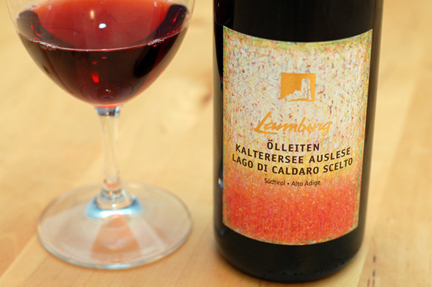
Once such bottle came into our lives the other day after wine seller Marcy Jiminez in Houston recommended it to me: the 2008 Laimburg Alto Adige/Südtirol Kalterersee Auslese Classico Superiore DOC Ölleiten (Kalterersee is German for [Lago di] Caldaro Scelto; “Ölleiten” refers to the fact that the vineyards lie adjacent to olive groves).

Here’s the link to the winery and link to the wine and fact sheet.

The wine was bright and fresh, with the zinging acidity and balance of technicolor (red berry and black cherry) fruit and earthiness that really turn us on. And even in a market like Texas, where we pay more for European wines than our counterparts in New York and California (thanks to higher alcohol tax, higher storage cost, and the big distributors’s choke-hold monopoly on the Texas legislature), this wine weighed in at only $23.

We love, love, loved it…

Especially after tasting a wine like this, it’s not hard to understand why Schiava was such a popular grape in another era.

As editors Calò et alia write in Vitigni d’Italia (Grape Varieties of Italy, Calderini, Bologna, 2006), Schiava (pronounced SKEE’AH-vah) “was one of the first grape varieties to be cited in the legal documents and treatises of the Middle Ages.” Its popularity was so great that “it represented the viticultural model for Slavic grape growing by antonomasia.”*

The name Schiava comes from the High German Schlaff, an ethnonym denoting “A person belonging by race to a large group of peoples inhabiting eastern Europe and comprising the Russians, Bulgarians, Serbo-Croats, Slovenes, Poles, Czechs, Slovaks, etc.” (Oxford English Dictionary). And it is related to the Italian schiavo (meaning slave, from the Latin sclavus) only in its morphology.

In other words, it was (and is) an ampelonym that, by synecdoche,** represented a cultural epoch in which Slavic culture dominated that part of the world.

When I attended Vinitaly earlier this year, I asked Florian Gojer of the Gojer winery to pronounce Lagrein for the Italian Grape Name & Appellation Pronunciation Project. When I asked him to pronounce Schiava, he insisted on using the German name, noting that in “Alto Adige, we use the German” Vernatsch.

My philological intuition points me to a relationship with Vernaccia but that inquiry will have to wait for another day. In the meantime, here’s Florian…

* antonomasia: “The use of a proper name to express a general idea, as in calling an orator a Cicero, a wise judge a Daniel” (Oxford English Dictionary).

** synecdoche: “A figure by which a more comprehensive term is used for a less comprehensive or vice versâ; as whole for part or part for whole, genus for species or species for genus, etc.” (Oxford English Dictionary).

Franciacorta “reset” applauded by winemakers

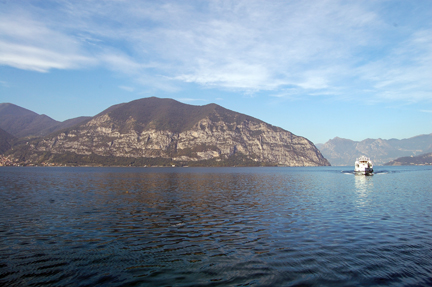
Above: The gorgeous Lago d’Iseo (Lake Iseo) provides maritime influence for the vineyards of Franciacorta. The beauty of Italy’s topography is immeasurable.

“No inflated numbers this time. No triumphalism. And not even any orgasms during a ‘Ring Around the Rosie,'” wrote my good friend, winemaker, and Franciacorta superhero Giovanni Arcari on his blog yesterday. “Nonetheless, it feels like a good moment to celebrate a success, even if that success was generated by a problem.”

Giovanni was referring to newly announced Franciacorta appellation regulations that will lower yields, raise the minimum vineyard age, and help to raise production standards throughout the appellation, where Champagne-method sparkling wines are produced.

By all accounts, Italy produces more sparkling wine than any other country: at latest count, “400 million bottles with Euro 1.7 billion in sales.”

Despite the generally bleak outlook for Italian winemakers, these figures have resulted in robust chest-beating, fist pumping, and a surplus in funds devoted to marketing (the “triumphalism” to which Giovanni refers).

But Franciacorta, an affluent appellation created in the 1960s and funded by Italian steel magnates, has suffered the economic crisis more acutely than any other sparkling wine producer: as Franco Ziliani reported on his sparkling wine blog earlier this year, prices for Franciacorta — a luxury product — have reached alarming lows, with wines being sold in Europe for as low as Euro 4.

Above: One of the most interesting tastings I attended during the 2011 European Wine Bloggers Conference was a flight of nearly 30 Franciacorta crus at the Berlucchi winery. I think that many would be surprised at the diversity of growing sites in the appellation (but more on that in a future post).

The new appellation regulations were approved by an overwhelming majority (by Italian standards) of 80% of consortium members, reports Giovanni.

And the measures will deliver significant change in an appellation dominated by large commercial producers whose bottom line often trumps character and originality in the wines they bottle.

Of all the sparkling appellations in Italy, Franciacorta — there’s no doubt in my mind — has the potential to deliver truly great and original wines: even though very few of the top bottles make it to the U.S., I’ve tasted some stunning wines in Franciacorta, where fresh, clean, bright Pinot Noir and Chardonnay take on an intensely saline quality that pairs superbly with the fresh water cuisine of the Italian Lake District.

And the new appellation regulations, everyone seems to agree, are a step in the right direction. [We must] “improve to grow and grow to improve,” wrote Giovanni in the chiasmus of his title. And they are sure to do more than consortium president Maurizio Zanella’s recent appeal to the Italian media to stop using the term bollicine (tiny bubbles) when referring to Franciacorta.

Franciacorta and sparkling wines from Italy have been on my mind lately because I’ve been asked to speak on a panel devoted to the subject at the upcoming Viva Vino conference in Los Angeles.

The Holy Grail quest to produce sparkling wines has played an enormous role in shaping the history of Italian wine in general. And I’ll devote an upcoming post to my research.

In the meantime, if you want to get the discussion rolling, please share your thoughts in the comment section.

What is it, after all, that makes sparkling wine play such a powerful role in our vinous psyche?