Alice Feiring joins us @SottoLA with Frank Cornelissen and Lou Amdur

From the department of “ubi maior minor cessat”…
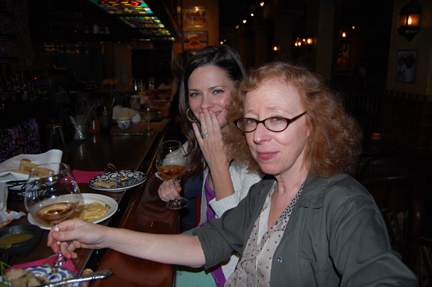
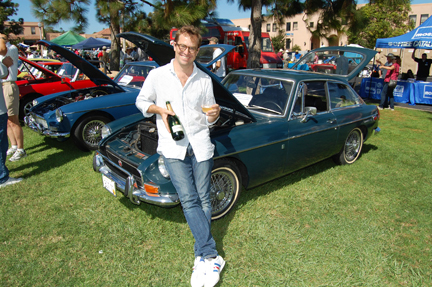
Above: When ever Alice (foreground), Tracie P, and me get together, we always manage to cause trouble (just ask Alice; she’ll tell you!).

A few months ago, I was approached by one of the top wine distributors in California, Amy Atwood, who asked me if Sotto in Los Angeles (where I curate the wine list) would like to host a wine dinner with radical natural winemaker Frank Cornelissen, who raises wines on Mt. Etna (Sicily).

I was thrilled, of course, and I immediately reached out to Natural wine authority Lou Amdur, a Los Angeles icon in the field: to not have Lou at the event would have been nothing less than egregiously negligent.

And of course, my dream was to have Alice Feiring there as well: between her excellent blog and her two monographs on the subject, Alice is the Natural wine movement’s leading authority and its most sage voice. (And she’s also a dear, dear friend who has not only mentored me at different moments of my career but also helped me regain my footing in some of the darkest moments of my life.)

Well, folks, I’m here to tell you that dreams do come true.

We’ve hit the Natural wine trifecta: this week Alice agreed to attend our Cornelissen dinner at Sotto on November 11.

Click here for details. I hope to see you there: it should be a night to remember…
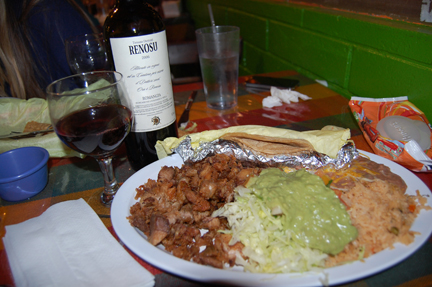
Declassified Dettori 06 Cannonau Renosu & carnitas at Bahia Don Bravo (La Jolla)

Last year I was lucky to pick up a case of 2006 Romangia Rosso Renosu by Dettori (Sassari, Sardinia), Alessandro Dettori’s declassified Cannonau from the “uneven” 2006 vintage there (as Antonio Galloni has called it).

The U.S. retailer and Alessandro don’t seem to be on the same page as to why the wine was declassified (possibly because of a language issue?).

According to Alessandro, he decided to bottle the wine in 2008 in the middle of a disastrous vintage for him. Normally, he would have let the wine age longer in vat before bottling. But according to one of his ever lyrical emails, the bottling was inspired by a bout of powdery mildew during the devastating summer (for Dettori) of 2008.

Maybe he was concerned the onslaught of bacteria tainted a few of his vats. Or maybe, as he suggested in an email, he remembered how previous generations bottled their wine right away. They did so because they wanted the wine to be ready for the winter and feared being without wine. But by doing so, they also avoided potential spoilage issues.

I’d seen mixed reactions to this wine in the chat rooms. But I also know that Alessandro’s wines require patience — in your cellar and at the table.

He calls his declassified wines “Renosu,” meaning sandy (from the Latin [h]arena, meaning dry, sterile sand). According to his own gloss on the term, it refers to the wines raised in the lower-lying sandy subsoils as opposed to his hillside vineyards (when in fact, the grapes used to make this wine were once intended for his flagship red wine, the Dettori Rosso).

The good news is that the only bad news is that I wish I would have bought more of it!

When opened a bottle the other night with a heaping helping of carnitas at our favorite taco stand in La Jolla, Bahia Don Bravo.

We didn’t get any of the volatile acidity that folks on the boards have talked about and the wine was fresh and bright, juicy and tasty. Had I not known it was a declassified Dettori, I would have said it was the rosso (it’s one of those wines that, if you follow the producer, you can easily pick out in a blind tasting).

I loved the wine and it was a fantastic pairing for the salty, fatty carnitas.

Georgia P had refried beans for the first time that night. I think it’s safe to say that she liked them. ;)

We were sad to say goodbye to grandma Judy, Georgia P’s cousins, and all our good friends in San Diego. But after a week on the road and away from our little house at the corner of Gro[o]ver and Alegria, it was time to get back to Texas where we belong…

Luigi Tecce: “what I don’t put in my wine”

Luigi Tecce’s wines first came to my attention two years ago when I was visiting and tasting in southern Italy. They blew my mind… They’re some of the best wines I’ve ever tasted… period… end of report…

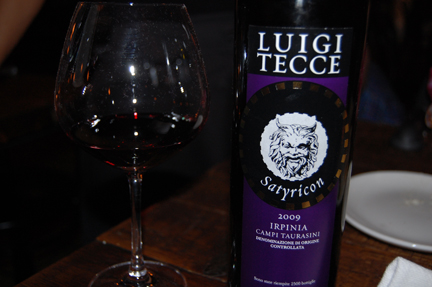
And I’m very proud that we have the 2009 Satyricon (Campi Taurasini) and 2007 Poliphemo (Taurasi) on our new fall list at Sotto in Los Angeles.

These are native-yeast-fermented, large-cask aged STUNNING expressions of Aglianico from Campania. I’ll never forget the look on Tracie P’s face when she tasted the wine with me last night at dinner.

“This,” she said, “THIS is what Aglianico tastes like.”

She would know: she lived between Ischia and Naples for nearly five years.

I loathe the saying that Aglianico is the Nebbiolo of the south. If anything, Nebbiolo is the Aglianico of the north!

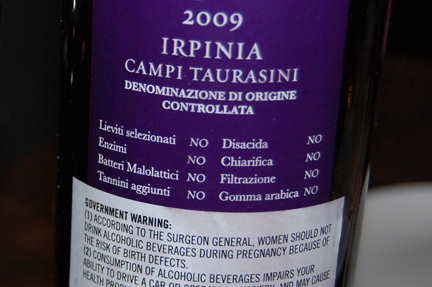
But I will say that there is a virtual kinship between Luigi Tecce and Bartolo Mascarello. Here’s a translation of the back label:

cultured [pharmaceutical] yeast NO
enzymes NO
malolactic bacteria NO
added tannins NO
de-acidification NO
clarification NO
filtration NO
gum Arabic NO

No need to call this wine “Natural.” It’s just wine… great wine… friggin’ brilliant wine…

Amphora-aged Cerasuolo d’Abruzzo, almost as good as sex cc @SottoLA

“Just one look…”

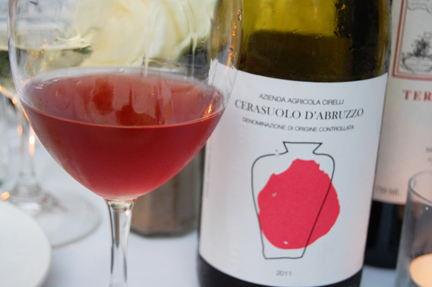
There are certain wines that seduce you from first glance. Their color and visual texture alone are enough to make you horny.

Such was the case yesterday early evening when I opened a bottle of Francesco Cirelli’s amphora-aged Cerasuolo d’Abruzzo for some of our best friends. I’ll never forget the moment when I poured it into the glass and the whole table collectively sighed…

Beyond its hue, Francesco’s wine achieves a benchmark balance of savory and sweet and its mouthfeel and finish are toe-curling.

It could possibly be my favorite wine for 2012, almost as good as sex.

Earlier this year, I asked Francesco to pose for my video camera and pronounce Cerasuolo d’Abruzzo for the Italian Grape Name and Appellation Pronunciation Project (see below). And I’m extremely proud and thrilled that we will be debuting the wine this week on my fall list at Sotto in Los Angeles (I’ll be at the restaurant tonight and tomorrow).

Cultural entrepreneurship on the rise among Italian winemakers

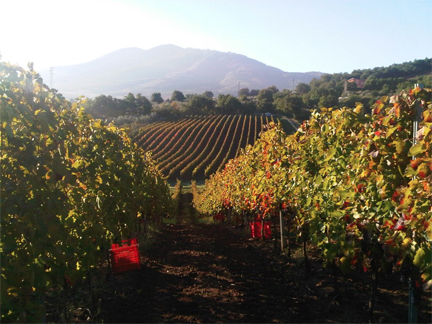
A photo of Vigne del Vulture’s vineyards in Aglianico del Vulture, taken September 20. Image via Gabriele Ladislao Moccia’s Facebook.

While Tracie P, Georgia P, and I were in Melfi (Basilicata) a few weeks ago, we had the chance to meet and taste with a young producer, Gabriele Ladislao Moccia. His winery, Vigne del Vulture, is new on the scene: a native of Vulture and purveyor of fine food products, Gabriele has been using his contacts in the nordic countries to distribute his wines with great success.

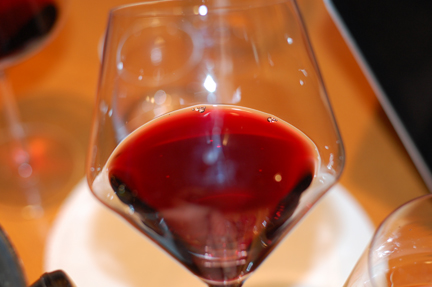
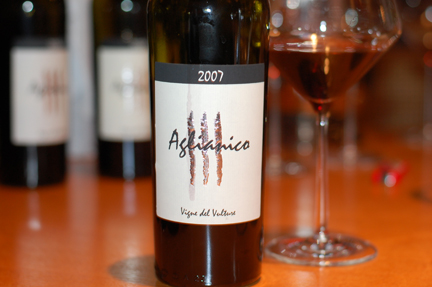
Above: I wouldn’t call Gabriele’s wines classic in style but they are a true expression of the grape variety. Note the dark color and transparency of his 2007, which I liked a lot.

His wines aren’t yet available in the U.S. but I wanted to write a note about them because I believe that Gabriele represents a new trend of young Italian entrepreneurs who recognize the value of authenticity in their wines.

Vigne del Vulture’s wines are a little rough around the edges and they still need to come into focus. But I was impressed by Gabriele’s resolve to make wines that truly reflect the appellation.

A generation ago, many Italian winemakers set out to make wines for the American market: if you follow along here at Do Bianchi, you’ve seen my reportage on wine industry greats like Ezio Rivella who have declared — very publicly — that they were “deliberately adopting a California style.”

Above: I thought that Gabriele’s 2007 showed the best in the flight we tasted. It tended toward modernity but didn’t ever lose its continuity with true varietal expression and the appellation.

As we traveled through Italy on this last trip, I found more and more signs of a new generation of young Italians who are looking to enter the U.S. market with wines that reflect their local traditions, even if they do lean toward modernity.

Of all the winemakers we visited, Gabriele was one of a score of thirty-somethings who embrace authenticity (if not tradition) in their approach to their products.

This trend is the opposite of the generation that came before them. Perhaps they take their inspiration more from a renewed sense of identity and purpose than from old man Mondavi and the Napa Valley revolution.

I liked Gabriele a lot and I’m looking forward to tasting the new releases next year when they arrive.