

Category Archives: de vino
Taste with me @JaynesGastropub tomorrow in San Diego
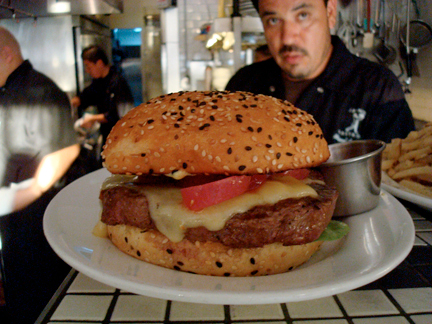
Here are the details! Hope to connect with you tomorrow in “America’s Finest City” (and my hometown).
How a bag of weed launched the biodynamic movement in California
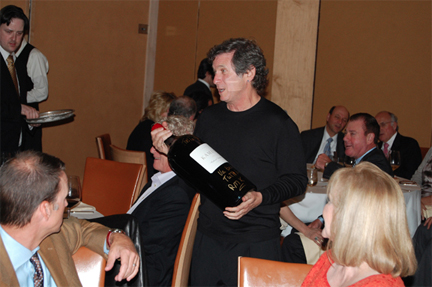
Wax on, wax off. Yes, Robert Kamen (above) is the dude who wrote the iconic line. He’s also written numerous screenplays that have been made into Hollywood blockbusters.
Yawn. That’s the least interesting part of the story.
In my view of the world, what’s really fascinating about Robert is that he inadvertently and unwittingly financed California’s biodyanmic movement.
Robert comes to Texas every year to speak a wine dinner at the swank restaurant Tony’s in Houston, owned by my friend and client Tony Vallone.
He’ll be there next week, doing his song and dance for the petroleum crowd, but I’ll be in Italy doing a job for a client of mine (the event is already sold-out btw).
So I called him the other day and asked him about how, why, and when he decided to hire Phil Coturri — the father of California’s biodynamic movement — and if he had intended to play the role of the movement’s financier.
The story’s been told many times. Back in 1980, Robert sold his first screenplay and went up to Sonoma to party in celebration. A few weeks later, using the money from the script, he purchased the property that would ultimately become his Kamen Estate, now famous for its “mountain Cabernet” and a line of wines that commands respect among wine professionals who might otherwise write off yet another Northern Californian wine produced by a “Hollywood guy.”
But don’t use the binomial “Hollywood guy” around Robert. It really gets under his skin.
“Look at the wineries owned by ‘Hollywood guys,'” he said to me, obviously ticked off. “They planted vineyards. I planted a farm.”
“We don’t just grow grapes here. Six months of the year, Phil grows grapes. The other six months of the year, he grows cover crops.”
“When I hired Phil [in 1980],” said Robert, he wasn’t “thinking in terms of the future. I just didn’t want to do things that were deleterious to the property.”
At the time “Phil’s rap was so compelling. And it was just fortuitous because the organic movement was just picking up then.”
I asked if he saw himself as pioneer in organic and biodyanmic farming in the Northern California wine community.
Yes, he said, “but I’m not a proselytizer. I’m not a crusader.”
Today, he told me, the Kamen estate in Sonoma (replanted in 1996 after a fire destroyed the vineyards) is the model that Phil uses to show other grape growers who are interested in converting to organic and biodynamic farming.
His farm “was the laboratory” for the biodynamic movement. Today “it is the showcase,” said Robert.
So why, I asked, did he hire Phil in the first place?
“After I sold my first script and came up here, we partied all night long on the property” that he would buy a few weeks later.
“I wanted to meet the guy who grew the pot we smoked… because I wanted to buy more. It was that good. And that guy was Phil.”
I asked Robert if it was okay for me to post this information on my blog. He said, sure, go ahead.
I can’t post the words that he reserved for our president and the federal government’s attitude regarding the states’ legalization of medicinal and recreational marijuana. But that’s another story.
And although it really has nothing to do with this story, I just have to share one last nugget.
When I asked Robert where Phil learned to grow grapes, here’s what he said.
“Phil’s a farmer — an Italian farmer. In 1974, he went to work his first harvest at Mayacamus. And the guy who taught him was named Joe Miami. I’m not making that up.”
When a Hollywood New York screenwriter tells you that he’s not making shit up, you KNOW it has to be true.
Sublime elegance in Clos Rougeard (thank you from the heart @adamjapko)
From the department of “some how, some way, I get to taste funky-assed wines like every single day”…

Collectors generally want to “taste me” (as we say in the biz) on their Italian lots. Thanks to their generosity, I’ve had the opportunity to taste many Italian wines that would otherwise be out-of-reach for a bourgeois like me.
Occasionally, someone will break out some bottles from their French collection for me. And that’s what happened when a blogging colleague of mine, the inimitable and brilliantly dynamic Adam Japko, thoughtfully brought two bottles of the extremely rare Clos Rougeard Saumur-Champigny to Austin last week.
My tasting note: wow WOW!
I had never had the chance to taste the wines previously and it was clear, from first sip, why so many great tasters and writers hold this wine to be the greatest expression of Cabernet Franc from the Loire valley.
Here’s Dressner’s haughty backgrounder on the estate.
To it, I’ll only add that these wines are the apotheosis of what I like to call the “unbearable lightness” in wine, where richness and power find a graceful and willing dance partner in elegance and nuance.

Adam also tasted me on the Valentina Cubi Amarone della Valpolicella, a gem of a wine and wonderful discovery that he made by chance on a business trip to Verona.
One of the signatures of biodynamically farmed wines like this is their Technicolor fruit and electric acidity. And when you combine those elements with “typicity,” you are guaranteed a winner.
I liked the wine a lot and loved its food-friendliness. So many expressions of overcropped Valpolicella go for “big” and “bold” and “muscular” these days. It’s great to see a “gentlewoman” farmer like Valentina embrace the traditional style and deliver wines that can be enjoyed at the table.
I’ve made so many wonderful friends through wineblogging. And my newly sparked friendship with Adam is such a great example of how blogging creates vibrant networks of like-minded and similarly spirited people.
We had so much fun that we would have stayed to close the joint if I didn’t need to get back to my girls and he didn’t need to get some rest before his talk the next day.
Adam, thanks, again, man, for the generosity, friendship, and solidarity… Know you have a friend in Austin and there’s always a seat at our dinner table for you…
But, then again, you already knew that… :)
family portrait & shout-out 2 @FourSeasons @TRIOAustin @MarkDevinSayre
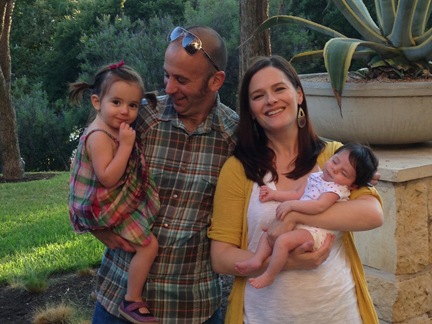
Above: The garden on “Lady Bird Lake” (actually the Colorado River) at the Four Seasons hotel in Austin is one of our favorite spots in town. The superb staff takes the experience there from A to A+.
Granted, I’ve spent so much time at Trio (restaurant) at the Four Seasons in Austin, Texas since I moved here five year ago that I know most of the staff by name.
I first went there back in 2008 when I wanted to take Tracie P on a romantic date and share a great bottle of wine (Vosne-Romanée by Mongeard-Mugneret, I still remember well).
The restaurant’s wine director, Mark Sayre, one of the top wine professionals in Texas, has been a good friend ever since (and he loves to tell the story of how I “interviewed” him over the phone when I called to inquire about the list).
Since that time, it’s become my go-to spot for business meetings, professional wine tastings, and family outings (it’s where Tracie P and I courted in the eighteen months that led up to our union).
Last week, I took all of my girls there for a margarita for Tracie P, a glass of wine for me, and snacks for Georgia P.
We couldn’t have been seated for more than two minutes before Georgia P had a popover (see the video below), a coloring book, and crayons.
The Four Seasons brand is well known for its extreme hospitality and the hotel and restaurant here in Austin are flagship examples of how earnest graciousness is so key to a fulfilling restaurant experience.
Chapeau bas, Four Seasons! Trio is such a wonderful asset in the Austin wine community.
Harvest update from Ornellaia’s Masseto & points beyond

Yesterday, my friend Leonardo Raspini, vineyard manager at the Tenuta dell’Ornellaia, sent me the photo above. The grapes in the photo are from the estate’s famed Masseto vineyard.
As one of the most manicured growing sites in the world (according to WineSearcher, the average retail price for the 2009 [current] vintage is $517 but if you look around, you can find a bottle for around $350), Masseto is a benchmark for any vintage. And because Merlot is always picked before Sangiovese, it gives a good indication of the harvest outlook.
Here’s what he had to say…
“The grapes you see in the photo belong the central part of the vineyeard, where the clays are abundant [in the subsoil], giving the Merlot bunches a particular shape and quality.”
“The harvest began on September 9 and it’s moving ahead well, with a 10-15 day delay [with respect to recent vintages], which originated during budding and flowering.”
“Ripening is ideal thanks to a sunny but cool climate. Yesterday, we were harvesting in the high part of [the] Masseto [vineyard] and the grapes couldn’t be in better shape.”
Yesterday in Montalcino, my friends at the Tenuta Il Poggione began picking Sangiovese for their rosé wine “despite some light rainfall.”
And earlier this week, my super good friend Laura at Il Palazzone (Montalcino) posted this excellent harvest update, including predictions for the vintage and comparisons, by some leading experts, to 1979.

Up in the Veneto, my friend and client Luca Ferraro began picking his Glera grapes for Prosecco on Saturday.
He reports — with his usual candor — that unexpected rainfall is “cause for concern.”
Tracie P and I are keeping our fingers crossed for them.
In the Castelli di Jesi in central Italy, our friends and clients Alessandro Fenino and Silvia Loschi’s Verdicchio harvest is in full swing.
And down in Puglia, my friend and client Gianni Cantele is elated about the quality of his Negroamaro grapes.

But what he’s really got us thinking about (and craving for) today is his mother’s eggplant parmigiana.
“My harvest exile in the cellar continues,” writes Gianni, who, like all winemakers during this period of the year, literally lives at the winery without being able to return home. “I’m beginning to miss my bed and the comforts of home. But I will stoically carry on.”
“There are two things that give me the strength not to give up: Negroamaro grapes worth shouting about (a great vintage!) and my mother’s eggplant parmigiana.”
All in all, Italian grape growers are hoping for a great vintage this year, despite some inclement weather that’s affecting northern and central Italy.
I’ll be in the Veneto in a few weeks and will report back then. And I’ll also be in Montalcino, where they should be gearing up for the Brunello harvest.
L’shanah tovah, everyone. I’ll see you in a few days. May your fast be easy and may your new year be sweet and filled with joy and health…
Italian government announces natural wine inquiry
The image below and following text (translation mine) are from a post by Giovanni Corazzol that appeared today on the popular Italian wine blog Intravino.
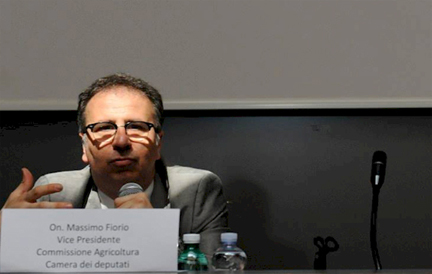
“The meaning of ‘natural wine’ must be clarified. Many bottles are labeled as such and they have invaded the Italian market. It’s a definition that, until today, has been self-regulated and it creates the risk of disorienting consumers and penalizing winemakers.”
With these words, Massimo Florio, a member of [the Italian parliament’s] Chamber of Deputies and vice president of the [Italian government’s] agriculture commission, announced an inquiry into the question [of natural wines].
I’m posting from the road today and don’t have time to translate the entire article. The government announcement has already sparked a thorny debate in Italian-language social media. I’ll post translated excerpts as soon as possible.
The most talked about wine in Texas
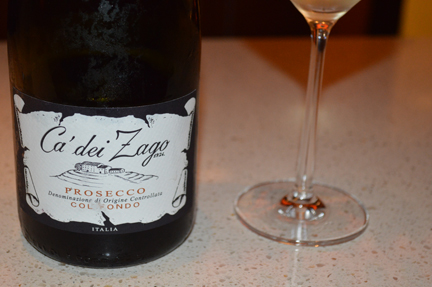
Posting on the fly and from the road today but just wanted to share my note on this Prosecco Col Fondo, the Ca’ dei Zago, the first to make it to Texas.
Everyone — EVERYONE — in Texas seems to be talking about it: sommeliers and wine buyers from Houston to Austin have been asking me about it via text and on the Facebook etc.
I had the chance to taste it last night with one of the most dynamic wine bloggers I’ve ever met (more on him and our meeting later) and we were both thrilled by the wine.
The first tasting descriptor that came to mind was one that Italians like to use for wines like this: sapido, meaning sapid or flavorful. The wine had that great saltiness that lees aging can impart to Glera grapes and it was balanced by the classic sour green note that Prosecco has when it’s made in a traditional and transparent style.
There’s no doubt in my mind that Prosecco Col Fondo — doubled-fermented-in-bottle, lees-aged, and undisgorged Prosecco — is going to be the next big thing in Italian wine. And I’m thrilled to see that a Col Fondo has finally made it to Texas.
Alfonso wrote a great post on his recent visit to Proseccoland, including notes from his tasting at Ca’ dei Zago.
Okay, gotta run now! More later!
“The essence of wine is the person”—Angelo Peretti (@internetgourmet)

I feel compelled to post this translation (mine) of Italian wine and food writer Angelo Peretti’s post, published today on his Internet Gourmet.
“The Essence of Wine is the Person.”
September 10, 2013
Over the last few days, I’ve read the many ideologisms scribbled in the margins of the deplorable story of a winemaker who keeps company with verbal vulgarity and racial epithets.
There have been calls by certain commentators, including some leading experts, for the wine to be evaluated on its own, irrespective of who made it.
Has the world of Italian wine come to this?
Perhaps it’s a romantic ideal but I remain convinced that the essence of wine is terroir and the essence of terroir is the person.
If we insist on judging the wine regardless of the person, the wine becomes a commodity — a mere product of consumption.
At that point, we might as well devote ourselves to carbonated soft drinks. At least we know that they are all technically identical.
This is wine criticism’s “betrayal”: when it casts wine’s humanistic roots into darkness and negates its spirit of place in the name of an Enlightenment-age ideal of the presumed objectivity of “taste.”
Please let us take a step back. Let us return to our roots and to the essence of being.
If wine proves unable to express this essence, we will have succumbed to the levelling embrace of global industry.
—Angelo Peretti
author of Internet Gourmet
Image by my friend Giovanni Arcari, taken Sunday at dawn in his vineyard in Franciacorta. “The harvest is roughly 20-25 later than in recent years,” he writes.
Electric Arneis in a bottle of Roero by Brovia (not a bad band name @ablegrape?)
In oenography, synaesthesia — “the use of metaphors in which terms relating to one kind of sense-impression are used to describe sense-impressions of other kinds; the production of synæsthetic effect in writing or an instance of this” (Oxford English Dictionary) — is owed to our human inability to describe wine.
Without spending too much time on the epistemological implications of oenophilia, it’s worth noting that when we describe wine we don’t actually describe the wine. In fact, we describe what it tastes like.
And there are those among us would-be wine writers who rise above the facile simile and reach for the metaphor.
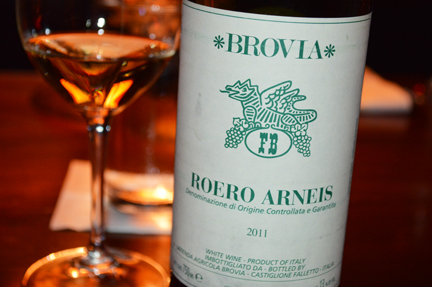
When my friend Bubba and I shared a bottle of Roero Arneis by Brovia last night, it wasn’t like drinking electricity in a glass. It was electricity in the glass.
The wine was electric. It was alive… ALIVE!
You don’t see a lot of the Brovia Arneis in this country but looking back on my visit with Giacinto Brovia a few years ago, I remember that we did indeed taste it then.
There’s very little of it in Texas. But my friend and client Jeff at Vino Vino in Austin was able to snag some.
There’s so much great Arneis out there. It’s one of those grapes that’s pretty hard to screw up.
But this one is the one…
My score on a scale of 1-100? Run don’t walk…
 Do Bianchi