Breaking news: Nebbiolo power brokers agree to create Piemonte Nebbiolo DOC

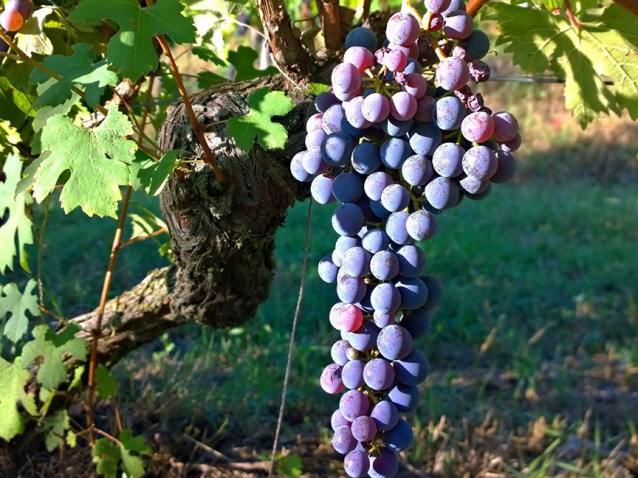
nebbiolo-grapes-docAbove: Nebbiolo grapes ripening this week in an appellation that lies outside the hallowed Langhe Hills. If approved, new Piedmont appellation regulations would allow growers across the region to label their Nebbiolo as “Piemonte Nebbiolo DOC.” Currently, only growers in select townships can use the grape name in labeling.

According to a person familiar with their discussions, the Barolo-Barbaresco-Alba-Langhe-Dogliani Consortium and the Barbera d’Asti-Wines of Monferrato Consortium have agreed this week to move forward with the creation of a Piemonte Nebbiolo DOC.

The person spoke on condition of anonymity because details of the agreement have not yet been made public.

After the Asti-Monferrato Consortium circulated proposed language for a new Piemonte Nebbiolo DOC among its members in August, vice presidents of the Barolo-Barbaresco-Alba-Langhe-Dogliani Consortium Pietro Ratti and Aldo Vacca publicly shared their opposition.

“It’s obvious that the big producers have caught a whiff of a good bargain,” said Vacca in an interview published in La Stampa on August 24. “But if the goal is that of releasing great quantities of low-priced wines into the market, we run the risk of compromising the entire of balance of Nebbiolo” produced in Piedmont.

Current Barolo-Barbaresco-Alba-Langhe-Dogliani Consortium president Orlando Pecchenino and his predecessor Pietro Ratti had to concede their efforts to block creation of the new DOC had no foundation, said the person familiar with their discussions.

When the proposed language for the new DOC became public last month, many industry observers, including leading Italian wine writers, predicted that a Piemonte Nebbiolo DOC would cloud consumers’ perceptions of Nebbiolo. They fear that its creation could lead to overly aggressive expansion of Nebbiolo plantings in the region and subsequent degradation of the Nebbiolo “brand.”

Such an appellation “is simply unacceptable and depressing for a grape variety like Nebbiolo,” wrote Slow Wine Guide editor Giarcarlo Gariglio.

Other trade observers pointed out that the proposed language mirrored existing appellation regulations that already allow certain Piemonte DOC growers to write Nebbiolo on the labels of their wines even though they use grapes from vineyards outside the hallowed Langhe Hills, considered by many to be Nebbiolo’s spiritual home.

Others contended that a grape variety and its name cannot be claimed exclusively by a single appellation or group of associated appellations.

“International law does not allow for the simple name of a cultivar to be reserved and protected by an exclusive geographic designation,” wrote legal expert and professor Michele Antonio Fino, director of the Master in Italian Wine Culture at the University of Gastronomic Sciences in Pollenzo (Piedmont).

Portland tasting Monday 9/12 expands to include dinner menu pairings

nostrana-restaurant-portland-reviewI mean, just look at this photo I lifted from the Nostrana Facebook this afternoon! What Italian enogastronome wouldn’t want to go to that restaurant???!!!
That dude is wearing a t-shirt that says “I heart Teroldego!”

I love it!

Response to our Monday, September 12 Franciacorta Real Tasting at Nostrana in Portland, Oregon has been so robust that the lovely folks at the restaurant have decided to create a micro-pairing menu for guests who dine with them that evening. A handful of the wines I’ll be pouring will be available by-the-glass and I’ll be visiting with guests throughout dinner service. Details to follow.

The 6:00 p.m. tasting is looking pretty full at this point. So if we can’t fit you in then, please come for dinner following and let’s taste together!

Franciacorta Real Story Tasting
Nostrana
on the patio
FREE
Monday, September 12
6:00 p.m.
1401 SE Morrison St.
Portland OR 97214
(503) 234-2427
Google map

Ron Washam’s satyr: sexuality, satire, and self-projection in 21st-century wine blogging

From the department of ostentatio genitalium… id est, NSFW…

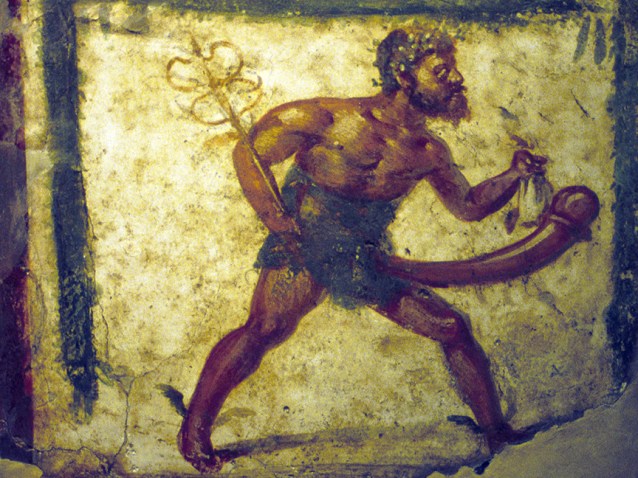
satyr-penisAbove: an ithyphallic satyr as depicted in a Roman mosaic in Naples (image via Tyler Bell’s Flickr Creative Commons).
Ithyphallophobia or ithyphallophilia? It’s hard to put your finger on it. Before you can, you have to get it up.

It’s only natural that the Hosemaster of Wine would resort to puerile sexual violence in a pseudo-satire of Alice Feiring, his debut piece for Robert Parkerization, Jr.’s venerated Wine Advocate. It’s behind a paywall that keeps “free for all,” I’ve been told, even the hoi polloi out. Read it if you must. Just be sure to don a doily doused in eau de toilette.

And it’s only logical that he would have no better arrow from his quill to loose… or to release, as it were.

As he wrote in his peppy post announcing his new brave collaboration, “nothing is more deadly to a satirist than becoming part of the establishment.” In the wake of Washam’s self-castration and the fulfillment of his Oedipal reversal, the now blinded however once beloved satirist now found himself in a conundrum: whom to attack when the platform whence he casts his missiles is that of the king?

Pietro Aretino, arguably the greatest of all satirists, self-fashioned himself the flagellum prinicipi (literally the flagellator [the scourge] of princes, for those like Washam who arrived tardy to Latin class). And as the whipper of kings taught us, satire has no balls (pardon the pun) when it resides in rich men’s halls. By virtue of its very nature, its vice is that used to squeeze the powerful and lustful, not the meek and just.

He’s parodied Alice, her writing, and advocacy before (5 or 6 times now? I’ve lost count). But when those feathers were launched from his Heraldsburg treehouse, they were lithe “as vines among the trees.” Today, they are as lugubrious as the masthead from which they were cast.

I can’t say that I was a follower or lover of his writing in the past. But respect and honor were due to the man for the outsider role of flagellator that he played so well in the enoblogosphere. I mean that most sincerely.

To attack Alice from Parker’s mansion on the hill, with crude sexual innuendo no less, is by no hand of a man. It’s from the palm of a puer.

Below: caps off to you, Ron! Cheers! It’s all in good pun… (image via Wikipedia Commons).

hosemaster-of-wine-blog

Taste with me: Portland (9/12), Las Vegas (10/17), Atlanta (November TBD)

Happy end of summer, everyone! Please come out and taste with me this fall!

portland oregon license free imagesMy Franciacorta Real Story Tour 2016 is winding down with three events in three different cities, each a wine destination in its own right.

The response to my events over the last 18 months has been nothing short of wonderful. But no city has responded with as much gusto as Portland, Oregon, a city believed by many tradesfolk to be the number-one destination for Italian wine in the U.S.

Heartfelt thanks to the lovely people at Nostrana for making this happen (Monday, September 12) and please stay tuned for updates on Las Vegas (October 17) and Atlanta (November, date to be determined).

A note to distributors and suppliers: please feel free to contact me if you’d to show your Franciacorta wines at any of my tastings. As long as the producer is an active consortium member (nearly all those imported to the U.S. are) and is a participant in the CMO promotion for north American, I would love to show the wines. The more the merrier!

RSVP is not required but encouraged so we can get a headcount. Please email me at jparzen@gmail.com to let me know you’ll be joining us. Thanks!

Franciacorta Real Story Tasting
Nostrana
on the patio
FREE
Monday, September 12
6:00 p.m.
1401 SE Morrison St.
Portland OR 97214
(503) 234-2427
Google map

Image via GoodFreePhotos.

Is Nebbiolo the new Pinot Grigio? Two controversial proposals for new Italian appellation rules

nebbiolo harvest 2015Above: Nebbiolo grapes in Piedmont.

Italian wine writers and bloggers have been up in arms this week and last over two controversial proposals for major changes in appellation rules.

The first, which is to be voted on today by growers, is the creation of a new Pinot Grigio delle Venezie DOC modeled after the current Delle Venezie IGT, which includes wines grown in regions of Friuli-Venezia Giulia, Veneto, and Trentino-Alto Adige.

If approved, the new appellation would allow growers to produce Pinot Grigio with yields of up to 21.6 metric tons per hectare “in good vintages.” That’s more than 9.6 U.S. tons per acre, a high yield by any measure. (To put this figure in perspective, “the U.S. has one of the highest national average yields, at 6.5 tons/acre,” according to the Oxford Companion to Wine.)

“Before [the creation of] this new appellation that applies to all three regions,” said Luciano Moretto, president of the Pramaggiore Wine Exhibition, earlier this year, “every region had its own [Pinot Grigio]. This will change everything. With this single mode of production, we can really take off in certain markets. I’m thinking of the United States, Russia, and China, nations where we need to compete with many behemoth producers and where counterfeits cause damage to us. This will be a source of considerable profit.”

In an op-ed published on Friday, the editors of the Slow Wine Guide wrote: “Who is the winner in this case? Industrial agriculture: producers of chemical fertilizers, fungicides, herbicides, etc. Because [with the creation of this DOC] vineyards will be transformed into assembly lines, where everything is pumped and everything needs to be perfectly clean, without even the smallest trace of disease.”

Today’s vote comes on the heels of another controversial proposal for changes in the Piemonte DOC. In a draft of new appellation rules circulated this month among members of the Asti Monferrato Consortium, the authors call for the creation of a Piemonte Nebbiolo DOC that would give growers greater freedom in using the word Nebbiolo in labeling wines grown across the region (and not just in Langhe and Roero).

If approved, these would include, among other categories: wines made from only 85 percent Nebbiolo grapes; rosé from Nebbiolo; and even sweet and sparkling wines. (Source: Slow Wine.)

Piedmont’s Regional Commission will consider the proposed changes in an assembly in September.

Pointing to the creation of the Prosecco DOC in 2009, some industry observers fear that the creation of a Piemonte Nebbiolo DOC as proposed by the Asti Monferrato Consortium would lead to overly aggressive expansion of Nebbiolo plantings in the region and subsequent degradation of the Nebbiolo “brand.”

“We oppose this request,” said Produttori del Barbaresco cooperative director Aldo Vacca in an interview published by La Stampa last week. “Langhe Nebbiolo is the appellation that has seen the biggest growth in the entire region. It’s obvious that the big producers have caught a whiff of a good bargain. But if the goal is that of releasing great quantities of low-priced wines into the market, we run the risk of compromising the entire of balance of Nebbiolo” produced in Piedmont.

His concern was echoed by that of Pietro Ratti of Renato Ratti, a legacy producer of Barolo.

“Nobody wants to stop people from growing a successful variety like Nebbiolo,” he told La Stampa, “But it’s one thing to plant a grape variety and another to manage an appellation. Today, there’s no denying that the Piemonte appellation represents a second-tier category while Nebbiolo is a first-class wine. It’s a delicate issue because it affects the economy, the region, and consumer perceptions.”

Earthquake recovery in Italy: how to donate to the Italian Red Cross

earthquake amatriceAmmado is the official micro-donation platform for the Italian Red Cross.

Here’s the link for donations to the Italian Red Cross and earthquake relief efforts. Donations can be made using a credit card and don’t require an Italian social security number (Italian micro-donation channels require one).

Here’s a link to information on what the International Federation of Red Cross and Red Crescent Societies is doing on the ground in central Italy to aid recovery.

I’m currently working on a couple of micro-donation campaigns here in Houston. More on those shortly…

Image via press_and_kitchen.

Earthquake in central Italy, 6.2 magnitude. Our hearts and prayers go out to our Italian sisters and brothers…

italy earthqake mapAbove: a 6.2 magnitude earthquake struck central Italy early this morning (image via the United States Geological Survey website).

Across social media this morning, I’ve been reading accounts of this morning’s devastating 6.2 magnitude earthquake in central Italy, which occurred at 3:36 a.m. local time.

The epicenter was 10 kilometers southeast of Norcia in Perugia province (Umbria).

But the most extensive damage seems to have occurred in small hill towns in Latium and the Marches. According to all reports I can find, Accumoli (Rieti province, Latium), Amatrice (Rieti), and Arquata del Tronto (Ascoli Piceno province, Marches) were among the hardest hit.

In a statement this morning, the mayor of Amatrice reported that the entire historic center was destroyed (New York Times).

Click here for La Repubblica coverage and images of the devastation. As of this posting, 63 lives have been claimed. Updated, Thursday, August 25: at least 241 lives have been claimed (La Repubblica).

From Rome to the Marches and even as far north as Parma, social media users I follow have been checking in and posting dispatches on relatives and friends living in the affected areas.

One of the most moving was by my friend Fabio Ciarla who lives and works in the wine industry outside of Rome.

“You wake up in the middle of nightmare and head back down the Via Salaria,” he wrote this morning, “the same road you would take when you were little with your family on a drive to Ascoli Piceno where [brother] Valentino studied enology. Not just through Amatrice but also towns like Posta, Sigillo, and Accumoli… Those were happy trips. Today it’s a Calvary.”*

Our hearts and prayers go out to our Italian sisters and brothers this morning. G-d bless them, G-d bless us all.

*Calvary: “the proper name of the place where Christ was crucified” (Oxford English Dictionary) and by extension a site of doom.

Happy Ferragosto! See you next week…

Taking a break this week for some serious downtime with family.

Buon Ferragosto a tutti! Happy Ferragosto, everyone!

(In case you’re wondering what Ferragosto is, check out this post I did for the Italy-America Chamber of Commerce last week.)

Wishing everyone a happy week, I’ll see you on the other side…

torno subito forse

Wine & Spirits features 3 Houstonians (and I’m one of them)

What a thrill for me to be included among the “50 masters of place” in the current issue of Wine & Spirits magazine!

But it was an even greater thrill for me to learn that I was just one of three Houstonians whose expertise was featured in the book (as they say in magazine publishing parlance).

Wine educator, writer, and buyer at one of the biggest retailers in the country (Spec’s), Bear Dalton wrote about Bordeaux.

And Evan Turner, owner and wine director at Helen (one of the best restaurants in Houston and one of the most original wine lists in the country), wrote on Xinomavro, the great red variety of Greece.

Present company excepted, the Houston-based media continues to slog away and along on its quixotic quest to portray our city as a bunch of air-conditioned hillbillies living on a land-filled swamp.

In fact, Houston is one of the most intellectually vibrant and culturally rich cities in the world and our groovy wine scene is a reflection of that. Three out of fifty, ain’t bad, Mimi!

It was also a thrill to see so many of my good friends among the contributors: Alice, Brett, Elaine, Shelley, Ceri, Pascaline…

What did I write about? Friulian white blends, of course. Check it out on newsstands now!

wine and spirits masters place

Natural wine group VinNatur releases controversial farming and production guidelines (English-language version)

angiolino mauleAbove: Angiolino Maule, right, founder of the VinNatur association for natural wine and one of the world’s leading advocates for pesticide-free wines (photo by Alfonso Cevola).

“I was beginning to feel like a sheriff,” said Angiolino Maule, founder of the Italian natural wine advocacy group VinNatur, when I met with him at his winery earlier this year.

He was referring to his group’s monitoring for the presence of chemical residue in the soils of its members’ vineyards.

When we met and tasted together this spring, he told me that the group is working on a new method for monitoring the health and biodiversity of the soils. The new system, he said, won’t be based on laboratory analyses of soil samples. Instead, it will focus on the presence of insects and other animal life among the vines.

“If there are insects in the vineyards,” he said, “it means that pesticides are not present.”

Maule and VinNatur have not yet revealed the criteria for the new monitoring system. But in a press release issued last month, they announced that they are in the process of developing the new protocol together with government-sanctioned certification groups and the Italian Ministry of Agriculture and Forestry.

In the meantime, the group has published its new guidelines for the production of natural wines.

As the wine world continues to wrestle with the definition of natural wine, VinNatur has presented its new checklist of permitted and forbidden practices as a new benchmark in defining the category.

“Those who choose to drink natural wine,” write the authors of the press released issued by the group (English), “have the right to receive tangible guarantees on what they will find in the bottle. Declaring oneself to be a ‘natural winemaker’ is not enough — one must be truly aware of the great responsibility that there is regarding the health of enthusiasts and clients, and act accordingly.”

The new guidelines haven’t been met by cheers in all corners of the natural wine movement. And more than one detractor has pointed to the fact that other similar “guidelines” have been published in the past.

“Whatever certificate, little medals, or badges… no, thanks. I’m beautiful the way I am,” wrote natural winemaker Corrado Dottori in a blog post. “Making natural wine is not a question of procedures. It’s a state of mind. VinNatur has got it wrong. Fuck the police. You have betrayed the revolution” (translation mine).

In a blog post entitled “Bla bla … natural wine … bla bla,” natural winemaker Alessandro Dettori contends that the focus should be on “agriculture… terroir, and the artisanal character” of winemaking (translation mine).

Click here for the English-language version of the guidelines.

Click here for the English-language version of the press release.