From my good friend @GiampaoloVenica:
- Winter view from Grado island lagoon now I understand Pasolini inspiration coming out from.
For you Jeremy pic.twitter.com/9s5G7qgx
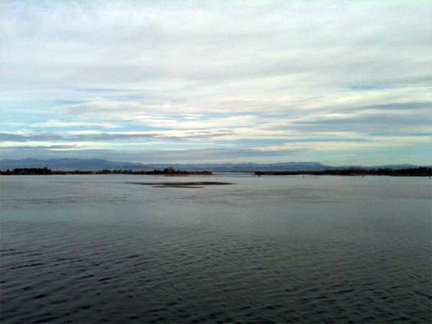

From my good friend @GiampaoloVenica:
For you Jeremy pic.twitter.com/9s5G7qgx
The following is my translation of Franco Ziliani’s tribute to the great Italian partisan, journalist, anti-globalizationist, lover and connoisseur of Nebbiolo, Giorgio Bocca, who died Sunday in Milan…
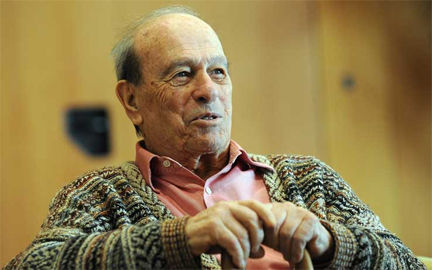
Photo via Il Journal.
He was allergic to any form of rhetoric and he was truly un-Italian in his respect: Italian journalist, partisan, and essayist Giorgio Bocca, 91 years old, died in Milan on Sunday. He deserves to be remembered with a dry eye and not without a touch of irony.
For this reason, I’ve decided to remember this surly, free-thinking, independent man from Piedmont not as a maestro of Italian journalism (which he was, indisputably, regardless of your political leanings) but rather as the great (and demanding) connoisseur of wine whom I had the pleasure to interview twice in his home on Via Bagutta in Milan.
One wine, above all others, was often cited in his books: Barolo, a wine for which he reserved great passion, a wine he drank only when produced by a few carefully selected and trusted producers.
And so, as I think of how Bocca has left us, it’s only natural to evoke the name of another great man from Langa, whose dry, ironic personality was intimately familiar to Bocca. When ever the writer was in the area, he’d go visit this man and they had much more in common than their love of wine: they shared a keen interest in culture, politics, and, of course, in Barolo.
I’m thinking of Bartolo Mascarello, an indisputable leftist like Giorgio Bocca, leftist but not sectarian, enlightened and enlightening, rigorous in his being in favor or against something or someone but not intolerant, perhaps not open to dialog with those whose ideas he opposed but always willing to listen.
And so as I reflect on this goodbye to the great journalist from Cuneo, Giorgio Bocca, I’d like to think that somewhere — in some corner of the imagination, I don’t know where — Bartolo Mascarello is waiting for Giorgio. He’s sporting one of his ironic, amused smiles and of course, he’s speaking in the noble dialect of Langa. He’s opening a buta — a bottle — of a special wine intended to welcome Giorgio to this truly special parlor…
Bartolo, pop open a buta! Giorgio is here!
The following profile appeared yesterday on the English-language version of the ANSA website.
(AGI) Milan – Giorgio Bocca died on Christmas day in Milan at 91 years of age. He had been a wartime partisan, journalist, founder of the newspaper ‘La Repubblica’ and a long-time collaborator of the Fininvest TV networks. News of his death was released by Feltrinelli, a publishing company who published several of his books and that recalled him as “a great journalist, a great combatant and a great friend”. “Since the partisan war of resistance up to these last few days of the Italian and global crisis – the publishing company continues in a note – he witnessed, observed and told the history of our Country through seven decades. Giorgio Bocca’s enquiries, short polemic articles and books have accompanied and nourished the building of civil society through many generations of Italians”. In January, Feltrinelli will pubish his latest book: ‘Grazie no, 7 idee che non dobbiamo piu’ accettare’ (‘No, thanks: 7 ideas we can no longer accept’). In the past, in addition to his journalistic activities, Bocca – who was born in Cuneo on the 28th of August 1920 – wrote several essays and his having fought with the “Giustizia e Liberta'” Partisan division often led him to tackle the issue of fascism and resistance although he also wrote books on terrorism during the ’70s, on journalism and on the problems of the South of Italy.
During the last few months, some of his comments on the ‘Meridione’ had placed him at the center of controversy after he defined Naples as ‘flea-bag’ with ‘unhealable areas’ or Palermo as a city “stinking rotten, with monstruous people gushing out of slums”. A skilled polemicist, during the last few years, he had often delved into the condition of journalism in Italy: in 2008, in an interview on the ‘Le invasioni barbariche’ TV show, he said that while the journalists of his generation “were driven by ethics” today “truth is no longer of interest” and “publishers are always on the payroll of advertisers”. Among the last recognitions awarded to him was the 2008 Ilaria Alpi Prize for his Life-Long Achievements: “All those that go into journalism do so because they hope they might reveal the truth: even if it’s difficult, I call on them and encourage them to continue along this road”.
Maybe it’s because she knew I was depressed by the flurry of bad news from Europe.
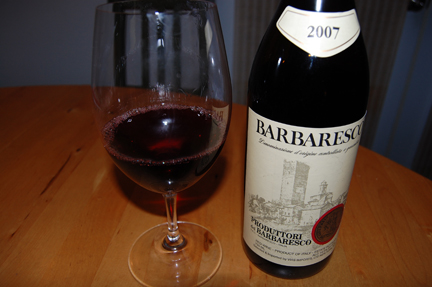
But it’s definitely because I’m the luckiest guy in the world: when Tracie P came home from work yesterday, she brought me a bottle of 2007 Barbaresco by Produttori del Barbaresco, which — believe it or not — I still hadn’t tasted.
However bizarre the 2007 vintage in Langa, everything I’ve tasted so far from Barbaresco and Barolo has been simply sensational. Here’s what one of my favorite wine writers, Antonio Galloni, had to say about this strange but glorious (imho) vintage:
At first kiss, the 2007 classic (as opposed to vineyard-designated) Barbaresco by Produttori del Barbaresco was very generous with its fruit. Arguably the most elegant bottling I’ve ever tasted from the winery that forms the centerpiece of our wine collection, the wine showed stunning balance before quickly closing up, with the muscular tannin dominating the wine in my glass for the rest of the evening (I’ve saved the great part of the wine in the bottle and will revisit it tonight and tomorrow night). If ever there were an expression of Barbaresco “Barolo-esque” in its power, this would be it: there was a delicate menthol note in the mouth that reminded us of some of our favorite “east-side,” “Helvetian” growers.
It’s too early for final judgment on this wine, but wow, my impression is that we have a lot to look forward to…
In other news…
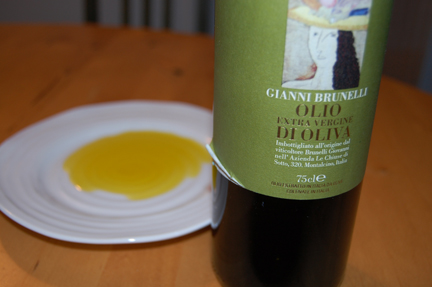
I also opened a bottle of Gianni Brunelli olive oil that Laura Brunelli gave me when I visited the family’s amazing farm in Montalcino in October.
A drizzle over some still warm toasted bread was unbelievably good, one of the mineral olive oils I’ve ever tasted. (When tasting olive oil, please be sure the olive oil is room temperature and always taste with warm bread; the gentle heat of the bread will prompt the oil to release its full flavor.)
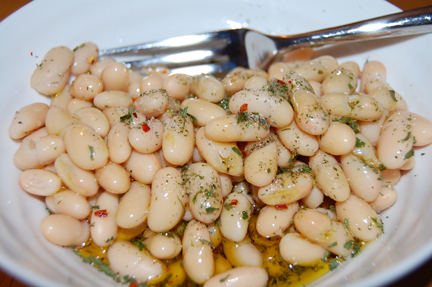
I used the oil to dress some fresh red leaf lettuce and some cannellini beans. Utterly and absolutely delicious.
Whereas Ligurian olive oil tends toward the fruity and Sicilian toward the spicy, great Tuscan olive oil leans toward salty: I added just a dash of kosher salt to both the salad and the beans and Laura’s oil imparted all the savoriness I needed to both dishes. Fantastic stuff… Enough to cheer a wine blogger up after a day of gloomy news from his adoptive country…
Stay tuned for a post on my visit with Laura, a tour of her amazing “biodynamic” house, and a tasting of some current and older vintages of her family’s incredible wines… one of the best tastings from my last trip to Italy… Thanks for reading!
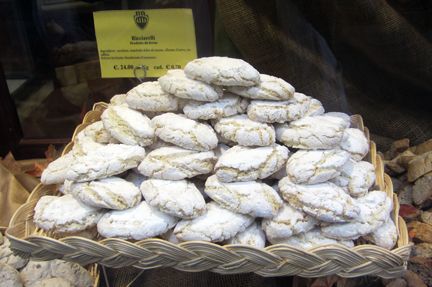
Above: Ricciarelli from Nannini in Siena. I took these photos in October while visiting a good friend there.
From Frank Bruni’s editorial today on Berlusconi’s “post-script” to the report in the Wall Street Journal that the Monte dei Paschi Foundation might lose control of the historic bank — the “world’s oldest bank” — the news from Italy is depressing these days.
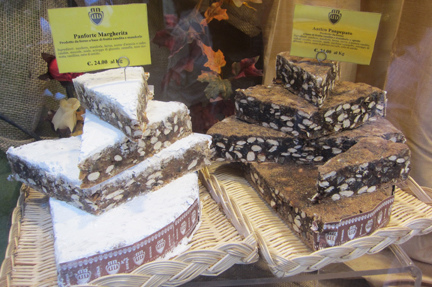
Panforte.
It’s hard for me to write about Italian wine these days when people I know and care about are being affected directly by the economic crisis in Europe.
A good friend from Siena writes:
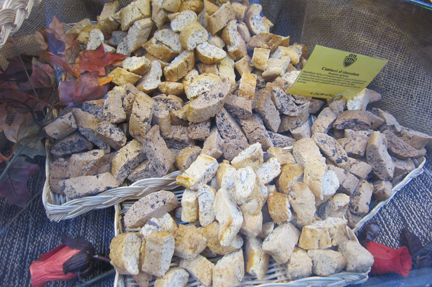
Cantucci.
“Maybe it is finally the time to consider tourism the first industry of Siena,” writes my friend, “and start again from this point.”
If you’ve ever been to Siena, you know that it is one of the most beautiful cities in the world. It’s also a cultural hub of Western Civilization, a city whose contribution to Italy’s national history is rivaled only by its intellectual and aesthetic treasure.
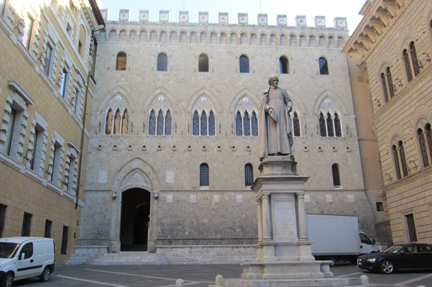
The Monte dei Paschi di Siena bank is just up the street from the Nannini pastry shop.
I’m no fan of bankers but it’s sad to think of what Siena would be like without Monte dei Paschi, an institution that has helped to protect and cultivate the city’s works of art for more than 500 years.
Some of Italy’s greatest wines are raised within a forty-minute radius of Siena — Chianti, Montalcino, Montepulciano…
Our Italian friends are in our thoughts these days…
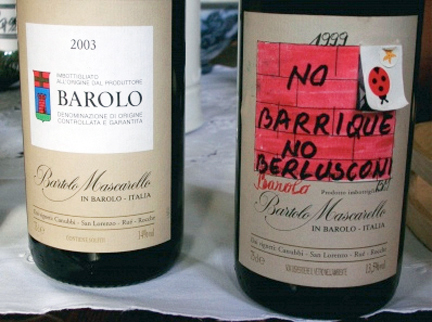
Bartolo Mascarello’s famous label, “No Barrique, No Berlusconi,” a now iconic image that empowered wine as an ideological expression. Photo via Spume.
The great 20th-century novelist, poet, essayist, and politician Leonardo Sciascia employed Sicily as synecdoche for Italy in his novels Il giorno della civetta (The Day of the Owl, 1961) and A ciascuno il suo (To Each His Own, 1966). The works were parables of what he would later call the “Sicilianization” of Italy: a phenomenon whereby the Sicilian model of bureaucratic and political bankruptcy and clannish self-interest had contaminated the entire Italic peninsula as the nation first tasted the sweetness of prosperity thanks to the “economic miracle” of that decade.
Today, as I joyously read the news that Berlusconi has pledged to resign, I am reminded of Sciascia’s parables. In many ways, Berlusconi’s 17-year tenure as Italy’s leading politician is a parable of the Italian nation’s overarching abandonment of the social ideals that emerged in the period immediately after the second world war, when social and economic equality, dignity, and liberty were paramount in the hearts and minds of Italians who had suffered through the tragedy of fascist and Nazi domination. The memory of those wounds was still vibrant in 1994 when Berlusconi first took power. Today, the generation that embraced the humanist ideals of Italian post-war communism has greyed. And the greed and moral bankruptcy embodied by Berlusconi will remain as the legacy that has reshaped Italy and swept away the renaissance of Italian greatness — in design, technology, fashion, cuisine, etc. — of the decade that preceded his reign.
His tenure corresponds neatly to the tragic Californianization of the Italian wine industry that took shape in the 1990s when scores of Italian producers abandoned the values of the generation that had made wine before them.
Berlusconi may be on his way out. But, sadly, barriques are here to stay.
In the face of the European debt crisis and the social and economic turmoil that has gripped Italy (my first love) and Greece (my new love) — “Crisis in Italy Deepens, as Bond Yields Hit Record Highs,” New York Times — it’s been difficult to write about wine here on the blog.
Tonight Tracie P and I will raise a glass of traditionally vinified Nebbiolo to Italy’s future… and tomorrow I’ll pick it up again…
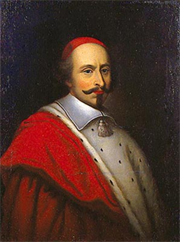 With all the talk of Berlusconi’s imminent fall, the Italian media often mentions the so-called frondisti (the rebels in the Berlusconi coalition) and the malpancisti (literally, those who suffer from stomach aches).
The frondisti take their name from the frondeurs of 17th-century France: the Parisian mobs who used slings (fronde in Italian, frondes in French) to hurl stones and other missiles “to smash the windows of supporters of Cardinal Mazarin,” minister to the French monarch (above, left).
“In 1644, Mazarin tried to prevent [the city of Paris from] growing further and to raise taxes by fining those who built houses outside the City Walls. This policy produced widespread resentment. The Fronde began in January 1648, when the Paris mob used children’s slings, frondes, to hurl stones at the windows of Mazarin’s associates.” (From the Wiki.)
An early documented use of malpancista dates back to 2004. It refers to members of a political alignment who express dissent or disagreement. Their “stomach ache” belies a change of heart (heartburn?).
As Italian journalist Aldo Grasso recently noted, a stomach ache is generally relieved by a visit to the toilet.
My advice to Berlusconi? Vai a cagare…

The chamber of deputies has just approved Berlusconi’s budget with 308 voting yes, 0 voting no, 1 abstention, and 321 not voting at all (!).
He’s hanging on by a thread… but he’s hanging on…
Here’s the link to live streaming from the Chamber of Deputies…
http://webtv.camera.it/light/indexflash.php
My fingers are crossed that Berlusconi will finally be ousted… But I fear that he’ll survive this round…
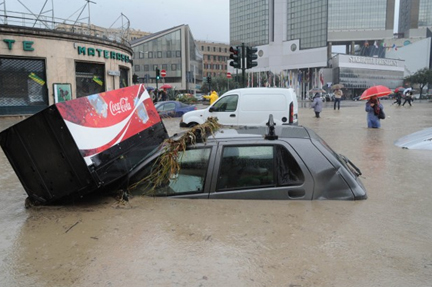
Photo via Genova.Repubblica.it.
Our hearts and prayers go out to the families of victims of torrential rains in Genoa (Genova) and northwestern Italy: 6 persons died in Genoa on Friday and the city government has declared a day of civic mourning today.
The city is still under a flash flood watch, with more rains expected today and tonight.
Like many residents, writer, poet, humorist, educator, blogger Mitì Vigliero (aka Placida Signora, one of my favorite Italian-language blogs) has left the city for higher ground but she’s posting updates on the weather and emergency resources on her Twitter feed here.
Our thoughts and prayers also go out to the people of Greece, whose economy continues to be paralyzed by its government’s inability to move forward with the European Union debt deal.
I’ve been following Chicago-based Greek-American writer Maria Karamitsos’s Twitter feed for updates on the crisis.
 When Ryan Opaz asked me to “defend the written word as a medium of wine blogging” for a panel at the European Wine Bloggers Conference, I have to admit I was nonplussed.
My short talk was to be part of a panel entitled “Defending Storytelling” (here’s the video, btw) and each participant was charged with “defending” a medium: photography, video, oral storytelling, and the written word (my medium).
Isn’t the written word, I thought to myself, a sine qua non of wine blogging? And even though we use all sorts of media to “blog” (not “write”) about wine, isn’t writing at the core — literally and historically — of what we do as wine bloggers?
It occurred to me that Brescia, the conference host city, was once part of the Most Serene Republic of Venice and that at the height of the Venetian state’s power, the late-15th- and early 16th-century humanist printer Aldus Manutius developed the octavo book format — the world’s first pocket-sized book, an innovation that reshaped the way knowledge was consumed in Renaissance Europe. (That’s Aldus’s “device,” above, a dolphin wrapped around an anchor, a visual representation of his oxymoronic motto, festina lente, meaning hurry slowly, in other words, hurry to achieve as much as you can but do so thoroughly.)
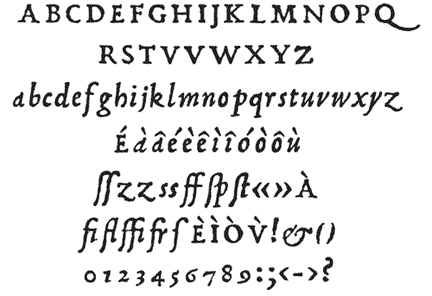
He also created a new typeface, a cursive font (also above) that would revolutionize printing and would soon come to be known as italics (because they were invented in Italy). His inspiration for the new character was the humanist cursive (hand-written) script that had brought new clarity, precision, and elegance to literature in Europe in the early Renaissance.
In many ways, the Aldine revolution is not dissimilar from the blogging revolution: like the Aldine octavo and italic font, the new blogging media have reshaped the way information and knowledge are syndicated. And just as Aldus’s tiny books unchained readers from the elitist lecterns of dimly light reading rooms, the blogging medium has unleashed wine writing and opened a new frontier for the everyman who enjoys wine.
The written word, I said in my address, represents a continuity between the past and future of vinography (the retelling of wine in any medium) just as the Aldine cursive font represented a cohesion between the writing that came before and the writing that would follow.
Another example I made was the @ sign. Did you know that the earliest known use of the @ sign was an elided abbreviation that denoted an amphora full of wine? And while a Florentine is credited with the first known written instance of the symbol, it was during the height of the Venetian empire and the Venetian printing industry that the @ sign took the shape that we know it today.
Just ask any blogger if she/he has ever used italics or the @ sign: without this continuity of the written word we wine bloggers would not be here today, nor would we be here tomorrow.
 Do Bianchi