Oops I did it again: pizza and Bertani 1988 Amarone!

Oh baby
It might seem like a crush
But it doesn’t mean that I’m serious
‘Cause to lose all my senses
That is just so typically me
Oh baby, baby

Above: Charles Scicolone can often be found at La Pizza Fresca in Gramercy (Manhattan), where they allow wine luminaries to bring their own bottles. The list there leans heavily toward modern and the prices are prohibitive. The pizza is good (although not as good as the pizza I recently tasted in San Antonio! I’ll be posting on that shortly so stay tuned).

Franco is going to kill me. I did it again: while Tracie B and I were in Manhattan for the last show in the NN+ tourette a few weeks ago, I paired pizza with an absolutely, undeniably, unquestionably, and egregiously inappropriate wine.

Two inappropriate wines, actually: Bertani 1988 (yes, 88!) Amarone and Cantalupo 1996 Ghemme Collis Breclemae (above).

One of the most important things I learned in college (and one of my favorite mottoes) was “This statement is false.” (It is a classic example of the Russel paradox. The other important thing I learned was that no movie is set in the future: “If the story has been told,” film professor Tinazzi used to say in Padua, “then it has already happened.”)

Above: Charles always orders the Margherita but I am always partial to the Puttanesca there. I never ate anchovies on my pizza until a pizzaiolo wrote the name of my band using anchovies on a pizza many years ago when I was on a summer tour in the Dolomites playing cover tunes (yes, I toured in a cover band in Italy). Evidently, Elvis Presley used to eat salt-cured anchovy fillets to soothe his throat while on tour.

What bearing does the above have on the present post, you ask? In the wake of the brouhaha that followed Dr. V’s post in which he quoted me as saying pizza could not be paired with wine, and my subsequent apologia pasoliniana, I feel compelled to confess that what I did was wrong: one should never pair two such elegant wines with the acidity and saltiness, not to mention the high temperatures, of pizza. At the same time, and here’s where the paradox kicks in, the experience was decadent, sumptuous, utterly delicious, and thoroughly enjoyable.

Above: Tracie B had a pizza bianca with broccoli raab. Also in attendance were friends Frank Butler (who generously brought the Bertani) and Michele Scicolone, who recently launched her excellent blog (definitely worth adding to your feed if only for the recipes that she shares). Charles has also become an avid blogger and I’ve been enjoying his blog and Facebook as well.

Charles’s 1996 Ghemme was earthy and had a crazy eucalyptus note, still very powerful and young, an amazing expression of Nebbiolo (and very definitely Piedmontese despite what Henri Vasnier said the other day on Brooklynguy’s blog). I’ve tasted this wine a number of times over the years and it is just beginning to come into its own.

The 1988 Bertani was sublime: a great vintage by one of the appellation’s greatest producers, very traditional in style, powerful and rich, yet already attaining the ineffable lightness that Amarone begins to achieve in its late adolescence.

Were these wines wasted by a paradoxical pairing? In other words, did we ruin the wines by pairing them with foods that detracted from their aromas and flavors? My feeling is that no, we did not: we experienced them in a new and different way than their traditional pairings. After all, the traditional pairing for an Amarone like that is pastissada de caval, horse meat stewed until stringy in red wine. Where would one find a horse to eat in Manhattan?

Oops, I did it again… Thanks Frank and Charles for bringing such incredible wines!

In other news…

If you’re into Loire and Chenin Blanc, check out Tracie B’s post on our visit to Chaume and her take on Chaume vs. Sauternes.

Memories of Baldo Cappellano

Above: Teobaldo Cappellano in his cellar (photo courtesy of Polaner).

I met Teobaldo Cappellano on a number of occasions and enjoyed his wines immensely. He was a staunch, vocal defender of traditional winemaking and his Barolo was aged in large, old-oak casks. He fought tirelessly against the homogenization and over-commercialization of wine and was a steadfast opponent of the use of international grape varieties in Italian wine. His uncle, a pharmacist, was the creator Barolo Chinato, and Cappellano’s chinato was widely considered the best. It was a treat to get to taste with him over the last few years at Vini Veri and I felt honored to report on his contribution to the Brunello Debate in October 2008. If you speak Italian (and even if you don’t), I encourage you to watch the archived stream of the debate at Franco’s blog (just visit the blog and you’ll find it embedded to the right). His cadenced authority is matched only by his emboldened passion.

In his post today at Vocativo, Luigi Metropoli reminded us of Baldo’s motto: io evolvo all’indietro, “I evolve backwards.”

The world of wine has lost one of its great rabbis — if not the greatest.

Today, the blogosphere is flooded with tributes and memories of Baldo, as he was known. I’ve collected and translated some passages below.

The world of wine — and not just Piedmontese wine and not just the Barolo and Langa community (which he represented with authority) — is in mourning today for the sudden and cruel passing of Teobaldo Cappellano. He was a tireless activist and an advocate of lost causes — causes even more worthy for the very fact they were lost — because when you know that you have no chance to prevail, defending your beliefs is even more righteous.
—Franco Ziliani, Vino al Vino

Langa and the entire world of Italian wine are orphans today. Everything will be more complicated now that destiny has shown us high noon.
—Marco Arturi, Porthos

One of those gentle giants, long and weedy, he is winemaker, jokester, philosopher.
—Alice Feiring

The last of the Mohicans.
—Gigi Padovani

Barolo has died.
—Consumazione obbligatoria

Someone like Baldo Cappellano cannot die.
—Divino Scrivere

He was a winemaker philosopher.
—acquablog

In morte di messer Teobaldo Cappellano

The great winemaker Teobaldo Cappellano has died. “Barolo has died,” noted one Italian wine writer today.

Memories of Teobaldo and posts in his honor are flooding the Italian blogosphere as I write this. I’ll post some translations later today. Right now, I’m just overwhelmed by the thought of a world without him.

You only live twice: lunch at La Tour d’Argent

Above: La Tour d’Argent’s signature dish, duck breast in civet. The duck bones are crushed in a press and their juices are used to make a civet (sauce). Civet is an ancient recipe. In my translation of the 15th-century Ars Culinaria by Maestro Martino (UC Press, 2005), you’ll find an excellent recipe for venison civet, for example.

In all honesty, I’m a little embarrassed by the extravagance of a lunch Tracie B and I enjoyed in Paris a few weeks ago while we were in town for the NN+ tourette France 2009.

Above: We drank a 1991 Volnay Les Champans 1er Cru with the main course. Lunch wasn’t cheap but the list was jam-packed with very reasonably priced “outer borough” Burgundy. I was looking at 1989 Marsannay but the excellent sommelier pointed out that 1991 is drinking better in general and that Marsannay would have been too tannic with our duck. His choice was superb and he kept me well under my price point. Note the dust on the bottle: this is a sign that it has been well cellared in situ and has rested peacefully. (Check out Eric’s cool article on “Those Other Burgundies.”)

Especially in these tough times (and believe me, I am so relieved and fortunate to be busy with work these days, when so many of my peers are having trouble), I couldn’t help but be more than a little self-conscious.

Above: Watching the wine service at La Tour was a thrill. Our sommelier was so friendly and helpful. Frankly, it’s intimidating to approach a wine list like that (check out this pic that Tracie B snapped of me). I knew that I wanted to drink old Burgundy and I told our steward my price point, my preference in style (traditional), and we discussed our menu. The 91 Volnay was fantastic and you’d be surprised at how little I paid for it: because La Tour buys so much wine on release, the prices are actually surprisingly affordable (as long as you stay clear of the heavy hitters).

But, hey, you only live twice: I can’t imagine that Tracie B and I will be back in Paris any time soon and a lunch like this is something you do once in your life (And since we were on tour, we ate mostly ham sandwiches while we were there! And so this was our one extravagant repast. Believe it or not, I actually lost weight.)

Above: For every course, the mise en place was a work of art. I loved how they trimmed the lettuce leaves to match the size of these delicately sliced, raw scallops. We paired this first course with a 4-year-old Savennières.

I’ve read a lot of food and wine bloggers talking about how they are cutting back on and reeling in their wine budgets, these days (and so are we here in Austin). That’s perfectly understandable as well as indispensable in this new “age of responsibility.”

Above: A picture really isn’t worth a thousand stinky flavors and aromas! The cheese course was phenomenal. We paired with an equally stinky vin jaune.

But it is equally important to go out and spend money on wine and in restaurants and support local businesses and merchants. Remember: every time you buy a bottle of wine (even if you’re spending less on wine these days), you are supporting a whole chain of people in the industry — producer, importer, broker/vendor, distributor, and restaurateur/retailer (including the shippers, drivers, delivery people, etc.).

Not that La Tour d’Argent needs any help from me and Tracie B: a pair of bankers sitting next to us ordered two bottles of old Mersault and I can only imagine what they paid (probably in the thousands, gauging from my perusal of the list).

Above: I have no idea what we ate for dessert but it was delicious.

Lunch is certainly more affordable at La Tour than dinner and Tracie B and I stuck to the fixed price menu. You would be surprised at how little we actually spent, considering the venue.

All I can say is that the experience was worth every penny. Tracie B was simply stunning that day, the sunlight reflecting off the Seine and giving her a glow that I will never forget as long as I live.

You only live twice…

Nicolas Joly, Tracie B, and me

cellar

Above: Tracie B in the cellar at Coulée de Serrant, the celebrated Nicolas Joly estate in the Loire Valley.

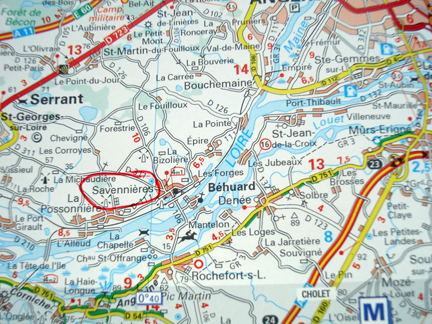
Our trip to the Loire Valley (between NN+ gigs in France) revealed to us just how varied the production of Chenin Blanc really is and how uniquely terroir-driven the appellations. The short drive from Savennières to Chaume, for example, showed us how macro- and micro-climate could change radically after a 7-minute drive at country-road speeds.

Tracie B called dibs on blogging our excellent tasting at Joly a few weeks ago and so you’ll just have to visit her blog to get the low-down (click here) on oxidation vs. botrytis, Les Clos Sacrés vs. Les Vieux Clos, sandy vs. slate, to aerate or not to aerate, and many more mouth-watering, “tongue-splitting” tidbits.

In other news…

Check out this post at VinoWire on a new DOCG: a red Moscato (yes, a RED Moscato) from Bergamo (yes, Bergamo). Turns out that it was once one of Italy’s most famous appellations, Moscato di Scanzo. Franco and I posted about it here.

One night in Paris with Alice

Above: Alice F and Tracie B, two of my favorite ladies, and I went natural-winebar-hopping the other night in Paris.

If you ever get a chance to go natural-winebar-hopping in Paris — where many believe the winebar concept and the natural winebar were born — with the leading lady of natural wine writing, Alice Feiring, go for it. In perhaps the only city on earth where the maître d’s are ruder than the hosts at Babbo or Sparks Steakhouse, Alice your-table-is-waiting-right-this-way Feiring, Tracie B, and I ended up at Racines in the picturesque Passage des Panoramas at the end of the night a few weeks ago while we were in town for gigs with NN+.

Above: The first wine we drank at Racines was this entirely stinky, cloudy, dirty, oxidized Chenin Blanc by winemaker Eric Callcut, who calls it “The Picrate,” which I imagine is a reference to the picric acid. I imagine that picrate tastes like saltpeter since it is used in explosives but I didn’t get a gunpowdery note on this wine. Thoughts?

Between her popular blog Appellation Feiring and her wine-memoir/manifesto The Battle for Wine and Love or How I Saved the World from Parkerization, there is no denying that Alice is one of the wine writing world’s boldface names — whether you agree with her radical positions or you find yourself diametrically opposed to them (there’s really no middle ground with her, which is something we all love about her). But in Paris, she is considered a primissima donna and Tracie B and I were thrilled to be her companions: the toast of the Parisian natural wine circuit seemed to bow before her as if in audience with the queen.

Above: The charismatic owner, Pierre, already enjoyed quite a following even before Food & Wine called Racines “Paris’s hottest winebar.”

As it turns out, owner Pierre Jancou’s family is from Modena, where I taught for a summer many, many moons ago for U.C.L.A. When we discovered our Emilian connection, he insisted that we taste Donato Camilli Lambrusco, which was fantastic — bright with acidity but light in the mouth. Even though we savored the minerality in every last drop of the Chenin Blanc (The Picrate, above), we agreed that the Lambrusco was the wine of the night. (Franco, I know… I know… I’m the only dude who drinks Lambrusco in Paris. That’s HOW much I love Italian wine!)

Pierre is not the only one at his restaurant that speaks Italian with an Emilian accent. His charcuterie speaks Emilian dialect, too, and the lardo melted sumptuously in the mouth, with the natural fruit of the Lambrusco slicing through its liquid fat like a serrated ravioli cutter on a Sunday morning. I ate blood pudding (below) and beets as my main course (just to keep things light). Tracie B and Alice split the sole, which was also excellent if pricey.

Above: The artisanal and natural qualities of Pierre’s food really stood out in the blood pudding and beets. His radically natural ingredients brought a balance and lightness to a dish you would otherwise expect to be gut-splittingly heavy. I ate every last morsel.

For someone who once performed “One Night in Paris” at the Paris Paris nightclub in Paris (yes, it’s true), this was one night in Paris that I will never forget.

The best nachos ever (and in the French press)

Above: Do Bianchi’s pick for “best nachos ever” at Polvo’s in Austin.

Do Bianchi got some props today in the French press. In a Valentine’s Day post, Le Monde’s blog Le Post called my “gastronomic blog” a sign of the recent “radical change” in Americans’ tastes (presumably after the presidential election). Gee… if that’s a compliment, I think I prefer a French insult.

So I thought I’d post on this Valentine’s Day on a good ol’ Tex-Mex classic, nachos.

I’ve eaten nachos all across these fine United States of America, and as partial as I am to the nachos served at the sometimes crusty but always classic El Cholo in Los Angeles, Polvo’s in Austin now holds the title of “best nachos ever” in the Do Bianchi Pantheon of ars culinaria mexicana.

While the decor at Polvo’s ain’t the Ritz, the waitstaff is friendly (although the hosts are sullen). Everything I’ve eaten there has been great (and well-priced), including the mole (we went there last night for dinner before an excellent Guy Forsyth show). My only true lament: what do you have to do in this town to get a beer without a lime in it?

My valentine, Tracie B, makes some pretty mean nachos herself, with spicy ground and sautéed turkey, melted cheese, and her own homemade tomatillo sauce (above). Sooooo good…

In other news…

NN+’s video was a Valentine’s Day feature on YouTube today! Pretty nifty…

Happy Valentine’s, y’all!

Italian wine: the price is right (and catching up on my reading)

It wasn’t easy to get online where Tracie B and I were staying last week in Paris: there was no wireless in Céline’s father’s fourth-floor studio on the Left Bank in the 6th and I am only now catching up on my blog and newspaper reading. (I don’t know: a week’s stay in a private apartment in Paris two doors down from the Seine or wifi? I’ll take what’s behind door number 1, Bob.)
I was thrilled to see Eric’s article on Italian Unknowns in The Times. I am a huge fan of Valle dell’Acate’s wines and was so glad to see the winery get the attention it deserves. The Cerasuolo di Vittoria is one of my favorite Sicilian wines — regardless of price.

Now more than ever, Italian wines represent the greatest value for their quality on the market today. I don’t know why Eric second-guessed himself, wondering out loud if “Italian wine buffs will easily cite omissions.” In my view, his picks are right on the money and the price is right.

Back in the blogosphere, Italian Wine Guy continues to blow my mind with how he pushes the envelope of wine blogging. I really dug his use of images from the Pasolini 1961 classic Accattone, set in the tough neighborhoods of Rome (that’s star Franco Citti, above), one of my favorite films of all time. His introspective “Beatrice interviews” offer unique perspective and insight into the world of Italian wine.

I just couldn’t resist Simona’s culinary anamorphism in this post on a traditional dish of her native Umbria, torciglione (above). Whether chopped liver in the form of the Twin Towers (2nd Ave. Deli) or a Renaissance-era depiction of the tower of Cremona to commemorate a noble wedding (Francesco Sforza and Bianca Maria Visconti, 1441), I am a sucker for food fashioned to resemble something else.

I can’t read Vinograf’s blog (it’s written in Czech) but I often find myself staring aimlessly at it. I know its author and I share an affinity for some of the same wines and it’s one of the most visually interesting blogs in my GoogleReader.

Buona lettura (or buona visione, as the case may be)!

Coulée de Serrant! (and NYC show Monday is nearly sold out)

chicken

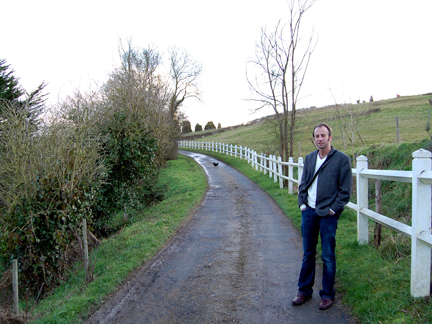
Above: Tracie B snapped this pic of me at Coulée de Serrant. Do you see the chicken crossing the road? Why does it cross the road, you ask? To “regulate” the vineyards, no doubt! (That’s the euphemism they use at Coulée de Serrant.) Mother nature does her work…

On Thursday (after a string of three rocking and super fun gigs in Paris), Tracie B and I visited Coulée de Serrant in Savennières (Loire), the estate and vineyard where some of our favorite wines are made.

map

We’re about to leave now for the NN+ gig in Lyon and I’ll post about our fascinating visit as soon as we’re back stateside. We learned that it is botrytis and not oxidation (as many believe) that give Joly’s wines their distinct aromas. Tasting the 07s revealed just how vintage-driven these wines are (compared to the 05s, the most recent we’d tasted in the U.S.). We had a blast!

In other news…

We were happy to learn that the Monday show at the Mercury Lounge in NYC is nearly sold out. There are still tickets available (click link to buy) so please pre-buy if you can. Looking forward to seeing y’all in NYC: it’s been so much fun to play the new album (available on Itunes now, btw) and I can’t wait for you to hear it!

Okay, gotta run! Don’t wanna be late for the gig!

Natural Lambrusco in Paris (and late for sound check)

lambrusco

We’re on our way to sound check (and I’m running late, as usual) and I can’t wait to post about recent enogastronomic adventures. Last night, Tracie B, Alice, and I did drink this fantastic natural Lambrusco by Camillo Donati with Pierre at Racine.

Ok… gotta run… more later… stay tuned!