Super Cocina and Franco’s editorial on the Italian Unity Bottle project

Rolled in early this morning to San Diego where I’ve been asked to sit as one of the judges of the San Diego International Wine Competition (and ya’ll thought I was kidding about drinking oaky “Napa Cab” on Facebook!).

Made a beeline to Super Cocina (above) where brother Tad hooked me up with the goods. Man, anyone who comes to San Diego and doesn’t check this place out might as well just stay home… I love it that much… The chicharrònes were super tender and swam deliciously in their tomatillo sauce.

In other news…

I just finished translating Franco’s editorial on the “Italian Unity Bottle Project.” Click here to see what he had to say.

Aglianico: Grape Name Pronunciation Project

CLICK HERE FOR ALL EPISODES TO DATE.

Since I launched the Italian Grape Name Pronunciation Project one month ago today, the most requested ampelonym has been Aglianico.

The grape name poses a challenge for non-Italophones because of the phoneme gli (in Aglianico).

In Italian, the sound that corresponds to gli is what is called a palatal lateral approximant (click the link for the Wiki page) and is represented in the International Phonetic Alphabet by the following symbol:

ʎ

For the video, I have rendered the grape name as follows:

ah-L’YEE’AH-nee-koh

Italian speakers will note that Bruno — the nicest dude, one of my favorite growers of Aglianico, and a native of Campania where Aglianico is used to make some of the region’s and Italy’s most noble wines — pronounces gli with a softer inflection than his counterparts in the North of Italy, where a five- as opposed to seven-vowel system makes the i in gli more closed (more nasal).

Thanks for reading and speaking (and drinking) Italian grapes!

The new DOCG list and a killer Offida Pecorino

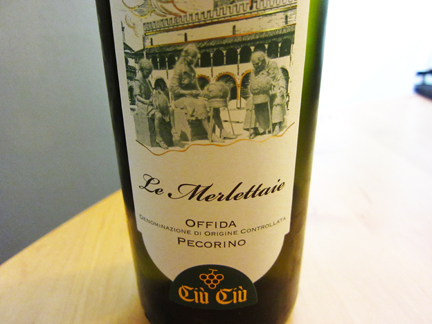
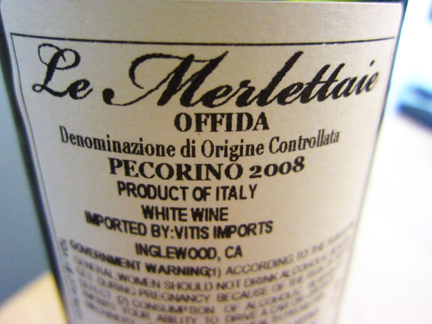
Above: The 2008 Offida Pecorino Le Merlettaie by Ciù Ciù is the best Pecorino I’ve ever tasted in the U.S. Really, really dug this wine.

“Official” is a relative qualifier in Italy. And I make that statement with all due respect and sans ironie. In the linear, Protestant thought processes of the Anglo-Saxon mindset, actors tend to see things in “black or white,” “day or night,” “yes or no”… In the non-linear, Catholic all-embracing Romance understanding of the world and the way it works, lines are blurred and absolutes are malleable. (Does anyone remember Bertolucci’s treatment of absolutes and Plato’s cave in Il conformista, 1970?)

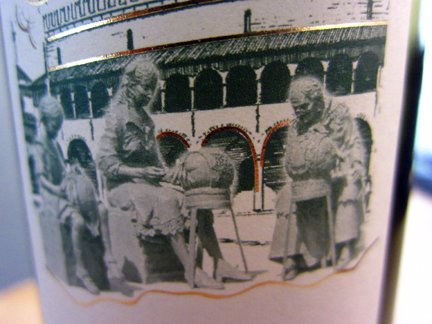
Above: Le Merlettaie is named after the famous lacemakers of Offida. The merletto a tombolo (tombolo is the pillow used to make the lace) is one of the great national treasures of Italy. I found this video showing how the lace is made.

In the wake of the publication of Alfonso Cevola’s update DOCG list, contentious emails have been hurled across the internets this morning debating the currency of the “official” number of DOCGs. I guess it depends what your definition of “is” is.

The only thing I know for certain is that Alfonso has done the wine world a service by compiling and diligently updating the list. Whether you’re a Master Sommelier candidate studying for your exam or your a server in a fine-dining establishment who wants to be able to discuss the Italian appellation system intelligently with your patrons, his list is an indispensable tool in deciphering the canon law of Italian wine.

Above: To DOC or DOCG… I say “schlemiel, schlimazel!” Pecorino, when vinified in a traditional manner, is delicious (BTW, the schlemiel spills his soup on the schlimazel.)

I can also confirm that Offida Pecorino will be equally delicious when it attains its new “Terre di Offida” DOCG status. The one that we drank last night showed sturdy acidity and a wonderfully viscous mouthfeel, with nutty and stone fruit notes.

In other news…

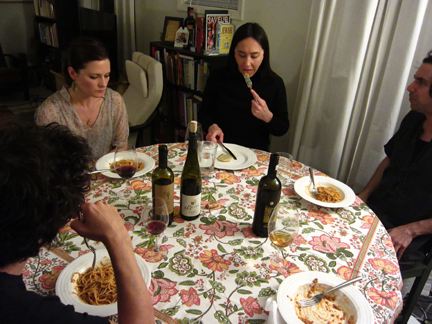
Last night, Tracie P made ragù alla bolognese for Nous Non Plus and the utterly inimitable and magical David Garza who came over to listen to our tracks and sprinkle some of his amazing gold dust on us. He brought a beautiful 1964 handmade nylon string guitar and it was amazing to hear him play and noodle on the patio before dinner. He’s performing the last concert of his residency at the Continental Club (gallery) in Austin on Monday night.

Nebbiolo: Grape Name Pronunciation Project

CLICK HERE FOR ALL THE EPISODES.

Video by Tracie P.

Aldo Vacca from Produttori del Barbaresco was in town last week and he graciously agreed to appear in the seventh episode of the Italian Grape Name Pronunciation Project. (You can read about Aldo’s Texas adventures here on Alfonso’s blog).

Thanks again to everyone for submitting videos and audio recordings of grape names. I promise I will post each and every one of them!

Sicilian Grapes: Italian Grape Name Pronunciation Project

CLICK HERE FOR ALL THE EPISODES.

Of all the Italian winemakers I know of (personally or virtually), Marilena Barbera is probably the most active on social media. When I asked people to contribute to the Italian Grape Name Pronunciation Project, she was among the first to submit recordings. Here are her recordings of some Italian grape names. Thanks for reading, listening, and “speaking” Italian grape names! :-)

How to make unsulfured wine (one man’s method) and are pharmaceutical yeasts unavoidable?

Above: Angiolino Maule didn’t know us from Adam and Eve when I called him in January asking if we could visit his winery and vineyards. By the end of the visit, we had become fast friends (sometimes it helps to speak Italian with a Veneto accent!).

If you follow along here at the blog, you know how much we love the wines of Angiolino Maule. They’re delicious and they’re affordable. And, in the words of the winemaker, they’re made with the utmost respect for Nature (with a capital N).

The story of how he went from factory worker to pizzaiolo to winemaker to Natural winemaker has been told many times before. The only thing I’ll add to it is that in an earlier time in his life, Angiolino was a gigging saxophone player and he loves music. When Tracie P, Alfonso, and I went to taste with Angiolino and family recently, the house was filled with music — speed metal, on the day we visited, preferred genre of son Francesco. The Maule family loves music and nearly every member plays an instrument and there were musical instrument strewn about the house. And you imagine our shared delight when, over dinner at Angiolino’s brother-in-law’s pizzeria I Tigli, we realized that famous Veneto jazzer Ruggero Robin is a close mutual friend.
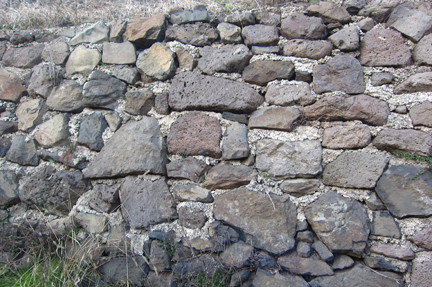
Above: A stone wall in Gambellara reveals the volcanic nature of the subsoil. Note the wide pores of the red stone.

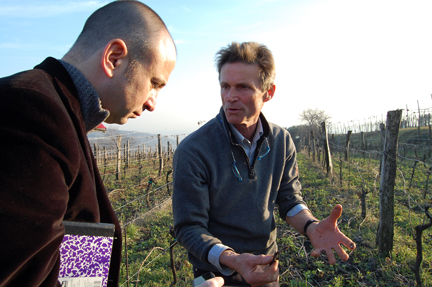
Although he also grows a few red grapes (more for professional pride than for any other reason, he said), his estate is about Garganega (if you have trouble pronouncing the grape, click here for the Italian Grape Name Pronunciation Project). His farming practices and winemaking methods are impeccably natural and he went to great lengths to explain to us how his growing sites are regularly tested for the residual presence of farming chemicals. Not only does the farmer have to eliminate the use of chemicals in order to grow Natural wine, he explained, the grape grower must also ensure that there is no chemical runoff from adjacent farms. He exclusively uses vegetal (as opposed to animal-based) composts to “re-pristinate” the nitrogen and carbon balance of his subsoils and he is actively engaging the academic community in an attempt — the first, he claims — to provide scientific evidence of how Natural winegrowing works.
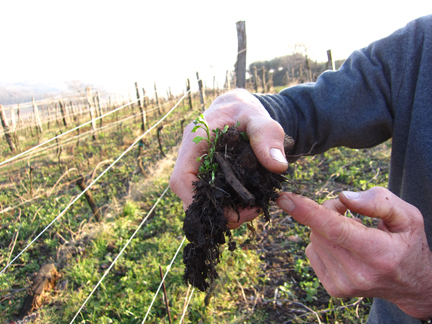
Above: “When you take something from the soil, you have to give something back,” said Angiolino as he explained the application of vegetal compost to revive the microorganisms needed to achieve balance in his subsoils. While no one truly understand how the Natural chemistry works, Angiolino is working with university researchers to provide new empirical insight.

“We [Natural winemakers] are like the prostitute who marries the most upright boy in the village,” he told us, using an old adage to explain his expanding relationship with academia. “We need to make sure that the husbands’ shirts are ironed and that the children get to school on time so that the townsfolk will begin to take us seriously.”

But perhaps the greatest revelation that day was his method for unsulfured wine, i.e., wine to which the winemaker adds no sulfites, using only the natural components in the wine (sulfur is a natural byproduct of fermentation, btw) to preserve the wine and prevent oxidation.

The secret? He bottles directly from cask, using a syphon (a “straw,” he called it). He introduces the syphon into the cask through the bunghole and then lowers it to the center of the cask. He then begins to draw off the wine and bottle it directly. In this manner, he explained, the wine does not come into contact with oxygen and thus oxidation is avoided. (I know another winemaker in Slovenia who uses this method for bottling, although with a much more elaborate setup; you can guess who.) When racking (moving wine from one vessel to another), the resulting oxidation can only be corrected using sulfites, i.e., engineered SO2. (Sulfuring in wine is not a bad thing, btw… Over sulfuring wine is the bad thing. 99.999999999% of the wine you drink, even the finest wine, is sulfured. The truth is that without the use of sulfur, we wouldn’t be able to enjoy fine wine today.)

The other secret? Angiolino sulfurs the wine that lies at the bottom of the cask: at a certain point during the bottling process, enough oxygen enters the cask to cause slight oxidation and Angiolino minimally sulfurs that parcel to stabilize the wine. He rigorously labels his wines with a reporting of the alcohol, acidity, and sulfur content on the back label. Only his unsulfured wines report “NON CONTIENE SULFITI” (“does not contain sulfites”).
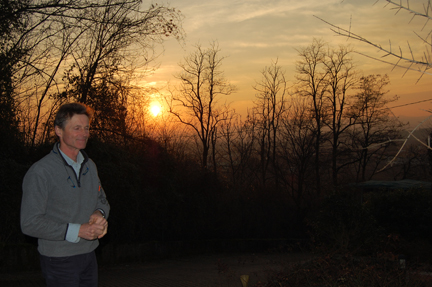
Above: Angiolino’s life and winemaking are about honesty. He is open and upfront about everything he does, feels, thinks, and believes. He talks very frankly about why he broke away from Vini Veri, which he helped to found, and how he regulates his VinNatur group with an authoritarian spirit. His wines aren’t for everyone. We love them.

There was another revelation that has been the subject of a lot of debate and discussion in our home.

At a certain point, Tracie P asked Angiolino how a Natural winemaker can avoid contamination by pharmaceutical yeasts, especially in an appellation like Gambellara, where industrial commercial winemaking dominates the landscape. “Is it possible,” she asked in her Neapolitan-cadenced Italian, “for yeast from the Zonin winery at the bottom of the hill to float its way up to your cellar?” (As lovers of Natural wine well know, one of the main tennets of the category is the exclusive use of native (also called wild or ambient) yeasts in fermentation.) If you’ve ever looked into Tracie P’s beautiful blue eyes, you know that it’s impossible to tell her a lie.

Angiolino paused and said, “that’s a very good question.” He paused again.

“When I first started making wine, I used cultured yeasts in my winery. The truth is,” he said, “once you’ve used cultured yeasts in any environment, they remain present. They never go away.”

Wow, this was a heavy moment for all of us. It called into question everything that we’ve been taught by the cultural purveyors of Natural wine. If only on an epistemological level, this revelation begs the question: is it even possible to make a wine using only native yeasts when pharmaceutical yeasts are present all around us?

In other words, is there such a thing as a 100%, purely wild fermented wine? Does the residue from previous vinifications (even Beppe Rinaldi conceded that he’s used cultured yeast on occasion) eliminate the possibility of a 100%, purely wild fermented wine? Does the yeast residue that travels on the shoes of a cellar worker contaminate a cellar forever?

It’s important to keep in mind that there’s a big difference between the use of “killer” yeasts that impart specific flavors through widespread application during fermentation (think California style) and neutral yeasts, applied sparingly and with forethought, to encourage and speed fermentation (Consider that Bruno Giacosa and Mauro Mascarello openly and regularly use neutral yeasts and Aldo Vacca uses a cultured yeast called “Barolo strain” that replicates the native yeasts of Langa — I’ve asked each of them directly.)

Do Angiolino’s wines meet the Natural wine dogmatists’s lofty requirements? I believe they do. Is truly Natural wine, as they define it, possible? I’m not sure anymore. Do Tracie P and I tend to like self-defined Natural wines more than others? Most definitely. Is Natural wine more about being conscious of how commercial and industrial winemaking changed the world of wine in the post-WWII era than it is about oxymoronic dogma? The answer surely probably lies somewhere between the Zonin factory in the village of Gambellara and the Biancara winery at the top of the hill, where Angiolino makes “magical music in a glass” (according to the importer’s glistening marketese).

The only thing I know for certain is that I admire Angiolino immensely and we love his wines. I love them because they taste real to me. They taste of rocks and fruit. They taste like my beloved Veneto. The speak a language that I understand. And when Tracie P and I share a bottle, we are happy — even happier remembering Francesco’s speed metal that day.

Teroldego: Italian grape name pronunciation project

CLICK HERE FOR ALL EPISODES TO DATE.

After I read a — how can I put this gently? — not flawless transliteration of the ampelonym (grape name) Teroldego in Eric the Red’s recent article devoted to the grape variety, I felt that something needed to be done (and because Eric is a friend and a blogging colleague, I knew he wouldn’t mind).

My first thought was to record my own voice speaking the grape name and post shortly videos on YouTube. After all, I do possess a Ph.D. in Italian, I lived for many years in Italy, I travel there 3 or 4 times a year, and my Italian colleagues acknowledge that I speak Italian with native-speaker proficiency (however with a Padua accent).

But then it occurred to me: wouldn’t it be cool if I could get native Italian grape growers and winemakers to record themselves pronouncing the names of native grapes?

My first call was to Elisabetta Foradori, arguably the most famous producer of Teroldego and the subject of Eric’s article. I have never met her but she was kind enough to take my call and she laughed warmly when I described my idea to her. A few weeks later, she sent me a recording of her enunciating the ampelonym. The video above is the first in a series of the “Italian Grape Name Pronunciation Project” that I will post on YouTube and archive here at Do Bianchi.

I hope that this project will serve as a useful tool to wine professionals and wine lovers all over the world.

IF YOU ARE AN ITALIAN GRAPE GROWER OR WINEMAKER AND WOULD LIKE TO APPEAR IN THIS SERIES, PLEASE FEEL FREE TO EMAIL ME AN MP3 OR ANY OTHER KIND OF AUDIO FILE (OR VIDEO) OF YOU PRONOUNCING THE NAME(S) OF NATIVE GRAPE VARIETIES.

A Puritanical Italy: has it come to this?

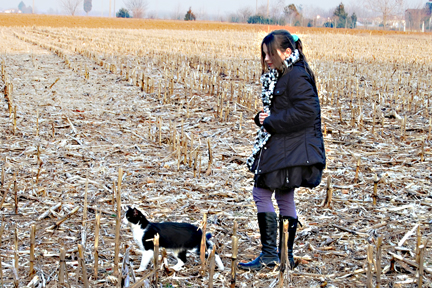
Above: On our last trip to Italy, this image — a winemaker’s daughter chasing a cat through a field — fascinated me. The cat, hoping to receive a treat, wouldn’t let the girl pick it up. But it never strayed farther than arm’s reach. She was a Pasolinian allegory of purity and innocence, the cat her serpent leading her to edge of the field where she would ultimately move beyond the farm’s borders toward the impurity of urban living and the pressures of modern society.

When we travel to Italy, Tracie P and I are very fortunate to find a host of characters gladful to share the flavors and aromas of the garden of Europe, the fair country, ancient Enotria and Esperya — the land of the setting sun, as the Greeks called it, the “Evening Land.” Blessed with a mastery of the language and endowed with years of experience there, we move seamlessly from the quartermaster of Marco Polo to the trinciante — the carver — of the osteria whom we bribe with veteran smiles and harmless guile, blank verse and syncopated song.

Don’t get me wrong: although we thoroughly enjoy every moment of it, those of you who follow (and have followed recently) along here on the blog know that we are keenly and acutely aware of how food and wine as text — as discourse — are just one red thread interwoven into the fabric of this ancient and fascinating nation.

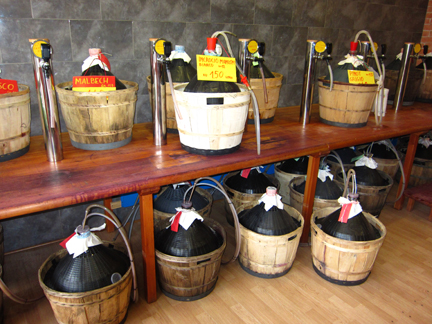
Above: Most middle-class families by their daily wine at supermarkets or at dispensaries like this one in Favaro Veneto in the terra firma of Venice.

However joy-filled and wondrous our trips seem, we never lose touch with the challenges and ills that Italians and Europeans face every day, particularly in a world where the Italian state provides less and less for the middle-class Italian, while placing more and more pressures on her/him in finding and practicing civic and national pride and ownership.

I’m deeply saddened to report (for those of you who haven’t followed the meager coverage by The New York Times) that Italian society is on the cusp of a startlingly profound peripeteia. In bizarre twist of cultural roles, Italian prosecutors are on the verge of taking down Dr. Evil himself, Silvio Berlusconi… but not by means of legal action addressing his self-serving mediatic tyranny and corruption… He will be taken out, instead, through the application of a puritanical denouement.

In early April (it was announced while I was still there last week), he will be tried for paying a minor for sex.

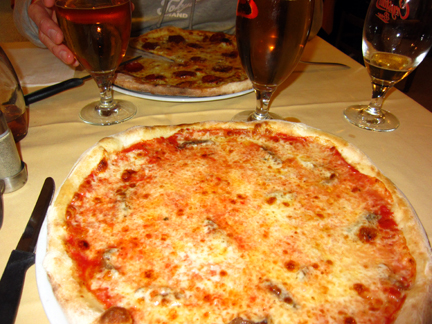
Above: My last night in Italy, this time around, I shared a pizza and a beer with a colleague and friend (who happens to be a Berlusconi supporter). The pizza was decent but forgettable. Sometimes a pizza is just pizza.

Prostitution is legal in Italy, although organized prostitution is not. And even though the legal age of consent there is 14 years of age, it is illegal to pay for sex with a minor (under 18 years of age).

Believe me: although I am not Italian and have no civic stake in Italian society other than my personal interest in Italy and the many friends I have there, I am thrilled to see Berlusconi go (and I sincerely hope this is the final nail in his political coffin). His racist remarks about Obama or his belief that “Mussolini didn’t send anyone to concentration camps… he just sent them on vacation” provide ample reason to despise him. But the manufactured consent he has generated through his control of television and newspapers, orchestrated solely in the view of his open desire to become richer through the manipulation of Italian legislation (he stated so very clearly in a now infamous interview with historian Enzo Biagi, Italy’s Walter Cronkite), offer us indisputable evidence of what a menace he is to Italian, European, and Western Civilization. Good riddance, I say.

Above: Tracie P and I use all kind of electronic media to communicate when we’re in Italy but we still love postcards.

“Since when did the Italians become puritanical?” That’s what my bandmate Verena asked rhetorically in an email thread the other day. In fact, as Verena knows well, the Italians haven’t become puritanical. Indeed, one of the things I love and cherish about Italy is the fact one is not constrained by the yoke of bourgeois and Victorian attitudes there.

But it has come to this: short of taking to the streets and squares the way the Egyptians have done, Italy must resort to a Republican-inspired puritanical Bill Clinton-era tactic to oust the country richest and most despicable man from its most powerful office.

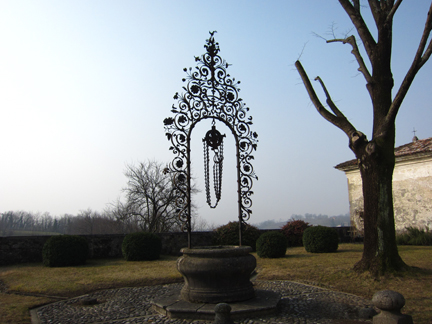
Above: If you look carefully at the wrought-iron adornment of this well (near Buttrio in Friuli), you’ll see that it is made of grape bunches, leaves, and tendrils.

I hope and pray that gourmets and gourmands of English-language literature will appreciate the allusion with which I have chosen as congedo of this post, a few lines culled from D.H. Lawrence’s poem, “Grapes.”

Buona lettura, everyone, and buona domenica. Thanks for reading…


But long ago, oh, long ago
Before the rose began to simper supreme,
Before the rose of all roses, rose of the all the world, was even in bud,
Before the glaciers were gathered up in a bunch out of the unsettled seas and winds
Or else before they had been let down again, in Noah’s flood,
There was another world, a dusky, flowerless, tendrilled world
And creatures webbed and marshy,
And on the margin, men soft-footed and pristine,
Still, and sensitive, and active,
Audile, tactile sensitiveness as of a tendril which orientates and reaches out,
Reaching out and grasping by an instinct more delicate than the moon’s as she feels for the tides.

Of which world, the vine was the invisible rose,
Before petals spread before colour made its disturbance, before eyes saw too much.

Dusky are the avenues of wine,
And we must cross the frontiers, though we will not,
Of the lost, fern-scented world:
Take the fern-seed on our lips,
Close the eyes, and go
Down the tendrilled avenues of wine and the other world.

Bombe glacé and 2006 Brunello on my mind…

Just had to share this image of an incredible bombe glacé, captured last night at Tony’s in Houston where I had dinner with a colleague, newfound friend and fellow Italophile.

In other news…

Franco’s first impressions from Benvenuto Brunello, fresh off the presses and translated by yours truly…

Tasting 42 Tocai

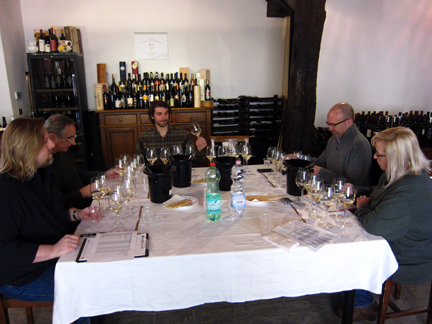
At our first Consorzio tasting in Cividale yesterday morning, team blogger COF2011 tasted 42 — yes, count them forty-two — bottlings of 2009 Tocai Friuliano, Friuli’s flagship native white grape variety (labeled as “Friuliano” when shipped outside of the U.S.).

It was fantastic to taste so many different bottlings — in a wide variety of styles by such a range of producers — in one sitting.

There were a lot of great wines but the standouts for me were: Eramcora, La Sclusa, and Rocca Bernarda. When I taste Tocai, especially young Tocai, I look for varietal expression, freshness, good acidity, balanced alcohol, white fruit, and that sexy aromatic note of dried grass and bittersweet almond. Again, lots of great wines in this tasting yesterday but looking back on my notes, these were the ones that really floated my boat.

I also “starred” Alturis (doesn’t seem to have a website), Cadibon, and Ronco delle Betulle.

Definitely a good-to-great vintage for this grape in COF.

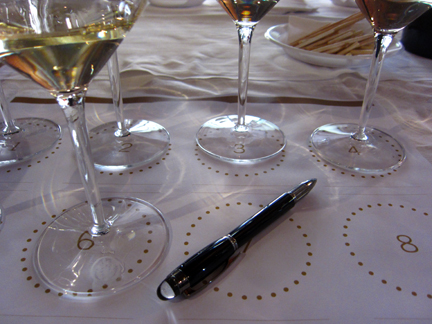
The tasting was also special for me because I used the new Mont Blanc pen that Tracie P got me for our anniversary.

For the record, the tastings are not blind, we all trade notes and impressions during each flight of six wines, and the staff at the Consorzio COF is fantastic, offering technical information and facts sheets whenever we request them. One of the best formal tastings I’ve ever attended…