A voice of reason in Montalcino? A top producer addresses the absurdity…

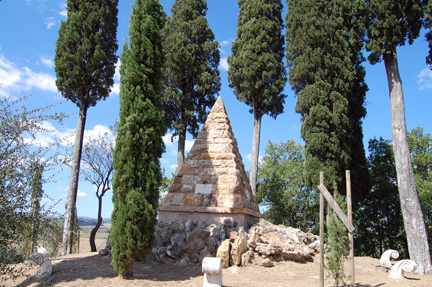
Above: A monument rests atop Montaperti, not far from Montalcino. It commemorates the 1260 battle between the Guelphs and the Ghibellines, when the temporal and spiritual [im]balance of power in the Western World lay in precarious uncertainty. In the wake of the battle, a cloud of darkness fell over Italy for centuries to follow.

Italy’s top wine blogger, Mr. Franco Ziliani, has obtained and yesterday posted (with the author’s permission) a letter addressed to members of the Brunello Producers Association by the scion of a storied Montalcino family, Stefano Cinelli Colombini, owner of the Fattoria dei Barbi. Even in the wake of an aborted call for a vote early this year to allow international grape varieties in Rosso di Montalcino (which, by law, must be made with 100% Sangiovese grapes), certain members of the body are asking its technical advisory council to consider calling again for a vote on the matter.

I have translated the letter in its entirety and believe that its truths are self-evident.

*****

Dear friends and producer colleagues, I have just attended a meeting organized by the Consortium [Brunello Producers Association] where we discussed the inclusion of other grapes [besides Sangiovese] in the Rosso di Montalcino [appellation]. And I am writing to share my deep-seated reservations. We are faced with a serious problem because an overwhelming majority voted against the inclusion of other grapes in the Rosso di Montalcino [appellation] in a recent assembly.

An assembly vote should not be put up for discussion just a few months later. With all due respect, I would like to remind you that we have just put a tremendous rift behind us. It happened because the [fifteen-member technical advisory] Council was too stubborn to call for votes on votes [sic] on an argument (the blending of Brunello [with grapes other than Sangiovese]) for which the assembly had already expressed its clear dissent.

The message conveyed by the members is more than evident: appellation regulations are to be changed only if there is clear and broad consensus beforehand. All it takes is to ask for signatures from the members who wish to modify the appellations. We were just a handful of members but it took us just a week to gather the signatures of more than two thirds of the members against the blending of Brunello. I am certain that the Consortium has the means and the personnel to do a better job than we did. If as many producers were to sign [a call for a new vote], it would only be right and correct to call an assembly vote on whether or not blending should be rejected. Otherwise, you should stop.

Anyone who lives in this community knows that [a proposal for] blending will be voted down by the assembly, that such a vote will once again create a rift among members, and that a media storm will inevitably follow.

We must avoid such a useless confrontation. A new conflict between the assembly and the Council will lead only to paralysis and paralysis helps no one.

I’m not interested in who’s right and who’s wrong. Now, more than ever before, we need a Council that knows how to win the trust of its members. We don’t need a Council that opposes them.

The only plausible reason to allow blending has fallen by the wayside: the sale of Rosso di Montalcino is no longer falling. [Consortium] director [Stefano] Campatelli says that during the first six months of 2011, 500,000 more bottles have been shipped than in the first six months of the previous year. This represents phenomenal growth.

Previously, there could have been some doubt but now the numbers show that the sales of Rosso di Montalcino depend on the price of Brunello and not on the Sangiovese. When Brunello was sold in bulk at Euro 300 per hectoliter, no one wanted to buy the Rosso anymore. With Brunello at Euro 800, the Rosso is soaring with a 40% increase in sales.

If you think about it, it’s only logical that if a bottle of Brunello only costs a few Euro more than the Rosso, everyone will buy the Brunello. The cure for the Rosso di Montalcino malaise is higher prices for Brunello and not blending, which would not make the Rosso technically better. Blending would only make it the same as many other excellent wines that cost much less. It takes a lot more than slapping a Ferrari label on a [Fiat] Panda to sell it for Euro 100,000. And it takes more than the Montalcino name to set a high price for a wine that may be technically perfect but otherwise indistinguishable from many others that cost three or four Euros.

Your colleague, Stefano Cinelli Colombini, Fattoria dei Barbi

*****
In unrelated news, have you noticed that Franco has announced the winner of his recent “make me a new blog banner” competition? His new banner was created by Ms. Stefania Poletti, a native of Bergamo who now resides and works in Boston. Congratulations, Stefania! Nice work!
Sad news: terrible hailstorm in Collio (Friuli)

It’s with a heavy heart that I share the news about a terrible hailstorm that struck Collio late on Saturday night.

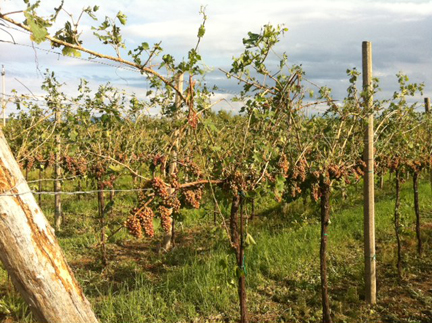
Franco and I posted about it this morning over at VinoWire and my good friend Giampaolo Venica — whose vineyards were miraculously spared — sent me the above photo of vineyards in Plessiva.

“‘The hailstorm, which lasted for a good 30 minutes, struck in a leopard-spot pattern [affecting] one out of every six vineyards,’ said Luigi Soini, director at the Cantina Produttori di Cormons. ‘In some cases, as in Plessiva, Zegla, and Preval, 100% of the crop was lost. In others, 80%. In the more fortunate cases, only 10-15% of the fruit was damaged… It’s been years since a calamity of this proportion has occurred in Collio.’”

Source: Università di Udine.

Note how the canopy in the photo above has been almost entirely destroyed. Even where vineyards were not affected directly by the hail, the rot that will follow can have a devastating effect on. Many wineries, said Giampaolo, including some of the biggest names, will not be producing wine in the 2010 vintage.

As much as we love Nature, she can also be cruel…

Risotto alla Parmigiana my recipe and other news

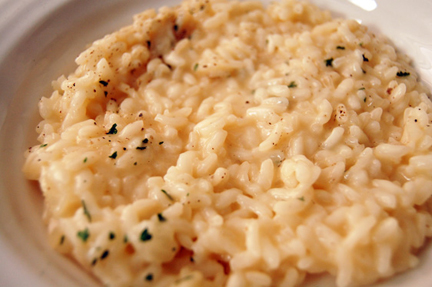
I just couldn’t resist jotting down this recipe, one of my favorites and one of the simplest things in the world to make. All it takes is the right ingredients and patience. The reward is one of the most delicious expressions of Italy you’ll ever taste. The photo appeared today in my Houston Press post on the Aligoté by Michel Lafarge. Buon appetito!

Risotto alla Parmigiana

Serves 4

Ingredients:

3 tbsp. unsalted butter
2 tbsp. finely chopped white onion
1 cup Carnaroli
½ cup white wine
chicken stock, as needed (2½-3 cups)
kosher salt
Parmigiano Reggiano, freshly grated

Melt the butter over medium-low heat in a wide sauté pan. Add the onion and gently cook until translucent, making sure all the while not to brown the onion (add a dash of water or white wine if needed). When the onion has become translucent, add the rice and toast over medium-low heat for 2-3 minutes, stirring occasionally (this step is fundamental and ensures that the individual grains don’t stick together or become lumpy). Deglaze with the white wine and when the wine has evaporated, begin adding the stock one ladleful at a time, stirring gently all the while (constant stirring is the secret to evenly cooked risotto). Season with salt to taste (not necessary if the stock is properly seasoned). As the stock is absorbed by the rice, continue adding more liquid as needed until the rice has cooked through (or to desired firmness), about 20-25 minutes. Remove from heat and gently fold in a generous amount of Parmigiano Reggiano. Sprinkle lightly with minced flat-leaf parsley and top with freshly cracked pepper. (For traditional Risotto alla Parmigiano, omit the flat-leaf parsley and pepper.)

Serve as a first course with extra Parmigiano Reggiano on the side and pair with Lambrusco di Sorbara.

In other news… Happy birthdays…

Today is Alfonso’s birthday. Anyone who’s been following along here at the blog knows the important role he’s played in our lives over the last years. He introduced me to Tracie P, was the best man at our wedding, and he’s our comrade in all things vinous and blogilicious. He has one of those great palates that you can only train and develop over years — decades — of tasting all kinds of wines, from every category. I admire him for how he lives his life, for his career, for his intellectual pursuits, for his natural gift in writing and the amazing stories he tells us about his life in Italy wine, and for the generous friendship that he’s shared with us. We talk almost every single day about everything under the sun and there are days when we seem to communicate telepathically through our blogs and social media (he and I are leading a panel on wine blogging at this year’s Texas Sommelier Conference in a few weeks, btw). And I probably don’t know anyone who can make laugh as hard as Alfonso can. We love him a lot and are thinking of him today on this special day.

Tomorrow is Cousin Marty’s birthday. Does anyone remember the scene in Mel Brooks’s The Producers when Gene Wilder gives the speech at the end in the courtroom before the judge? “This man… this man… this is a wonderful man.” That’s how I feel about Marty. He’s the Bialystock to my Bloom. I never knew Marty growing up: he’s my father Zane’s first cousin and because the families were estranged, I didn’t have much or any contact with him and his children. But when he found out that I moved to Texas to be with Tracie P, he reached out to us and made us part of his family’s life. And guess what? It turns out that I’m not the only fresser in the family! Like us, Marty loves food and wine (“I never met a Rhône I didn’t like,” goes one my favorite aphorisms of his) and he loves the theatrical experience of restaurant going. We’ve become so close over the last few years and the amount of fun we have together is criminal, really. There outta to be a law against it! Marty had a health scare this year and even in its darkest moments, I was blown away by the joy and hope and love and generosity of spirit that he mustered — not just for his own sake but for ours as well. Thank G-d that he’s fine. I just can’t imagine a world without him and Tracie P and I are sending lots of love and happy birthday wishes for his special day tomorrow.

In other other news…

Tomorrow I’m heading home to California where I’ll be pouring wine on the floor Wednesday and Thursday nights at Sotto in Los Angeles. If you’re in town, please come down and taste with me. We’re going to be debuting a new Gragnano (my favorite) and Randall Grahm’s excellent Syrah by the glass. Hope to see you!

Recioto, Maffei, and Cassiodorus: the Italian text

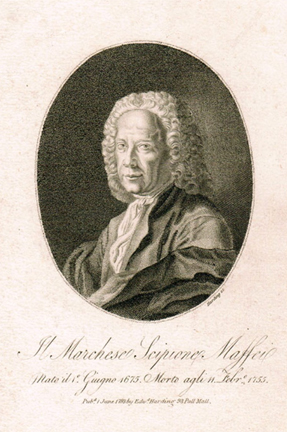
Above: Marquis Francesco Scipione Maffei, 18th-century archeologist, historian, art historian, and philologist (image via Michael Finney Antique Books and Prints).

Over the last few days, a number of people have retweeted my translation of Cassiodorus on Recioto della Valpolicella (Acinaticum) via Marquis Francesco Scipione Maffei (thank you Melissa, Raelinn, Randall, Meg, Lizzy, and Juel).

And yesterday, Italy’s A-number-1 wine blogger, Mr. Franco Ziliani, graciously and generously included it in his weekly wine blogging roundup for the Italian Sommelier Association.

In my initial post, I included my translation of the Cassiodorus text into English along with the original Latin.

Today, for Italian readers, I’m posting the Italian text, transcribed from Maffei’s Verona Illustrata (Verona Illustrated, originally published in 1731-32 in Verona).

If only I had time (and the financial resources) to devote myself full-time to my philological pursuits! Magari! For the time being, my enophilological research has to take a backseat to earthly necessities. It means SO MUCH to me when people enjoy these posts. THANK YOU one and all!

Here’s the text. Buona lettura! (Click here for my English translation.)

*****

“Non è da tralasciare la distinta memoria di due vini veronesi che ci ha conservata Cassiodoro, scrivendo a colui, che avea cura in queste parti delle contribuzioni fiscali a tempo di Teodorico. Dopo aver premesso, doversi per la Regia mensa far venire d’ogni parte le più rare cose, così proseguisce: ‘e perciò son da procurare i vini, che la feconda Italia singolarmente produce, accioché non paia aver noi trascurate le cose proprie, quando cercar dobbiamo anche le straniere… Spezie di vino veramente degna che se ne vanti l’Italia: imperciocché se bene l’ingegnosa Grecia, di varie e fine diligenze lodata, e condisce i vini suoi con gli odori, o con marine mischianze dà lor sapore, niente ha però di così squisito… il vino Acinatico, che da gli acini ha il nome… Questo è puro, per sapor singolare, Regio per colore; talché o ne’ suoi fonti possa tu creder tinta la porpora, o dalla porpora espresso il liquor suo. La dolcezza in esso si sente con soavità incredibile, si corrobora la densità per non so qual fermezza, e s’ingrossa al tatto in modo, che diresti esser un liquido carnoso, o una bevanda da mangiare… Vogliam riferire quanto particular sia il modo di farlo. Scelta nell’Autunno l’uva dalle viti delle domestiche pergole, sospendesi rivoltata, conservasi ne’ vasi suoi, e negli ordinari repositori si custodisce. S’indura dal tempo, non si liquida: trasudando allora gl’insulsi umori, soavemente addolciscesi. Tirasi fino al mese di Decembre [sic], finché l’inverno la faccia scorrere, e con maraviglia cominci il vino a esser nuovo, avendo in tutte le cantine si trova già vecchio. Mosto invernale, freddo sangue dell’uve, liquor sanguigno, porpora bevibile, violato nettare. Cessa di bollire nella sua prima origine, e quando può farsi adulto, comincia a parere per sempre nuovo. Non si percuote inguirosamente con calci l’uva, né con mischiarvi sordidezza alcuna s’infosca; ma vien’eccitata come alla nobiltà si conviene. Scorre, quando l’acqua indurisce, è feconda, quando ogni frutto de’ campi è svanito, stilla dagli occhi suoi liquor corrispondente, lagrima non so che di giocondo ed oltre al piacer del dolce, singolare è nella vista la sua bellezza'”.

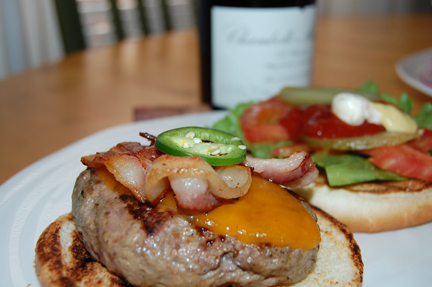
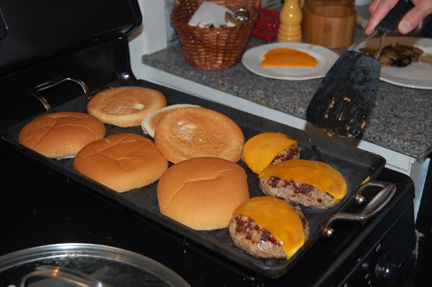
Bacon cheeseburgers and Chambolle-Musigny for my birthday and Tracie P is showing!

In years past, my birthday has been marked with a bistecca alla fiorentina. (Last year’s Florentine-style porterhouse was particularly memorable because it coincided with James Suckling’s announcement that he was leaving Wine Spectator.)

But this year, with Baby P on the way and the implementation of new austerity measures, bacon cheeseburgers (another guilty pleasure of mine) seemed more idoneous.

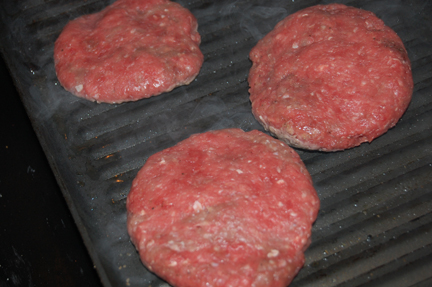
I always use ground sirloin for my burgers, seasoned with salt, pepper, and Tabasco.

We sacrilegiously paired with a bottle of 2001 Chambolle-Musigny Les Charmes by Leroy (!!!). I know what you’re thinking: austerity measures and a $300+ bottle of wine? It was given to me by a friend at a famous auction house after I helped her out by researching a lot of famous Tuscan wine for her.

I wrote about the wine this morning over at the Houston Press blog, where I’ve been having a lot of fun with the “Odd Pair” rubric that I author. It’s been great to get out of my comfort zone and write about a wider variety of wines (and even some wines I wouldn’t reach for normally).

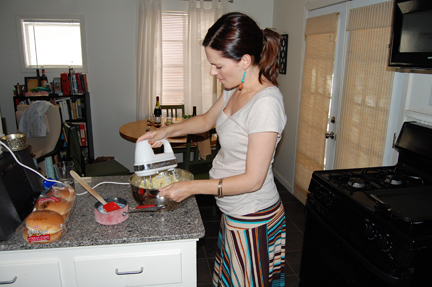
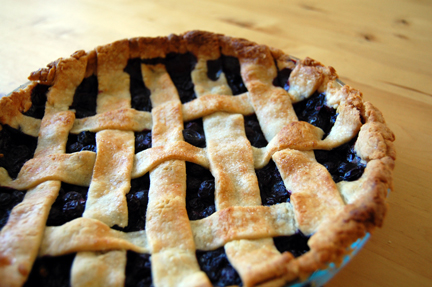
I made the burgers and Tracie P made the mashed potatoes (as my birthday request) and the traditional blueberry pie (this year with lattice-top crust!). She’s really beginning to show!

Baby P and she are doing great and we’re looking forward to finding out Baby P’s sex in a few weeks. :)

Thanks, so much, for all the birthday wishes! They mean so much to me… What a special birthday this year and what an amazing year this has been and will be… We can’t tell you how much your support means to us…

European Wine Bloggers Conference: PSYCHED for October!

It was pretty much a foregone conclusion that Ryan Opaz and I were going to become fast friends when we meet last month for the first time at the Radici Wines festival in Apulia. Ryan is simply one of the coolest dudes in wine blogging today and I completely dig, his style, his energy, his mission, and his vibe… My kinda people…

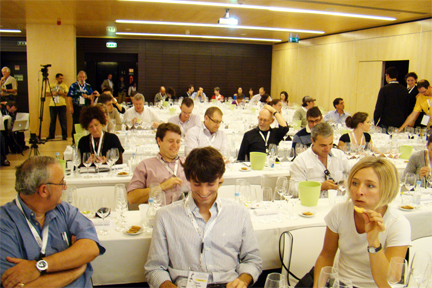
I am entirely geeked and psyched to share the news that Ryan and his partner in marriage, life, and business Gabriella have asked me to speak at a couple of events at this year’s European Wine Bloggers Conference in October in Italy… YES ITALY! In Franciacorta to be exact… How friggin’ cool is that?

In coming months, I’ll be posting on the panels and seminars in which I’ll be participating and I am thrilled to get to meet so many bloggers and winemakers whom I only know virtually and through their wines. The super cool Evan Dawson is going to be the keynote speaker! That’s way rad and I’m stoked to finally get to connect and taste with him. Stay tuned!

In other news…

I’m taking the rest of the day off because a little bird just landed on my shoulder and told me that today is my birthday! Tracie P baked me a blueberry pie with lattice-top crust and we have a special secret menu planned for tonight… See you tomorrow! And thanks for all the birthday wishes! This birthday is a really special one for me. :)

Recioto della Valpolicella, an ancient pitch by Cassiodorus

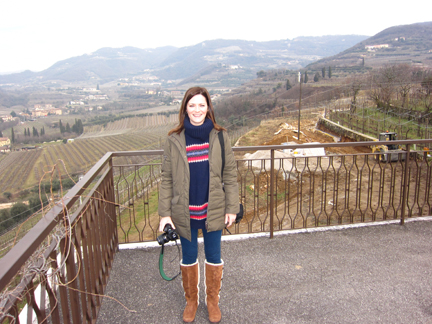
Above: I snapped this photo of Tracie P when we visited the Valpolicella together with Alfonso in early 2011.

In every book about Italian wine and every promotional text you read about the Valpolicella and Soave, there is always an obligatory mention of the wine produced in antiquity there, Acinaticum. But none of them — to my knowledge — ever reproduces or reprints the primary texts where the wine is mentioned.

In the course of my research of the origins of the enonyms Vin Santo (Italian) and Vinsanto (Greek), I came across a wonderful tome entitled Verona Illustrata (Verona Illustrated, originally published in 1731-32 in Verona) by the Marquis Francesco Scipione Maffei. Not only was Maffei an archeologist and chronicler of Verona’s history, he was also a philologist. And one of his most important contribution to classical studies was his translation and study of a manuscript containing the letters of late-Roman-era statesman Cassiodorus (some believe that Maffei was the first to discover the vellum-bound handwritten book).

Over the weekend, as I was working on a short piece on the Veneto that will be published later this year in Italy, I revisited the text and have rendered a translation of — what I consider — a salient passage below on Acinaticum.

The most remarkable thing I discovered was that Cassiodorus was writing to the Canonicarius Venetiarum — the treasurer of the Veneto region under Rome — imploring him to buy Acinaticum for the royal table. In essence, it was a sales pitch for the unusual wine of Valpolicella. I have translated it from the Latin using Maffei’s Italian translation as a guide. It is one of the most inspiring pieces of wine writing I have ever read… and a wonderful pitch!

I love when he writes, “On the palate, it swells up in such a way that you would say it was a meaty liquid, a beverage to be eaten rather than drunk” (“tactus eius densitate pinguescit, ut dicas esse aut carneum liquorem aut edibilem potionem”).

Buona lettura!

Italy rightly boasts of its truly worthy types of wines. And for however much we praise the ingenious Greeks for their wide variety of wines and their skill in dressing their wines with aromas and sea mixtures to give them flavor, they have nothing as exquisite as this…. The wine called Acinaticum, which takes its name from the acino or [grape] berry.
It is pure, singular in flavor and regal in color, so much so that you would say that it has been used to dye crimson [fabric] or that it is the liquid pressed from crimson. The sweetness in it is incredibly delicate and its density is formed by a firmness [in texture] unknown to me. On the palate, it swells up in such a way that you would say it was a meaty liquid, a beverage to be eaten rather than drunk.

The grapes are selected from vines [trained] on locally managed pergolas, they are hung upside down, and [then] they are stored in their amphoras, the regular vessels used [for their vinification]. With time the grapes become hard but do not turn into liquid. They sweat out their insipid fluid and become delicately sweet. This continues until December when the winter begins to make their juice run, and, wondrously, the wine becomes new [fresh] even as you find wine already mature in all the other cellars. The winter must — the cold blood of the grapes, the bloody fluid — [becomes] potable crimson, violet nectar. It stops boiling [fermenting] in its youth and when it is able to become an adult, it once again becomes new [fresh] wine.

The grapes are not tread with injurious shoes! Nor is any filth allowed to mix with them. They are stimulated [i.e., vinified] in accordance with their nobility. [During the time of the year when] the water hardens [freezes], the liquid flows. When all fruit has disappeared from the fields, this wine is fertile and its noble fluid oozes from its buds. I am unable to describe the goodness of its tears. And beyond the pleasure of its sweetness, its beauty is singular to behold.

Latin (unabridged):

Et ideo procuranda sunt vina, quae singulariter fecunda nutrit Italia, ne qui externa debemus appetere, videamur propria non quaesisse. comitis itaque patrimonii relatione declaratum est acinaticium, cui nomen ex acino est, enthecis aulicis fuisse tenuatum. [3] Et quia cunctae dignitates invicem sibi debent necessaria ministrare, quae probantur ad rerum dominos pertinere, ad possessores Veronenses, ubi eius rei cura praecipua est, vos iubemus accedere, quatenus accepto pretio competenti nullus tardet vendere quod principali gratiae deberet offerre. digna plane species, de qua se iactet Italia. nam licet ingeniosa Graecia multifaria se diligentiae subtilitate commendet et vina sua aut odoribus condiat aut marinis permixtionibus insaporet, sub tanta tamen exquisitione reperitur simile nil habere. Hoc est enim merum et colore regium et sapore praecipuum, ut blattam aut ipsius putes fontibus tingi aut liquores eius a purpura credantur expressi. dulcedo illic ineffabili suavitate sentitur: stipsis nescio qua firmitate roboratur: tactus eius densitate pinguescit, ut dicas esse aut carneum liquorem aut edibilem potionem. libet referre quam singularis eius videatur esse collectio. autumno lecta de vineis in pergulis domesticis uva resupina suspenditur, servatur in vasis suis, thecis naturalibus custoditur. rugescit, non liquescit ex senio: tunc fatuos humores exsudans magna suavitate dulcescit. Trahitur ad mensem Decembrem, donec fluxum eius hiemis tempus aperiat, miroque modo incipit esse novum, quando cellis omnibus reperitur antiquum. hiemale mustum, uvarum frigidus sanguis, in rigore vindemia, cruentus liquor, purpura potabilis, violeum nectar defervet primum in origine sua et cum potuerit adulescere, perpetuam incipit habere novitatem. non calcibus iniuriose tunditur nec aliqua sordium ammixtione fuscatur, sed, quemadmodum decet, nobilitas tanta provocatur. defluit, dum aqua durescit: fecunda est, cum omnis agrorum fructus abscedit. distillat gemmis comparem liquorem: iucundum nescio quid illacrimat et praeter quod eius delectat dulcedo, in aspectu singularis eius est pulchritudo.

If any of you Latinists want to help me refine the translation, please do so by leaving alternative translations or suggestions in the comments! Thanks in advance!

The Italian DOC/G system is dying

Whenever my students, readers, or colleagues ask me about the Italian DOC and DOCG systems and what is the difference between the two, I always tell them: It’s important to keep in mind that the Italian appellation system was created not to protect the consumer or to enhance Italian producers’s capabilities in marketing their wines. It was created — as the dearly missed Teobaldo (Baldo) Cappellano pointed out in the Brunello Debate of October 2008 — to protect the territories where the wines are produced.

There is a widespread misconception of the system — for which Italian producers and North American educators are to blame — that the DOCG denoted a higher level of quality “controlled and guaranteed” by authorities for the protection of consumers. In fact, the DOCG represents more rigorous “monitoring” (as we would say in UN-speak) of practices “on the ground,” intended to protect the appellations themselves. In other words, these more stringent regulations were created and implemented to ensure that once a winemaking tradition was officially established, it would enjoy the support of the state when threatened by outside forces or internally unscrupulous producers.

Today, over at VinoWire, Italy’s A-number-1 wine blogger Franco Ziliani and I have posted his observations and commentary on the creation of Italy’s first-ever DOCG for rosé.

Salice Salentino Rosato, you wonder? Or a rosé from Nebbiolo or perhaps Sangiovese? No, Italy’s first rosé DOCG is Castel del Monte Bombino Nero, an appellation that allows for the following grape varieties:

Bombino Nero and/or Aglianico and/or Uva di Troia from 65-100%. Other grapes allowed in the production of this wine, by themselves or blended, include non-aromatic grape varieties recommended and/or authorized by the Province of Bari, provided they are grown locally, [for] up to 35% of the blend.

As they say in Italian, siamo arrivati alla frutta, in other words, it’s time for the [poison-laced] fruit at the end of the meal, a common technique for assassination in the Middle Ages.

The Italian DOCG system has been co-opted, colonized, and raped (there is no better word) by misguided and misinformed, greedy robber-baron Italian producers and money-grubbing politicians who have used lobbying and gerrymandering to create a false “luxury brand” for the sole purpose of lining their pockets with dollars of innocent North American consumers. How many times have you visited a wine store where some young and well-intentioned sales person has told you: See the DOCG label on the Chianti Classico? That means it’s a better wine than the DOC.

Today, the Italian DOCG system is the saddest form of wine writing (vinography) that I have ever encountered. It makes me want to heave.

For the most up-to-date and ever-growing list of Italian DOCGs, see Alfonso’s post here.

The best meal in Greece, the most beautiful Greek woman, and the CORRECT pronunciation of Xinomavro

Many great meals were thoroughly relished by a wine blogger last week in Greece but the one that he cannot stop thinking and dreaming about was a dinner prepared by Maria Constandakis, who — together with her husband and agronomist Yannis — oversee the Boutari winery in Crete.

The meal began with a Cretan dakos, a wholewheat rusk, a bit larger but similar to the frisa of Apulia, where they top it with diced mozzarella, tomatoes, and tuna. Here, tradition calls for fresh tomato purée and crumbled feta. And while the Apulians gently soak their frisa before dressing it, the Cretans use the water naturally purged by the tomato when it is tossed with the salty cheese.

Next came the classic Greek zucchini “meatballs,” the kolokithokeftedes. The wine blogger had experienced this dish before but in his own words, “to have Maria’s, made from zucchini she grew herself in the winery’s garden, is a game-changer.”

The next morning, said wine blogger photographed Maria’s zucchini.

When you travel in Greece during summer, horiatiki — the classic village or summer salad — is served at nearly every meal. But there was something different about Maria’s. Upon further inquiry, the blogger discovered that Maria included freshly torn glistrida or purlane in her salad, also grown in her garden.

Still used as an effective folk remedy for certain ailments of the mouth, purlane grows wild in Greece (the blogger even found it along the sidewalks of one of the small towns he visited in Northern Greece). Like nettles, it slightly stings the tongue and according to legend, those who consume it are prone to loquaciousness. (Said blogger has never been accused of being long-winded! But true to legend, he stayed up late into the night discussing philosophy and politics with his companions over many glasses of raki.)

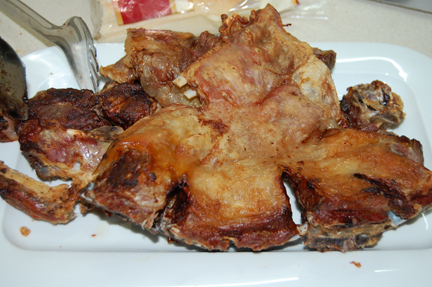
The pièce de résistance, however, was Maria’s slow-roasted lamb. Even though, technically, the meat had not been smoked, the effect was the same: the bones were so tender that that crumbled gently in the blogger’s mouth, rewarding him with their sweet marrow.

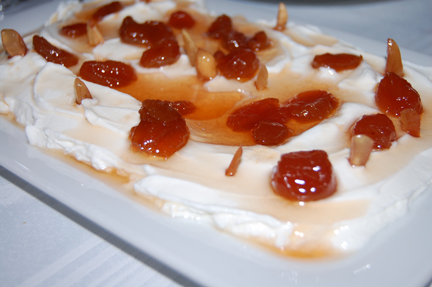
Said blogger is rarely said to eat dessert but there was no way for him to resist Maria’s yogurt topped with cherries she had stewed herself.

Said blogger enjoyed many great meals in Greece but none came close to that prepared by Maria.

In other news…

In the days that followed, said blogger, an accomplished linguist, learned that he had been incorrectly pronouncing the name of the most noble red grape variety in Greece, Xinomavro.

Click here to listen to the correct pronunciation.

Ciliegiolo: Italian grape name pronunciation project (and a fun post about Lambrusco)

CLICK HERE FOR ALL EPISODES

Before I left for Greece, Wine Parkour requested an episode of the Italian Grape Name and Appellation Pronunciation Project devoted to the ampelonym Ciliegiolo.

So I reached out to my friend and excellent producer of Morellino di Scansano Gianpaolo Paglia, who graciously agreed to video himself pronouncing the grape name. (You may remember Gianapolo for the excellent meal he and I shared last year in Maremma and for my posts about his decision to sell his barriques and his declaration that he would no longer age his wines in new small French oak cask; click here for the thread.)

I wouldn’t exactly call Gianpaolo the “Dustin Hoffman” of Italian wine but you will definitely walk away from this video knowing how to pronounce Ciliegiolo (not an easy one for Anglophones)!

In other news…

However jetlagged today, I managed to churn out a fun post this morning for the Houston Press on Lambrusco. My editor there has been very generous in letting me create my “wine as exegetic tool” posts (read “wine as a pretext and excuse to study culture”). Have you ever visited Emilia-Romagna? Then you’ll know what I’m talking about!