A super fun show at Francofolies

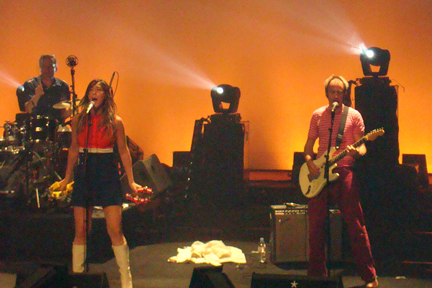
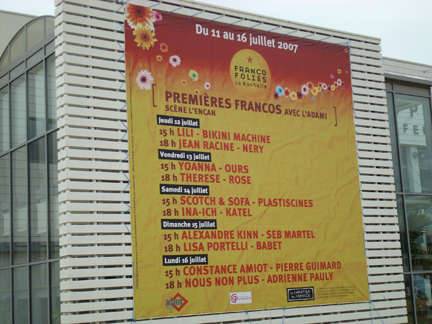
Today Nous Non Plus shared a bill with Adrienne Pauly (whose career really seems to be taking off in France) at Francofolies in La Rochelle (France). We played a great show to a packed house of 400 people, who, by the end of the show, were dancing in the aisles (it was a seated show, unusual for us). Some pics…

franco_3.jpg

franco_1.jpg

franco_2.jpg

franco_4.jpg

Catering at Francofolies

jar_driving.jpg

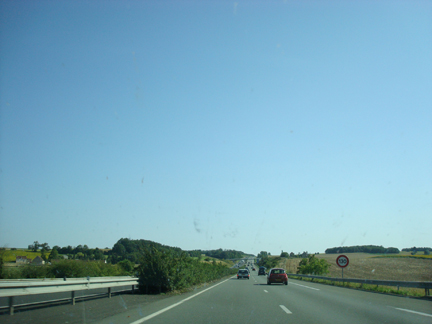
We drove this morning from Vosne-Romanée to La Rochelle, a journey that took us back up toward Paris on the A6, then over to Orléans, and then on the A10 to Tours and down to La Rochelle (not far from Bordeaux).

cross_country.jpg

The trip took us through the “heartland” of French agriculture and then through the Loire Valley, where we could see signs for (but could not stop at) Chinon, Saumur, etc.

Just outside of Tours we stopped for gas at a rest stop and by chance we happened upon the other members of Nous Non Plus.

We were met in La Rochelle by our handlers Pierre and Pascal from Scène et Public, our agent for France and Europe, who had booked us at the Francofolies festival. After a long day of traveling, everyone was hungry and Pascal was raving about the catering tent behind the mainstage. We checked into our hotel and made our way through La Rochelle, which was in full party mode, with musicians (buskers and festival performers) everywhere.

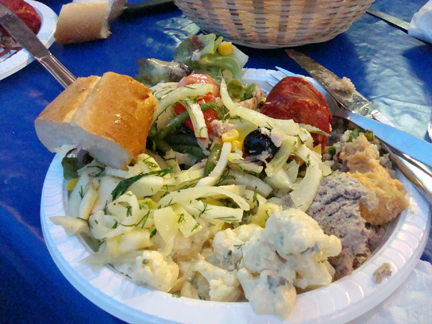
When we arrived at the tent, even the French among us (including Patrick Woodcock of Mellow, Céline Dijon’s boyfriend) agreed that the spread was the best “catering” they had ever seen at a music festival: summer salads, freshly shucked oysters, fish loaf (which I loved), couscous, saffron rice, a cheese board… amazing… (N.B.: the French use the American word “catering” which they pronounce KAH-tehr-eeng.)

catering.jpg

I was happy to eat a meal lighter than my typical Burgundian repast!

rose_rochelle.jpg

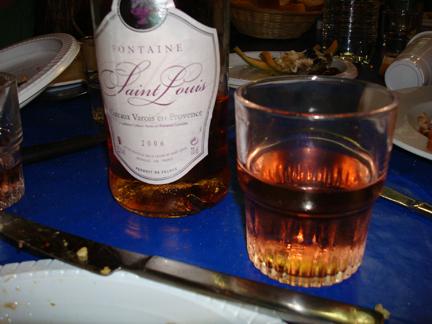
It was also nice to drink something a little less demanding on the palate, like the Provençal rosé they served.

I had a great time talking about wine with Pierre and Pascal. Nearly everyone I meet here knows and appreciates wine, although Pascal is not a fan of Italian wine. The French seem to know only Sicilian wine (and occasionally they’ll tell you that they like Lambrusco).

everyone_chewing2.jpg

Above, from left, Céline Dijon (Verena Wiesendanger), Bonnie Day (Emily Welsch), François (our sound guy), Pascal (our handler), François Hardonne (David Griffin), Prof. Harry Covert (Greg Wawro).

Halfway through dinner, a huge storm exploded over La Rochelle and everyone poured into the main tent to escape the rain. The tent was transformed into a fantastic party (you can imagine). At a certain point, an African group started up a contagious rhythm by banging empty wine bottles on the tables and the whole tent broke out in song led by the group’s lead singer… A smoke-filled tent of happy happy people, their bellies full of wine.

Despite the rain, the festival went on, and I caught the tail-end of the closing set by ex-tennis star Yannick Noah, who closed the penultimate night of the festival on the main stage. Man, that guy can work a crowd…

A Wine Older than Me: Spanna Colline Novaresi VdT 1958 Vallana

Opening fifty-year-old wine with fellow forty-year-old and friend Jeff Grocott at Morandi.

Spanna VdT 1958 Vallana

A few weeks ago, good friend and fellow child-of-the-Summer-of-Love Jeff Grocott proposed that we drink a bottle of old Spanna by Piedmontese (Novarese) producer Vallana to celebrate the near completion of our nearly four decades on the planet. Jeff, a page-one editor at the Wall Street Journal, wrote a number of wine features and tasting notes when he was an editor at the WSJ Weekend Section. You have to subsribe to the WSJ online edition in order to browse/search old articles but you can find some of Jeff’s articles on the web. His story on wine storage, which appeared in syndication, is one of the most popular and it offers some interesting and solid insights into the myths/truths of cellaring. Jeff and I met a few years ago when I was doing media relations for a NYC wine merchant and have since opened and enjoyed many bottles together, including a Barolo Riserva (Red Label) 1990 Giacosa that my friend and colleague Jim Hutchinson generously poured for us in his apartment last winter (served with a Coda alla Vaccinara that Jim had cooked all day in his crock pot).

Jeff, who lives in the village with his wife Barbara, had spied the Spanna 1958 Vallana at the relatively new Morandi on Waverly at Charles St.

We were both reluctant to open such an old bottle at a place like Morandi: similar to the ever-popular Da Silvano, Morandi is a glamorous, star-studded (see our celebrity encounter below), pseudo-trattoria New York City cafeteria — not exactly the place you think of when it comes to old wine. The bottle was reasonably priced but what was its provenance? how had it been stored? what kind of wine service would we find at a bustling downtown “feed-em-and-turn-the-table” eatery on a hot July evening?

While the food at Morandi was unremarkable (typical greasy but well-dressed downtown Italian), the wine list offered some interesting Nebbiolo options, including a Barbaresco 1988 Produttori del Barbaresco magnum at a good price. I was also impressed by the Ligurian whites on the list and a few labels from Basilicata, unusual for a restaurant where wine-savvy diners are unlikely to be found.

Jeff Grocott and Rosario "Roy" Marino

Above: sommelier Rosario “Roy” Marino (right) tasted with me and Jeff (left).

As it turns out, where were greeted by Rosario “Roy” Marino, a Salerno native, who gave us a great table in the back, had set the bottle upright (at Jeff’s request) the night before, and produced excellent Burgundy-style crystal glasses and a crystal decanter for our table (before opening the Vallana, we ordered a glass of Donnas Rouge from Val d’Aosta, which Roy poured in the restaurant’s standard glass stemware).

Novara is a lower-lying, wine-producing zone found to the east of the Langhe Hills (Piedmont) were the more famous Barolo and Barbaresco appellations are produced. The Spanna DOC was created in 1969. In order for the bottle to be labeled “Spanna” (Spanna is the Novarese name for Nebbiolo), it must contain at least 85% Spanna (Nebbiolo). This wine was made before the DOC existed and thus was labeled vino da tavola (table wine; see label detail below).

Judging from the newish cork and clean label, the Spanna Vino da Tavola 1958 Vallana had been recently rebottled (and probably topped off with a little bit of new wine, as is the custom among many Piedmontese producers who keep reserves of older wine in their cellars).

Spanna has often been cited by wine experts (including the great Shelly Wasserman) as one of Italy’s greatest aging wines. Many people think only of Barolo (and Barbaresco) as cellar-worthy Nebbiolo. In fact, Nebbiolo grown in the Langhe was not labeled as Barolo until Ratti’s legendary 1971 bottling, while Spanna, Gattinara, Grumello etc. had already achieved fame as long-lived wines in the 1960s (for those who read Italian, I found this informative and moving account of drinking a bottle of 1964 Spanna discovered in the mud by rescuers in the aftermath of the 1969 flood in Novara).

I believe that Spanna’s longevity can be attributed — at least in part — to the addition of smaller amounts of less tannic, more acidic grape varieties. Vespolina and Bonarda other grapes are allowed in the appellation. Many have pointed to Antonio Vallana’s blending skills as the secret behind his remarkable wines.

The wine was fantastic: after the initial stink dissipated (not uncommon in wines this old), the nose opened up beautifully and the wine had gorgeous fruit, nice acidity, and perfectly softened tannins. The 1958 harvest is considered one of the great twentieth-century vintages for Piedmont and this nearly-fifty-year-old wine was powerfully elegant but retained some of the rustic character that you find in the naturally and traditionally made wines from Novara. We enjoyed it thoroughly.

As we were paying and preparing to leave, a party of three was seated next to us. Jeff discretely told me, “turn around and look who is sitting next to you.” Little did I know but the Edge was rubbing elbows with me. Wow… He was dining with two young women (I imagine one was his daughter). I wonder what they drank. I’m sure that Roy took very good care of them.

Vallana Lable Closeup

Old Spanish at Il Buco

Centovini_Spuntino

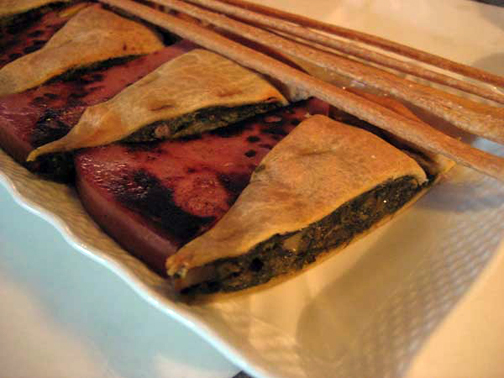
Above: the Spuntino Reggiano at Centovini (photo by Winnie).

Last night began with a Spuntino Reggiano at Centovini with my colleague Winnie. The Spuntino Reggiano (a “snack in the Reggio Emilia style”) is a dish inspired by a visit I made with our colleague Jim Hutchinson to Correggio where we discovered the Lambrusco of Vini Lini. The snack consists of grilled mortadella wedges (which were awesome) and erbazzone (called “torta di verdura” here), a Swiss chard and Parmigiano-Reggiano pie which benefitted from chef Patti Jackson’s amazingly light and tasty pie crust. We paired — of course — with a glass of Lambrusco Labrusca Rosso 2006 from Lini. The fresh wine tasted great after a way-too-hot day in NYC.

From Centovini, I walked over to Il Buco where I met my good friends Mitzi and Flip.

Flip is one of the world’s greatest luthiers (not kidding… see below): he and I met through our mutual friends, the band Hello Stranger, with whom Nous Non Plus has done a lot of shows in NYC as well as touring.

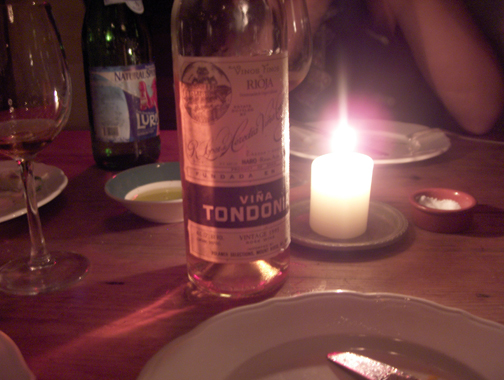
Despite her concern that the wine would be too oxidized for our palates, our waiter brought us a bottle of Rosado 1995 by Lopez de Heredia. I can understand her reluctance: old rosé from Spain is not everyone’s cup of tea and does not have the fruit forward mouth and nose that blush lovers expect. I do find it strange however — and this happens a lot — that waiters and sommeliers tell people the wine is “oxidized.” I know what “oxidized” means and I like oxidization in certain wines (when it is intended by the winemaker). But I can’t imagine that the term means much to unititiated wine drinkers. Couldn’t she have said something like “the wine won’t have the fruit that you might expect from a rosé”?

Rosado_at_il_Buco

I love Lopez de Heredia and drink and buy the wines when I can find them. The 12-year-old rosado was bright and full of life, had structure, and a rich nose. It went well with the octopus and potatoes — a favorite dish there.

The wine director at Il Buco, Roberto Paris, and I have been friends many years and he always surprises me with the bottles he opens for me. He had given us my favorite table, where we had a great view of Sandra Bernhard‘s table (I’m a fan and couldn’t help to do a little star-gazing). We were thinking about doing the 1987 Rioja from Lopez de Heredia but Roberto promised he had something special that he knew we would love.

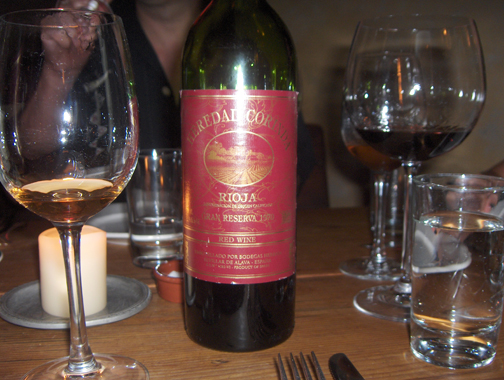
Heredad_Corinda_at_il_Buco

He disappeared and came back a few minutes later with a wine that “no one orders because they don’t know it”: Heredad Corinda Gran Reserva Rioja 1970 (embotellado por Bodegas Herbasa) — yes, 1970!!!. Flip and I particularly enjoyed the nose of this wine and in the mouth, it was rich but so light. Roberto’s wine knowledge is fantastic and we were all blown away by the wine, paired with some goat’s and cow’s milk cheese and prosciutto.

By the end of the night, the conversation had turned to Flip’s work and the many famous guitars he’s worked on over the years. I had been waiting to ask him about Paul McCartney’s 1963 Hofner bass, “the most famous guitar in the world,” as Flip put it. He worked on it some years ago.

“They flew it out to NY on the Concord,” he said. “It had it’s own seat on the plane and its own bodyguard,” who, evidently, remained in the guitar’s presence the whole time Flip worked on it. Flip also recommended seeing Will Lee’s Fab Faux Beatles cover band, which, he said, plays amazing versions of tracks from the White Album.

Nous Non Plus Debuts in Paris

The night after our amazing debut in Paris, the band dined in the home of Céline’s gracious parents, Syliva and Uli Wiesendanger. We were all a little tired following our big night at the Flèche d’Or, still drunk in the afterglow of playing for a 500+ crowd and one of the city’s top rock clubs.

Celebration was in order and Uli started us off with a wonderful Pinot Gris rosé. Although Chardonnay and Pinot Noir rightfully dominate the hills of Burgundy, growers do plant a few other varieties there. Technically, Pinot Gris is neither a red nor white grape: its white skin is bespeckled with red and purple. Hence the name: "gray" Pinot (in romance languages, white grapes are called blancs while red grapes are often called "black" or noirs. Pinot Gris, called Pinot Grigio in Italian, falls somewhere in the middle of black and white). The lovely pink coloring of this wine was undoubtedly the result of skin contact during maceration. The hue wasn’t quite as dark as you might see with a Pinot Noir rosé: the lightly colored Pinot Gris skin gave the wine a bright rose glow. The wine was fresh and bright in the mouth and paired well with the smoked salmon tartines.

Next in the flight was a 1996 Corton Grancey Grand Cru by Latour that I found at the Wiesendangers’ neighborhood Nicolas, a chain of wine shops scattered throughout Paris (luckily this branch was open on Sunday evening). This wine was simply gorgeous: 11-year-old Grand Cru by one of Burgundy’s oldest "shippers." Maybe not as graceful and refined as the wines you find from smaller houses but this wine was undeniably powerful, with intense fruit, and lingering secondary and tertiary aromas and flavors. Paris is one of the world’s greatest "wine" cities: to think that I found this wine in a commercial chain at a price I couldn’t believe! Still aglow from the concert of the night before, I purchased two bottles for a song.

Above: the morning after (photo by Greg Wawro).

Last but not least in the flight were a few bottles of Château Bonnange, produced by Claude Bonnange, a gentleman winemaker and friend of Uli’s who owns a 38-hectare estate just outside of classified Bordeaux. While so many new winemakers in Bordeaux are trying to make overly concentrated and oaked wines for the American market, producers like Bonnange are inspired solely by their passion for wine. Wines like this are nearly impossible to find in the States. Bonnange makes very few bottles and from what I’ve gathered googling the house, most of its bottles are sold to fine restaurants in France. I believe that the wine was a classic blend of Merlot, Cabernet Sauvignon, and Cabernet Franc (perhaps with some Malbec?). It had a wonderful classic right-bank nose, judicious wood, and beautiful fruit in the mouth. These bottles, which had been given to Uli personally, were a wonderful coda to a flight of three wines that I would rarely if ever have the chance to drink in New York.

Not unexpectedly, the end of the night found us gathered around the Wiesendangers’ harpsichord, gleefully singing our favorite Beatles songs. A night to remember following a night that I’ll never forget.

Rocking Out in Montréal

Above: me with good friend and Montreal Mirror Music Editor Rupert Bottenberg.

The second week of July brought Nous Non Plus to Québec where we played in Québec City and Montréal. We drove up the night before the first show and stopped in Montreal to catch up with Montreal Mirror Music Editor, Rupert Bottenberg, at BU on Boulevard St-Laurent. Over the years, Rupert and I have become friends through music, getting together when we’ve played in Montréal and when he comes down to NYC for the College Music Journal festival. Since Rupert and I have historically met in loud rock clubs, where beer is the beverage of choice, it was high time we connected over a glass of vino.

I’ve been really impressed with the excellent cuisine and wine lists in Québec. Rupert suggested that we try BU (the name comes from the past participle of boire, to drink, and is meant to evoke — claims the owner Patrik — the term cru, i.e., a French "growth," or vineyard site).

Above: our enthusiastic sommelier Olivier moves faster than the speed of light (photo by Lorraine Carpenter).

When I first glanced at the list, the 2000 Bucci immediately caught my eye. A six-year-old Verdicchio might seem a stretch but Bucci is known for its longevity (I recently tasted the 2002 at Del Posto in NYC a few months ago). The wine was very much alive, with good alcohol and acidity, and paired well with pâté-topped crostini (while the list at BU is primarily French, there were some good Italian selections and the menu was italophile). Bucci’s Verdicchio is a stunning example of what an otherwise humble grape can do when treated naturally and respectfully. I love the taste and mouthfeel of old wine and I was glad to share this one with my bandmates and friends.

Although I’ve never traveled to Mâcon, I’ve read that mâconnais custom calls for the older wines to be served first. This is due to the fact that the Chardonnay grown there makes for intensely aromatic wines that become more gentle over time. The younger wines would overpower the palate if poured first and in spite of my self-doubt, I was glad that we did the Domaine Cordier Mâcon-Milly-Lamartine 2003 as the second wine in the flight. It was a real treat (and great value) and married well with the marinated octopus. North Americans are so accustomed to drinking overly oaked and concentrated California Chardonnay: we were all pleasantly surprised by the wine’s gorgeous fragrance and freshness.

The Maréchal Ladoix 2003, recommended by our wonderful sommelier Olivier, was good, although very ripe, perhaps due more to the vintage and its youth than to the winemaker’s approach. The wines from Ladoix are often called flabby but I liked the acidity in this village wine and its fruit, although overly pronounced, was genuine on my palate (not extracted through concentration).

I liked the Domaine du Colombier Crozes-Hermitage Cuvée Gaby 2003, also recommended by Olivier, but it certainly needed more time to develop. Every time I’ve traveled to Québec, I’ve been impressed by how many Rhône wines the restaurateurs have in their cellars: Crozes-Hermitage represents one of the best values in fine wine today, a relatively undiscovered country for those of us who reside below the Canadian border, and I am always excited to try the wines that the Québecois are cellaring.

The next night found us in Québec City where we performed once again at the Galerie Rouge, right next door to what has become one of my all-time favorite restaurants, L’Utopie. Although we didn’t have time for dinner, I did pop in before our set to taste a few wines. Belgian sommelier Bernard Mesotten is one of the most impressive young wine professionals I have met and without blinking an eye, he produced three wines and a distillate that I had never tasted before: a Chardonnay, a vin jaune, a Poulsard, and a vin de liqueur from the Jura region in France, each from the Overnoy estate (see photo below). Knowing I had about 45 minutes before the band took the stage, he quickly created this flight for me. Nestled between Burgundy and Switzerland, the appellations of Jura are relatively unknown in North America. I was particularly impressed with Poulsard, a black grape that makes a wine so light and fresh that its often compared to rosé, and the vin jaune, "yellow wine," which is made by allowing the lees (the dead yeast cells) to form a film over the wine, thus creating a natural cap so that that wine can age in open vats (perfect for the cold climate of the region because the lower temperatures naturally stop fermentation). The wine has a wonderfully viscous mouthfeel (due partly to the evaporation during the uncovered aging) and the oxidation gives the wine complex flavors that you normally find only in old whites. To my mind, Bertrand is everything that a sommelier should be: passionate and curious about wine, generous with his knowledge, and always searching for wines beyond the obvious choices. Next time we perform there, I hope to sample more lots from his excellent list of Languedoc Syrahs. Bravo Bertrand!

We played to a packed house that night and as our popularity has grown in Québec, it’s been amazing to see the francophone fans respond to our new album, mouthing the words to the songs as they rock out to the music. Nous Non Plus’ little utopie indeed.

Above: a few of the wines tasted at Utopie before our show next door at the Galerie Rouge (photo by Greg Wawro).

Wow Cleveland!

Yesterday, following our performance on the Miller Lite stage at the Rock ‘n’ Roll Hall of Fame (as part of the College Music Journal festival… that’s me on the far left), Nous Non Plus joined friends Jenny and Daniel Margolis at Lolita in Cleveland.

While many wines were consumed that night, the highlights were a Castellblanch Rosado Seco NV and a Struzziero Acuto di Soprano 1999.

The Rosado Seco is a traditional-method (i.e., double-fermented in bottle) Cava rosè, made, I read on the winery’s site, with Trepat (a grape commonly used in Northeast Spain for light reds and rosés) and Garnacha (a varietal akin to Grenache grown in Southern France and the Southern Rhône and Cannonau from Sardinia). The wine was bright with balanced fruit and gorgeous fizziness. It was a perfect pairing for the housemade charcuterie that Lolita serves (the most impressive part of the menu, although the mezedes (the traditional "small plates" of Greece, served similarly to the tapas of Spain or the cicchetti of Venice) were also fantastic, especially the seafood.

Jeremy Parzen

I’ll confess that I didn’t know the Acuto di Soprano and when the waiter recommended it. The wine was excellent and although I had heard of the producer Struzziero, I had never heard of a label with this proprietary name. Taurasi is made from 100% Aglianico grapes, the noble varietal of Southern Italy, grown in Campania. Its most famous producer is Mastroberardino, a favorite of mine. Although Mastroberardino virtually created and holds a monopoly over the appellation Taurasi, there are a few other producers who make it. As it turns out, this wine was created for HBO by Struzziero to sell as a souvenir from the Sopranos (something about Anthony Soprano’s lineage and a wine he discovers in an episode of the show). The wine had no oak on it and was made in the traditional style. Excellent juice and at a reasonable price, too. Surprisingly good for a "gimmick" wine. (Although I’ve never tasted it, they say that the so-called "porn star" wine, Sogno Uno, is a respectable blend of Cesanese, Montepulciano, and Sangiovese).

The service at Lolita was good, the waitstaff and chef highly knowledgeable about the dishes they prepared and served. I’m not so crazy about the Riedel stemless stemware (see photo above, a conundrum indeed) but the evening ended with us all singing and smoking in the courtyard over some excellent dried-grape Muscat.

Crystal City Riesling

Above: Robert Weil Rheingau Riesling Spätlese 2002 and Fritz Haag Riesling Auslese Brauneberger Juffer-Sonnenuhr 2002.

Last night Nous Non Plus performed in Las Vegas, where, between loading in our gear and playing the gig, we took time out for a round of Karaoke and some excellent German Rieslings accompanied by fantastic (although very spicy) Thai food.

This bizarre restaurant was highly recommended by my friend Steve Samson, ex-executive chef at Valentino. The Lotus of Siam occupies a modest space in a strip-mall, otherwise devoted to 99-cent stores and Karaoke bars. By the time we sat down (after a few rounds of Karaoke awaiting our table), there were Low Riders in the parking lot, partying and showing off their hydraulics.

When the waiter brought us the book, I was completely blown away: there must have been more than 300 lots, including 1995 Margaux ($450). The list was dominated however by German Riesling. Although I have some experience with Alsace, I must confess that I know next to nothing about German wines. The waitstaff was not much help in choosing the wines, so I based the selection on what the restaurant’s cellar master seemed to prefer (he had verticals of both producers).

The first wine was a Spätlese or "late harvest" from the Rheingau, the second a Auslese or "later harvest" (i.e., a superior wine in the German appellation system) from Juffer-Sonnenuhr (vineyard site) in Brauneberger (appellation) in the Mosel.

As we dined on a series of dishes that included super spicy ground pork, sausages made from pork testicles, stewed pork, each accompanied by lettuce and julienned carrots and sliced cucumbers and tomatoes, these sweet wines stood up well to the intense flavors of the cuisine. While the first wine did not show a great deal of character, the second opened up nicely, revealing fruit at first but minerality and structure as it came to room temperature. German Rieslings are famous for their longevity and the character they develop with the passing of the years. I could only wonder out loud how these wines would show if given proper time to age. They did pair beautifully with the food.

Addendum – Upon reading this post, Nous Non Plus drummer Greg Wawro (below, far right) told me that he felt the foods were so spicy that they overpowered any balance in the wines. In retrospect, I have to agree: the sweetness of the wine paired well with the intense flavors but the spice overwhelmed our palates. Greg is right to note that the tasting conditions were far from ideal. Nonetheless, it was a stimulating if not balanced experience: as the Romans used to say, when in Vegas…

The show that night was well-attended, even though we didn’t go on until 1 a.m. Between watching our good friends Hello Stranger and the end-of-night beers and goodbyes (it was the last night of a three-night run), we barely made it back to our hotel by sunrise. The joke of the evening was "what transpireth in Vegas, remaineth in Vegas." But this experience was definitely worth bringing home (see pic below).

From left: Dan Crane, Jeremy Parzen, Ryan Williams, and Greg Wawro. Menswear by Imp of the Perverse. Photo by Emily Welsch, who also attended.

A Northern Utopie

Above: Nous Non Plus in their own little Utopie in Québec City (photo by Emily Welsch).

Last night found Nous Non Plus in Québec City, where we dined at l’Utopie, a fine restaurant – as the fates would have it – smack dab next door to the club where we performed. Maître d’hôtel Frédéric and sommelier Bertrand graciously created a meal for us, pairing flavors and textures to the wines we had selected under their tutelage. (In another happy twist of fate, I would run into the two of them at a tasting in New York only a few days later!)

The first wine was a white: Costières de Nîmes 2003, a blend of Grenache Blanc and Roussanne. The latter, Bertrand told us, has been aged in large oak casks in order to achieve measured oxidation of the wine. As a result, the wine was rich in color and wonderfully aromatic. On one level the style struck me as completely modern: the wine was highly manipulated and some might say affected. At the same time, I thought about how he had used a very old technique (aging in large oak barrels where greater amounts of air cause the wine to "age" more quickly) to obtain the richness he wanted (in balance with the conventionally vinified Grenache). The wine was bold and drank more like a red than a white in its mouthfeel and finish. Fréderique paired it with Sea Scallops sprinkled to taste with aromatized fleur de sel.

The next wine was a Coteaux du Languedoc 2003, a 100% Carignan. The wine seemed to embrace the "biodynamique" approach that has become an overarching philosophy for French winemakers in recent years. The sturdy Carignan paired well with Nova Scotia stockfish served over grilled chestnut soup and mashed green cabbage and raisins.

While the star of the evening remained the Costières de Nîmes, the biggest treat for me was the St-Joseph 2003, a 100% Syrah. Many believe that Northern Rhône represents today the greatest value in fine and collectible wine and this wine was fantastic. I enjoyed it immensely with the macreuse, a lean cut of beef served over celeriac, foie gras, marrow, and armillaire mushrooms.

As Bertrand and Frédéric rocked on the dance floor at our show, I couldn’t help but think we had found a small utopia in Québec. The band played seventeen songs, including three encores, and we all slept very well that evening.