Southwestern Mexican Culinary Adventures

Indulge me with my indulgences: a photo reportage of my trip out west and what I ate…

Grilled yellow peppers at Mexicali Taco in El Centro, California (no link, sorry; see location info below).

Tacos al carbon are wrapped in butcher paper at Mexicali. The slow-roasted pork was tangy and delicate. So good…

The fresh salsa bar at Mexicali. When I stopped there at lunch, they were replenishing the condiments and the grilled peppers were still warm.

Mexicali Taco catapulted itself to the top of my “best Mexican restaurants ever” list. Definitely worth a trip to El Centro. Mexicali Tacos, 2003 S 4th St, El Centro, CA 92243, (760) 353-4505.

A hot dog “estilo sonoro” (Sonoran style) at El Güero Canelo, Tucson, AZ (“The Blond Redhead,” not to be confused with one of my favorite bands, Blonde Redhead). The Sonoran-style hot dog (perrito caliente) is wrapped in bacon, cooked on a griddle, and then topped with pinto beans, finely diced tomatoes, yellow mustard, relish, and mayonnaise.

The griddle for El Güero Canelo’s awesome Sonoran dogs.

The garnish at El Güero Canelo includes grilled spring onions, sliced cucumber, sliced radish, pickled onions, and roast peppers.

El Güero Canelo now has a second location in North Tucson but I went to the original in South Tucson, near the airport, where his old taco stand is still used to make the Sonoran dogs (above).

A visit to a bar — somewhere in the Sonoran desert — was rewarded with a “Michelada,” made with Clamato, Corona, Worchestershire Sauce, and lime juice. I am not a fan of Corona, which tastes more like water than beer to me, but it was great in the Michelada. Tasty and refreshing…

Saguaro cactus (Carnegiea gigantea) in the Ironwood Forest National Monument.

I had a late-night snack of homemade menudo (tripe and hominy soup, topped with freshly dished onion and chopped cilantro, not to be confused with my not-so-favorite band). It was leftover from a New Year’s day celebration (Mexican families traditionally eat menudo for breakfast on New Year’s day).

A bowl of homemade posoles, a traditional Mexican soup, made with pork and hominy, topped with shredded lettuce, sliced radish, and a small dollop of homemade salsa, and garnished with a crispy tortilla.

Traditional pan dulce (literally “sweet bread”) which I didn’t get to taste but I photographed nonetheless (it’s usually served for breakfast with coffee).

Back in La Jolla, I had a classic “wet” carne asada burrito at Alfonso’s, one of the old-school Mexican restaurants (probably inspired by El Cholo in Los Angeles, founded 1923) where the comfort food will cure even the most dogged hangover and the margaritas are always great. Alfonso’s, 1251, Prospect St, La Jolla, CA 92037, (858) 454-2232.

They don’t kid around at La Valencia where the huevos rancheros truly “drown” in ranchero sauce. La Valencia is a 1920s, silent-movie era luxury hotel. I wouldn’t exactly call the cuisine “cutting-edge” but it’s always dependable and the views and décor are fantastic. When in town, I can often be found at the hotel’s Whaling Bar at the end of the night.

Sunset in La Jolla. Thanks for indulging me by reading this post (if you’ve made it this far!).

New Year’s Eve: Taittinger alla puttanesca

Above: brother Tad poses with a magnum of Taittinger La Française and his puttanesca sauce.

The Parzen family brought in the New Year at Tad and Diane’s (my brother and sister-in-law’s) house, where we opened a magnum of Taittinger N[on V[intage] La Française.

Many people drink and think of Champagne solely as a stand-alone, special-occasion wine but it’s one of my favorite “food” wines: when it’s well made, it has good acidity, fruit, and body, and it’s arguably the most versatile wine in terms of its pairing possibilities. We drank the wine throughout our meal and it went great with Tad’s pear wedges (topped with “Maytag” blue and wrapped in prosciutto and arugula), an artichoke and cheese dip (brought by one of the guests), and even Tad’s spicy puttanesca sauce.*

Wine in large format (in this case a magnum or 1.5-liter bottle) is always fun to pour at parties and Champagne in particular shows better when aged in large format (experts haven’t really been able to pinpoint the reason for this but it likely has something to do with the fact that wine generally ages better in large quantities, probably because the oxygen-to-liquid ratio is reduced). The wine was drinking beautifully and paired wonderfully with everything — from the antipasti to ice cream cake and cookies.

My nephew Cole and I had spent the afternoon writing and recording a song using GarageBand. He was impressed by the size of the bottle and so I gave him some pointers on opening Champagne (his father noted it’s a skill that proves useful later in lafe):

– always have a serviette or clean dish towel handy (to wipe down the bottle and in case of spills)
– after you’ve removed the capsule by pulling the ribbon counter-clockwise, always keep your thumb over the cork as you twist the wire (in case it pops; the wire twists away from you and it always takes six turns to remove it)
– make sure the bottle isn’t pointing at anyone (in case it pops)
– tilt the bottle at a 45° angle, hold the cork firmly, place your thumb over the cork, and then slowly twist the bottle from the bottom as you gently apply pressure to pull out the cork

Above: December’s Children at Beaumont’s in Bird Rock (La Jolla) — Justin Richert, Danny Baker (left), John Yelenosky (center), Andrew Harvey, and Irwin (right).

The strike of midnight found me at a local bar, Beaumont’s, where I sat in with December’s Children.

I’ve known and played music with these dudes since I was a teenager. Each of them is a excellent musician in his own right. Danny Baker has got a great voice and his Les Paul Gold Top sounds great (I believe it’s a 57 reissue). My doppelganger Jeremy Farson, an accomplished painter, also sat in (if you click the link, scroll down the page to read about Jeremy).

I rocked out on Voodoo Child and Come On (Let the Good Times Roll) — a great way to ring in 2008 (which has got to be better than 2007!).

* Contrary to popular belief, pasta alla puttanesca is not so-named because it was or is the preferred victual of prostitutes (a common but erroneous folkloric etymology, owed to the fact that puttana means “prostitute” in contemporary Italian). The noun puttana and the adjective puttanesco are derived from the Italian putto (Latin, putus), “boy.” By the sixteenth-century (long before tomatoes and dried pasta were popular in Italian cuisine), the term puttanesco was already used in Italian to denote something belonging to a “lesser station in life,” so to speak, “boyish” or “girlish” or even “whoreish,” if you like. Pasta alla puttanesca is a pasta tossed in a tomato-sauce that has been flavored typically with cured anchovies, olives, capers, and chili flakes: the qualifier alla puttanesca refers to the fact that it is not a rich dish. In other words, it’s not a meat sauce or a sauce flavored with stock. It’s a dressing for pasta made savory by combining “humble” ingredients (another related word, puttanata means “rubbish” or “crap” in Italian, as in the expression, non dire puttanate, “don’t talk crap,” and has nothing to do with prostitutes). A meretrix may enjoy eating pasta alla puttanesca, but the dish wasn’t named after her.

Check out the follow-up post I did on Sugo alla puttanesca.

Although she makes a brief reference to it in her entry “Pasta Sauces,” Gillian Riley, author of the recently published Oxford Companion to Italian Food (October, 2007), does not offer an entry for pasta alla puttanesca. I’ve been leafing through the book during my trip out west…

War Is Over if You Want It

Photo credit: Heather Bowden, La Jolla Local, December 2008.

Thankfully, I’m getting out of town for a while. I can’t reveal where I’m heading but my destination may look like the holiday card I received from a high school classmate Heather Bowden, a graphic designer and photographer.

Thanks to everyone for reading and clicking the blog this year. The 2007 vintage was a tough one for me: special thanks to my family and friends who have stood by me and lent me their support and love. I couldn’t have done it without “a little help from my friends [and family].”

I’ll be taking a little break for the next week or so but check back after the New Year for tales of my travels (and a big surprise that will be announced in early ’08).

If you want it, War is over now…

*****

So this is Christmas
And what have you done
Another year over
And a new one just begun
Ans so this is Christmas
I hope you have fun
The near and the dear one
The old and the young

A very merry Christmas
And a happy New Year
Let’s hope it’s a good one
Without any fear
And so this is Christmas
For weak and for strong
For rich and the poor ones
The world is so wrong
And so happy Christmas
For black and for white
For yellow and red ones
Let’s stop all the fight
A very merry Christmas
And a happy New Year
Let’s hope it’s a good one
Without any fear
And so this is Christmas
And what have we done
Another year over
And a new one just begun
Ans so this is Christmas
I hope you have fun
The near and the dear one
The old and the young
A very merry Christmas
And a happy New Year
Let’s hope it’s a good one
Without any fear
War is over over
If you want it
War is over
Now…

— John Lennon, Yoko Ono

Neil Young in Washington Hts. and German Beer Downtown

Wednesday night, my old friend and once partner in musical crime, Foosh, brought me along as his guest to Neil Young in concert at the ol’ United Palace Theatre in Washington Hts. in the upper extremities of Manhattan.


Above: the United Palace Theatre is an old gem and they don’t mind when patrons rock out.

Definitely one of the top-five concert experiences in my life, the show consisted of an intimate acoustic set where he played a bunch of his old guitars and a mind-blowing, rocked-out electric set including a fantastic twenty-minute guitar solo. The guitar tones were truly amazing, like the notes of an old Nebbiolo, earthy and rich but fresh and surprising — with live acidity and fruit — at the same time.

It was great to see a legendary performer like Neil Young play a small venue like that, with easy-going security, cheap beer, and a raucous crowd of got-my-drink-on fans. It reminded me of when I went to concerts as a kid in the late seventies and early eighties, when rock n’ roll shows were just that: rock n’ roll. Dancing in the aisle by stoned-out-of-their-minds people was allowed.

Above: I enjoyed a Jever at Loreley before Foosh and I headed up to Washington Hts. to see Neil Young in concert.

Some years ago now, Foosh opened the now classic Lower East Side haunt Loreley, a German beer garden and restaurant inspired by his hometown of Cologne, Germany. The all-German beer selection there is great, the bartenders really know how to draft beer properly (with a proper head, see above), and the spaetzle and schnitzel are awesome. The place is always jam-packed on Friday and Saturday nights but you can sometimes find a place to sit on weeknights — if you’re lucky. The first time my band played our now show-stopping version of “99 Luftballons,” it was for the opening of Loreley way back in 2003.

Above: a video of Nous Non Plus playing “99 Luftballons” at the great Lower East Side rock club Sin-é before it was closed to make way for gentrification (read the stockbrokerization) of lower Manhattan.

Se hace la boca agua a la Boqueria


Above: couldn’t resist the Viña Bosconia 1999 by López de Heredia at Boqueria.

Monday evening found me with my long-time friend Bret Scott at Boqueria, a great and wine and tapas bar on 19th st. named after the Mercado de la Boqueria in Barcelona (don’t forget to aspirate that “c” in Barcelona!).

Bret owns and runs an entertainment agency specialized in spoken word and dance, Global Talent Associates, and he used to book my band back in the day.

Bret’s traveled more extensively in Spain than I have and we both agreed that Boqueria gets it right. I had some tostadas topped with tuna and Bret had a slice of tortilla española (also called a tortilla de patatas), a traditional Spanish potato omelet.

The Viña Bosconia 1999 by López de Heredia was great although a little meatier than the house’s typical light style. I guess its ripeness was due to its youth and possibly the vintage. We both enjoyed it thoroughly (it was reasonably priced) and will definitely return to boqueria.

Above: Jamón Serrano hangs in the shop window at Boqueria.

Sex, Wine, and Rock and Roll

…well, no sex actually, just good wine and rock and roll with Nous Non Plus and The Little Death last night at the Mercury Lounge in Manhattan. Thanks to everyone who came out last night to support us and rock out. It was a great way to end NNP’s 2007!

Special thanks to our sponsor, Bollinger, who generously provided refreshments for the green room and our set — no other beverage will suffice (although last night they only sent non-vintage Special Cuvée and Céline noted that she only drinks Grande Année).

It was one of those super packed nights at the Merc, and, if I do say so myself, we were electric.


Céline was in top form… man, that girl can sing.


Céline instructs the crowd to clap their hands and say yeah.


It happens every time… she makes me blush on stage.


Laura and Moby from The Little Death. They rocked it pretty hard last night.

For more photos, check out fan and friend Gary Wexler’s gallery.

Thanksgiving 07 (Palm Springs, CA)


My niece and nephew Amalia and Abner.

“Don’t carve the turduckenTM without me!!!!” (nephew Eli, bro Tad, and mom Judy)

It was the first time we’d all spent Thanksgiving together in many years. Brothers Micah and Tad made toasts about how lucky we all are to have never known truly hard times in our lives. We all remembered how our “poppa,” our grandfather (our mom’s dad), grew up poor and made it his life goal that his children and grandchildren would never face the troubles he did. He made it…

It all helps to put this year’s trial and tribulations into perspective.

In my toast, I told everyone how happy I was for the support and love they’ve given me over the last four — very (emotionally) tough — months. It taught me, I told everyone, that it doesn’t matter how good or bad the wines you drink and the foods that you eat (even though I make a living writing about that stuff)… all that matters — I know now — is the people with whom you break bread and the folks who share your cup of wine… “Family,” said Micah, “that’s the most important thing…” Thanks to Micah for hooking up our Palm Springs family Thanksgiving. I even got a tan!

Nephew Cole is a rockin’ guitar player (and I mean that… we made a recording of us playing some blues).

Nephew Eli and his dad (my bro) Tad. Eli told me that he is a “fiscal conservative.” He’ll be able to vote next year… amazing…


Tad and my sister-in-law Diane.


The 97 Leroy Bourgogne Blanc was corked (damnit!) but the 99 Quintarelli Valpolicella was a treat, the 04 Roty Gevrey-Chambertin perfect with the meal, and the 03 Barbaresco by Produttori del Barbaresco (opened 3 hours before we drank it at the end) was heavenly.

Mom Judy and sister-in-law Marguerite (she’s expecting… Marguerite, that is…).

Bro Micah wrastles the turduckenTM.

“You’ll have to have them all pulled out…

…after the Savoy Truffle.”

Above: this 26-ounce truffle fetched a whopping $208,000.

George Harrison’s song “Savoy Truffle” has nothing to do with Piedmont truffles. In fact, it was inspired by a box of chocolates:

“Savoy Truffle is a funny one written whilst hanging out with Eric Clapton in the sixties,” wrote Harrison. “At that time he had a lot of cavities in his teeth and needed dental work. He always had a toothache but he ate a lot of chocolates—he couldn’t resist them and once he saw a box he had to eat them all.”

“He was over at my house and I had a box of ‘Good News’ chocolates on the table and wrote the song from the names inside the lid…” (Harrison, George, I, Me, Mine, San Francisco, Chronicle, 2002 [1980], p. 128)

The “Savoy” in the Good News chocolates box probably referred to the famous Savoy Hotel and Restaurant in London, where celebrity chef Auguste Escoffier began cooking in the late nineteenth century. The hotel and restaurant get their name from the Savoy theater, which in turn took its name from the nearby Palace of Savoy, built by Peter Earl of Savoy in the thirteenth century. Since the middle ages, the House of Savoy has been closely linked to Piedmont (where white truffles are hunted) and in the early eighteenth century, nearly all of the region came under control of the House of Savoy. In 1861, Victor Emmanuel II of Savoy became Italy’s first king.

Though George calls the song — based on an affectionate anecdote — “a funny one,” the colorful chocolate-inspired lyrics of “Savoy Truffle” also address the issues of excess and over-indulgence in modern-day society. After all, the singer reminds us, “You’ll have to have them all pulled out after the Savoy Truffle.”

This year’s truffle season in Piedmont hasn’t been great and I’ve heard that many NYC restaurateurs have had to discard their truffles after the tubers arrived in bad shape. I had some white truffles at a Piedmont-themed dinner where I spoke at the end of October. They were pretty good but not phenomenal. Frankly, white truffles never seem to taste the same outside of Piedmont. I wonder how the lucky owners of the above truffle — a group of Hong Kong businessmen — will serve it.

When my friend Steve sent me the link to the story above about the 26-ounce truffle, I thought to myself, “does anyone really need a truffle that big?”

Me? I’d rather keep my teeth.

Above: an early draft of George Harrison’s lyrics for “Savoy Truffle.”

Creme tangerine and Montélimar
A ginger sling with a pineapple heart
A coffee dessert–yes you know it’s good news
But you’ll have to have them all pulled out
After the Savoy truffle.

Cool cherry cream, nice apple tart
I feel your taste all the time we’re apart
Coconut fudge–really blows down those blues
But you’ll have to have them all pulled out
After the Savoy truffle.

You might not feel it now
But when the pain cuts through
You’re gonna know and how
The sweat is going to fill your head
When it becomes too much
You’ll shout aloud.

But you’ll have to have them all pulled out
After the Savoy truffle.

You know that what you eat you are,
But what is sweet now, turns so sour–
We all know Obla-Di-Bla-Da
But can you show me, where you are?

Creme tangerine and Montélimar
A ginger sling with a pineapple heart
A coffee dessert–yes you know its good news
But you’ll have to have them all pulled out
After the Savoy truffle.
Yes, you’ll have to have them all pulled out
After the Savoy truffle.

— “Savoy Truffle,” George Harrison

Amphoras vini aperio: the band is back in town

Nous Non Plus has been back in town for the College Music Journal festival and the sexy sixsome played three shows (a showcase and a couple of parties). And we’ll be playing a Halloween show at Rubulad (undisclosed location in Brooklyn) on Friday.

Above: Our track “Lawnmower Boy” was just used in a TV commercial in Slovenia. The spot is a lot of fun…

In other news, bassist and singer Jean-Luc Retard (aka Bjorn Turoque) and our track “Château,” a song about the Château Marmont in Los Angeles, were recently featured in The Los Angeles Times (click to read).

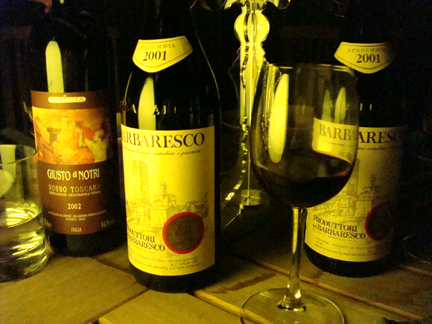
giusto_prod.jpg

Last night we took time out to enjoy steak and wine chez Céline. Our friend Patrick Woodcock, a former member of the French band Air and the founder of Mellow, was in town. Patrick is always very generous with us when we play in Paris, giving us a hand with gear and transportation, etc. We always try to do something special together when he’s in NYC (and he loves steak and red wine).

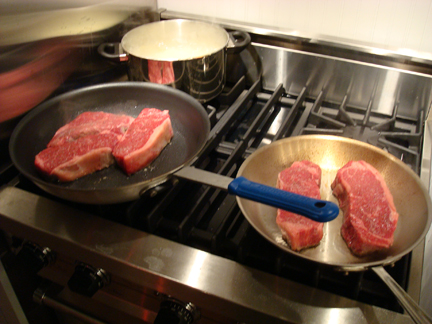
steaks.jpg

Above: Jean-Luc was in charge of searing the shell steaks. Like Patrick, the band likes its steak rare (although Bonnie Day is vegetarian).

Since my living situation changed this summer and I no longer have anywhere to store my wine, there’s really nothing left to say or do but to drink the wine.

We opened two bottles of one of my favorites, 2001 Barbaresco by Produttori del Barbaresco. This wine has many years ahead of it but was drinking great nonetheless. As Patrick noted, this very traditionally made wine had a wonderful “chewy” mouthfeel and its tannins cut right through the nicely marbled fat of the shell steaks. As go I through the “cellar” (essentially a bunch of cardboard boxes), I’ve stumbled across a few surprises, like the 2002 Giusto dei Notri by Tua Rita above. I know that Patrick likes wines from Bordeaux and everyone enjoyed this opulent Bordeaux-style Cabernet and Merlot blend from Bolgheri (Tuscany).

With all this recent talk of oak vs. no oak, I thought it only right and fair to open this modern-style bottle and reflect on the dialectic from the other side of the table, so to speak. Of the many famous Bolgheri producers, Tua Rita and Grattamacco seem more reserved in their style. I’ve met Rita at Vinitaly… she’s a nice lady.

patrick_celine.jpg

Above: Céline and Patrick on Céline’s terrace.

The tannin and the wood on the Tua Rita weren’t entirely “integrated,” but I liked the goudron, tar notes on the nose. However you feel about oak and/or international grape varieties grown in Italy, no one can deny that Tua Rita’s wines are very well made. It’s only a pity it couldn’t have laid there forgotten for another 5-10 years in the back of the closet where I used to store my wines. But then again, there seem to be no certainties in life these days and while some people might advise carpe diem, my thought is aperi amphoras vini.

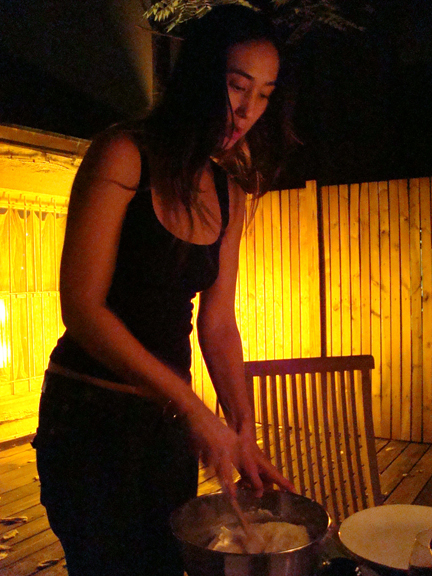
mash.jpg

Above: you wouldn’t think it but Céline is an excellent cook and made fantastic mashed potatoes, roast carrots, and wilted spinach.

In other news, the fires in California continue to burn out of control. My family is fine but the air quality is getting really bad. My brother Tad and his wife Diane have been housing some evacuees and it’s still not clear whether or not my friend Charlie lost his house. I found this map, updated regularly, of the fires and evacuation sites.