A Wine Older than Me: Spanna Colline Novaresi VdT 1958 Vallana

Opening fifty-year-old wine with fellow forty-year-old and friend Jeff Grocott at Morandi.

Spanna VdT 1958 Vallana

A few weeks ago, good friend and fellow child-of-the-Summer-of-Love Jeff Grocott proposed that we drink a bottle of old Spanna by Piedmontese (Novarese) producer Vallana to celebrate the near completion of our nearly four decades on the planet. Jeff, a page-one editor at the Wall Street Journal, wrote a number of wine features and tasting notes when he was an editor at the WSJ Weekend Section. You have to subsribe to the WSJ online edition in order to browse/search old articles but you can find some of Jeff’s articles on the web. His story on wine storage, which appeared in syndication, is one of the most popular and it offers some interesting and solid insights into the myths/truths of cellaring. Jeff and I met a few years ago when I was doing media relations for a NYC wine merchant and have since opened and enjoyed many bottles together, including a Barolo Riserva (Red Label) 1990 Giacosa that my friend and colleague Jim Hutchinson generously poured for us in his apartment last winter (served with a Coda alla Vaccinara that Jim had cooked all day in his crock pot).

Jeff, who lives in the village with his wife Barbara, had spied the Spanna 1958 Vallana at the relatively new Morandi on Waverly at Charles St.

We were both reluctant to open such an old bottle at a place like Morandi: similar to the ever-popular Da Silvano, Morandi is a glamorous, star-studded (see our celebrity encounter below), pseudo-trattoria New York City cafeteria — not exactly the place you think of when it comes to old wine. The bottle was reasonably priced but what was its provenance? how had it been stored? what kind of wine service would we find at a bustling downtown “feed-em-and-turn-the-table” eatery on a hot July evening?

While the food at Morandi was unremarkable (typical greasy but well-dressed downtown Italian), the wine list offered some interesting Nebbiolo options, including a Barbaresco 1988 Produttori del Barbaresco magnum at a good price. I was also impressed by the Ligurian whites on the list and a few labels from Basilicata, unusual for a restaurant where wine-savvy diners are unlikely to be found.

Jeff Grocott and Rosario "Roy" Marino

Above: sommelier Rosario “Roy” Marino (right) tasted with me and Jeff (left).

As it turns out, where were greeted by Rosario “Roy” Marino, a Salerno native, who gave us a great table in the back, had set the bottle upright (at Jeff’s request) the night before, and produced excellent Burgundy-style crystal glasses and a crystal decanter for our table (before opening the Vallana, we ordered a glass of Donnas Rouge from Val d’Aosta, which Roy poured in the restaurant’s standard glass stemware).

Novara is a lower-lying, wine-producing zone found to the east of the Langhe Hills (Piedmont) were the more famous Barolo and Barbaresco appellations are produced. The Spanna DOC was created in 1969. In order for the bottle to be labeled “Spanna” (Spanna is the Novarese name for Nebbiolo), it must contain at least 85% Spanna (Nebbiolo). This wine was made before the DOC existed and thus was labeled vino da tavola (table wine; see label detail below).

Judging from the newish cork and clean label, the Spanna Vino da Tavola 1958 Vallana had been recently rebottled (and probably topped off with a little bit of new wine, as is the custom among many Piedmontese producers who keep reserves of older wine in their cellars).

Spanna has often been cited by wine experts (including the great Shelly Wasserman) as one of Italy’s greatest aging wines. Many people think only of Barolo (and Barbaresco) as cellar-worthy Nebbiolo. In fact, Nebbiolo grown in the Langhe was not labeled as Barolo until Ratti’s legendary 1971 bottling, while Spanna, Gattinara, Grumello etc. had already achieved fame as long-lived wines in the 1960s (for those who read Italian, I found this informative and moving account of drinking a bottle of 1964 Spanna discovered in the mud by rescuers in the aftermath of the 1969 flood in Novara).

I believe that Spanna’s longevity can be attributed — at least in part — to the addition of smaller amounts of less tannic, more acidic grape varieties. Vespolina and Bonarda other grapes are allowed in the appellation. Many have pointed to Antonio Vallana’s blending skills as the secret behind his remarkable wines.

The wine was fantastic: after the initial stink dissipated (not uncommon in wines this old), the nose opened up beautifully and the wine had gorgeous fruit, nice acidity, and perfectly softened tannins. The 1958 harvest is considered one of the great twentieth-century vintages for Piedmont and this nearly-fifty-year-old wine was powerfully elegant but retained some of the rustic character that you find in the naturally and traditionally made wines from Novara. We enjoyed it thoroughly.

As we were paying and preparing to leave, a party of three was seated next to us. Jeff discretely told me, “turn around and look who is sitting next to you.” Little did I know but the Edge was rubbing elbows with me. Wow… He was dining with two young women (I imagine one was his daughter). I wonder what they drank. I’m sure that Roy took very good care of them.

Vallana Lable Closeup

Old Spanish at Il Buco

Centovini_Spuntino

Above: the Spuntino Reggiano at Centovini (photo by Winnie).

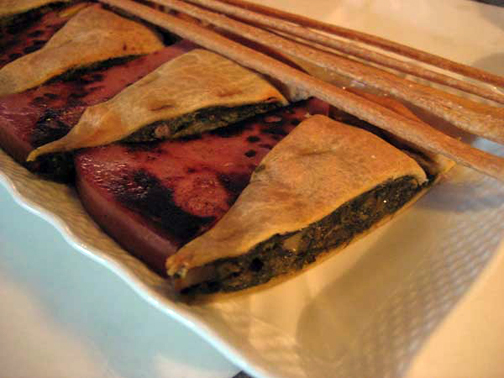
Last night began with a Spuntino Reggiano at Centovini with my colleague Winnie. The Spuntino Reggiano (a “snack in the Reggio Emilia style”) is a dish inspired by a visit I made with our colleague Jim Hutchinson to Correggio where we discovered the Lambrusco of Vini Lini. The snack consists of grilled mortadella wedges (which were awesome) and erbazzone (called “torta di verdura” here), a Swiss chard and Parmigiano-Reggiano pie which benefitted from chef Patti Jackson’s amazingly light and tasty pie crust. We paired — of course — with a glass of Lambrusco Labrusca Rosso 2006 from Lini. The fresh wine tasted great after a way-too-hot day in NYC.

From Centovini, I walked over to Il Buco where I met my good friends Mitzi and Flip.

Flip is one of the world’s greatest luthiers (not kidding… see below): he and I met through our mutual friends, the band Hello Stranger, with whom Nous Non Plus has done a lot of shows in NYC as well as touring.

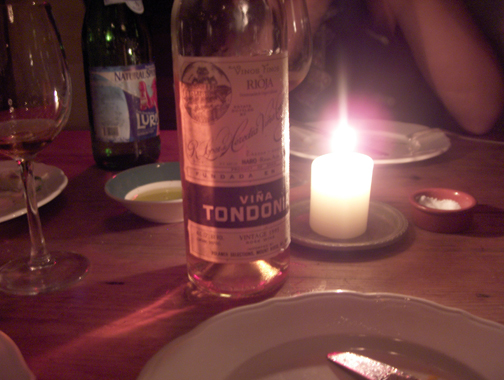
Despite her concern that the wine would be too oxidized for our palates, our waiter brought us a bottle of Rosado 1995 by Lopez de Heredia. I can understand her reluctance: old rosé from Spain is not everyone’s cup of tea and does not have the fruit forward mouth and nose that blush lovers expect. I do find it strange however — and this happens a lot — that waiters and sommeliers tell people the wine is “oxidized.” I know what “oxidized” means and I like oxidization in certain wines (when it is intended by the winemaker). But I can’t imagine that the term means much to unititiated wine drinkers. Couldn’t she have said something like “the wine won’t have the fruit that you might expect from a rosé”?

Rosado_at_il_Buco

I love Lopez de Heredia and drink and buy the wines when I can find them. The 12-year-old rosado was bright and full of life, had structure, and a rich nose. It went well with the octopus and potatoes — a favorite dish there.

The wine director at Il Buco, Roberto Paris, and I have been friends many years and he always surprises me with the bottles he opens for me. He had given us my favorite table, where we had a great view of Sandra Bernhard‘s table (I’m a fan and couldn’t help to do a little star-gazing). We were thinking about doing the 1987 Rioja from Lopez de Heredia but Roberto promised he had something special that he knew we would love.

Heredad_Corinda_at_il_Buco

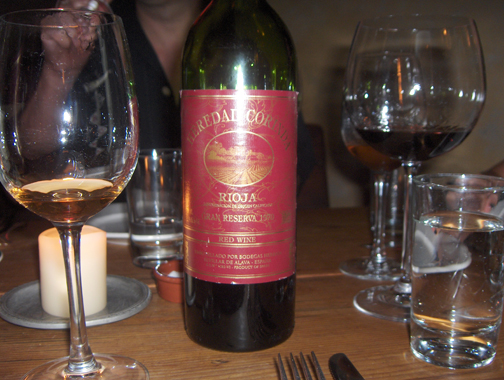
He disappeared and came back a few minutes later with a wine that “no one orders because they don’t know it”: Heredad Corinda Gran Reserva Rioja 1970 (embotellado por Bodegas Herbasa) — yes, 1970!!!. Flip and I particularly enjoyed the nose of this wine and in the mouth, it was rich but so light. Roberto’s wine knowledge is fantastic and we were all blown away by the wine, paired with some goat’s and cow’s milk cheese and prosciutto.

By the end of the night, the conversation had turned to Flip’s work and the many famous guitars he’s worked on over the years. I had been waiting to ask him about Paul McCartney’s 1963 Hofner bass, “the most famous guitar in the world,” as Flip put it. He worked on it some years ago.

“They flew it out to NY on the Concord,” he said. “It had it’s own seat on the plane and its own bodyguard,” who, evidently, remained in the guitar’s presence the whole time Flip worked on it. Flip also recommended seeing Will Lee’s Fab Faux Beatles cover band, which, he said, plays amazing versions of tracks from the White Album.

Tasting with Richard Parsons at Porter House

Dining with the rich and powerful in NYC.

Last night I attended a dinner for roughly 40 persons in a private room at Porter House in the Time Warner Center at Columbus circle. Time Warner CEO Richard Parsons sat at the head table and guests tasted 9 bottlings of his Brunello di Montalcino Il Palazzone. Richard’s wife Laura Parsons and Washington insider Vernon Jordan also attended, not to mention the sommeliers, wine directors, and general managers of a number of top NYC restaurants (Babbo, Esca, Felidia, San Domenico, Four Seasons among others). I had been invited by my friend Amanda de Leon, who is president of Il Palazzone. Richard Parsons and his wife dine regularly at I Trulli and he and Ron Lauder often lunch at Centovini (two of the businesses for which I do marketing).

One of the most fascinating elements — to my mind at least — about working in the New York City restaurant scene is how the allure of fine dining and the aphrodiasic of money and power bring together some of the most unlikely bedfellows. On the one hand, between Vernon Jordan and Richard Parsons, I broke bread with two of the country’s most powerful dealmakers and Washington insiders. I exchanged pleasantries with Mr. Jordan who sat with Amanda and chatted briefly with Mr. Parsons about I Trulli. I can’t imagine any other context where I would come into contact with such luminary figures. On the other hand, after working as a writer/copywriter in New York for the last ten years, I have seen some of the more unsavory sides of the city’s restaurateurs and wine merchants. Working in the wine and restaurant business in NYC is kind of like being in the mafia: the overblown egos and the intense competition create a sort of kill-or-be-killed working environment. Politicians and powerbrokers like to eat well and perhaps more than anything else, like to feel like they are restaurant insiders. Restaurateurs like to feel like they have access to power. Having seen some of those restaurateurs and wine merchants up close, I find them strange bedfellows.

But what really blew my mind about the dinner was how Il Palazzone’s enolgoist, Paolo Vagaggini, stood up and told the party — first in broken English and then in Italian — that the Palazzone winery “respects and reflects the tradition of Brunello and makes a very traditional wine.” In fact, the wines are very modern in style: very fruit driven and concentrated, oaky and high in alcohol. What tradition is he talking about? The one launched by Wine Spectator’s James Suckling and the inimitable Robert Parker in the early 1990s? Forget Mondovino, we need Michael Moore!

Although they’re not wines I would drink at home, they are very well made modern-style wines. The 2001 Riserva will drink well in a few years and both the 1998 Brunello and 1998 Brunello Riserva showed well.

The food at Porter House was mediocre and the 1995 Brunello Riserva, which I had tasted a number of times over the last few years, seemed shot (at least the bottle poured at my table). But the evening’s glamour — borne out of the odd marriage of monied power and restaurant power brokers — made for a memorable evening nonetheless.

Stepping out into the street after the dinner, I was happy to return to the warm June night air and the smells and sounds of the Upper West Side. Those dinners remind me of Fellini’s 1950s movies where the characters fill the emptiness of their lives with meaningless conversation. Last night the welcomed Broadway street scene was the little girl who Marcello meets at the end of La dolce vita. It reminded me that there is a “sweetness” to life in NYC… where dinners like that happen every night and no one even notices. Broadway and the Upper West Side just keep doing their thing — they don’t care about overly oaked Brunello, badly cooked steak, and unsavory restaurateurs who cuddle up to the rich and powerful.

Foodies vs. Winies?

My friend and colleague Winnie helps me to understand the “foodie vs. winie” dialectic.

I was recently inspired to create my Do Bianchi blog by my friend and colleague Winnie. She works with me in the marketing department for the company that runs Vino, I Trulli, and Centovini. She is also the editor of the Slowfood newsletter, The Snail. She’s one of the best food writers that I know.

Browsing her blog, I came across a link to an Epicurious/Gourmet Mag blogger that Winnie particularly admires, Francis Lam. I was intrigued by his take on “foodies vs. winies” and wanted to address some of the issues he raises. See quotes from his post and my reflections.

…food geeks are insufferable, but wine geeks are TOTALLY insufferable, and most people try to limit their insufferability. Once, at dinner with a real winie (if I’m forced to answer to “foodie”, it’s only fair to call them “winies”, right?) I took a bite of peas and exclaimed, “Oh my God. . . that tastes so much like pea!” Kind of annoying, sure. But then my winie friend took a bite and said, “Yeah. . . it tastes like pea skins.”

Wine geeks are insufferable (and I would argue that food geeks are equally insufferable, especially when they consider talking about food more important than eating well, but then again I guess that’s why all of us are in this business. “Foodie” and “winie” (a neologism? or is this what they call us all the time?) are reductive terms. We all need to approach food and wine within the context of who and where we are and whenever style supercedes substance, we all might as well just stop eating and drinking all together.

…have you read any wine tasting notes lately? Yeah, I don’t blame you. Last time I picked up a wine magazine, I realized that I can’t really blame my pea-skin loving friend. Hey, I understand how hard it is to talk about what something tastes like–we really don’t have much of a vocabulary for it.

I can’t say how much I agree: wine tasting notes are the “lice” of the wine world (as Montale once said of pronouns in poetry). Wine tasting notes are such a turnoff to so many people. Wine should taste like wine and the sad thing is that people overlook the fact that you need to start your knowledge by learning what different grapes and appellations taste like. You have to learn what Merlot tastes like before you can begin to describe the differences between Merlot grown in different places and vinified using different methods.

…I’ll say this at the risk of losing all my credibility in the gastronomic world: WINE IS NOT AS IMPORTANT AS FOOD. It’s just not.

As much as I agree with the central theme of his post, I have to say that a statement like this is just ridiculous and it’s irresponsible for someone like Francis to publish an “absolute” like this (in all caps?). This is a great example of what’s wrong with the blogosphere. Wine and food are equally important: uninformed bloggers like Francis are not aware of the fact that wine (like beer, also an important source of nutrients) were essential to human existence unti the post-second-world-war era when consumerism and the hegemony of American puritanism transformed wine into a purely “luxury” item.

Despite what oenophiles will tell you, wine is not central to food. To wit: all of the food cultures that have developed without wine: Hello, Muslim world! Hello, Asia! Hello, Mexico!

Again, why does he have to write in such extreme colors? And, again, he is misinformed: just think of the great fourteenth-century Persian poet Hafiz and the many verses he devoted to the mystical pleasures of wine. Muslim culture developed without any wine? Yeah, right.

…it’s a real problem that the idea of “knowing” wine means that you’ve memorized grapes and vintages, or that you know to look for the grapefruit, chalk, and sea salt in your glass of Pouilly-Fumé. These things might matter, but the bigger question, I think, is not how to get people to name the 13 varietals in Chateauneuf-du-Pape, but how to get people excited about trying something new, something good.

I felt compelled to write this post because what Francis is saying is fundamentally right (at least in my mind). Knowing wine, as he writes, is being excited about “something new, something good.” I tell people all the time: don’t listen to the would-be poets who taste “star anise” in their wine (when’s the last time they put star anise in their mouths?). All you need to know about wine is whether you like it or not. Drink what you like and don’t let anyone tell you different!

…that’s what I might say if I were going to be thoughtful about this.

Good thing Francis has decided not to be thoughtful.

Rocking Out in Montréal

Above: me with good friend and Montreal Mirror Music Editor Rupert Bottenberg.

The second week of July brought Nous Non Plus to Québec where we played in Québec City and Montréal. We drove up the night before the first show and stopped in Montreal to catch up with Montreal Mirror Music Editor, Rupert Bottenberg, at BU on Boulevard St-Laurent. Over the years, Rupert and I have become friends through music, getting together when we’ve played in Montréal and when he comes down to NYC for the College Music Journal festival. Since Rupert and I have historically met in loud rock clubs, where beer is the beverage of choice, it was high time we connected over a glass of vino.

I’ve been really impressed with the excellent cuisine and wine lists in Québec. Rupert suggested that we try BU (the name comes from the past participle of boire, to drink, and is meant to evoke — claims the owner Patrik — the term cru, i.e., a French "growth," or vineyard site).

Above: our enthusiastic sommelier Olivier moves faster than the speed of light (photo by Lorraine Carpenter).

When I first glanced at the list, the 2000 Bucci immediately caught my eye. A six-year-old Verdicchio might seem a stretch but Bucci is known for its longevity (I recently tasted the 2002 at Del Posto in NYC a few months ago). The wine was very much alive, with good alcohol and acidity, and paired well with pâté-topped crostini (while the list at BU is primarily French, there were some good Italian selections and the menu was italophile). Bucci’s Verdicchio is a stunning example of what an otherwise humble grape can do when treated naturally and respectfully. I love the taste and mouthfeel of old wine and I was glad to share this one with my bandmates and friends.

Although I’ve never traveled to Mâcon, I’ve read that mâconnais custom calls for the older wines to be served first. This is due to the fact that the Chardonnay grown there makes for intensely aromatic wines that become more gentle over time. The younger wines would overpower the palate if poured first and in spite of my self-doubt, I was glad that we did the Domaine Cordier Mâcon-Milly-Lamartine 2003 as the second wine in the flight. It was a real treat (and great value) and married well with the marinated octopus. North Americans are so accustomed to drinking overly oaked and concentrated California Chardonnay: we were all pleasantly surprised by the wine’s gorgeous fragrance and freshness.

The Maréchal Ladoix 2003, recommended by our wonderful sommelier Olivier, was good, although very ripe, perhaps due more to the vintage and its youth than to the winemaker’s approach. The wines from Ladoix are often called flabby but I liked the acidity in this village wine and its fruit, although overly pronounced, was genuine on my palate (not extracted through concentration).

I liked the Domaine du Colombier Crozes-Hermitage Cuvée Gaby 2003, also recommended by Olivier, but it certainly needed more time to develop. Every time I’ve traveled to Québec, I’ve been impressed by how many Rhône wines the restaurateurs have in their cellars: Crozes-Hermitage represents one of the best values in fine wine today, a relatively undiscovered country for those of us who reside below the Canadian border, and I am always excited to try the wines that the Québecois are cellaring.

The next night found us in Québec City where we performed once again at the Galerie Rouge, right next door to what has become one of my all-time favorite restaurants, L’Utopie. Although we didn’t have time for dinner, I did pop in before our set to taste a few wines. Belgian sommelier Bernard Mesotten is one of the most impressive young wine professionals I have met and without blinking an eye, he produced three wines and a distillate that I had never tasted before: a Chardonnay, a vin jaune, a Poulsard, and a vin de liqueur from the Jura region in France, each from the Overnoy estate (see photo below). Knowing I had about 45 minutes before the band took the stage, he quickly created this flight for me. Nestled between Burgundy and Switzerland, the appellations of Jura are relatively unknown in North America. I was particularly impressed with Poulsard, a black grape that makes a wine so light and fresh that its often compared to rosé, and the vin jaune, "yellow wine," which is made by allowing the lees (the dead yeast cells) to form a film over the wine, thus creating a natural cap so that that wine can age in open vats (perfect for the cold climate of the region because the lower temperatures naturally stop fermentation). The wine has a wonderfully viscous mouthfeel (due partly to the evaporation during the uncovered aging) and the oxidation gives the wine complex flavors that you normally find only in old whites. To my mind, Bertrand is everything that a sommelier should be: passionate and curious about wine, generous with his knowledge, and always searching for wines beyond the obvious choices. Next time we perform there, I hope to sample more lots from his excellent list of Languedoc Syrahs. Bravo Bertrand!

We played to a packed house that night and as our popularity has grown in Québec, it’s been amazing to see the francophone fans respond to our new album, mouthing the words to the songs as they rock out to the music. Nous Non Plus’ little utopie indeed.

Above: a few of the wines tasted at Utopie before our show next door at the Galerie Rouge (photo by Greg Wawro).

Wow Cleveland!

Yesterday, following our performance on the Miller Lite stage at the Rock ‘n’ Roll Hall of Fame (as part of the College Music Journal festival… that’s me on the far left), Nous Non Plus joined friends Jenny and Daniel Margolis at Lolita in Cleveland.

While many wines were consumed that night, the highlights were a Castellblanch Rosado Seco NV and a Struzziero Acuto di Soprano 1999.

The Rosado Seco is a traditional-method (i.e., double-fermented in bottle) Cava rosè, made, I read on the winery’s site, with Trepat (a grape commonly used in Northeast Spain for light reds and rosés) and Garnacha (a varietal akin to Grenache grown in Southern France and the Southern Rhône and Cannonau from Sardinia). The wine was bright with balanced fruit and gorgeous fizziness. It was a perfect pairing for the housemade charcuterie that Lolita serves (the most impressive part of the menu, although the mezedes (the traditional "small plates" of Greece, served similarly to the tapas of Spain or the cicchetti of Venice) were also fantastic, especially the seafood.

Jeremy Parzen

I’ll confess that I didn’t know the Acuto di Soprano and when the waiter recommended it. The wine was excellent and although I had heard of the producer Struzziero, I had never heard of a label with this proprietary name. Taurasi is made from 100% Aglianico grapes, the noble varietal of Southern Italy, grown in Campania. Its most famous producer is Mastroberardino, a favorite of mine. Although Mastroberardino virtually created and holds a monopoly over the appellation Taurasi, there are a few other producers who make it. As it turns out, this wine was created for HBO by Struzziero to sell as a souvenir from the Sopranos (something about Anthony Soprano’s lineage and a wine he discovers in an episode of the show). The wine had no oak on it and was made in the traditional style. Excellent juice and at a reasonable price, too. Surprisingly good for a "gimmick" wine. (Although I’ve never tasted it, they say that the so-called "porn star" wine, Sogno Uno, is a respectable blend of Cesanese, Montepulciano, and Sangiovese).

The service at Lolita was good, the waitstaff and chef highly knowledgeable about the dishes they prepared and served. I’m not so crazy about the Riedel stemless stemware (see photo above, a conundrum indeed) but the evening ended with us all singing and smoking in the courtyard over some excellent dried-grape Muscat.

Big Wednesday

Una Serata da Leoni

I Normanni Falanghina 2004
Castello di Verduno Verduno Basadone 2004
Livio Sassetti Rosso di Montalcino 2002
Castelli Martinozzi Rosso di Montalcino 2001
Produttori del Barbaresco Barbaresco Rabajà 1997
Giacomo Conterno Barolo Cascina Francia 1995
Schramsberg Blanc de Noirs NV

Last night, an old friend from college days, Steve Samson, and his friends Debbie and Mike came over to cook up some food and drink some Nebbiolo. Steve and I met during our junior year abroad in Italy. Since that time (so many years ago), he has enjoyed a remarkable career in cooking, studying and working in Italy and New York, and ultimately becoming the executive chef of Valentino in Santa Monica, one of the country’s premier Italian restaurants, with one of the world’s most remarkable Italian cellars.

Steve is a world-class chef and I knew that the dinner would be worth remembering, a true serata da leoni, an evening for the lions (a reference, in my world, to the Italian title of the great surf flick Big Wedsnesday, Mercoledì da leoni in Italian).

Our mutual friend Puddu from Bologna writes: "as the roman would say ‘ammazza che magnata’!!!"

Crab Salad topped with
Diced Avocado, Apple,
and Julienned Serrano Peppers

I Normanni Falanghina 2004

The bright, approachable Falanghina, a white grape from Campania (Southern Italy), paired perfectly with the seafood. The wine’s acidity stood up nicely to the richness of the avocado and the sweetness of the apples.

Seared Scallops served over Purée of Jerusalem Artichokes
with Hazelnuts sautéed in Butter and Mandarin Oranges

Castello di Verduno Verduno Basadone 2004

Perhaps Italy’s smallest appellation, Verduno (Piedmont) is made from the rare Pelaverga grape, an aromatic, spicy red that goes great with food. The wine was light but sturdy enough to match nicely with the fatty scallops (the Verduno township also produces Barolo).

Above: Chef Steve Samson rolls out the dough for his stuffed pasta.

Tortelli Stuffed with Swiss Chard and Ricotta
served over Tomato Cream Sauce

Livio Sassetti Rosso di Montalcino 2002

Chef Steve writes that "there’s no cream in the tomato sauce. I blend it on high and add EVOO [extra virgin olive oil] while blending. The emulsification of the oil gives it the light color."

The 2002 vintage was a poor one for Central Tuscany. Many producers in Montalcino did not make Brunello (or they made less than usual) and used their top fruit for their Rosso. I’ve really enjoyed Sassetti’s 2002 Rosso (his Brunellos are, in general, a little too expensive for me, but I found this Rosso at a good price). Although we enjoyed it with the stuffed pasta, we all agreed that the more traditional Castelli Martinozzi Rosso 2001 was better (see below).

Pennoni al Ragù di Agnello (Lamb Sauce)
served over Fresh Ricotta and topped with Grated Pecorino

Castelli Martinozzi Rosso di Montalcino 2001

Martinozzi’s wine are among my favorites. His vineyards are in Santa Restituta, one of the highest subzones in Montalcino and close enough to the western coast to benefit from superb ventilation (the altitude cools the grapes at night during summer, thus allowing them to ripen more slowly; the ventilation helps to keep the fruit dry, thus reducing rot). He uses no barrique for this wine: it reminds me of the wines I began to drink in Montalcino in the late 1980s, before the modernist craze took off there. Martinozzi is the real deal: grapes + earth = wine. (Although, when I interviewed him recently, he told me that he does barrique his Riserva wine, as per the tastes of the Swiss and German markets, he said.)

Pork Shoulder Braised in Milk with Wilted Kale

Produttori del Barbaresco Barbaresco Rabajà 1997

In a recent Wine Spectator Piedmont vintage guide, the authors recommended holding your 97s and drinking your 96s. As for my cellar, my 96s are still under lock and key and I’m just beginning to see the 97s show their stuff. The vintage saw a very warm summer and the wines are already coming around. I decanted this bottle early in the evening. There’s not much I can say: 1997 single-vineyard Produttori Barbaresco is one the best I’ve ever tasted. I love this juice.

Piedmontese Cheeses (Bra, Robiola, Castelrosso)

Giacomo Conterno Barolo Cascina Francia 1995

I’ve been lucky enough to taste older vintages of Giacomo Conterno’s wines on a few notable occasions (including a luncheon, at my old job, where I poured a vertical of his famed Monfortino from the 1950s; another was a 1971 shared with me by sommelier Bob Franco of I Trulli). I opened and decanted this bottle at the very beginning of the evening and by the time I served it, it was pure hedonist indulgence. As Murray Moss (one of my new bosses) noted to me the other day a propos a nineteenth-century ceramic figurine that he adores, I wouldn’t want to exist in a world without Giacomo Conterno’s wines. I’m sure the 1995 would have had many years ahead of it, but after decanting and a few hours of aeration, it was simply gorgeous.

Wine and Song

Schramsberg Blanc de Noirs NV
After so much great wine, the evening ended in true Italian style: some bubbles and a song, a true serata da leoni.

A hearty thanks to Steve Samson for sharing his culinary wizardry.

Crystal City Riesling

Above: Robert Weil Rheingau Riesling Spätlese 2002 and Fritz Haag Riesling Auslese Brauneberger Juffer-Sonnenuhr 2002.

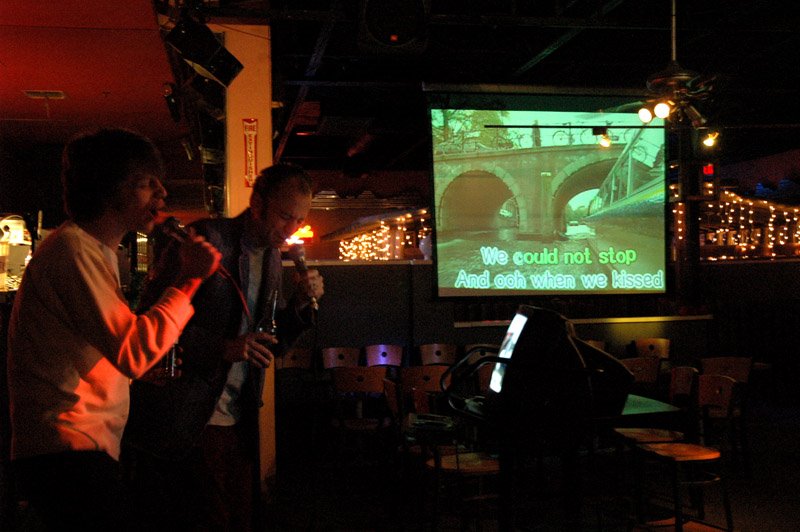
Last night Nous Non Plus performed in Las Vegas, where, between loading in our gear and playing the gig, we took time out for a round of Karaoke and some excellent German Rieslings accompanied by fantastic (although very spicy) Thai food.

This bizarre restaurant was highly recommended by my friend Steve Samson, ex-executive chef at Valentino. The Lotus of Siam occupies a modest space in a strip-mall, otherwise devoted to 99-cent stores and Karaoke bars. By the time we sat down (after a few rounds of Karaoke awaiting our table), there were Low Riders in the parking lot, partying and showing off their hydraulics.

When the waiter brought us the book, I was completely blown away: there must have been more than 300 lots, including 1995 Margaux ($450). The list was dominated however by German Riesling. Although I have some experience with Alsace, I must confess that I know next to nothing about German wines. The waitstaff was not much help in choosing the wines, so I based the selection on what the restaurant’s cellar master seemed to prefer (he had verticals of both producers).

The first wine was a Spätlese or "late harvest" from the Rheingau, the second a Auslese or "later harvest" (i.e., a superior wine in the German appellation system) from Juffer-Sonnenuhr (vineyard site) in Brauneberger (appellation) in the Mosel.

As we dined on a series of dishes that included super spicy ground pork, sausages made from pork testicles, stewed pork, each accompanied by lettuce and julienned carrots and sliced cucumbers and tomatoes, these sweet wines stood up well to the intense flavors of the cuisine. While the first wine did not show a great deal of character, the second opened up nicely, revealing fruit at first but minerality and structure as it came to room temperature. German Rieslings are famous for their longevity and the character they develop with the passing of the years. I could only wonder out loud how these wines would show if given proper time to age. They did pair beautifully with the food.

Addendum – Upon reading this post, Nous Non Plus drummer Greg Wawro (below, far right) told me that he felt the foods were so spicy that they overpowered any balance in the wines. In retrospect, I have to agree: the sweetness of the wine paired well with the intense flavors but the spice overwhelmed our palates. Greg is right to note that the tasting conditions were far from ideal. Nonetheless, it was a stimulating if not balanced experience: as the Romans used to say, when in Vegas…

The show that night was well-attended, even though we didn’t go on until 1 a.m. Between watching our good friends Hello Stranger and the end-of-night beers and goodbyes (it was the last night of a three-night run), we barely made it back to our hotel by sunrise. The joke of the evening was "what transpireth in Vegas, remaineth in Vegas." But this experience was definitely worth bringing home (see pic below).

From left: Dan Crane, Jeremy Parzen, Ryan Williams, and Greg Wawro. Menswear by Imp of the Perverse. Photo by Emily Welsch, who also attended.

92 Biondi Santi Rosso and 89 Grattamacco

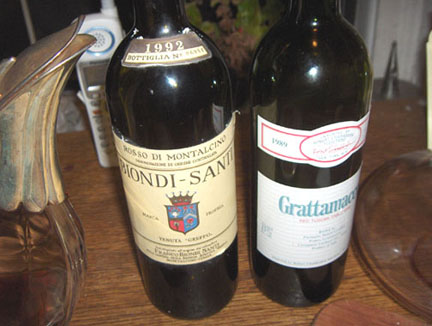
Bandmate and neighbor Greg Wawro brought over a few aged Porterhouse steaks last night to pair with some big Tuscan wines that I had been saving: a ’92 Biondi Santi Rosso and an ’89 Grattamacco (note how dated and simplistic the label of the Grattamacco appears in the photo above).

The 1992 vintage is widely considered to have been a poor one in Tuscany: did Franco Biondi Santi use his top grapes for this Rosso that year? I think that this is the case since he made little or no Brunello that year… at least, there doesn’t seem to be any on the market. This bottle came to me via a self-described hobbyist of vintage wine who lives in Mondovì in Piedmont. It was so moderately priced that I couldn’t resist buying it. I wasn’t sure if it would survive the trip nor was I certain that the wine hadn’t lost its life. I decanted it about thirty minutes before drinking. Although the first aromas were not so pleasant, the wine opened up beautifully. It certainly had seen better days but for me, there’s nothing like the taste of old wine. It was bright and still had a lot of good acidity. Biondi Santi’s wines are made expressly to age and this one paired wonderfully with our bistecche alla fiorentina (alla Upper West Side).

The 1989 Grattmacco… pure hedonistic pleasure. I’m really not one for Bordeaux-style wines from Italy. But I had a chance to taste a lot of Grattamacco working for one of my former clients and really came to enjoy the wines. When I had the opportunity to buy this bottle at a discounted price (one of the perks afforded by the client), I jumped. Historically, Grattamacco has been made with Cabernet Sauvignon, Merlot, and Sangiovese. This bottle seemed to be an even balance of the first two, with lesser amounts of the Italian grape. It was fantastic and paired beautifully with aged cheddar.

The best thing about the Grattamacco was how the wood (i.e., the barrique, the new oak) had integrated – or better yet – had had the time to integrate well. In this country, we are so accustomed to drinking young overly oaked Bordeaux-style wines, that most wine enthusiasts believe the prickly sensation in the back your mouth is a good thing. On the one hand we drank a wine that had no barrique whatsoever. Although the Rosso has passed its peak, it was still very much alive. An oaked Rosso di Montalcino would never last that long (fourteen years!). On the other hand, we drank a very modern wine where the flavor of the wine was not overshadowed by the new wood.

A judicious balance of Old World and New… the wines were some of the most interesting and rewarding that I have ever opened in my home.

A Northern Utopie

Above: Nous Non Plus in their own little Utopie in Québec City (photo by Emily Welsch).

Last night found Nous Non Plus in Québec City, where we dined at l’Utopie, a fine restaurant – as the fates would have it – smack dab next door to the club where we performed. Maître d’hôtel Frédéric and sommelier Bertrand graciously created a meal for us, pairing flavors and textures to the wines we had selected under their tutelage. (In another happy twist of fate, I would run into the two of them at a tasting in New York only a few days later!)

The first wine was a white: Costières de Nîmes 2003, a blend of Grenache Blanc and Roussanne. The latter, Bertrand told us, has been aged in large oak casks in order to achieve measured oxidation of the wine. As a result, the wine was rich in color and wonderfully aromatic. On one level the style struck me as completely modern: the wine was highly manipulated and some might say affected. At the same time, I thought about how he had used a very old technique (aging in large oak barrels where greater amounts of air cause the wine to "age" more quickly) to obtain the richness he wanted (in balance with the conventionally vinified Grenache). The wine was bold and drank more like a red than a white in its mouthfeel and finish. Fréderique paired it with Sea Scallops sprinkled to taste with aromatized fleur de sel.

The next wine was a Coteaux du Languedoc 2003, a 100% Carignan. The wine seemed to embrace the "biodynamique" approach that has become an overarching philosophy for French winemakers in recent years. The sturdy Carignan paired well with Nova Scotia stockfish served over grilled chestnut soup and mashed green cabbage and raisins.

While the star of the evening remained the Costières de Nîmes, the biggest treat for me was the St-Joseph 2003, a 100% Syrah. Many believe that Northern Rhône represents today the greatest value in fine and collectible wine and this wine was fantastic. I enjoyed it immensely with the macreuse, a lean cut of beef served over celeriac, foie gras, marrow, and armillaire mushrooms.

As Bertrand and Frédéric rocked on the dance floor at our show, I couldn’t help but think we had found a small utopia in Québec. The band played seventeen songs, including three encores, and we all slept very well that evening.