Yesterday’s Wine: Merle Haggard

Your presence is welcome with me and my friend here.
This is a hangout of mine.
We come here quite often and listen to music
Partaking of yesterday’s wine.

(from “Yesterday’s Wine,” written by Willie Nelson, performed by George Jones and Merle Haggard as a duet, and by Willie Nelson)

Above: The inimitable Merle Haggard at the Austin Music Hall on Wednesday night. Tracie B surprised me with tickets!

With the awesome show we saw on Wednesday night in Austin, Tracie B and I have fulfilled two panels in our “Yesterday’s Wine” triptych, Willie Nelson, George Jones, and Merle Haggard (we saw Willie in October and so we’re just missing George Jones now). We had a blast: he played a lot of the hits, including “Okie from Muskogee,” “I Think I’ll Just Sit Here and Drink,” “If We Make It through December,” and “Are the Good Times Really Over.” It was amazing to think about how apropos the latter two are today, with the economy in tatters and the future uncertain:

    I wish coke was still cola,
    And a joint was a bad place to be.
    And it was back before Nixon lied to us all on TV.
    Before microwave ovens,
    When a girl could still cook and still would.
    Is the best of the free life behind us now?
    Are the good times really over for good?

    Are we rolling down hill like a snowball headed for hell?
    With no kind of chance for the Flag or the Liberty bell.

Above: Isn’t she a doll?

In other news…

I had some of the best ragù (not counting Tracie B’s) I’ve had in a long time at Samson’s in McKinney (north Dallas) where I was traveling for work. Served over potato gnocchi, it had just the right consistency and balance of sweet, savory, and fatty flavors. Chefs and brothers Samuele Minin (who makes the gnocchi) and Germano Minin (who makes the ragù) are from Udine (Friuli) and they really know what they’re doing. Paired wonderfully with 2006 Langhe Nebbiolo by Produttori del Barbaresco, which is simply singing right now. Life could be worse… especially when you’re on the company dime!

It’s sgroppino time (I wish it were)

Man, it’s been a long week… and it’s only Thursday. I’m on the road again today and am looking forward to some relaxing (and gastronomic-literary pursuits) this weekend. I sure wish it were sgroppino time!

A sgroppino is made from sherbet (usually lemon) and Prosecco (and sometimes a shot of vodka). It is served at the end of the meal to aid in digestion. The word itself, from the Italian groppo or knot (akin to the English crop; see below), means “a little helper in pushing out a knot in the — ahem — digestion.”

A sgroppino was mandatory after our horse meat dinner (left) last April in Legnaro (Padua, Veneto).

And a sgroppino (below) really hit the spot after dinner at the osteria of the famous restaurant and inn on the Slovenian border La Subida (Cormons, Friuli), also last April after NN+ played at Movia.

Be sure to check out the Miller Time commercial below. That’s just about how I feel right now!

From the Oxford English Dictionary Online Edition:

[OE. crop(p = OLG. *crop(p, MDu. crop(p, MLG., LG. and Du. krop, OHG. chropf, MHG., Ger. kropf, ‘swelling in the neck, wen, craw of a bird’, in ON. kroppr hump or bunch on the body, Sw. kropp the body, Da. krop swelling under the throat. These various applications indicate a primitive sense of ‘swollen protuberance or excrescence, bunch’. The word has passed from German into Romanic as F. croupe, and It. groppo, F. groupe: see CROUP, GROUP. OE. had only sense 1, ‘craw of a bird’, and 3, ‘rounded head or top of a herb’; the latter is found also in High German dialects (Grimm, Kropf 4c); the further developments of ‘head or top’ generally, and of ‘produce of the field, etc.’, appear to be exclusively English. The senses under IV are new formations from the verb, and might be treated as a distinct word.]

I. A round protuberance or swelling, the craw.

1. a. A pouch-like enlargement of the {oe}sophagus or gullet in many birds, in which the food undergoes a partial preparation for digestion before passing on to the true stomach; the craw.

2. transf. and fig. The stomach or maw; also the throat. Now Sc. and dial. Cf. GIZZARD.

If you’ve got the time, we’ve got the sgroppino:

You had me at hello: Cajun-style oysters at Cochon in New Orleans

Above: You had me at hello… The oven-roasted gulf oysters at Cochon in New Orleans.

The food at Cochon in New Orleans last night was fantastic. The wood-fired-oven-roasted gulf oysters, sprinkled with Cayenne pepper, paired beautifully with a bottle of Charles Joguet 2007 Chinon Les Petites Roches. The vegetal notes in the wine were perfect for the spiciness that adorned the oysters and the chewy mouthfeel of the wine was wonderful with the sexy texture of oysters. Oysters and Chinon? Call me crazy but the pairing worked brilliantly.

Above: Moon River…. I’ve only traversed the great Mississippi river a few times in my life and its grandeur always impresses me. I’ve read Twain’s The Adventures of Huckleberry Finn countless times, one of my favorite books.

I’ll be glad to get back home to Austin tonight but New Orleans is a blast — great folks, great food, great wine, great music, beautiful city — but the people down here are still hurting four years after the disaster. Nearly everyone I’ve come into contact with on a professional level has in some way referenced Katrina. Yesterday we visited the warehouse of a major distributor. The warehouse manager told me how he had to destroy everything he had in stock following the hurricane. “We know a lot about destroying bottles,” he said with a sigh. Today, they’re up and running but using a skeleton crew and bare-boned allocations.

If you are looking for a food and wine destination, check out New Orleans. The folks down here need our support and the food and wine scene is great…

Produttori del Barbaresco tomorrow in Austin

From the “this is my favorite wine ever” department…

Above: There won’t be any pizza (sorry, Franco) at tomorrow’s tasting but there will be 2004 and 2005 classic Barbaresco by Produttori del Barbaresco and 2006 Langhe Nebbiolo. These are some of favorite wines and favorite vintages. (I snapped the above photo last summer at Mamma Mia Pizzeria in Pacific Beach, San Diego.)

If you happen to be in Austin tomorrow, please come see me at Austin Wine Merchant where I’ll be pouring my beloved Produttori del Barbaresco. Click here for details. A vertical of Produttori del Barbaresco? Life could be worse…

You only live twice: lunch at La Tour d’Argent

Above: La Tour d’Argent’s signature dish, duck breast in civet. The duck bones are crushed in a press and their juices are used to make a civet (sauce). Civet is an ancient recipe. In my translation of the 15th-century Ars Culinaria by Maestro Martino (UC Press, 2005), you’ll find an excellent recipe for venison civet, for example.

In all honesty, I’m a little embarrassed by the extravagance of a lunch Tracie B and I enjoyed in Paris a few weeks ago while we were in town for the NN+ tourette France 2009.

Above: We drank a 1991 Volnay Les Champans 1er Cru with the main course. Lunch wasn’t cheap but the list was jam-packed with very reasonably priced “outer borough” Burgundy. I was looking at 1989 Marsannay but the excellent sommelier pointed out that 1991 is drinking better in general and that Marsannay would have been too tannic with our duck. His choice was superb and he kept me well under my price point. Note the dust on the bottle: this is a sign that it has been well cellared in situ and has rested peacefully. (Check out Eric’s cool article on “Those Other Burgundies.”)

Especially in these tough times (and believe me, I am so relieved and fortunate to be busy with work these days, when so many of my peers are having trouble), I couldn’t help but be more than a little self-conscious.

Above: Watching the wine service at La Tour was a thrill. Our sommelier was so friendly and helpful. Frankly, it’s intimidating to approach a wine list like that (check out this pic that Tracie B snapped of me). I knew that I wanted to drink old Burgundy and I told our steward my price point, my preference in style (traditional), and we discussed our menu. The 91 Volnay was fantastic and you’d be surprised at how little I paid for it: because La Tour buys so much wine on release, the prices are actually surprisingly affordable (as long as you stay clear of the heavy hitters).

But, hey, you only live twice: I can’t imagine that Tracie B and I will be back in Paris any time soon and a lunch like this is something you do once in your life (And since we were on tour, we ate mostly ham sandwiches while we were there! And so this was our one extravagant repast. Believe it or not, I actually lost weight.)

Above: For every course, the mise en place was a work of art. I loved how they trimmed the lettuce leaves to match the size of these delicately sliced, raw scallops. We paired this first course with a 4-year-old Savennières.

I’ve read a lot of food and wine bloggers talking about how they are cutting back on and reeling in their wine budgets, these days (and so are we here in Austin). That’s perfectly understandable as well as indispensable in this new “age of responsibility.”

Above: A picture really isn’t worth a thousand stinky flavors and aromas! The cheese course was phenomenal. We paired with an equally stinky vin jaune.

But it is equally important to go out and spend money on wine and in restaurants and support local businesses and merchants. Remember: every time you buy a bottle of wine (even if you’re spending less on wine these days), you are supporting a whole chain of people in the industry — producer, importer, broker/vendor, distributor, and restaurateur/retailer (including the shippers, drivers, delivery people, etc.).

Not that La Tour d’Argent needs any help from me and Tracie B: a pair of bankers sitting next to us ordered two bottles of old Mersault and I can only imagine what they paid (probably in the thousands, gauging from my perusal of the list).

Above: I have no idea what we ate for dessert but it was delicious.

Lunch is certainly more affordable at La Tour than dinner and Tracie B and I stuck to the fixed price menu. You would be surprised at how little we actually spent, considering the venue.

All I can say is that the experience was worth every penny. Tracie B was simply stunning that day, the sunlight reflecting off the Seine and giving her a glow that I will never forget as long as I live.

You only live twice…

Nicolas Joly, Tracie B, and me

cellar

Above: Tracie B in the cellar at Coulée de Serrant, the celebrated Nicolas Joly estate in the Loire Valley.

Our trip to the Loire Valley (between NN+ gigs in France) revealed to us just how varied the production of Chenin Blanc really is and how uniquely terroir-driven the appellations. The short drive from Savennières to Chaume, for example, showed us how macro- and micro-climate could change radically after a 7-minute drive at country-road speeds.

Tracie B called dibs on blogging our excellent tasting at Joly a few weeks ago and so you’ll just have to visit her blog to get the low-down (click here) on oxidation vs. botrytis, Les Clos Sacrés vs. Les Vieux Clos, sandy vs. slate, to aerate or not to aerate, and many more mouth-watering, “tongue-splitting” tidbits.

In other news…

Check out this post at VinoWire on a new DOCG: a red Moscato (yes, a RED Moscato) from Bergamo (yes, Bergamo). Turns out that it was once one of Italy’s most famous appellations, Moscato di Scanzo. Franco and I posted about it here.

One night in Paris with Alice

Above: Alice F and Tracie B, two of my favorite ladies, and I went natural-winebar-hopping the other night in Paris.

If you ever get a chance to go natural-winebar-hopping in Paris — where many believe the winebar concept and the natural winebar were born — with the leading lady of natural wine writing, Alice Feiring, go for it. In perhaps the only city on earth where the maître d’s are ruder than the hosts at Babbo or Sparks Steakhouse, Alice your-table-is-waiting-right-this-way Feiring, Tracie B, and I ended up at Racines in the picturesque Passage des Panoramas at the end of the night a few weeks ago while we were in town for gigs with NN+.

Above: The first wine we drank at Racines was this entirely stinky, cloudy, dirty, oxidized Chenin Blanc by winemaker Eric Callcut, who calls it “The Picrate,” which I imagine is a reference to the picric acid. I imagine that picrate tastes like saltpeter since it is used in explosives but I didn’t get a gunpowdery note on this wine. Thoughts?

Between her popular blog Appellation Feiring and her wine-memoir/manifesto The Battle for Wine and Love or How I Saved the World from Parkerization, there is no denying that Alice is one of the wine writing world’s boldface names — whether you agree with her radical positions or you find yourself diametrically opposed to them (there’s really no middle ground with her, which is something we all love about her). But in Paris, she is considered a primissima donna and Tracie B and I were thrilled to be her companions: the toast of the Parisian natural wine circuit seemed to bow before her as if in audience with the queen.

Above: The charismatic owner, Pierre, already enjoyed quite a following even before Food & Wine called Racines “Paris’s hottest winebar.”

As it turns out, owner Pierre Jancou’s family is from Modena, where I taught for a summer many, many moons ago for U.C.L.A. When we discovered our Emilian connection, he insisted that we taste Donato Camilli Lambrusco, which was fantastic — bright with acidity but light in the mouth. Even though we savored the minerality in every last drop of the Chenin Blanc (The Picrate, above), we agreed that the Lambrusco was the wine of the night. (Franco, I know… I know… I’m the only dude who drinks Lambrusco in Paris. That’s HOW much I love Italian wine!)

Pierre is not the only one at his restaurant that speaks Italian with an Emilian accent. His charcuterie speaks Emilian dialect, too, and the lardo melted sumptuously in the mouth, with the natural fruit of the Lambrusco slicing through its liquid fat like a serrated ravioli cutter on a Sunday morning. I ate blood pudding (below) and beets as my main course (just to keep things light). Tracie B and Alice split the sole, which was also excellent if pricey.

Above: The artisanal and natural qualities of Pierre’s food really stood out in the blood pudding and beets. His radically natural ingredients brought a balance and lightness to a dish you would otherwise expect to be gut-splittingly heavy. I ate every last morsel.

For someone who once performed “One Night in Paris” at the Paris Paris nightclub in Paris (yes, it’s true), this was one night in Paris that I will never forget.

The best nachos ever (and in the French press)

Above: Do Bianchi’s pick for “best nachos ever” at Polvo’s in Austin.

Do Bianchi got some props today in the French press. In a Valentine’s Day post, Le Monde’s blog Le Post called my “gastronomic blog” a sign of the recent “radical change” in Americans’ tastes (presumably after the presidential election). Gee… if that’s a compliment, I think I prefer a French insult.

So I thought I’d post on this Valentine’s Day on a good ol’ Tex-Mex classic, nachos.

I’ve eaten nachos all across these fine United States of America, and as partial as I am to the nachos served at the sometimes crusty but always classic El Cholo in Los Angeles, Polvo’s in Austin now holds the title of “best nachos ever” in the Do Bianchi Pantheon of ars culinaria mexicana.

While the decor at Polvo’s ain’t the Ritz, the waitstaff is friendly (although the hosts are sullen). Everything I’ve eaten there has been great (and well-priced), including the mole (we went there last night for dinner before an excellent Guy Forsyth show). My only true lament: what do you have to do in this town to get a beer without a lime in it?

My valentine, Tracie B, makes some pretty mean nachos herself, with spicy ground and sautéed turkey, melted cheese, and her own homemade tomatillo sauce (above). Sooooo good…

In other news…

NN+’s video was a Valentine’s Day feature on YouTube today! Pretty nifty…

Happy Valentine’s, y’all!

Ending on a high note: a swig of Bolly to wash it all down

bollinger99

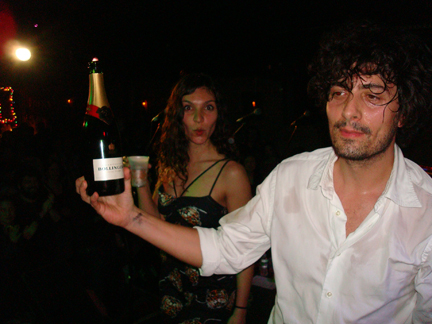
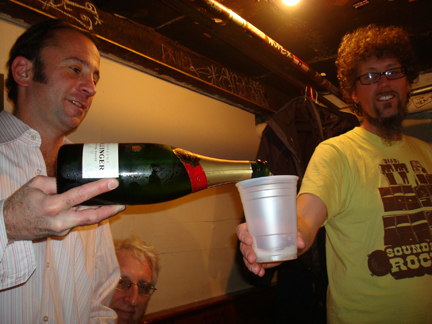
Above: Bonnie Day (Emily Welsch) and Jean-Luc Retard (Dan Crane) at the end of our sold-out show in New York on Monday night. Official Sponsor Bollinger (our only endorsement… no Ibanez guitars here!) provided us with a few bottles to end NN+’s “tourette” on a high note.

Touring is never easy and we were all pretty beat by the time we got to NYC for the final show of our tourette, as it was dubbed.

me_ry

Above: Me (Cal d’Hommage) and Maurice Chevrolet (Ryan Williams) in the green room before the show. Ben Shapiro, seated between us.

Yesterday our new record Ménagerie hit number 22 on the college radio charts. We’ve never debuted so strongly and I can’t conceal that I am thrilled at the response to the record.

crowd

Above: A view from the stage at the show. Thanks everyone for coming out on a Monday night.

A hearty thanks to everyone who came out. Check out JT’s take on the show (thanks for the shout-out, man!).

cavatelli

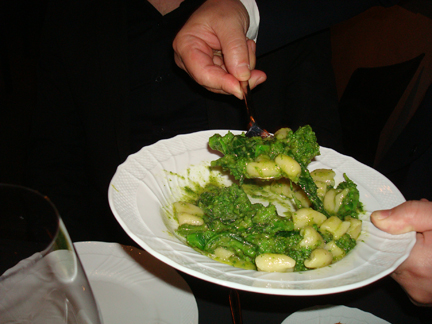
Above: Cavatelli with broccoli raab at Centovini in SoHo.

Tracie B, Prof. Harry Covert (Greg Wawro) and his lady Eileen, and Ben Shapiro and I convened at Centovini in SoHo for a light dinner (much needed after saucisson lyonnais!) and 2006 Pelaverga by Castello di Verduno before the show. Times may be tough in the NYC restaurant world these days but Nicola Marzovilla’s mother Dora’s cavatelli are always a winner in my book. The 06 Pelaverga had a richer mouthfeel (more corposo, you would say in Italian) than in previous vintages I’ve tasted. I like the way that winemaker Mario Andrion is making it even more rustic in style. A great food-friendly wine that will pair well with a variety of dishes.

Thanks everyone for visiting Do Bianchi, all the well wishes and the kind words about the tourette. Tracie B and I are back in Austin and tomorrow I’ll start posting about our enogastronomic adventures.

On deck for tomorrow: “The Best Pork Store in New York City.”

Stay tuned…

Pineapple prohibited: “xenofoodism” in Italy

Above: Self-described “gastronomad” Vittorio Castellani published this vignette today on the Acquabuona blog. He grabbed the cartoon from somewhere on the internet and rewrote the caption: “Now that they have finally closed all those kebab houses, sushi bars, and Indian restaurants, we can start going out to dinner again!” The “Lucca” on the back of the man’s shirt refers to the city in Tuscany, where “ethnic food” was recently prohibited by the local government.

As I sit here translating La cucina veneziana (Venetian Cuisine) for the Oronzo Editions (New York) series of regional Italian cookbooks (to be released this spring), I feel a certain if modest confidence of my status as a purveyor of Italian gastronomic culture. After all, since my early days writing for La cucina italiana, I have been involved in Italian wine and food writing and marketing for more than a decade.

In the light of my interest in (and love and passion for) Italian culinary tradition, I feel duty-bound to share some disconcerting news that arrived today from Italy (ironically, in the same GoogleReader page of feeds informing me that Prime Minister Berlusconi has called Italy’s 1938 adoption of the Race Laws “a deep wound”): according to a report published on Tuesday in the daily La Repubblica, the township of Lucca has officially banned any “ethnic” food vendors from its historic center. The text of the new law, passed by local legislators, is as follows (reported by La Repubblica):

    “In order to safeguard culinary tradition and [Lucca’s] unique architectural, structural, cultural, and historic character and urban design, the commissioning of administrative operations is not allowed when such activities are ascribable to different ethnicities” (translation mine).

Unfortunately, this is not an isolated case of what “gastronomad” Vittorio Castellani has called Italian “xenofoodism” in a comment he left on the newspaper’s website and on the wall of his FB group The Couscous Clan (even though his neologism, etymologically, doesn’t really mean fear of the food of others; it actually means the fetishization of foreign foods, if you read the suffix -ism in the sense that it is used in sexism or racism, “Forming nouns with the sense ‘belief in the superiority of one over another'” [OED Online Edition]; xenophagophobia or xenoanorexia are more apt terms, the latter being particularly fitting in my opinion).

Above: Italy’s agriculture minister Luca Zaia has adopted nationalist and protectionist policies with racist undertones since his installment in April 2008.

In fact, since Berlusconi took office last April and installed Luca Zaia as agriculture minister, the Italian government has adopted an official policy of agricultural protectionism with racist undertones. As Christmas approached last year, Zaia published this astounding declaration of karpophobia in his blog: “Zampone [pig trotter stuffed with head cheese, boiled], cotecchino [pork sausage encased in pork rind, boiled], and lentils will surely not be missing at the Zaia residence! No pineapple, but fruit from our [Italian] farms…”

In November, he asked his readers: “How do you select restaurants for your dinners and lunches? Have you ever visited Chinese restaurants or restaurants with other ethnic origins?” Thirty-one readers responded to this racially charged survey.

Above: Traditional “tramezzini” (literally, “in-betweens”) at Sant’Ambroeus in New York, the North American satellite of the Milanese classic cafè, opened in 1936. I highly recommend it in NYC or Italy.

What business do I have posting my editorial on Italian or even Lucchese “ethnic food” policies? None, aside from my knowledge that Italian cuisine became a universal gastronomic language thanks to its absorption and incorporation of foreign culinary traditions. Dried pasta? From the Arab world (yes, the Arab world). Tomatoes? From the New World. Corn for Zaia’s beloved polenta (I love polenta, too, btw)? From the New World. Stockfish (baccalà)? From Norway.

No polenta e baccalà? I can’t imagine a world without it nor do I know of another country where these two foodstuffs could be brought together so deliciously!

I’ll say no more but leave you with food for thought. At the height of fascism, Italian “purist” linguists created the world tramezzino to purge the Italian language of the English sandwich (used to denote what were called tea sandwiches in Britain). Where would the world be today without the Italians amelioration of English cooking? If only Italian winemakers would develop a fear of foreign grape varieties!

Thank you for reading this far…

*****

Se il mare fosse de tocio
e i monti de polenta
oh mamma che tociade,
polenta e baccalà.
Perché non m’ami più?

If the sea were made of gravy
and the mountains of polenta
oh mama, what sops!
polenta and baccalà.
Why don’t you love me anymore?

— from “La Mula de Parenzo,” traditional folksong of the Veneto and Friuli