Recipe for Picchiapò (we all loved each other so much)

My depressing post yesterday made think of the Roman dish Picchiapò and the great scene from the 74 Scola film C’eravamo tanto amati (We All Loved Each Other So Much) when the three main characters (an intellectual bourgeois, a rich bourgeois, and a proletarian) realize that they have lost touch with the ideals they fought for together as partisans during the Second World War. Italian leading man Vittorio Gassman fantasizes his own death and utters the famous line, our generation really stinks!

The clip is in Italian but you don’t need to understand Italian to watch it. Picchiapò plays an important role: it’s one of the great Roman “recycled” dishes, a dish born from necessity but a delicacy because of its very nature.

I should leave the recipe writing to Simona and her excellent blog Briciole but feeling inspired this morning after Tracie B’s brioche French toast, I went online and found and translated this recipe.

Picchiapò

Ingredients

l lb. leftover boiled veal or beef, cut into small pieces
2-3 onions
2 cups tomato purée
rosemary (basil is sometimes used and cinnamon can be used as well)
salt and pepper
2 cups white or red wine
extra-virgin olive oil, as needed

Slice the onions into rounds and then wilt with a drizzle of the olive oil in a pan. When they have lightly browned, deglaze with the wine.

Add the tomato purée and spices and simmer until the sauce thickens.

Add the meet and let it absorb the flavor of the sauce.

Serve hot with potato purée or boiled potatoes or seasonal vegetables.

The Scola classic film is a commedia all’italiana but it is also a stinging social commentary and a moving film about love and country. It is also a meta-film — a film about film — and includes a cameo by Marcello Mastroianni and Fellini and a number of timeless Italian film clips. I highly recommend it.

Vintage anti-Berlusconi propaganda and other relics

Above, from left clockwise: “I have to stay outside,” “You’re poor? It’s YOUR damn problem,” “We are voting for Berlusconi” (they’re dressed as Freemasons), and “this car has been de-Berlusconi-ized” (a play on denuclearized). These stickers were printed by Cuore (a magazine supplement to the leftist daily L’Unità) in the early 1990s during Berlusconi’s first campaign to become Prime Minister.

When I first traveled to Italy in 1987 for my junior year abroad as part of the University of California and Università di Padova exchange program, Italy and the outlook of Italians seemed much different than it does today. When I attended my first academic year there (and there would many years to follow, later at the Scuola Normal Superiore in Pisa, study at the Vatican Library, three summers in the Dolomite Alps where I earned my keep playing cover tunes, and summers in Montalcino where I first began to appreciate wine), the Italian Socialist Party still dominated Italian politics. In spite of the inconveniences posed by the legendarily lethargic Italian bureaucracy, health care was free for all (that first year, I badly sprained my ankle playing basketball and was amazed when I wasn’t even presented a bill at the emergency room) and a year’s tuition at the university cost roughly 300,000 lire, about $250 at the time (in 1989 I returned to Italy and re-enrolled at the Università di Padova).

Above: My junior year dorm room at Monte Cengio where I roomed with Steve Muench. We’re still close friends today (scroll to the bottom of this post).

That was before the Mani pulite investigation and the subsequent Tangentopoli scandal that brought the Socialists to their knees. And it was before the rise of Italy’s richest man Silvio Berlusconi as the most powerful politician to emerge in post-war Italy. Berlusconi famously told journalist and historian Enzo Biagi (think of him as our Walter Cronkite) that he entered politics because existing laws did not allow him to make even more money. If the law doesn’t allow me to grow richer, he decided one day, I’ll just rewrite the law.

Today in Italy, vigilante posses comb the streets at night harassing immigrants; doctors have been asked to report illegal immigrants (extra-communitarians, as they are called) to authorities when they request medical care; there have been cases where emergency health workers have allowed immigrants to die at the scene of accidents by delaying medical attention; Berlusconi’s agricultural minister has asked Italians to boycott Chinese restaurants; and Lucca has outlawed “ethnic” food in its center… The list goes on and on.

It’s a different Italy than the one first encountered by a bright-eyed U.C.L.A. junior who had a knack for languages in 1987.

Above: The last summer I played at the Birreria di Pedavena, my band and I stayed in the mountain pass village of Croce d’Aune.

I recently found the stickers and the photos in a shoebox that arrived last week in Austin from a storage space in Manhattan. They brought back memories of a time when the outlook of most Italians I knew didn’t seem rosy but was certainly instilled with a resilient humanitarian and humanist spirit. That attitude endures among most of the Italians I know but a dark cultural hegemony has taken hold there in the Berlusconi age.

Yesterday, an article in The New York Times reported how Berlusconi forced the resignation of the editor of the Italian Bishops’s Conference daily newspaper. He did so by publishing front page features in his own newspaper detailing the editor’s rumored sexual preferences. He did so because the editor had written an editorial about Berlusconi’s widely publicized (and in many instance self-propagandized) lasciviousness.

What’s this world coming to?

In other news, Agnelli heir and playboy Lapo Elkann has publicly announced that he is converting to Judaism.

What IS this world coming to?

Boccaccio’s tale of the conversion of Abraham comes to mind…

The (de)criminalization of alcohol in Italy

Above: Italy’s agricultural minister Luca Zaia is widely recognized as having an ego the size of the world’s largest panettone. Note the signature green pocket square (a nod to his separatist, xenophobic Northern League party) and his black tie (I’ll leave the semiotic analysis to the reader but fascism is always in the eye of the beholder).

“Incredible but true: I am in agreement with Zaia!” This was the title of a Facebook note that Franco posted yesterday after the ever-patriotic (patriotic, that is, if you consider the Veneto a sovereign state) Italian agricultural minister was quoted in a magazine interview as saying that Italy’s new “zero-tolerance” drunk driving law is excessive. Currently, “0.2 grams per liter of blood” is the legal limit, making the consumption of even one glass of wine illegal if you get behind the wheel. In the interview, published in Italy’s leading consumer automotive magazine, Quattro Ruote, Zaia proposed that it should be raised to 0.5 grams so that drivers will be allowed to have 2 glasses of wine as long as the alcohol content of the wine does not exceed 11%, in other words, as minister Zaia put it, as long as drivers are not consuming “structured” wines. (In a subsequently posted FB note, Franco suggested that minister Zaia take a full-immersion sommelier course: “where,” asked Franco, throwing his hands in the virtual FB air, “does he find wines with 11% alcohol content?”)

Zaia should know something about drinking and driving: although you won’t find it in his ill-translated and prolix Wikipedia entry, the forty-something minister used to work as a nightclub bouncer, or so I have been told by someone who knows him well.

I’ve been known to indulge in some of my own Zaia bashing, but today I’ll leave it to the experts.

And not that it’s any of my business, but Zaia is right: the new legal limit, which went into effect earlier this year and has been rigorously enforced with myriad check points, has led to senseless arrests and steep fines for food and wine writers, like Andrea dal Cero who lost his license in May after attending a spumante presentation in Emilia-Romagna.

Above: Just days before the event was to be held, organizers of the Taurasi Wine Fair canceled the convention, citing recent legislation that makes it illegal to serve alcohol at public events in town squares.

Italy (like Europe in general) has been wrestling with its relationship with alcohol and in some cases, the results have been disastrous, like the recent cancellation of one of the most important wine festivals in southern Italy, the Taurasi Wine Fair. See this editorial posted at VinoWire by the author of Divino Scrivere, Luigi Metropoli.

I sure hope that Italian pols will look closely and carefully at current legislation and I’m glad that Zaia is taking this issue seriously. After all, can you imagine how many folks will lose their licenses as they roll out of Vinitaly next April? If you’ve ever been caught in the post-fair traffic of the trade show (where there are never any traffic police to guide traffic and avoid grid lock), you get the picture.

Kermit Lynch is coming to Austin and he’s bringing some damn good music with him…

Above: Tracie B and me met Kermit Lynch in real life for the first time in May in San Francisco. In case you don’t know, Tracie B would be the good-looking one on the right.

Like so many good things that have happened to me over the last year and a half thanks to the blog, I met Kermit Lynch back in April when he commented on my post Idol and Bandol. Who knew that Kermit read my blog?

We’ve stayed in touch since then and a few months ago he asked me if I’d give him a hand organizing a listening party for his new release on Dualtone, Man’s Temptation. Needless to say, I was thrilled to get to work with him, in part because I love his palate and have always been a fan, in part because I’ve been digging his new disk and have become a new fan, and dulcis in fundo it’s just so cool to get to work with a luminary in the biz who loves country music as much as Tracie B and me.

In our trans-Atlantic conversations (he in Provence, me in Austin), he told me about how he grew up in the San Joaquin Valley, the son of an itinerant evangelist. The Grapes of Wrath was the backdrop: the souls his father saved were the same southern farmers who came to California in search of Merle Haggard’s “California Cotton Fields,” one of my favorite Merle tunes and one that Gram Parsons and Emmylou Harris both covered:

    My drifting memory goes back to the Spring of ’43
    When I was just a child in Mama’s arms
    My daddy ploughed the ground
    And prayed that someday he might leave
    This run down mortgaged Oklahoma farm

That’s some pretty serious country cred that Kermit’s got.

Here’s the info and the press release I composed to launch the event. I hope to see you there: if you’ve been planning a trip to Austin, this might be a fun time to make it out.
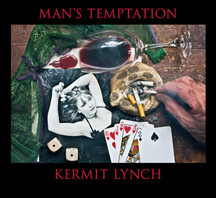
kermit_cover2Man’s Temptation: An Evening with Kermit Lynch

Monday, November 9 @ Vino Vino, Austin, Texas

listening party and wine tasting

singer, song-writer, and wine industry legend Kermit Lynch plays cuts from his new album Man’s Temptation (Dualtone) and talks about his music, his life, and his wines

Monday, November 9, 2009, 7 p.m.
$20 (ticket price includes 1 glass of wine)

Vino Vino
4119 Guadalupe St
Austin, TX 78751-4222
(512) 465-9282

with a menu inspired by the wines and travels of Kermit Lynch

All currently stocked Kermit Lynch wines will be available by the glass and available for sale retail.

Reservations required, space limited.

To reserve, please call (512) 465-9282 or email jeff@vinovinotx.com.

Rocker Interrupted: Kermit Lynch finally yields to temptation

Singer-Songwriter Kermit Lynch releases Man’s Temptation (Dualtone), a collection of ballads, rockers, and ditties, spanning forty years of faith, temptation, and musical salvation (produced by Ricky Fataar).

The only way to get rid of a temptation is to yield to it.
—Oscar Wilde

From the opening lines of Man’s Temptation, singer-songwriter Kermit Lynch cinematically sets the backdrop for the multi-layers of his life as a singer, writer, and wine Svengali:

    Paris and my mind is breaking
    Paris, I’m in a railway station
    Gare de Lyon…

But just when you think that the gravelly, smoky voice behind the old tube-driven microphone is about to head out to Lyon to taste wines with a Beaujolais producer, the melody of the track rises and steers the listener in another and entirely unexpected direction. The singer is in a railway station,

    Gare de Lyon, on my way to the next concert stage.

Man’s Temptation was recorded just last year in Nashville, Tennessee with some of the great country music players in the business today but the album represents a journey that began more than forty years ago in Berkeley, California.

Lynch was born in Bakersfield and grew up of the son of a teetotalling itinerant preacher who traveled the upper reaches of the San Joaquin Valley in search of souls to save. The setting was straight out of Steinbeck’s The Grapes of Wrath, as Lynch puts it, and the souls were southerners who had fled their native land and sought out the same “California Cotton Fields” that Merle Haggard’s father dreamed of as he tilled his rundown, mortgaged Oklahoma farm. It was there that Lynch discovered his first love of music (and grape juice, since no wine was to be had): Jimmy Rogers, Hank Williams, and the country recordings of Jerry Lee Lewis were the first cuts he would hear, the same music his father’s congregants listened to when not singing at church.

By 1966, Lynch had landed in Berkeley, at the height of the music scene. He began writing songs, started a band, and gigged around. But a first trip to Europe and a drummer’s cocaine habit interrupted and deferred the rockstar dream. Disillusioned by the flower power scene, Lynch decided to focus on making a living and turned to a second passion: wine.

Hit pause and fast forward: forty years later, Kermit Lynch is one of the most successful and respected names in the business and he is considered one of the world’s greatest wine writers, a pioneer in reshaping the American wine palate with wines that speak of place and the people who make them.

Hit play: forty years later, Lynch has delivered the album he lived and wrote all those years ago and in the lifetime that followed, a collection of ballads, rockers, and ditties that speak to the weaknesses and the strengths of man and his temptations.

From the original tracks like ballad “Gare de Lyon,” the Beggars Banquet-inspired country waltz “Backstreets of Moscow,” and the rocker “Buckle-Up Boogie” to covers of classic Dylan like “Girl from the North Country” and classic country like “Take These Chains from My Heart,” the verve, pathos, and fun of Lynch’s voice play counterpoint to some of the most bad-assed, finger-lickin’ pickin’ you’ve heard since the last time legendary session man George Marinelli (Bruce Hornsby, Bonnie Raitt) tuned up his git fiddle. The fresh analog-driven tones of the band provide an earthy palate of colors for the tableaux vivants painted by Lynch, whose face is probably slightly less wrinkled than his heart and whose voice is as gravelly and dusty as the vineyard roads of southern France that led this voice astray some forty years ago.

Kermit Lynch, rocker interrupted, is now waiting at the Gare de Lyon, getting ready to board a train on his way to the next concert stage.

Btw, I’ve taken a train from the Gare de Lyon to go play a gig in Lyon!

Folks in Sacramento know how to live well

On my way back to ATX today following my annual pilgrimage to Sacramento, in the heart of California farmland and wine country. Folks out there sure know how to live well. Here are some quick highlights…

Darrell Corti graciously treated me to a quick lunch today at One Speed after our morning meeting and before I headed out to the airport. Seafood risotto and 14-year-old Australian Sémillion from his cellar. I had never had an Australian wine that I liked until Darrell first shared some of his gems with me. This wine had gorgeous fruit and a rich mouthfeel, 11% alcohol, and acidity that Darrell aptly described as “sprightly” (Tracie B would have called it “tongue-splitting”).

Produce in Sacramento is unbelievably good: marinated artichokes, braised fennel, and roast peppers at One Speed.

The night before, I was the dinner guest of Darrel’s delightful neighbors, Joe and Deb. Deb’s tomato bisque with panzanella salsa paired superbly with Darrel’s Bert Simon 2005 single-vineyard Riesling. Deb and Joe are both superb cooks. I guess you have to be if you live next to Darrell Corti! Joe and Deb were so gracious to have me over and they throw a fantastic dinner party… Joe, a lobbyist, told a great story about meeting Ted Kennedy and how he loved to talk baseball.

2007 Nebbiolo Martinenga by Marchesi di Gresy. 2007 is going to be such a killer vintage for traditional-style Nebbiolo. Like the 07 Produttori del Barbaresco, this wine shows some serious, brawny tannin. It went great with whole chickens that Joe stuffed with cheese (I believe goat’s milk) and then grilled whole. The breast was as moist as the thigh.

This morning I gave Darrell a hand organizing wines for a tasting at his legendary store Corti Brothers. Darrell is the reason why I come back to Sacramento every year… to peruse his wondrous cabinets

It’s only been three days since I said goodbye to my lovely Tracie B. Feels like a lifetime but that ol’ Southwest Jetliner is carrying me back home where I belong tonight, not a minute too soon for this aching heart…

ZinFANdel is the new Beaujolais? Julia is the new Julia

julia

Tracie B and I went on a date last night to the movies, to see Julia and Julia. Our favorite movie house is Austin’s Alamo Drafthouse, where you can have dinner (bar food and pizza) and drink during the movie. But the coolest thing about Alamo is that as people are filing into the theater, before the previews, they show all these really cool vintage clips that are somehow related to or inspired by the film — often with great comic effect.

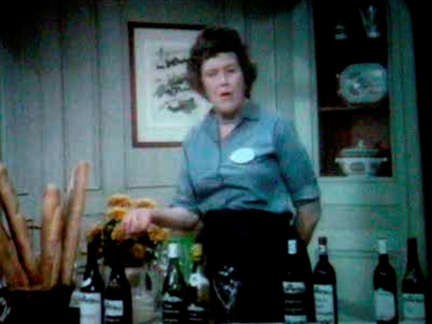
Yesterday’s pre-show reel included a number of 1960s commercials for instant foods (like Quaker instant grits, useful for “southerners traveling in the north,” or Cool Whip, “instantly frozen to preserve freshness”) and vintage Julia Child.

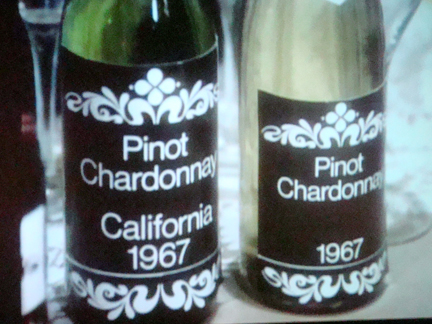
In one of the vintage Julia clips, she discusses how to throw a wine tasting party and talks about a flight of roughly ten wines. She calls Beaujolais a “hardy” wine and it seems to be her go-to wine. And when she gets to Zinfandel she pronounces it zin-FAN-del, with the penultimate syllable as the tonic syllable. Zinfandel, she says, is the American equivalent of Beaujolais. She also discusses Burgundian and Californian “Pinot Chardonnay” and she tells the viewer that Cabernet Sauvignon is the most noble of wines.

pinot

We’ve come an awful long way since the late 1960s, haven’t we? The labels of the wines are covered but on a number of them, you can see a strip label that looks like that old Oakie Bob Chadderdon. Is that possible?

I wouldn’t exactly call Julia and Julia a bildungsroman but I won’t conceal that we enjoyed it immensely. Meryl Streep is great, as always. And the tableaux from Paris and the discussion and descriptions of food were super fun.

But the funniest part — at least to me and Tracie B — was the discussion of blogging and its novelty in post-9/11 New York. After all, we both know the difference that blogging can make and the wondrous new paths it can take you on.

It was a year ago tomorrow that I first got on a plane in San Diego and came to Austin to meet the wonderful, intriguing, and gorgeous lady whom I met through a comment on my blog.

Savary Chablis and Tracie B’s enchilada casserole. Who knew? (also, Gramsci, Gaja, Israel Merlot in Italy, and natty wine in SF)

Above: Tracie B’s enchilada casserole may not be pretty but it’s shot to the top of my list of favorite things she cooks with meteoric celerity. And what better with the spicy and rich flavors of tomatillo sauce, cotija cheese, fresh peppers, corn, and cilantro, roast chicken, and corn tortilla than steely, mineral-driven (and affordable) Chablis? Who knew?

Seems we weren’t the only ones drinking Savary Chablis last night: a series of backs-and-forth on Facebook with Anthony on whether or not my silverface Princeton is a 69 or 71 was interrupted around dinner time because Savary 07 Chablis and Tracie B’s enchilada casserole were calling in my case, Savary Chablis Vieilles Vignes (I believe the 06) after his show last night (wherever he is!).

It’s Saturday and I’m working today (because I have a tight deadline on a hefty translation: a folio edition of twentieth-century Italian photography, pretty cool stuff actually). But before getting to work this morning, I did indulge in some Antonio Gramsci and his notion of cultural hegemony. I’d been thinking about Gramsci over the last week and how wine, in his era, was considered a luxury product in the eyes of the agrarian class (Italy was still in the early phases of its industrialization) and an important trading commodity by the landlords. How far the western world has come in such a short period of time! With the rise of globalization (unthinkable in Gramsci’s time when protectionism reigned) and the seemingly boundless exchange of wine today, Tracie B and I can enjoy an excellent and affordable (at our price point) Chablis that has traveled seemingly effortlessly across that misunderstanding otherwise known as the Atlantic Ocean. And we enjoyed it — no less! — with Mexican cooking spiced up by peppers grown in the farmland that stretches between Dallas and Austin in Texas (we still had some peppers left over from my stopped at the sorghum syrup and stuffed armadillo store).

My hankering for Gramsci was whetted in part by the soul searching that followed the wild exchanges this week but it was garnished by the news — which I read at Franco’s blog — that Angelo Gaja is importing Israeli Cabernet and Merlot to Italy. It seems that like the historic stockfish vendors of the Roman ghetto, Gaja saw an opportunity in bringing modern-style international grape varieties from the promised land and selling them to the “Israelite” communities (as they are called there) in Italy. Does Italy really need another international-style Merlot? From Israel?

Gramsci, where art thou?

In other news…

Above: I bet this guy knows his Gramsci. Guilhaume Gerard, one of the owners of Terroir in SF, pours great wine and writes a great blog with an emphasis on you know what.

I read at McDuff’s excellent blog that there is a now a site with information about the natural wine week event going on in San Francisco next week, hosted by different venues, including one of my favorite natural wine destinations, Terroir, with a symposium led by the inimitable Guilhaume (whose natural wine credentials, by all accounts, are impeccable and who has an amazing palate and writing style).

A bratty sparkling Barbera for the summer of 09

Above: The inimitable Michael Housewright (right) with his Italian business partner Antonello Losito. Michael’s new wine bar and shop Block 7 in Houston is on the cutting edge of wine sales and marketing and has already proved a success in highly competitive market.

This dude knows what he’s doing. Michael Housewright’s aggressive pricing at the newly opened Block 7 in Houston is like nothing I’ve ever seen. Every bottle on his list can be ordered by the glass (at market price), by the bottle (at a competitive retail price), or by the case (with case discount) in which case you can open a bottle and drink it in the restaurant/wine bar.

Above: 07 Barbera Vivace (i.e., slightly sparkling) by Roagna Igino (not the other Roagna, producer of old-school Nebbiolo) is competing with Bisson Ciliegiolo as my official favorite wine of the summer of 09.

When Tracie B, her childhood friend Talina, and I dined there the other night, Michael turned me on to a vivace (i.e., slightly sparkling) Barbera by Clò di Roagna Igino. The proprietary name birichina means brat in Italian, in other words, someone who is excessively vivace. Served slightly chilled, the acidity and fruit in this wine was awesome with my burger and fries. We also shared a bottle of Produttori del Barbaresco 2005 Barbaresco with another party: the price was too alluring to resist.

In other news…

Budweiser (well actually Shiner Bock) instead of Barbera tomorrow night: I’m playing my first Austin gig tomorrow at the Broken Spoke with this guy. Not exactly the summer of 1969 (more like the summer of 2009) but I’m stoked to break out my Tele at the Spoke.

Natural wine with a capital N: 91 Nicolas Joly Coulée de Serrant

Above: What is natural wine? The question of what it is (and what it isn’t) is one of the most hotly debated topics in the world of wine blogging and punditry today. No one would deny, however, that Nicolas Joly’s Coulée de Serrant is natural wine. The 1991 was fantastic the other night.

Things have been so crazy lately — between “keeping the world safe for Italian wine” (check out this recent post I translated for VinoWire) and hawking wine in California (hey, Alder, there are wine bloggers who start wine clubs and are proud to attach their names to them!). So crazy that I neglected to post about a very special bottle of wine — 1991 Coulée de Serrant — that Tracie B and I opened to celebrate our anniversary a few weeks ago.

Above: I had packed the bottle in a thermal bag (recycled from my mom’s annual mother’s day gift of gravlax from Barney Greengrass) with an ice pack and stashed it my suitcase and brought it back from La Jolla to Austin. The sturdy wine held up well — not surprisingly.

Where did we find this bottle? In this most unlikely of places: La Jolla’s oldest luxury hotel, located on Prospect, in the heart of downtown, La Valencia (often pronounced lah vah-LEHN-chah by locals), affectionately known as “The Pink Lady” or “La V.” A good friend and fellow wine dude had mentioned that he found the wine on the list, which is otherwise dominated by flights and flights of big, oaky California Cabernet. Tracie B and went in there a few months ago at the end of the night and convinced the current sommelier to sell it to me (I have to say it was a steal for a Joly that old).

Above: At Trio, chef Todd Duplechan prepares shishito peppers the same way that padrón peppers are served in Spain. The pepper is not spicy but tangy and moreish, as the British might say.*

As it turns out, I recently became friends on Facebook with the sommelier who put that wine on the list at La V, Dustin Jones, who now reps for Fourcade and Hecht. “It was definitely a hand sell,” he wrote me, “and a tough one at that, the fact that 6 bottles were put in inventory and they still have it suggests that this is not a wine that sells itself!” One man’s esoterica turned out to be our golden Chenin treasure: Tracie B and I were thrilled to get to taste an older Joly and it didn’t disappoint.

Above: We shared our 91 Coulée de Serrant with sommelier Mark Sayre and chef Todd, who surprised us with this special dessert for the occasion. Mark is without a doubt the top sommelier in Austin and so whenever I have something really special that we want to open away from home, I take it to him. Mark and I are good friends but whenever you BYOB, you should always remember to share a glass with your sommelier.

The wine had bright acidity and nuanced fruit on the nose and in the mouth and it showed a caramel note that Tracie B attributed to the winery’s practice of letting botrytis form on the grapes. (Remember her post on our visit there?) No one would question the “natural wine” street cred of Joly and Joly’s approach to winemaking proves over and over again how natural winemaking can deliver remarkably delicious wines with remarkable aging ability.

Above: We had so much fun that night at Trio and Mark and Todd made such a special dinner for us. Even I feel handsome when I’m standing next to the beautiful Tracie B. Who wouldn’t?

In the wake of the San Diego Natural Wine Summit, a few folks have written me pointing out that not every wine we poured at the event would be considered a “natural wine” by everyone. I’ve even heard from some of the most authoritative voices in the field. I’m beginning to believe that the notion of “Natural Wine” (with a capital N) is more of an ideology and an attitude about living, eating, and drinking than a set code of self-imposed regulations. Recently, I’ve been fortunate enough to have the opportunity to interact with Kermit Lynch, who, when I asked him about this, told me: “Before I find out how the wine is made, I taste it, and if I like it then I ask about the winemaking.”

Can a wine taste “natural” even if some elements of vinification go against natural winemaking dogma?

* Of food or drink: that makes one want to have more (Oxford English Dictionary, online edition).

Bats! Bats! Bats! And awesome 2001 Inferno

From the “this blew my mind” department…

Last night Tracie B and I were the guests of the lovely LeVieux family, whose daughter-in-law Laura and I grew up together in La Jolla. They live in Austin in a high-rise on Lady Bird Lake (which until recently was called Town Lake and isn’t a lake at all but rather a bend in the Colorado River).

I had heard about the famous Austin bats that emerge every night at dusk but I had never seen them. Wow… bats! bats! bats! They put on quite a show last night — even for those at the dinner party who consider themselves veteran bat spectators.

Watch the videos and you’ll see.

Mrs. LeVieux made her excellent Julia Child osso buco and so I brought a bottle of 2001 Balgera Valtellina Superiore Inferno, which sang in the glass. We’re at the peak of summer temperatures here in Austin and so we served it at cellar temperature. Its tannins were masculine yet gentle, its fruit voluptuous, a fantastic more-mineral-than-earthy expression of Nebbiolo.

The osso buco was tender and fell off the bone and the gelatinous marrow paired superbly with the rich but light-in-the-mouth wine.

Thanks for reading and happy Sunday to everyone!