More chestnut-flour polenta and pork facial glands

polenta

Wow, thanks, everyone, for all the wonderful comments and emails about yesterday’s post on dinner in the home of the lovely Bindocci family in Sant’Angelo in Colle (Montalcino, Siena). I thought I’d post a few more photos from the dinner. And thanks, especially, to Stefania and Fabrizio, who so graciously welcomed us into their home. That’s Stefania, above, slicing the chestnut-flour polenta with a string.

polenta

The incredible sensual experience of the chestnut-flour polenta is its combination of its sweet, chestnut flavor combined with its inimitable texture. The night we were invited, Fabrizio’s niece was there with her husband. They had just returned from Libya, where they had been living (they’re agricultural engineers and they work to create sustainable farming in the third world). To celebrate their return, Stefania had created this traditional Mt. Amiata menu (she was born in the mountains, while Fabrizio was born on the Orcia River Valley floor).

polenta

@BrooklynGuy the delicate but firm-to-the-bite texture of the pork facial glands (almost like candy), which have imparted their flavor to their cooking liquid, combined with the pillowy softness of the polenta was an unforgettable sensorial event in our mouths. The porousness of the polenta proved an ideal receptacle and medium for the rich jus of the offal. The two worked in concert, in a dynamic dialectic that rewarded the senses with its seamless ingenuity.

polenta

In another era, the slaughter of a pig was an important event in the familial and societal rhythm of life. While most of the pork was “put up,” as they say here in Texas, in the form of cured thigh and sausage, the offal was consumed in celebration of the good fortune of avere le bestie, as they say in Italian, of having beasts (i.e., livestock) on your estate. One of the coolest things about Il Poggione is that it is a working, integrated farm, where livestock is raised and sent to pasture in fields adjacent to the vineyards and olive groves. The integrated approach, says Fabrizio, is an important element in creating the terroir-driven wines for which their winery is so famous. We paired the 2006 “owner-selection” Rosso di Montalcino with the chesnut-flour polenta and pork facial glands (we served the 07 Rosso di Montalcino by Il Poggione at our wedding reception).

polenta

Some of the most memorable meals I’ve had in Tuscany have been centered around pig and boar liver. It’s so important to experience the wines of Montalcino (and Sangiovese in general) in the context of food and pairing. The 2001 Brunello by Il Poggione was such a fantastic wine — a great vintage from a great producer. But the greatest treat was to taste it in the context and flavor “economy” of traditional pairings. The tannin, red fruit, and acidity of Il Poggione’s Brunello, paired with nearly impenetrable richness and deep flavor of the liver, assumed a new ontographical significance, by which, I mean our ability to describe the nature and essence of things.

We ate liver again on the next day of our trip in Bologna… and there was an important reason for that. More on that later…

Please stay tuned and thanks, again, for reading and for the thoughtful comments… :-)

Maybe it’s the way she grates her cheese

Maybe it’s the way she grates her cheese,
Or just the freckles on her knees.
Maybe it’s the scallions. Maybe she’s Italian.
I can’t reveal her name but Eggplant is her game.

When my baby cooks her Eggplant,
She don’t read no book.
She’s got a Gioconda kinda of dirty look.

Michael Franks, “Eggplant,” The Art of Tea, 1976

jeremy parzen

Lately, life has been brimming over, teeming with some wonderful “firsts.” Our first dance as a wedded couple, our first trip to Italy together, our first Saturday night at home together, our first meals cooked in our new kitchen — whether a quesadilla, a tuna fish sandwich or Tracie P’s killer chicken and dumplings (a wonderful new recipe she clipped from a magazine), every meal feels special and all-the-more flavorful if only because with every meal we christen another piece in our new flatware, dishware, and cookware. Can you see how much my super-fine lady likes her new Cuisinart sauté pan? Perfect for one of her signature dishes, sautéed broccoli raab.

Last night, although exhausted after a weekend of unpacking and hanging photographs and art work (and finally setting up my little home studio), we threw our first dinner party and Tracie P made her first ragù in our new home. Beyond the fact that it is unbelievably delicious, Tracie P’s ragù holds a special place in my heart because when we first started writing each other, in the very early times of our relationship when we were just pen pals, we traded a lot of notes on our respective ragù philosophies… As many of you know, ragù can be a deal-breaker in any love affair! ;-)

She served the ragù, which she made in our new Le Creuset, over penne rigate by Rustichella d’Abruzzo, one of our favorite dried pasta brands. The whole penne rigate (ridged penne) vs. penne lisce (smooth penne) could have also been a deal-breaker but luckily my gorgeous Tracie P and I are of “one mind” on this issue. ;-)

When choosing the colors for our table setting, Tracie P went with our wedding colors: robin egg blue and pomegranate red.

(Btw, some super fun wines were served as well, including the 2007 Villa Bucci Verdicchio dei Castelli di Iesi, paired with appetizers, and a wonderful 2006 Vin de Paille by Vins de Vienne, 100% Marsanne, that we paired with a cheese course for dessert.)

Maybe it’s the way she grates her cheese… I’m just crazy about her… :-)

An Italian, a Mexican, and two Jews walk into a bar…

My lunch with Tony, Manny, and Marty…

Above: At lunch on Friday, I had the great pleasure to break bread with one of the top Italian restaurateurs in this country, Tony Vallone (left). That’s his good friend, and colleague and good friend of my cousin Marty, Manny Leal, right.

Let’s face it: there’s not a lot of great Italian food in Texas. Since moving here a year ago, I’ve found some great authentic-style Italian and Italian-American pizza, notably in San Antonio and Dallas. Otherwise, I cannot honestly say that I have found Italian cuisine that Tracie B and I truly and unreservedly enjoy.

But that all changed when cousin Marty first treated me to dinner at Tony’s in Houston (where, honestly, I cannot afford to dine but have had the great privilege to enjoy many meals now, thanks to the generosity of Marty and wife Joanne).

Above: Following a little cheese-crisp nosh, the medley of regional Italian first courses opened with some wonderful gnudi, “nude dumplings,” ravioli without the casing, a classic dish from the Maremma in Tuscany, traditionally made with nettles.

Tony and his passion for regional Italian cuisine first came to my attention way back in 1998 when I was working as an editor for The Magazine of La Cucina Italiana and the regional and rustico Italian cuisine craze was just about to explode. The magazine ran a 750-word piece on Tony in the front of the book. What I didn’t know then (and only would find out later) was that Tony wasn’t doing regional Italian cuisine because it had become hip or trendy. He was doing it because it’s what he had and has always done.

Above: The ravioli d’astice (langoustine ravioli) were sinfully good. The sauce for this dish, which could have been prepared in Naples or Venice, was made using the corallo (literally, the coral) of the crustacean: when harvested during mating season, the females carry delicious coral-colored roe that gives the sauce its unique color. True mastery of pastamaking is revealed in the consistency and lightness of filled pasta. Tony’s approached divinity.

“I had to go down to the docks and buy the calamari myself from the fishermen,” said Tony, reminiscing about the opening of Tony’s second location in 1972. “They didn’t sell them: they only used them as bait!” Tony was born in Houston, to a Sicilian mother and Neapolitan father, and has worked in the restaurant industry in one capacity or another since he was 11 years old. While Sicilian and Neapolitan dialects was spoken at home, a visiting uncle — the first in their family to achieve a university degree, in anesthesiology — instructed Tony as a child in “standard” Italian.

Above: The delicious amatriciana at Tony’s is made rigorously with guanciale (the cured pork jowl of central Italy, not prosciutto or pancetta) and dressed with pecorino (not Parmigiano Reggiano). From Tuscany to the Veneto, from Naples to Latium, Italian “regional” cuisine sings like Pavarotti (a frequent visitor to Tony’s) at the restaurant.

Since he first opened the doors of his kitchen in 1965 (originally in one of his father’s gaming rooms), Tony’s top sources for regional Italian recipes, he told me, were Carnacina (the father of “regional Italian cuisine,” whose works were first published in Italian in 1961 and first translated in 1969) and the many itinerant Italian cooks and chefs who would come to Houston, where the oil business lured many easterners and Europeans (and their cosmopolitan palates) early on.

Above: One of Tony’s early supporters was his early landlord, the legendary Houston developer Gerald Hines, who encouraged Tony to develop his skills in French cuisine. This Provence-inspired tuna paillard, dressed with a fresh fava beans, heirloom tomatoes, basil, and a classic vinaigrette, perhaps bespeaks an era when French, not Italian, cuisine dominated fine dining in this country.

A turning point came when Houston developer Gerald Hines told Tony that he was not going to renew the restaurant’s lease because the building was to be razed to make way for construction of the Houston Galleria. Hines was willing to give Tony a new and larger space, the developer told him, on the condition that he cultivate his French dishes. The new menu, unveiled in 1972, included fish bonne femme and beef filet au poivre. “We used trout instead of sole because it wasn’t available then for the bonne femme,” recalled Tony. “We used gulf oysters instead of mussels!”

Above: The litmus test for any great Italian restaurant, espresso. The schiuma (the foam) was sublime.

A subsequent visit from Houston social columnist Maxine Messinger resulted in a nearly 30-year culinary love affair. “You’re in trouble,” Maxine told Tony, “I like your restaurant!” By the mid-1970s, Tony’s had become — and continues to be — Houston’s top see-and-be-seen destination. “I’ve cooked for eight U.S. presidents,” said Tony, “six of them sitting presidents.” (I wondered: did the others eat standing up? I guess it doesn’t hurt that two of the last three presidents were from Texas!)

Above: This man… this man… no, he’s not a rebi. He’s my cousin Marty (my dad’s first cousin) and getting to know him and getting to spend time with him has been one of the most delightful however unexpected surprises since I moved to Texas to be with Tracie B more than a year ago. And the best part? He LOVES good food and fine wine. Marty, I’m so very glad that you, Joanne, Dana, and Neil are part of our lives.

But despite the glamor and limelight he enjoyed by adding Francophile cuisine to his offerings, Tony continued to travel to Italy and to New York, cultivating his knowledge of Italian cuisine and authentic regional ingredients. And most importantly, he remained true to his Italian roots. I believe wholeheartedly that his “linguistic” connection to Italy (the fact that he spoke Italian as a child) is a big part of the his genuine connection to truly authentic and truly delicious Italian cuisine. (Have you ever heard Mario Batali speak Italian?) More on this later.

I’d like to think that Tony enjoyed chatting with me the other day: he promised me another meeting and more tales from the wild west of Italian cuisine in a time long before Whole Foods Market carried Arborio, Carnaroli, and Vialone Nano. I’ll look forward to it.

Thanks again, Tony, for an unforgettable meal, and thanks cousin Marty, for turning me on to great Italian cuisine in Texas! Who knew?

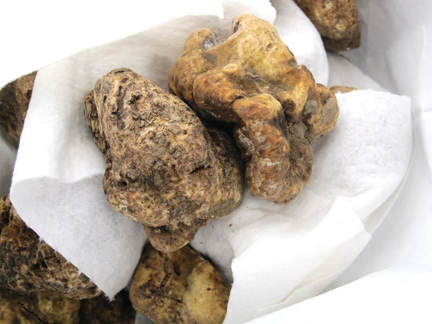
The undisputed queen of truffle porn

Anyone who writes a line like “nobody knows the truffles I’ve seen” should be given a Pulitzer prize for poetry!

Tracie B and I did a spit-take this morning during our Sunday-morning-coffee-and-tandem-blogging-and-Facebooking ritual when the author of Truffle Hunter Italy commented on my blog.

I don’t know who s/he is or what inspired the seemingly Italocentric blog but I love it… nothing like a little truffle porn on a Sunday morning to make the mimetic desire kick in! ahem…

Giacosa and Mauro Mascarello spar over 2006

Above: A recent photo of iconic Langa producer Bruno Giacosa.

Over at VinoWire, Franco and I have posted a preview of Franco’s article on Bruno Giacosa’s controversial decision not to bottle his 2006 Barbaresco and Barolo (to appear in the February issue of Decanter Magazine). But you’ll have to click over to VinoWire to get it. It marks the first time that Giacosa has spoken directly to the English-speaking world on the polemic move. You might be surprised by what some of his peers and interlocutors have to say about the vintage.

In other news… from the “just for gastronomic fun” department…

It’s that time of year again when we spacciatori di vino (wine pushers) hit the streets and start showing our wares again. It’s been good to reconnect with a lot of folks I only see when I’m on the road, like my good friend Josh Cross, who always has something fun on the menu at his awesome restaurant Oloroso in San Antonio. Josh and I both worked in the New York restaurant scene during the better part of the last decade and so we have a lot of friends in common.

He’s open for lunch now and so he treated me to one of his lunch specials, a take on “pigs in a blanket” (above): housemade venison sausage, cased in a runza dough kolache bun, served with a fig mustard and piquillo pepper relish.

I really like his sous chef Ernesto Martinez’s take on the German and Czech historical presence in Central Texas. How’s that for fusion?

Today, I’m on my way from Dallas to Houston, where I’ll be speaking at a wine tasting tonight. In less than a week, my beautiful Tracie B and I will be leaving for San Diego and the final preparations for our wedding. I wish ya’ll could see the grin on my face as I write this from a Starbucks in Ennis, Texas! :-)

1970 Latour and Arkansas cornbread

From the “life could be worse” department…

les forts

On what many (myself included) consider one of the greatest recordings of the last century, the great American lyricist Snoop Dogg sanguinely informs the listener: “I, somehow, some way, Keep comin up with funky ass shit like every single day.”

I felt a little like Snoop yesterday: as an average (and frankly gray) workday traveling and hawking wine (the first of the new year) evolved into intriguing flavors and aromas, I couldn’t help but wonder why it is that there always seems to be something interesting to taste around the corner these days.

Yesterday, my friends D’Lynn Proctor (below) and company at Grailey’s, a wonderful not-to-miss tasting room in Dallas, poured me a glass of Latour 1970 Les Forts.

grailey's

A lot of folks like to “taste me” on their old Italian wines, but I rarely get to taste old French wine and I was thrilled to put my nose in this glass. Does anyone remember Baudelaire’s macadam? That’s what this wine smelled like: tar, pitch, goudron, asphalt… I’m not one for blind tasting but this is one of those wines, we all agreed, that you would pick out as Bordeaux from the nose alone. The wine was bright in the mouth, with nervy acidity that took me surprise and a balanced medley of spice and fruit. (Mazel tov, btw, to D’Lynn on his upcoming wedding AND his invitation to take the Master Sommelier’s exam in August!)

And as if a noble wine French wine from 1970 weren’t enough to call it an extraordinarily sensorially satisfying day, the real treat came over dinner in the home of my friend and colleague Sam and his delightful betterhalf Belinda (originally from Arkansas), whose cornbread — there’s no other way to say it — was sinfully good.

arkansas cornbread

Belinda wouldn’t reveal all of the secrets to her magical Arkansas cornbread but she did explain that she makes it by dropping dollops of the cornbread dough (as it were) into a hot iron skillet (greased with cooking oil). She then turns the small loaves and transfers to hot oven. As the loaves settle, they fill out the skillet in a nearly perfectly shaped pattern (making for ideal serving portions).

arkansas cornbread

She then slices each loaf lengthwise and dresses with butter. Crispy on the outside with an ever-softer and moist center as you bite through to the middle.

The best part? Bellinda wrapped up some leftovers for me to much on as I make my way from Dallas to Houston today.

As long as I don’t get stuck in the mire of the macadam, who can say what delights await? Stay tuned…

Impossible wine pairing? Chicken and dumplings

Above: Did I mention the girl can cook? Tracie B made chicken and dumplings last night for the whole B family. Photo by Rev. B.

In Emilia-Romagna they eat tortellini and cappelletti in brodo (filled pasta in capon broth). In Central Europe they eat knödel served in broth. At the Jewish deli, they serve kreplach in broth. And in the South, they make chicken and dumplings.

Above: Tracie B’s chicken and dumplings. I can only wonder what Dr. V’s user-generated content would have to say about this most impossible impossible wine pairings — chicken and dumplings. But, man, were they good! This and below photos by Tracie B.

By its very nature, broth is an inevitably impossible wine pairing: the temperature alone makes pairing like grabbing the moon with your teeth as the French say.

Heeding the adage by restaurateur giant Danny Meyer, if it grows with it, it goes with it, I should have paired Tracie B’s delectable dumplings with Lambrusco (my top pick would have been a Lambrusco di Sorbara). In Emilia, versatile Lambrusco is served throughout the meal, with the appetizer of affettati (sliced charcuterie), with the first course of tortellini in brodo, with the second course of bollito (boiled meats and sausage), and even with the dessert of Parmgiano Reggiano served in crumbly shards, perhaps topped with a drop of aceto balsamico tradizionale di Modena or di Reggio Emilia (none of that hokey, watery aromatic vinegar). Lambrusco would have been perfect here.

Above: Don’t try this at home. Frankly, the 2004 Barbaresco Pora by Produttori del Barbaresco is going through a nearly undrinkable stage in its evolution.

But as food writer Arthur Schwartz says of pizza, if you can’t be with the one you love, love the one your with.

Before heading to Orange for the Christmas holiday celebration with the B family, I had reached into our cellar and pulled out a bottle of 2004 Barbaresco Pora by Produttori del Barbaresco. Frankly, the wine was too tight, overwhelmingly tannic, and even though it opened up over the course of the evening, it’s going through a nearly undrinkable period in its evolution. But that’s part of my love affair with this winery: experiencing the wine and the different single-vineyard expressions at different points in its life. And there are more bottles of 04 Pora to be had in our cellar. We ended up lingering over wine, sipping it is a meditative wine as we retired to the living room and watched a movie together and munched on oatmeal cookies that Tracie B and Mrs. B had baked that afternoon.

Above: Nephew Tobey wasn’t concerned with wine pairing. But he sure loved him some chicken and dumplings!

Happy Sunday ya’ll and thanks for reading!

Cajun boudin balls and Dolcetto (how’s that for fusion?)

Pam and Melvin Croaker’s fried corn-meal-dusted boudin balls paired superbly with an 2007 Dolcetto d’Alba Monte Aribaldo by Marchesi di Gresy at yesterday’s Christmas day supper. The weather’s been cold and windy here: Dolcetto is such a great wintry grape, with its rich, meaty mouthfeel and nervy acidity pillared by a fulcrum of gentle tannin and meaty flavor. At less than $20 a bottle, the single-vineyard Dolcetto Monte Aribaldo has been my 2009 holiday season standby wine.

Sadly, a bottle of 2004 Rosso di Montepulciano by Sanguineto was corked. It wasn’t corked in the tainted with a corky or wet dog smell, the way “viciously” corked wine can smell (as BrooklynGuy likes to say when he’s disappointed with a much-anticipated bottle like this one). It was just that the fruit had died: as BrooklynGuy might say, it wasn’t “terrible, just dull.”

Boudin balls are made from the filling of boudin sausage — pork, pork liver, rice and Cajun seasoning (spicy). They can be rolled in breadcrumbs or flour but Pam and Melvin used a cornmeal coating (also traditional) for these tasty delights. Soooooo good…

In other news…

Yet another dream came true this Christmas yesterday when Tracie B and I got the 3-quart All-Clad sauté pan we’d been hoping for.

Thanks Mrs. and Rev. B!