“The vintage is safe.” Italian growers breathe a collective sigh of relief after August rains “save” the 2022 harvest.

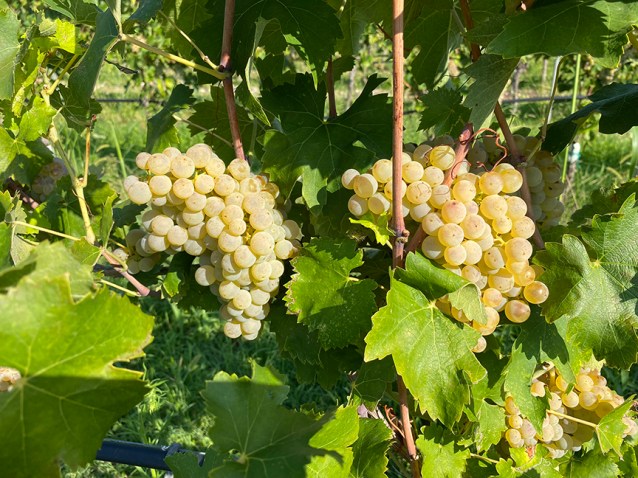
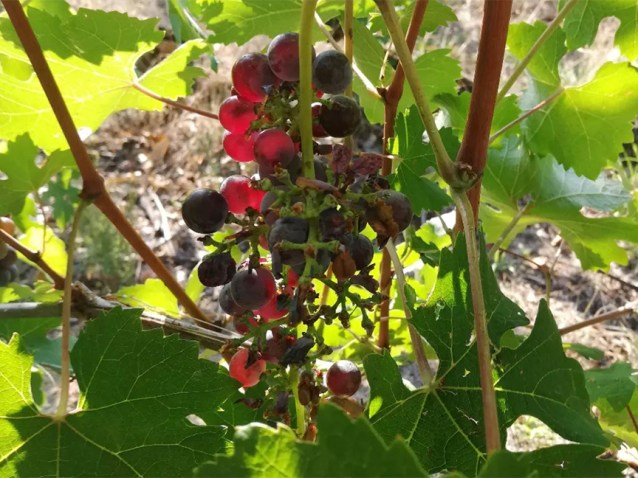
Above: Turbiana grapes photographed last week (September 14) in the Lugana appellation south of Lake Garda. Note the permanently mounted irrigation hose in the bottom of the image. “Emergency irrigation” was allowed across Italy in efforts to counter a drought that began in winter and persisted throughout the summer. Combined with prolonged, extremely high temperatures, it could have represented an existential threat to this year’s crop.

“The harvest is safe. Now we need to address the market situation.”

That’s the title of an e-blast sent out today by the Corriere Vinicolo, the official voice of the Unione Italiana Vini (UIV, the Italian union of grape growers and winemakers).

The missive, including assessments from Italian wine industry leaders, paints a cautiously optimistic picture for this year’s grape crop. Just a month ago, some trade insiders were predicting catastrophe for Italian growers. But early August rains, like a deus ex machina, changed the mood from despair to relief.

“Once again,” said UIV president Lamberto Frescobaldi, borrowing a metaphor from the world of basketball, “the vine has proved to be our team’s center. It has shown that even with high temperatures and drought, we can make high-quality wines in ample quantities.”

“The harvest currently underway is delivering grapes that range from good to excellent in quality,” said Riccardo Cotarella, president of Assoenologi (Italian enologists association).

But as the editors of the Corriere point out, the short-term challenge ahead is market uncertainty.

“Demand [for Italian wines] in foreign markets seems to be holding even though it’s not as strong as 2021” according to Fabio Del Bravo, director of ISMEA (the Institute of Farming and Food Market Services), who is also quoted in the report. “But in the domestic market, there are signs of dropping sales.”

Montalcino subzones, harvest 2022 update: Taste with me Tues. 9/20 in Houston @ Vinology.

Please join me next Tuesday at Vinology in Houston as we open three wines from Montalcino and discuss Montalcino subzones, including the classic and the new, and I share notes from my harvest 2022 trip. Click here to reserve. Thank you for your support.
After I posted a note about how I came to discover Montalcino wines, a lot of people asked me about Bagno Vignoni, a very special Medieval hamlet that lies about 30 minutes south of the hilltop city in Siena province.

That’s a shot of the main square/piazza in Bagno Vignoni — the bath amidst the wines. What piazza, you ask?

Bagno Vignoni is virtually unique among its village peers because instead of a main square, it has a hot springs (thermal) bath in its main public space. It is said that St. Catherine of Siena (1347-1380) frequently bathed there.

In the photo above, you see the bath as it probably looked during the Renaissance (about 200 years after Catherine). It’s no longer open to the public. But there are public baths as well as an upscale hotel where there is a gorgeous private thermal swimming pool and spa. (That’s where my friend the sommelier in the story used to work — his family owned the hotel.)

I’ll be talking a little about Bagno Vignoni at the Montalcino seminar I’m leading next Tuesday at Vinology here in Houston. And we’ll also be looking carefully at three Montalcino subzones. And lastly, I’ll be sharing harvest notes from my trip through central and northern Italy (just got back last night).

And dulcis in fundo, Tracie will definitely be joining us that night and we will all hang out at the bar afterwards and probably order a few pizzas. It’s going to be a great night.

It’s not a cheap date at $50 per person. But the pricing reflects the caliber of the wines. I hope you can join us. Thank you for your support!

Italian growers cautiously optimistic about 2022 vintage.

Posting on the fly this early Monday morning in Brescia where I’m staying. Two more days and many more meetings and tastings before I head back to Texas on Wednesday.
But I wanted to get a quick post up with an update about the 2022 vintage.

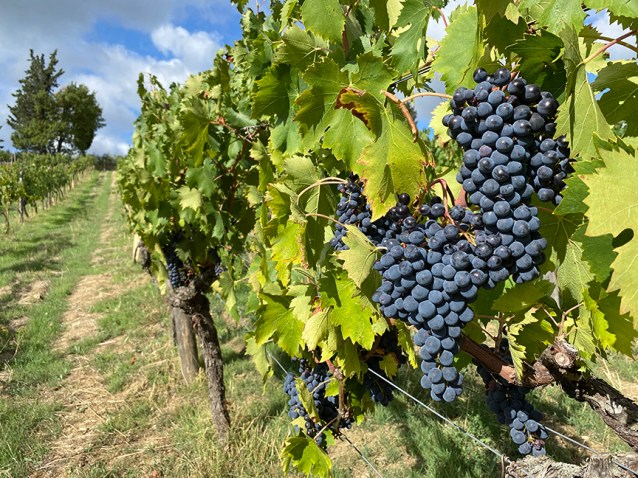
Those are Sangiovese clusters, above, in Panzano in Chianti.

Light rain there late last week was just what the growers need as the red grape begins.

As one winemaker pointed out to me, the biggest challenge they were facing wasn’t just the fact that the summer had been so hot and dry.

There was very little rainfall in the early part of the growing cycle, she pointed out. As a result, the summer heatwave and drought could have been catastrophic.

Luckily, the August rainfall seems to be just what the doctor called for. And despite some scattered hail and some reports of mildew, growers are optimistic that this will be a good and even great vintage in certain spots.

I’ll be writing a more detailed report when I get back to my desk. But let’s just all keep praying for mild weather in the days to come.

In other news…

Anyone who’s ever been a working wine trip like this knows what a slog it can be. I’ve been going non-stop.
But on Sunday I took time out to have lunch with Giovanni and a friend from my Italian university years in downtown Brescia.

Man, it was amazing to see the piazzas and restaurants full of happy people kissed by sunny skies! I couldn’t help but remember the time when we were reading about Brescia every day on the cover of the New York Times. We all talked about how blessed we are to be here today after what happened here and across the world in 2020.

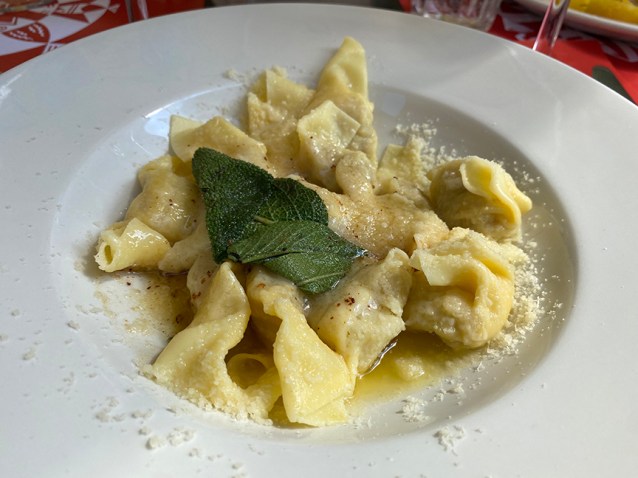
Those are the casoncelli I had for lunch at Trattoria Gasparo in the city’s historical center.

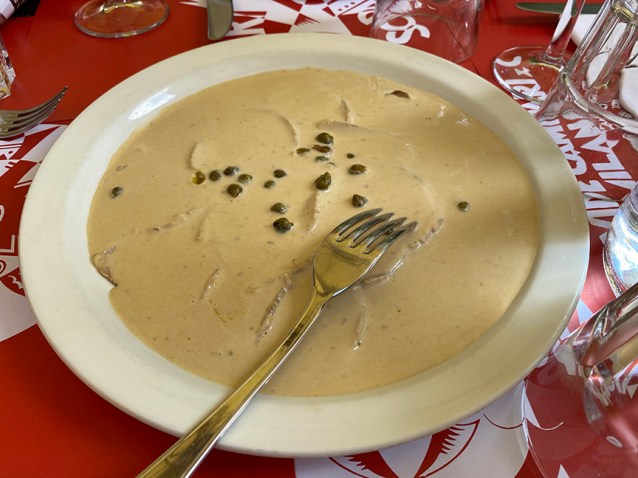
And, of course, who could resist a plate of vitello tonnato? Not me!

In Lombardy, they add a ton of sauce to the dish as you can see below. It’s like the Italian equivalent of a “wet burrito.” It was super delicious paired with Giovanni’s Franciacorta.

Wish me luck, wish me speed. Thanks for being here.

Taste Montalcino with me Sept. 20 in Houston @ Vinology.

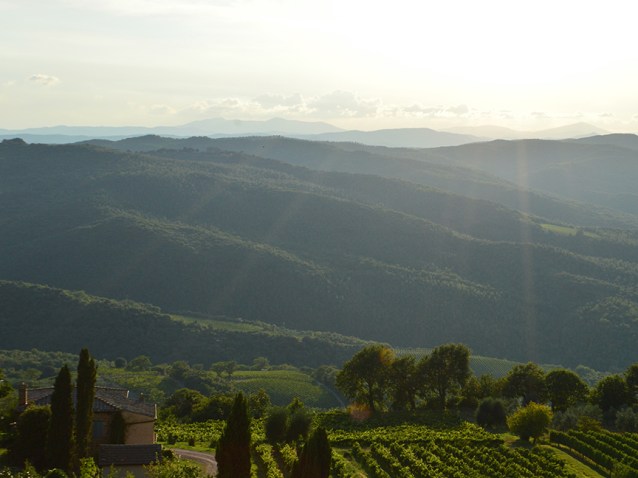
Above: a photo of mine from Montalcino, taken seven years ago (nearly to the day). Wine lovers and not, italophiles will tell you that the Orcia River Valley is — how to say this? — irresistibly delicious to the eyes.

Montalcino is where my turn as a wine lover began more than three decades ago. Well, actually, not Montalcino but Bagno Vignoni — the bath amidst the vines — just to the south of Montalcino on the Cassia, the ancient road that leads to Rome. That’s where it all started to come into focus for me.

A Hollywood friend (a composer of note and my Italian student) had lent me the keys to his apartment in Bagno Vignoni where to this day, a Renaissance-era thermal bath still sits in the center of the 14th-century village square.

Not long after arriving in this achingly beautiful Tuscan hamlet, the weary traveler was befriended by the town sommelier. And the latter proceeded to open many, many bottles for his newfound American friend.

At the time, Americans had hardly heard of Sassicaia or Ornellaia — two of the sommelier’s favorites. And only a handful of my compatriots knew the wines of Biondi Santi and Costanti (his top two Brunello) and Casanova dei Neri (he had served his mandatory time in the Italian military together with Giacomo). It was like he was predicting my future.

On Tuesday, September 20, I’ll be opening a flight of Montalcino wines for a small group of wine lovers and friends at Vinology.

You can imagine how geeked I am to get back to the “floor,” as we call it in the trade.

The $50 cost per person reflects the quality of the wines we’ll be tasting. And I can’t imagine we won’t be hanging out at the bar following the event as we catch up and visit over something groovy. Who knows? Tracie P might even make an appearance.

Please join me as we revisit Montalcino together. Click here to reserve. Thank you for the support.

(And for those of you who used to take part in our tastings at the unmentionable restaurant with the asshole chef, won’t it be grand to be reunited again? I hope you can join us.)

The “Swimmer”: Milan’s heroic efforts to save a wild boar trapped in the city’s canal system.

Above: a bas relief at the Basilica of Sant’Ambrogio in Milan.
It’s hard to say why a wine scribbler like me would be so obsessed with the tale of a wild boar that was trapped in Milan’s canal system for two weeks despite a heroic attempt to save her. My guess is that the story is an allegory for humankind’s alienation from the natural world. But that’s just me.

It all began earlier this week with a blog post about wild boars — feral hogs — destroying a small farm’s grape harvest in northern Italy. The story reflected a growing problem for humans and hogs in Italy: driven by lack of natural resources, the animals are increasingly turning to commercial farms and even urban centers in their search for food. In Rome, broods of wild boar are commonly seen navigating the streets as they forage through uncollected garbage.

After a university-years friend in Milan saw my post, she shared an anecdotal account of the boar’s tragic arc. But she missed an important detail. Mindless authorities didn’t try to kill the animal, as she told it. In fact, driven by compassion, the city’s civil servants did everything humanly possible to save it.

What started out in my mind as a Kafkaesque yarn about a wild beast cheated of life and liberty by heartless bureaucratic machinery had become a narrative plucked out of a neorealist documentary film all’antonioniana — an achingly poignant tale of humans unable, despite Herculean effort, to spare and revive the emaciated sow.

Here is an excerpted translation from a story in the Milanese edition of Italy’s national daily La Repubblica, dated August 18, shared with me by friend Andrea Gaviglio, a native of the Ambrosian city who owns and runs a legacy wine shop there, Vino Vino dal 1921. The hog was first sighted on August 4.

    Local police, public safety officers, and Metropolitana Milanese city engineers were all involved efforts to save the boar. They had dubbed the animal “the swimmer” because of its “excellent swimming ability,” which made its capture difficult following the first sighting according to firefighters. For nearly 15 days it seemed to have “disappeared” in a canal in Milan connected to the Darsena di Milano.

(The Darsena is a humanmade urban lake that serves as a hub for the city’s vast canal system. The word darsena means dock.)

    Agents from [Milan’s] fire department, together with agents from the city’s departments of fish and wild life and emergency management, had tried nearly everything in their efforts to “capture” the animal. A few days ago, they set two traps and video cameras at the canal entrance and exit (just before the Alexander Langer bridge near Piazza Tripoli. But the ungulate had seemed to have disappeared without a trace and its whereabouts were unknown for days. But then it would reappear as it ate the bait without ever being ensnared in the traps. That was when agents tried using the “trail of breadcrumbs” technique.

When they did finally “capture” the Swimmer, they were unable to resuscitate her.

In my view, the boar is a victim of humans’ wanton exploitation of the natural world. She probably fell into the canal, authorities believe, while drinking or looking for food around one of the city’s humanmade lakes. Her bitter fate proved too challenging for the humans: they were helpless in their struggle to free her from the very urbanity they themselves created.

As a famous Roman poet once wrote, naturam expellas furca, tamen usque recurret. You can chase nature away with your pitchfork, but it always returns [and reveals you for who you are].

Elaine Brown will be a featured speaker at this year’s Boulder Burgundy Festival.

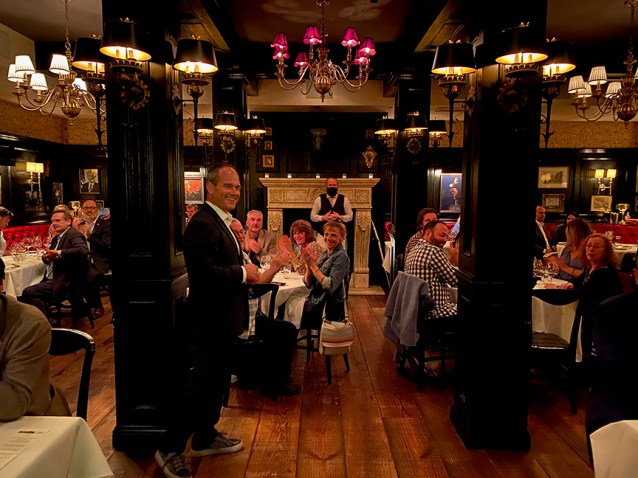
Above: Brett Zimmerman, founder of the Boulder Burgundy Festival, presents the Friday night dinner at last year’s gathering.
It gives me great pleasure to share the news that our good friend Elaine Brown will be a featured speaker at this year’s Boulder Burgundy Festival (Nov. 11-13).

She will be joined by Esther Mobley, San Francisco Chronicle wine columnist, and Carlin Karr, wine director for Frasca Food and Wine, for the long weekend’s first seminar, “Sustainability in Burgundy.”

And she will also be moderating the Sunday morning seminar, “Burgundy’s Rising Stars: Chassagne Montrachet & Volnay.”

But the coolest thing will be getting to rub shoulders and raising a glass with her throughout the three days of tasting and breaking bread — and many snails — with her and a simpaticissimo group of Burgundy collectors and lovers.

If you’re reading a wine blog right now, Elaine needs no introduction.

She’s someone who reshaped the way we think about wine blogging as she pushed the envelope of digital enography over the course of more than a decade.

First through her groundbreaking work as an illustrator and then her reimagining of the blogosphere as a medium for personal, thought-provoking and socially conscious narrative, her voice has become a model for a new generation of wine-focused creators.

Over the years, she’s always been keen to remember back to an early blogger trip to Friuli where her own new voice found its cadence. One such occasion was Jancis Robinson’s announcement that Elaine had joined her corral of top wine writers in 2015. In that post, they share a deeply moving early essay by Elaine that many veteran enonauts will remember fondly. I highly recommend it.

Check out the festival site for more info and registration. Hope to see you there! Happy Labor Day Weekend.

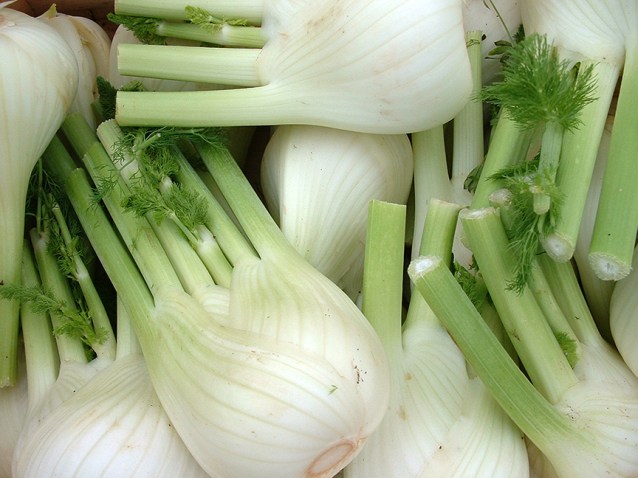
Let’s not use a homophobic slur when we talk about wine. On finocchi and infinocchiare, a philological clarification.

“The closer the look one takes at a word, the greater the distance from which it looks back.” – Karl Kraus.

Image via Nick Saltmarsh’s Flickr (Creative Commons).

A conversation at last night’s Italian Trade Commission dinner in Houston led to a discussion about the Italian word infinocchiare (to cheat or to swindle someone) and its relation to wine and wine tasting.

First of all, let’s get one thing straight: wine sellers did not doctor their wine with fennel (finocchio in Italian) or fennel seeds in the Middle Ages or Renaissance.

What they did do (and we have ample knowledge of this from primary sources) was to serve certain foods like fennel before customers would taste wines they were considering buying. They did this, it is now well known, to impair the buyers’ ability to perceive the aromas and flavors of the wine. (Fennel seeds were widely used in the preparation of salumi in the Middle Ages but that was an unrelated practice.)

And while the first known mention of fennel used to deceive wine buyers dates back to the 15th century (Corniolo Della Cornia’s La divina villa), the foods that were primarily used for this purpose were walnuts and cheese (Crescenzi mentions this in the early 14th century and Corniolo also mentions this a hundred or so years later; English speakers will find all of this info in Massimo Montanari’s excellent book Let the Meatballs Rest, And Other Stories About Food and Culture).

But today, philologists are relatively certain the word infinocchiare does not come from this practice (although Montanari seems not to be up on the current philological dialectic with regard to the lemma).

Instead, they believe (and I concur), it most likely came from the Greek word φένᾱξ (phénāx) meaning liar or cheater.

The word finocchio (commonly used in the plural, finocchi, to avoid equivocation), comes from the Latin foeniculum (the perennial herb was a popular vegetable in Roman times).

So to say that infinocchiare comes from a medieval practice of doctoring wine with fennel is entirely erroneous.

Neither of these terms is to be confused with the Italian homophobic slur finocchio.

The etymology of this ugly epithet is unknown. The one thing we know about it was that it originated in Florence, probably in the early 20th century. The most plausible etymology, embraced by many philologists today, is that it came from the name of a mask used in 19th-century Florentine theater. There’s no hard evidence of this. But it is believed to be the most likely etymon among experts in the history of the Italian language.

What’s important here is that three terms — finocchio (vegetable), finocchio (homophobic slur), and infinocchiare — are probably not related and should be considered separately in terms of their cultural significance.

Making flippant jokes about their homonymity only propagates an ugly cultural trope that gay people are in some way “deceiving” those around them.

Next on deck: the difference between lasagna and lasagne and cultural swindlers like so-called “chef” the Kevin Bryant at Roma restaurant in Houston. Yes, I have a bone to pick there as well, pun intended… stay tuned.

Italy’s wild boar problem: 10 metric tons of wine grapes lost to hungry feral hogs in Colli Euganei.

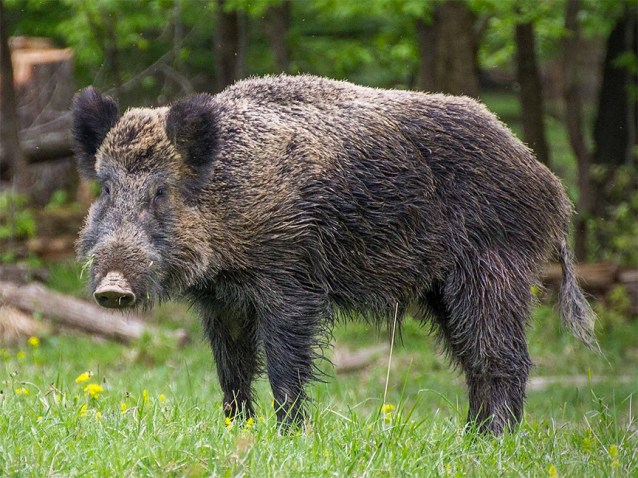
Image via Wikipedia Creative Commons.

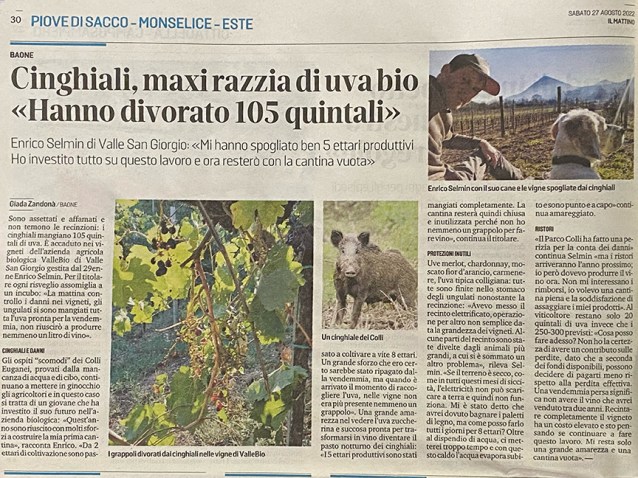
“Wild boars pull off mega heist in organic vineyards in the Colli Euganei,” read a headline in the Mattino di Padova, Padua’s daily newspaper, over the weekend. Feral hogs “devour 10.5 metric tons of grapes.”

Feral hogs — a term used in U.S. English to denote the cinghiali or wild boar that we love so much in our pappardelle al ragù di cinghiale — have increasingly become a nuisance and even safety hazard in Italy as hot temperatures, dwindling water resources, and scarcity of their natural foods have increasingly led them to venture into the human sphere.

Earlier this year, the Smithsonian magazine published an article entitled — no joke — “Wild Boars Are Ransacking Rome.”

Check out this video posted on Twitter by Wanted in Rome.

You’ll see a brood of the beasts strolling down a heavily trafficked street in Italy’s capital.

Beyond the neighborhoods of the Eternal City, where the biggest concern is that they will spread disease or physically harm residents, the animals have come to represent an existential threat for small wine growers.

Enrico Selmin had used electric fences to protect his five hectares of organically farmed grapes — his first commercially viable crop.
“My five productive hectares were completely eaten,” he told the Mattino. My winery [opened just this year] will remain closed and unused because I don’t even have one cluster to make wine.”

For large-scale growers, the animals, which have little fear of humans, represent a growing problem in terms of crop loss. But for someone like Enrico, it means starting all over from scratch. He also lost his investment in the electric fence.

Last year, Italy’s national daily La Repubblica reported that the Chianti Colli Fiorentini appellation lost 30 percent of its crop to feral hogs.

Tuscany’s regional government has allocated €4 million to build “double fences” to keep the beasts out of vineyards, and farm and ranch land.

Efforts to curb the damages have been underway since 2015 when it became clear that the problem needed to be addressed, says Chianti Colli Fiorentini president Marco Ferretti in the Repubblica coverage. But programs to hunt and kill the animals were put on hold during the pandemic. As a result, the boar population continued to grow during 2020 and 2021.

Italian wine growers are already contending with one of the hottest and driest vintages on record. The last thing they need is to contend with ungulates eating their already diminished crop.

*****

Roadkill is certainly no solution to this ongoing and increasingly challenging ecological problem.

But nearly anyone who’s ever dined in the home of Tuscan in wine country will tell you that roadkill boar is thoroughly delicious. My favorite has always been gooey fried boar liver paired with a nice glass of young Sangiovese and a side of chestnut flour polenta and white beans.

What happens to grapes when they don’t get enough water? With harvest already underway, Italy continues to hold its breath…

“The Sreja 2022 died before it was even born,” wrote Cascina Fornace grower and winemaker Enrico Cauda on his Instagram this week. He was referring to one of his top red wines, Sreja, made from 100 percent Nebbiolo grapes, grown and raised in Roero.

“It died in the bellies of of the parched people of the woods. What the f*&%. #sreja #cacscinafornace #roero #everythinglost” (translation mine).

Like many Italian winemakers, Enrico and his crew have been dealing with extremely high temperatures and prolonged drought. In some places across the peninsula, the drought persisted for more than three and a half months before moderate rainfall gave them some relief — and hope.

And now that the red grape harvest is around the corner, Enrico, like his peers and counterparts at all levels of the wine trade, is facing the challenges of extreme hydric stress.

As Riccardo Cotarella, the president of the Italian association of enologists (Assoenologi), wrote in a widely circulated statement earlier this month:

    everything will depend on what happens in coming days because the vines will need a significant amount of water in the ground. They need it not just to keep their vegetation alive. They also need to feed the many berries in the clusters that they have produced. If enough rain falls over the next few days, we should be able to save the harvest. If not, we are going to have problems… If the rain doesn’t come, we will see a phenomenon where the plant will need to take back the little water it has given to the berries. This is the worst-case scenario. Let’s hope it doesn’t happen.

In the case of Enrico’s Sreja, the precipitation was too little, too late.

From grape growers to bottlers, from large importers to small distributors across Europe and the U.S., the trade is holding its breath and praying for the best as the red grape harvest approaches.

According to Cotarella, there will be “appellations that suffer to a greater extent while others will suffer to a lesser extent. It depends on the type of soil and the vineyards’ exposure. This means we can’t generalize about the entire country in our analysis without recognizing these distinct differences.”

For many white wine growers, it seems that last week’s rain was enough to carry them through to a successful if not abundant 2022 harvest.

The following are a few snapshots from around the country (from growers I follow on social media).

I’ll be heading to Italy soon and will post updates as I travel across central and northern Italy. In the meantime, I’m keeping up with it all via social media and have also been giving some growers a hand with translations of their “statements” and press releases on the situation there. Stay tuned…
Continue reading

Esther Mobley will be featured speaker at Boulder Burgundy Festival 2022.

For more than a decade, the Boulder Burgundy Festival has quietly grown an extremely loyal following among top Burgundy collectors and wine lovers.

The inspiration for the festival came to founder Brett Zimmerman after he volunteered at Daniel Johnnes’ Paulée festival in New York. The idea was to put together a similar gathering of top wines and wine professionals but with one major difference: a more approachable price of admission.

Over the years, Brett has invited a wide range of wine media personalities to be part of the event: Eric Asimov, Jancis Robinson, Ray Isle, Alice Feiring, Raj Parr… And the roster of producers has been equally impressive. Care to have dinner with the likes of Jean-Charles le Bault, Jean Marc Roulot, or Guillaume d’Angerville? Just to name a few.

Today it’s official: this year’s featured speaker will be Esther Mobley, wine columnist for the San Francisco Chronicle.

She will be appearing on a panel on “sustainability in Burgundy” and she will also be joining for nearly all of the tastings, including the Sunday morning seminar, and dinners, giving guests a chance to hob-nob with one of their favorite critics.

I’ve been a media consultant for the festival since 2014 and I also manage media and original content for the Boulder Wine Merchant, Brett’s amazing shop.

As I always like to say, Italy is my signora but Burgundy is my mistress. Although still not a cheap date, the Boulder Burgundy Festival is a great way for the Burgundy-curious like me to spend time with some of the world’s most extraordinary wines — and the people who love them.

The event’s legendary marquee tasting, the Paulée-Inspired Lunch, is already sold out. But there are still spots available for the seminars and dinners (pricey but worth every penny, especially for the all Grand Cru menu). The Sunday walk-around Grand Tasting is one of the weekend’s best values and its been an invaluable experience for people like me who want to taste through Burgundy (more than 200 wines) without breaking the bank.

Add to the mix all the great people and restaurants in Boulder, the beautiful setting, and the city’s cannabis-friendly laidback vibe… and it’s a recipe for a great weekend. Tracie will be there with me this year as well.

Registration is now open for Boulder Burgundy Festival 2022, November 11-13 in Boulder. I hope to see you there!