Stop telling me I’m a bad person because I live in Texas.

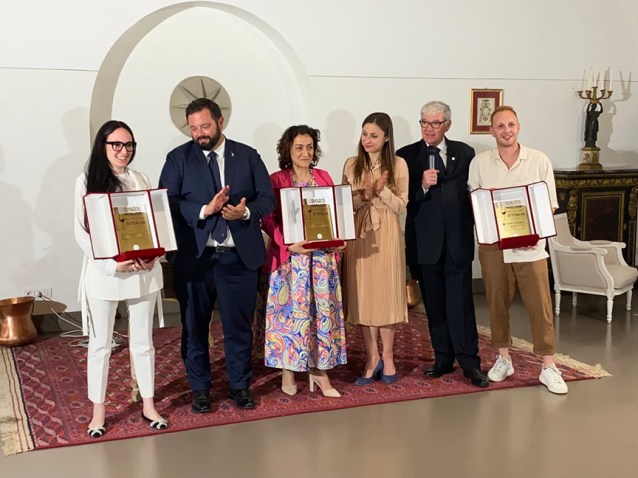
Last week while in Los Angeles for work, I attended the Gambero Rosso Tre Bicchieri tasting. For those who have never been to one of those events, it’s a huge Italian wine industry schmooze fest. For the most part, it’s all about hugs and high fives and catching up with people who work in our trade.

Among so many other colleagues and friends, I ran into a prominent importer of Italian wine whom I’ve known for years. We’ve eaten dinner together, we’ve been on panels together, and we even share friends beyond the world of wine.

For whatever reason that day, when conviviality should have been the byword, he decided to give me an earful about our lives in Texas. No matter what I told about how we live here, he was determined to instruct me on the evil character of our geography. He even went as far as to insinuate that we live our lives in Texas because we enjoy our segregation.

When I pointed out that my native state, California, is the most segregated place I’ve ever lived, he dismissed my claims as MAGA propaganda.

When I told him that my politics and activism land on the hard left of the spectrum, he countered that he was so far left that I wouldn’t even come close to his political rectitude.

When I asked him to consider all the Black and Brown people who live in Texas — by choice, just like us — he wrote me off as a denialist and revisionist.

Ever since I moved to Texas to be with the woman I love and raise a family with her, people from California and New York have continuously and tirelessly given me shit about being a Texan.

Even my own immediate California family derides me for it. One sister-in-law told me she was “scared” for her sister who moved here. Another asked me “how can you live there with all those awful people?”

This country is never going to find its way out of its moralistic morass until we begin to understand — to comprehend truly — that Texans and all southerners are human beings, too. State boundaries do not represent monolithic ethical, moral, and aesthetic divides. There are all kinds of people in Texas, just as there are all kinds of people in California (including plenty of ultraconservative racists, among others, in my home state).

Stop judging me by my geography. Stop telling me I’m a bad or morally failed person because I live here. The false moral superiority of my ex-friend is a mirror and equally insidious reflection of the ultra-right conservatives he pigeon-holes us with.

That’s a photo of my wife Tracie and our two daughters, Georgia and Lila Jane, above. Tracie was born in Texas. Our girls were born in Texas. I am an adoptive Texan. Yes, we are concerned about our family’s reproductive rights. We are concerned about our voting rights (we were gerrymandered this year, no joke). We are concerned about our right to free speech and gun safety.

But we are also living, breathing human beings who hope, dream, and work for a better world. And we share in those aspirations with our community, including Black, Brown, Asian, and White, Jewish, Christian, and Muslim people among many others.

As the saying goes, I know you like to think your shit don’t stink, but lean a little bit closer…

When’s the last time you tasted wines from Uruguay? Taste Uruguayan wines, Calabrian foods, Italian wines and Texas BBQ with me at Taste of Italy Houston 3/6.

Above: producers of Sicilian pistachio cream at last year’s Taste of Italy in Houston.

One of the super cool things about this year’s Taste of Italy trade fair and festival in Houston is that it’s the first time the gathering will include international producers.

I’m super geeked, for example, to taste a flight of Uruguayan wines that will be presented on Monday at the Omni hotel in my adoptive hometown.

I’m also looking forward to the Calabrian gastronomy panel I’ll be moderating with a Calabrian food expert and a Calabrian chef on the morning of the festival.

And of course, who can resist the Italian wines and Texas BBQ seminar that I’ll be leading together with Dale Robertson, wine writer for the Houston Chronicle, and Tom Dobson, the Italian buyer for Spec’s, the behemoth Texan chain of wine retail outlets. Pit master Ara Malekian will be doing the smoking. Every year, he’s one of the most compelling speakers at our gig. And the wines Tom selected are über cool.

Lastly, don’t forget the grand tasting where more than 50 producers, including the Uruguayans, will be presenting their foods and wines.

Click here for all the details and registration links. I hope to see you on Monday in Houston! Thanks for supporting the Italy-America Chamber of Commerce, the organizer, and thanks for loving and drinking Italian wines.

A Sangiovese for the ages by one of Italy’s youngest talents at Montefili.

One of the great pleasures of returning to my old stomping grounds in New York City has been reconnecting with my old boss and friend, Nicola Marzovilla, legacy restaurateur and now Chianti Classico grape grower.

But an even greater delight has been that of meeting and spending time with his extraordinary winemaker, the indomitable Serena Gusmeri.

She’s from Brescia, another connection we share. Before working with Nicola at his Vecchie Terre di Montefili estate in Panzano, she had never made a red wine in her life. But now she’s one of the hottest enologists in Tuscany, with astronomic scores from the opinion-making mastheads.

As Nicola likes to say, “I used to hate the critics but now I love them!” (When Nicola met Tracie for the first time many years ago, he told her that she needed to get glasses, just to put this in context.)

I visited Serena and the historic Montefili estate in September of last year, just a few days before the Sangiovese harvest was to begin there. I was blown away by the farm, the highest in Panzano. The village is Italy’s first organic biome: every farmer in the commune now farms there organically.

The property hadn’t been abandoned when Nicola took it over a decade ago. But let’s just say that it hadn’t been “updated.”

Today, Serena works closely with a leading biodynamic consultant to align her farming practices with the soils’ biodiversity. In other words, they survey the flora and soils’ nitrogen levels etc. to understand how best to grow the grapes.

The results have been spectacular.

Last week when I was in town, my client and I dined at Nicola’s new and impossible-to-get-in Manhattan restaurant, Nonna Dora’s Pasta Bar, where he opened his most coveted expression of Sangiovese for us, the 2018 Vigna Vecchia — 100 percent Sangiovese made from vines that are more than 40 years old, raised in galestro and alberese-rich soils. Remember the post I did a few weeks ago, “Chianti 101: galestro and alberese”? The images came from my September visit to the farm.

This wine, still very young in its evolution, is rich in body and texture, with vibrant acidity that keeps its heft in balance. The flavors tend toward the darker fruits and the savory character that you find in the greatest of Sangiovese.

We paired it with Nicola’s mom Dora’s orecchiette with rabbit ragù.

Believe me when I say it: it was great to be back in the city.

Thank you again, Nicola! And great to see the old I Trulli crew!

The most compelling wine we drank last week in NYC was a Merlot at LaLou in Brooklyn. Can you guess where it was from?

One of the most exciting stops last week during my time in New York with my client Michele Marsiaj, owner of the Amistà winery in Nizza, was at LaLou in Brooklyn, Joe Campanale and Dave Foss’s French-leaning wine bar.

Those are the anchovies we ordered as an appetizer — minus one. One of the fishes is missing because when you sit down to eat with a bunch of Piedmontese and olive oil-cured anchovies show up, it’s like it vying for latkes with your two brothers at Hanukkah. I was lucky to photograph the last four. And they were excellent.

Crusty bread from the über-hip She Wolf bakery in Brooklyn really took that dish over the top.

Those are the wonderfully ethereal “Parsian” gnocchi, which were hard not to inhale. Another over-the-top winner dish that we all thoroughly enjoyed.

But the real show stopper at last Wednesday night’s dinner was a 21-year-old Merlot. Or should I say a Merlot-heavy blend with Cabernet Sauvignon and Cabernet.

When you see a wine that old on a wine list at a hip Brooklyn spot, you know that there was someone who believed in and loved it enough to put it out there (they also had the 2000) despite its age and possible fitness issues.

The price was more than reasonable and so we ordered it. And man, this wine, from Edi Simčič in Slovenia, delivered freshness, slightly ripe red fruit, very light but perceptible tannin, and awesome drinkability and food-friendliness.

We were floored by how good it was.

We spend so much time paying attention to elegant classic whites and macerated whites from Friuli and Slovenia that we often forget that this transnational region for wine production is arguably the home to the best Merlot in this part of the world.

I’ll never forget drinking 1997 Merlot from Radikon with a group of sommeliers back in 2010 during a trip to Gorizia commune. You’d think that the film Sideways had never even been made! It was that good.

The Duet by Simčič isn’t even the estate’s top red wine. It’s part of their “essential line,” in other words, their entry tier. But man, this wine had it all going on. I can’t wait to get back in May to order the 2000.

I highly recommend the restaurant, the wine list, and, of course, the Merlot!

Joe and Dave, great place, great people, great vibes, and great times. We really enjoyed it.

Aldo Sohm’s was everything you could dream of in a wine bar.

Even after all these years, I still hadn’t ever made it to Aldo Sohm’s super wine bar in midtown Manhattan. But that lacuna was rectified when I convened there last night with my client and his crew.

When I say that his joint is everything you could dream of in a wine bar, the reason is plain and simple: as soon as our party of four sat down, I asked our server to pick our first bottle and a round of appetizers and before you knew it, our glasses where full and beautiful food appeared before our hungry eyes.

That may seem like a mundane occurrence. But it’s rare, especially these days when staffing is a major challenge for concept wine destinations, that the servers can deliver food and wine happiness with such confidence and élan.

It were as if Aldo Sohm, arguably the top sommelier in New York and undeniably one of the leading wine professionals in the country, had imparted his grace and knowledge to his team through osmosis (not reverse osmosis, I may add for the the wine-hip crowd).

From the moment we handed our coats to the host (it’s cold in NYC this week!) to the last glass of wine we drank and bite of food we ate, Aldo’s team gently and elegantly guided us through the deliciousness of the list and the menu.

I loved the globally creative dishes and the verve of the mise en place. Grilled avocado and white Burgundy were followed by a beautifully stuffed red pepper (“one of chef Eric and Aldo’s favorites”) and a perfectly executed bánh mì paired with Billecart-Salmon rosé (thank you, Francesca and Michele!).

We couldn’t have enjoyed it more and I highly recommend it, especially to theater goers who will surely agree that’s it’s the perfect pre-show destination. The wine list is the best that you’ll find in this part of town for sure. After all, who needs another martini at Sardi’s?

Thank you Aldo and team! What a perfect way to show off the city to a group of jet-lagged Italians!

The never-ending saga of the Italian traffic ticket.

Above: a shot taken while waiting for stop light in Rome in September 2022.

The last time I got a traffic ticket in Italy, it was because of an utterly honest mistake.

It was my first time returning after the lockdowns in 2020. I was rolling into the town of Bra, Piedmont, where I stay during my teaching gig at Slow Food U.

During the health crisis, they had expanded the pedestrian area to include outdoor dining at the hotel where I stay. In years past, I could drive through there to access the hotel’s courtyard parking.

Because the parking area was no longer accessible (owing to the tables and chairs blocking it), I was forced to make a trip around the block. As a result, I had no other choice but to enter the dreaded ZTL — the zona traffico limitato or limited traffic zone — for which you need a resident’s permit. It was a mistake anyone could have made.

As with previous tickets, I received a “preview” from the rental company.

Being that I would be returning to Bra a few months later for a second round of seminars, I decided to go to the police station and pay the fine directly. I was hoping to avoid the late fees I’ve incurred in the past when I’ve waited for the “official” ticket to be forwarded.

It turns out that it was a bad move. Even after I paid the ticket through the proper channels, I still received a notice via email from an agency called Nivi saying that I still needed to pay, including exorbitant late fees.

After much back and forth, including impeccable documentation of my payment, they finally managed to find my payment. And I was absolved…

I’m glad I played it the way I did but in retrospect, I wish I had just paid the late fees when Nivi came calling. I could have avoided a lot of anxiety in the meantime.

I still can’t figure out what the acronym Nivi stands for. But its website says its a “European Municipality Outsourcing” group — a collection agency.

Now I’ve received a notice from the rental agency that I was clocked doing 118 kilometers per hour in a 110 zone. I was literally less than 5 mph over the speed limit!

I called up a friend in Italy who was happy to pay the fee and help me avoid the late fees. But the codes on the “preview” wouldn’t allow him to do that. He called the “municipality” that issued the citation. They said that I would have to wait until the “official” ticket arrived. But they also said that I might not be forced to pay.

I’m happy to pay my traffic fines. And I consider myself a very safe, cautious, and respectful driver. But I can imagine how daunting this may all seem to someone who just wanted to enjoy their vacation in Italy. Hoping this is helpful.

Here’s why every aspiring food and wine communicator should have a blog. Congrats to my former student on her new site!

One of the things I love the most about my teaching gig at the Slow Food University of Gastronomic Sciences in Piedmont is that many of my ex-students have carved exciting career paths for themselves after graduating from the school.

But nothing could be more rewarding in my teaching experience than discovering that one of my ex-students has launched a blog.

And that’s what happened last week when a student who took my food and wine communications seminars last year sent me her excellent new site, Sophie Eats (check it out… it’s great!).

Over the years, it’s become clear that a lot of the students want to pursue careers as influencers. For them, social media is the medium where they see a path forward. And one of the things we discuss each year is how social media has reshaped the way we think about food and wine communications. Just think of the restaurant-focused #MeToo movement and the key role social media played in driving the narrative and bringing about social change (it’s always one of the most exciting seminar days when we cover the subject).

But social media, I always point out, doesn’t allow the aspiring food and wine influencer, communicator, writer-for-hire to build an independent space for themselves on the internets. That space is important in part, I tell them, because it helps them to create brand recognition (after all, they are their own brand) and to optimize their search engine results.

But even more significantly, an independent blog serves as their resume and calling card. And this, in my experience, is an essential element for those who want to find work as writers and copywriters. Nearly every young writer I know has at the very least a site where they aggregate links for their recent works and host an about page.

We can argue all day about what exactly a blog is. In my view, a blog is an online journal that is updated regularly. In line with this, I believe that social media is a form of microblogging and thus is also a blogging medium. What is Instagram anyway? A media sharing platform that most users update on a regular basis.

But social media gets to keep the clicks and the search engine optimization for itself. By feeding our feeds with our media, we are working for the social media companies. I don’t think there is anything wrong with using social media to build your brand and brand awareness. But I believe those who plan to forge a career in food media need to have their own space where their own stories can have a long-term impact on their career path.

It’s always a disappointment to my students when I talk to them about how there are a dwindling number of mainstream food and wine writing gigs today. But in an age where every food and wine brand needs high-quality content that will engage readers, it couldn’t be a better time for young writers hungry for work.

I just met with a just-turned-thirty writer in New York who currently has apartments in Paris and New York thanks to the amount of writing gigs she has on both sides of the Atlantic. And she even finds time to write the occasional eno-journalism piece. And yes, she has a website that she updates regularly with links to her recent publications (sounds like a blog, doesn’t it?).

Sophie, congrats on the launch of your big, beautiful, loud, colorful, and wonderful blog. I’m looking forward to following along.

Food industry readers, if you’re looking for a writer to hire, I can’t recommend Sophie — and her blog — highly enough.

Calling all Houston food and wine lovers: Taste of Italy (3/6) registration now open. BBQ/Italian Wine seminar tickets going fast.

Above: developed by the Italy-America Chamber of Commerce in Houston, the Taste of Italy trade fair and festival, the largest in the U.S. devoted exclusively to Italian food and wine, now has “chapters” in Dallas and Vancouver.

What do you get when you put a bunch of Italians, a bunch of great Italian foods and wines, and a bunch of hungry and thirsty gastronomes in a room together in Southeast Texas?

Now in its ninth year, Taste of Italy is back in full swing on Monday, March 6 in Houston. I’ve been involved as one of the organizers and the event’s emcee for eight years now. And the work I’ve done together with the Italy-America Chamber of Commerce, the gathering’s host, is something I am the most proud of. The chamber, which is ranked in the top ten worldwide and the number-one chamber office in North America, genuinely connects Italian and American businesses (see the event’s “Success Stories” here).

On Monday, March 6, we are returning to the swank Omni hotel where more than 50 Italian food and wine companies will be showing their products.

Click here to register for the grand tasting.

And click here to register for the BBQ and Italian wine seminar that I will be leading with Spec’s Italian wine buyer Tom Dobson and celebrity pit master Ara Malekian (this event is close to selling out so please be sure to sign up to ensure availability; see the link for the super cool flight of wines that Tom has chosen).

I’ll also be leading a seminar on Calabrian gastronomy. I’ll share that link as soon as it becomes available.

Thank you for loving Italian food and wine and thank you for supporting the work I do with the Italy-America Chamber of Commerce here in Houston. I hope to see you on Monday, March 6 at the Omni!

Some good meals on the road last week…

Man, what a week last week! Four planes in four days!

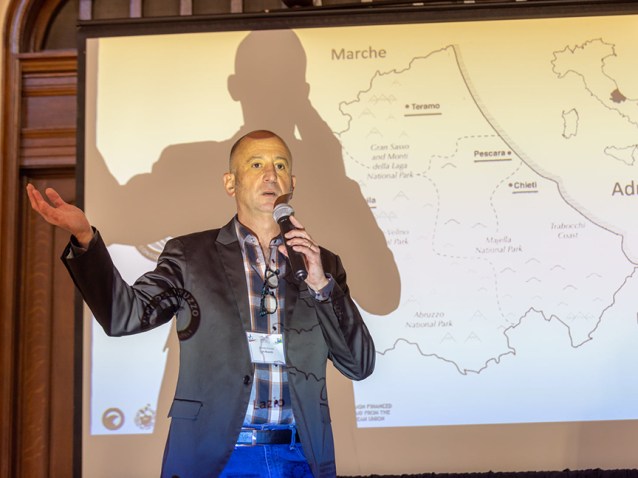
On Tuesday, I flew up to Dallas to have dinner with the president and communications director of the Abruzzo consortium.

Honestly, I wasn’t expecting to love Fachini as much as I did. The whole Eye-Talian concept as presented on their website seemed a little bit misguided at first glance. And the waiters in tuxes, while cute, made it seem like it was going to be more of a show than substance.

But the homemade gardiniera that they served as an aperitivo at the bar was fantastic, as were the ricotta and focaccia.

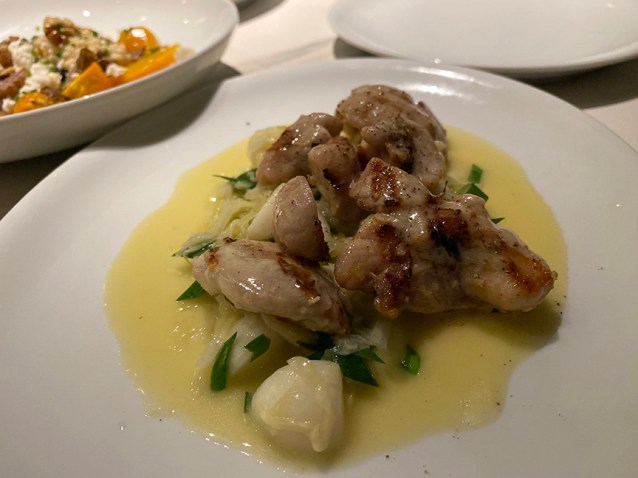
Those are the cappelletti above. I had never seen green cappelletti before and we were a far cry from the traditional way this filled pasta is served (traditionally in capon broth with generous amounts of freshly grated Parmigiano Reggiano). But the pasta was delicious, the stuffing perfectly calibrated, and the tomato sauce was more of a coulis than a true sauce. The latter was light and not overly acid-driven. I loved this dish.

And after all, as Tony used to say (and I agree wholeheartedly), Italian food is not authentic unless it’s creative.

The next day, I led three seminars at Eataly — Moscato d’Asti, Pinot Grigio delle Venezie, and Abruzzo — over the course of four hours with 15-minute breaks between each one. Huge shout-out to the event staff at Eataly for another job well done and heartfelt thanks to my friends at IEEM in Miami/Verona who asked me to come up for a morning of tasting and sharing notes on some great wines. It was exhilarating but exhausting. I made a mad dash the airport and flew home… only to get on a plane Thursday morning and fly to NYC.

Friday found me at the swank and beautiful surf and turf Carne Mare at South Street Seaport in Manhattan where I joyfully dug into the chicken cutlet alla milanese. Again, not traditional but utterly delicious. I really enjoyed and highly recommend this place.

South Street Seaport has been totally renovated and is super fun, with high-end shops and restaurants. It was a beautiful day in New York and the view of the Brooklyn Bridge… as my friend Paul says, it just never gets old.

Also have to give a shout-out to the fine staff at Ulivo on West 28th St. They took such great care of our party and I loved the fried burrata (below). It was as decadent and as delicious as it looks. And man, their kitchen really knows how to slice prosciutto correctly.

All in all it was an amazing week of wines and wonderful italophile folks. I feel so blessed to do what I do for a living. But I couldn’t wait to get home to Tracie and the girls and our chihuahuas.

Thanks to everyone who took such good care of us. The wave of Italian cuisine in this country only gets better and more compelling every year. And it’s so wonderful that New York has opened up again. I can’t wait to get back next week (yep, life on the road keeps on keeping on!). Stay tuned…

Why do we include “suggested serving temperatures” in tech fact sheets? Anachronisms and other questionable practices in superfluity.

With the annual wine trade fairs around the corner, wineries across Italy are gearing up by refreshing their “tech sheets” or “fact sheets” — the scheda tecnica in Italian.

A number of my clients rely on me for the English renderings of this so-called technical data. And the recent rush of requests for new translations and edits has had me scratching my head: why do we insist on including “suggested serving temperatures” as part of the tech sheet canon?

And for that matter, what good will knowing the pH of a certain wine help a sales rep who’s trying to place a wine at a pseudo-Italian restaurant where the buyer is more concerned with pleasing their clientele and making a decent margin for their bottomline?

One of the anachronisms that strikes me as particularly superfluous, especially today, is the entry for “training system.”

Back when Italian wine was still fighting to find a place for itself next to its transalpine counterpart, the note on training system was meant in part to distinguish the old head-trained alberello vines from the more modern cordon- and Guyot-trained vines. It was a sign that the winery in question had made the necessary investment to upgrade its growing practices. As if that would make the difference between a decent wine and a great one. Today, in fact, it’s actually cooler and more progressive in some circles to have head-trained vines!

And don’t get me started on “suggested pairings.” My favorite recent pairing suggestion was evasive. We’re not including suggested pairings, the author wrote, because everyone has their own tastes. It underlined, at least in my mind, the superfluity of recommending foods to eat with a given wine. After all, people who live in New York eat different things than people in Texas. People who live in Asia eat different things that people in Europe. What’s the point of recommending vitello tonnato for a Barolo when the end user might be a vegetarian?

The great 20th-century Italian novelist Carlo Emilio Gadda used to say that pronouns are the lice of thought. My belief is that tech sheets are the lice of our wine times.

When are we going to revisit these antiquated conventions of industry and start writing about wine in a more purposeful and thoughtful way?