Friulian aquaculture, lunch on the island of Ravaiarina

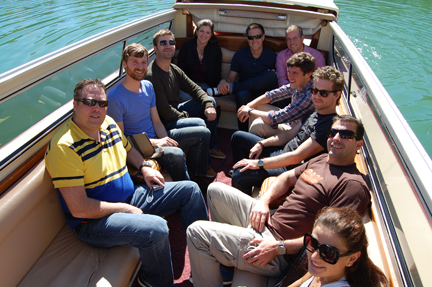
The team, from left, clockwise, each a taste-maker in her or his own right: Matthew Turner (head sommlier Michael Mina, San Francisco), Steve Wildy (beverage director, Vetri, Philadelphia), Brent Karlicek (wine merchant, Postino, Phoenix), Shelley Lindgren (wine director, A16, San Francisco), Bobby Stuckey (wine director, Frasca, Boulder), Jamie Garrett (sommelier, Sonnenalp, Vail), Joe Campanale (beverage director, Dell’Anima, New York), Lachlan Mackinnon-Patterson (chef, Frasca, Boulder), Mario Nocifera (director of operations, Frasca, Boulder), and Lara Persello (our handler, Turismo FVG).
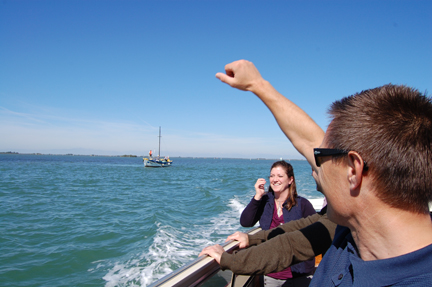
This morning we departed from Grado and headed toward the island of Ravaiarina.
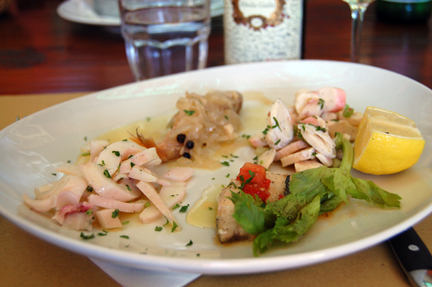
The antipasto.
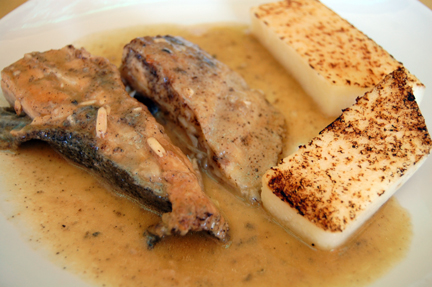
Turbot with its brodetto and white polenta.
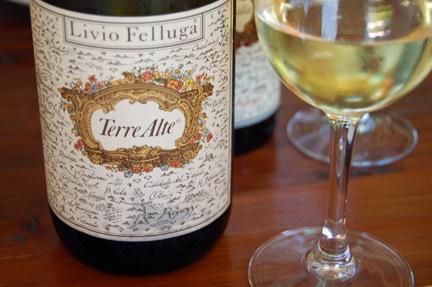
A classic of Friulian viticulture.
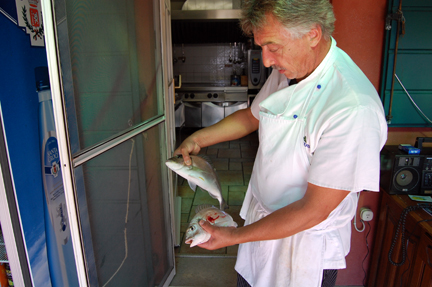
The island has its own fish farm in the form of a humanmade saltwater lagoon and the chef fishes his catch with a fishing pole as needed, like this orata (Mediterranean sea bass). Ingenious…

The fishery is perfectly attuned to the island’s aquaculture and mariculture.

La Ravaiarina
tel. 0431 845 84576

To reach the island and restaurant, you take a taxi boat from Grado.

97 Vie di Romans Pinot Grigio INSANE!

Dinner last night at the famous Ristorante all’Aquila d’Oro in Dolegna del Collio (Gorizia) began with this 1997 Vie di Romans Pinot Grigio Dessimis, which entirely blew me away with its nuance, and complexity. Pinot Grigio is so maligned and misunderstood and as much as Vie di Romans tends toward modernity (not my personal preference), there’s no denying that the winery delivers extreme elegance its bottlings. Fantastic wine…

Many excellent dishes were served last night (the stemware, dishware, silverware, and mise en place exquisite) but the course that impressed me the most was this incredible wild duck risotto. I was intrigued by the size and texture of the grain of rice and when queried, the owner revealed that it’s a Carnaroli hybrid that was developed for his family in Vercelli more than 30 years ago. Lachlan pointed out the fact that the grains do not stick together and the owner told me that no butter is used in this dish: only the stock was used to impart fat, thus bestowing a remarkable delicacy. Stunningly delicious…

Castello di Trussio dell’Aquila d’Oro
34070 Dolegna del Collio (Gorizia)
Località Ruttars 11
tel.: 0481 60545 (or 0481 61255)

Getting my spritz on in Friuli

Bobby, Lachlan, and I got our Aperol spritz on during the ora dell’aperitivo (the aperitif hour) in downtown Cividale del Friuli yesterday.

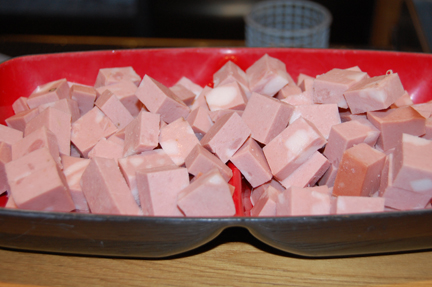
In keeping with my credo no wine without food, no food without wine, I just had to have a few mortadella cubes, even though I knew that much food lay in my immediate future…

Ornella Venica’s favorite wine

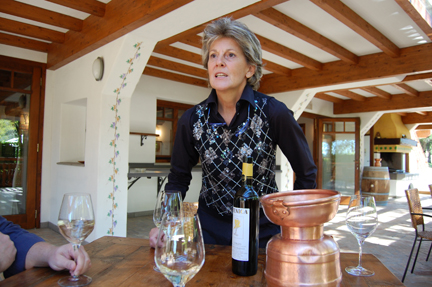
The inimitable Ornella Venica greeted me in the late morning with a glass of Pinot Bianco by her family’s historic winery, Venica & Venica. “Maybe not the most popular or important,” she explained, “but my personal favorite.”

For the next 5 days and nights, I’m going to be staying at the Venica & Venica estate in Dolegna del Collio (Gorizia, Friuli) with leading U.S. food and wine professionals Bobby Stuckey and Lachlan Mackinnon-Patterson (owners of Frasca in Boulder, CO), who asked me to join them and a group of wine buyers on a tour of Friuli (sponsored by the Regione Friuli Venezia Giulia).

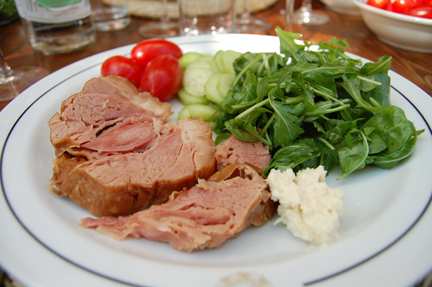
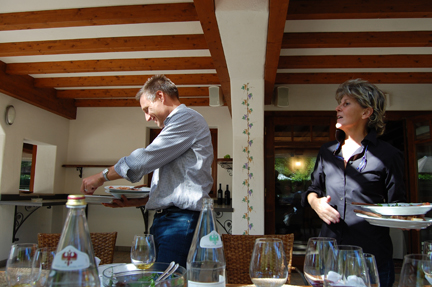
The main course at lunch was a delicious pork shank prepared by Ornella herself (note the kren in the foreground).

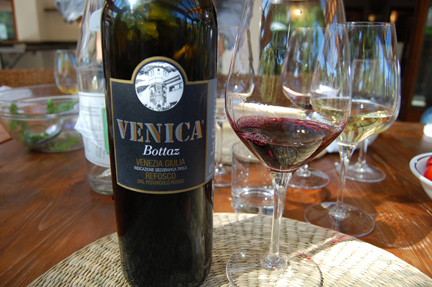
I’d never tasted the Venica Refosco. The 2008 (recently bottled) was killer… chewy and juicy.

I cannot conceal that I am very psyched to hang with Bobby (who helped Ornella clear the dishes after lunch) and Lachlan, two of the nicest dudes in the biz and undisputed Friulian insiders!

Stay tuned…

Coffee culture in Friuli

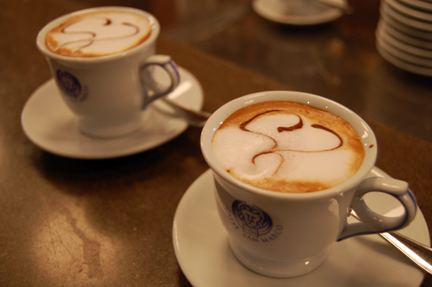
In Friuli, the default coffee service is caffé macchiato, i.e., an espresso with a spot of steamed milk, like this coffee that I had at the Caffè San Marco in Cividale del Friuli, where I stopped this morning on the way to my final destination.

One of my first major translations was the “Bottega del Caffè” (“The Coffee House”) by 18th-century Italian comediographer Carlo Goldoni, set in Venice with the then nascent European coffee culture as backdrop (New York, Marsilio, 1998).

Are you going to Scarbolo fair? First day in Friuli

Later today I hope to have the time to reveal why and how I’ve come to Friuli.

But before the official working leg of the trip begins, I wanted to take time out to catch up with my friend Wayne, who lives and works in Friuli as the sales and marketing director for the Bastianich winery here.

In a world where ego generally trumps humanity, Wayne is one of the rare and welcomed anomalies: a right guy, as one might have said a half-century ago, who just happens to work in the top tier of the food and wine industry. When he suggested we go meet winemaker Valter Scarbolo for dinner at his legendary restaurant La Frasca in Lauzacco (Udine), I couldn’t have been more thrilled.

Dinner began with Lorenzo d’Osvaldo’s superb prosciutto crudo and ossocollo and Valter’s housemade salame (above).

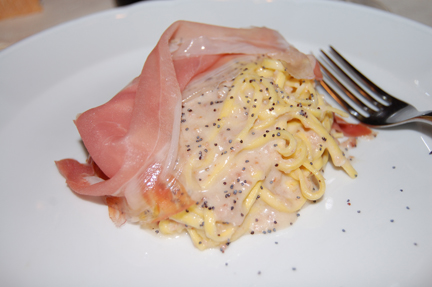
Next, di rigore, came tagliolini San Daniele.

This was followed by a dish that would have been met with wholehearted approval by any semiotician gourmand, Valter’s raviolo aperto, stuffed with montasio cheese and venison, topped with wild berries. (A bottle of sparkling Verduzzo for anyone who can place the exegetic pun I’ve made for this dish!)

As we were joined by Valter’s son Mattia who had arrived from his kick-boxing workout (and was evidently famished), the conversation turned to the current student housing crisis in Italy, soon to be faced by the young matricola.

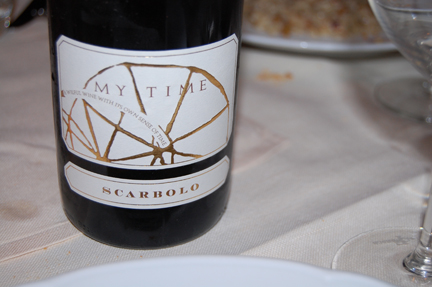
As we lingered over intensely aromatic formàdi frant (formaggio frantumato, literally splintered cheese, a classic farmer’s cheese of Friuli), the wine I kept going back to was Valter’s My Time, so-called because, despite the urgings of his enologist, he waits to bottle and releases this wine only when he feels it’s achieved its full potential. As it warmed up in the glass, this wine (made from Chardonnay, Sauvignon Blanc, and Tocai fermented in cask) was simply gorgeous, with nuanced fruit and noble structure, delightful with the pasta dishes, intriguing and intellectually stimulating with the cheese course.

Last night wasn’t a time for delving into the details of enogastronomic science: it was time for catching up with an old friend and making a new one.

When it comes your time to go to Scarbolo fair, please remember me to the one who lives there…

Stay tuned…

Lunch at Perbellini (Verona): some guys have all the luck

Some colleagues very graciously and generously bought me lunch today at the Perbellini installation at the design fair in Verona. What can I say? Some guys have all the luck… ;-)

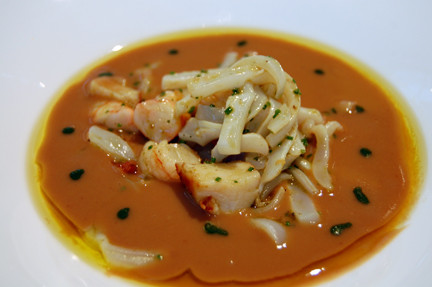
There is bean soup and then there is BEAN SOUP. In this instance, topped with a ragù adriatica

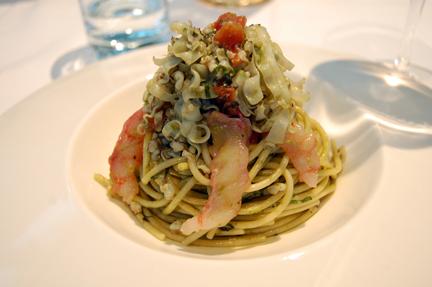
I would have never believed that I’d enjoy spaghetti freddi (cold spaghetti), but when in Perbellini… with cuttlefish, marinated prawns, basil, and lime.

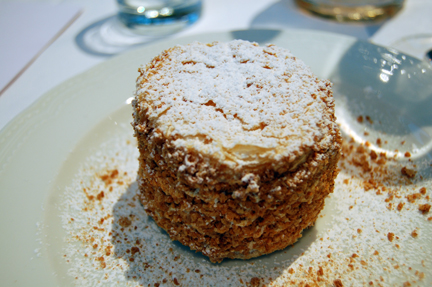
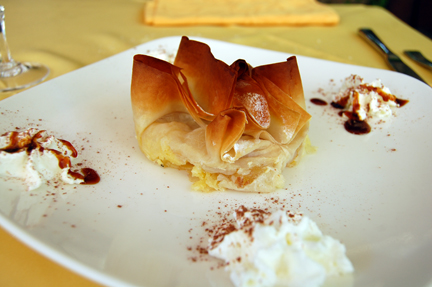
Perbellini’s famous millefoglie.

Duclis in fundo: I also had a peak at the design fair.

How do you say “happy as a clam” in Italian?

In Italian, when someone is as happy as a clam, you say that someone va in brodo di giuggiole, in other words, that she or he swims in jujube soup.

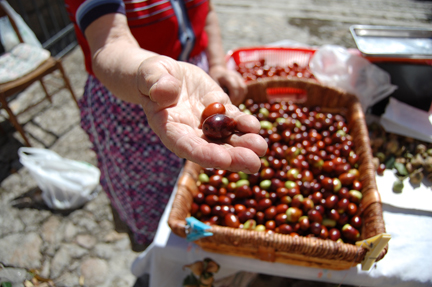
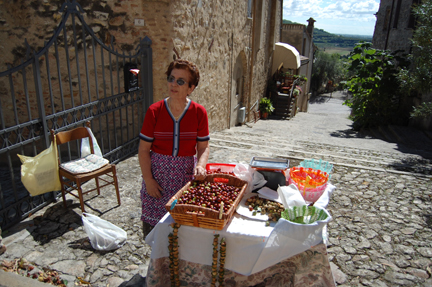
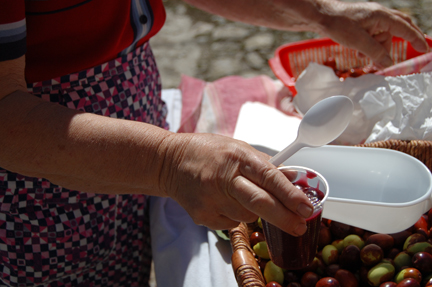
This sweet lady let me try one of her giuggiole in Arquà Petrarca. No Italian spoken here, just the sweet cadence of my beloved Veneto. Just to breath the fresh air of the Euganean Hills where Petrarch spent his last years of life fills my heart with joy.

She also let me try her sugolo, grape must pudding (made by boiling sweet grape must with flour). So yummy.

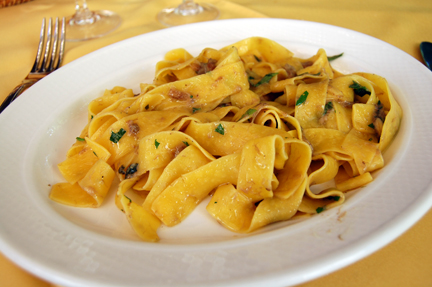
Lunch was served sotto una pergola (under a pergola), homemade pappardelle with fresh porcini (in season).

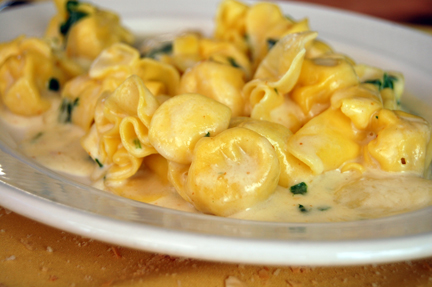
Fagottini stuffed with ricotta and pears.

I couldn’t resist the crostata di mele (apple pie).

Lunch with a wide selection of locally cured charcuterie, a pasta course, dessert, and wine (a Collli Euganei Pinot Bianco at a wonderful 12.5% alcohol!) was Euro 22 per person.

Have you ever taken a swim in jujube soup?

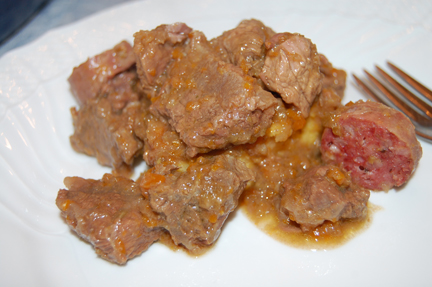
Zidarich Vitovska and horse meat dinner

Tonight I’ll be in Friuli (more on that later) but the weekend between the two working legs of this trip was spent in Padua, as a guest in the lovely home of my wonderful friends Sita and Steve, whom I’ve known since I was a junior at the Università di Padova (remember them [click and scroll down]?).

Sita knows how much I love and miss the horse meat of my beloved Veneto (more on that later) from my days as a grad student in Italy and so she prepared a wonderful dinner of horse meat for us on Friday night.

Steve knows how much I love the tannic white wines of Carso and so he grabbed a bottle of 2007 Zidarich Vitovska from his Eurocave. As it turns out, Sita’s uncle was the architect who designed the Zidarich winery!

The first course was horse meat salamino, ripe olives cured in olive oil, and taralli.

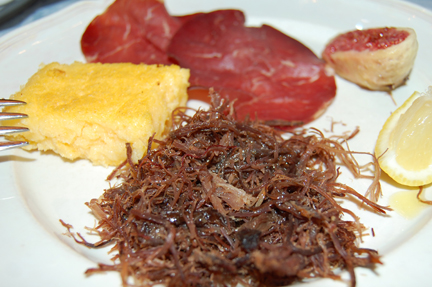
Next came my FAVORITE: sfilacci di cavallo, cured and shredded horse meat, dressed with olive oil and lemon and served with griddle-fried polenta. The horse meat bresaola and raw figs were equally delicious.

As the Vitovska came to room temperature and gently aerated in the glass, its tannic structure began to reveal itself. The floral notes on the nose and the mineral character of this wine blew my mind, so unbelievably good.

Sita really outdid herself with this spezzateino di puledro, pony and horse meat sausage stew, served over polenta (of course).

Horse meat became popular in Italy and France in the 1960s as an affordable source of protein for young families. Today, the Veneto is the only place I know of where it’s common to find horse meat butchers.

By the end of the meal, the Vitovska had opened up gloriously, the white fruit (apple and pear) singing to the rhythm of the wine’s acidity and tannin.

An acoustic guitar was produced and dutifully tuned and a chorus of John Lennon’s “Imagine” and some ubriaco brushed with Prosecco must made for the ideal coda to a meal of happy memories shared with good friends.

Tough times in Piedmont

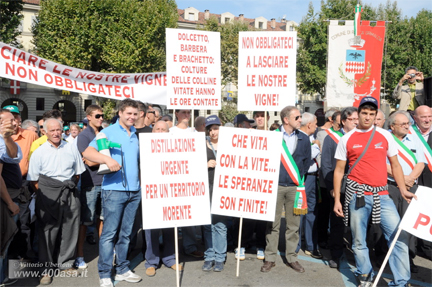
Above: In a protest mounted earlier this month in Asti, besieged Piedmont grape growers and winemakers pleaded for government aid (photo by 400AsaFoto.it).

I managed to carve out some time this morning to post over at VinoWire on recent developments in Piedmont for grape growers and winemakers affected by the global wine crisis.

On his excellent blog Sapori del Piemonte, Filippo Larganà has been providing some solid coverage of what’s happening on the ground there.