Bruno Giacosa 2007 (complete tasting notes, including some 05s and 04s)

barbaresco

Above: On Sunday, Tracie P, Franco, and I tasted seven wines with the great maestro of Barbaresco and Barolo, Bruno Giacosa (above), and his enologist Giorgio Lavagna. Photo by Tracie P.

How can I begin to describe the emotion that ran through our veins when we sat down on a beautiful snow-covered Sunday morning in Langa with Bruno Giacosa in the Bruno Giacosa tasting room in Neive to taste through the winery’s soon-to-be-released 2007s? Even the uninformed semiotician would have appreciated the myriad strata of meaning, many of them overlapping, as Tracie P, Franco, and I drew that first drop of Asili “white label” 2007 to our lips.

barbaresco

Above: Giorgio Lavagna, right, began to work with Bruno Giacosa in 2008 after the previous enologist, Dante Scaglione, stepped down — a move that surprised many observers of Langa wines. That’s Franco, seated to my left.

The legendary Giacosa winery has been the subject of much controversy over the last two years. In 2008, long-time enologist and Giacosa protégé Dante Scaglione was replaced by Giorgio Lavagna, who had served as enologist at Batasiolo (whose wines are made in a modern style, as opposed to Giacosa’s historically and rigorously traditional style). In 2009, Giacosa shocked the wine world when his British agent announced (in a matter-of-fact press release) that he would not be bottling his 2006 vintage because of the inferior quality of the harvest. I know of no other Langa winemaker who opted for such a drastic declassification and we spoke to many winemakers during our stay about the virtues of the 2006 vintage. (Franco and I have both written, at length, about Giacosa’s decision and how it has affected perceptions of the vintage as produced by other winemakers.)

barbaresco

Above: The 2007 Asili “red label” reserve (“riserva”) by Giacosa is one of the greatest expressions of Nebbiolo I have ever tasted.

But however fraught with anticipation, our encounter revealed that the truth was in the wines, in vino veritas, and what wines they were! In the words of Bruno Giacosa, the 2007 is destined to be one of the great vintages of our times.

The fact of the matter is that Bruno Giacosa does not release mediocre wines and the 2007s are no exception to the rule. Lavagna explained that the extremely mild winter of early 2007 anticipated the vegetative cycle and that, while harvest may have come early, the otherwise classic nature of the vintage gave the wines the tannic structure, profound acidity, and balanced fruit that make for the greatest expressions of Nebbiolo.

Here are my notes and observations from this truly unforgettable tasting.

barbaresco

Above from left, Barbaresco Asili “white label” 2007, Barbaresco Santo Stefano “white label” 2007, Barbaresco Asili “red label” 2007, and Barolo Rocche 2007 “white label.”

Bruno Giacosa 2007 Barbaresco Asili (white label)

The nose was already very evolved, offering surprisingly bright and seductive fruit. The tannin is very powerful but not aggressive and it sits in glorious balance with the fruit and resplendent acidity. The thing that impressed us all about this wine was how purely enjoyable it was — so early in its development — with notes of berry fruit accented by gentle, delicate spice.

“You can smell Asili” in this wine, said Bruno.

Bruno Giacosa 2007 Barbaresco Santo Stefano (white label)

Very powerful and aggressively tannic, mineral notes dominate the fruit in this wine at this early point in its evolution. It’s an “arrogant” expression of Nebbiolo.

“It’s more Barolo than Barbaresco,” said Bruno.

It’s got the tannic structure that Italians like to call “nervoso” or “nervy.” Often when I taste Giacosa’s wines, equine metaphors come to mind: this wine is a powerful young stallion, nervous in the corral, waiting to show its stuff.

Bruno Giacosa 2007 Barbaresco Asili (red label)

The only difference between the white and red (reserve) labels is the additional cask aging. Here the nose was still very closed and the tannin very rich. The fruit was darker in character but I would attribute that to the youth of this powerful wine, which will take longer to reveal the gorgeous fruit that we found in the white label Asili.

What an emotional and inspirational moment to taste this superb wine with Bruno! As we swirled, smelled, tasted, swished, and spit, Tracie P asked Bruno if he preferred Asili or Santo Stefano. “Asili,” he said without hestitation, “is my favorite. They can say what they want, but the best Barbaresco comes from Asili.

One important note: the rows that Giacosa has used historically to make his Rabajà have been reclassified as Asili and so, for the first time, with this vintage, the Giacosa previously bottled as Rabajà went into the Asili. Bruno noted that none of his wines will be labeled using the “menzione aggiuntiva” (“added mention”) Rabajà anymore.

Bruno Giacosa 2007 Barolo Rocche del Falletto (white label)

Of all the wines that we tasted that day, this was the only one that hasn’t spent any time in bottle (it was a barrel sample). The tannin is majestic and muscular at this early stage of its development. The fruit has not yet begun to emerge and its earthy, savory flavors dominated the palate. In Langa, it’s not uncommon to open wine and revisit it later in the day and the next day as well. My only disappointment at the tasting was not being able to spend some more time with this wine.

Bruno Giacosa 2005 Barbaresco Asili
(white label, no red label produced)

Anyone who’s ever tasted Giacosa’s wines knows that it’s difficult not to use superlatives when describing them. Where other bottlings of 2005 Barbaresco have impressed me with how ready they are to drink, this wine was aggressively tannic, a wonderful example of how Asili is a king among crus. By the end of our visit, it had begun to open up slowly to reveal rich red fruit. But aggressive as the tannin was, it still had that distinctive Giacosa signature: never harsh, always elegant, and however powerful at first, the tannin expanded evenly on the back of the tongue, seducing you softly with its muscle while never letting you forget that it was in command of your palate.

Bruno Giacosa 2005 Barolo Rocche del Falletto
(white label, no red label produced)

We all agreed that this regal expression of the Serralunga township (from one of its top growing sites) is destined to go down in history as game-changing bottling of Barolo. Giacosa did not make a “red label” reserve from this storied vineyard in 2005 and Giorgio said it he was “nearly” regretful that they hadn’t. Whether the decision was based on market conditions or on quality of the vintage, this wine will represent a great value for the superior quality in the bottle — whatever the color of the label, Bruno and Giorgio both agreed.

Bruno Giacosa 2004 Barolo Rocche del Falletto (white red label [barrel sample])

Nearly everyone agrees that 2004 was a superlative vintage in Barbaresco and Barolo and this Barolo Rocche del Falletto is a great example of what many consider a “classic vintage” in Langa. It is already very evolved but with many, many glorious years ahead of it. Tracie P and I certainly can’t afford to buy wines in the price point but, man, if I had the dough, this is one of the wines where I’d place my bet. (This wine is already in the market and the red label, they told us, will be released shortly.)

barolo

Bruno Giacosa 2004 Barolo Falletto (white label)

Following the tasting, Giorgio accompanied us to lunch at Enoclub in downtown Alba, where we opened a bottle of the 04 Barolo Falletto. The wine is also still very young in its evolution, richly tannic, but with wonderfully bright acidity. It was so great to enjoy this wine with food (tajarin with sausage ragù in my case). Especially in America, we tend to fetishize Giacosa’s wines to the point that we forget to serve them the way they were intended: with food.

Here are some observations and quotes I culled from our visit (some of them might surprise you).

barbaresco

Above: One of the most moving moments came for me when Giorgio excused himself to return to the winery to draw off a barrel sample. He asked us to continue with the tasting and so I employed my skill as sommelier. What an incredible feeling it was to pour Bruno Giacosa a glass of his wine!

Giacosa was born in 1929 and started making wine when he was 14 years old with the 1944 vintage.

Giacosa uses large-format French Allier casks and he changes them every 8-10 years.

When I asked him what he thought of winemaking in Langa today, he said that “The wines aren’t as good as they used to be.” Today, he told us, growers are using too many chemicals in the vineyard. In his day, only copper and sulfur (“and that’s all!”) were used. He also pointed out that the region has been over-planted and that it lacks the diversity of grape varieties because people have planted Nebbiolo where only Dolcetto and Barbera were planted formerly and even in sites not suited for grape-growing. When I asked Bruno what he thought of the Barolo and Barbaresco growers association, he replied: “The consortium is a waste of time.”

When enologist Giorgio Lavagna asked us what we thought of “biologic [i.e., “organic”] wine,” Bruno chimed in: “Biologic wine is a sham. There is no such thing.”

When I asked Lavagna if Giacosa used cultured yeasts, he said that indeed they do — regularly. Cultured yeasts, he said, were commonly (and have been historically) used at Giacosa to initiate fermentation. But the yeasts, strains developed especially for Langa, do not “dominate the natural yeast.”

When I asked Bruno when he thought these wines would be ready to drink, he said 8-10 years and in 4 years for some of them. As Giorgio pointed, it’s a matter of “cultural taste.” Where Americans and Brits tend to like these wines more when they have aged 20 and even 30 years, Italians prefer to consume them in “middle age,” as it were.

Worth checking out: Ken Vastola maintains an excellent “bibliography” of Giacosa’s wines here.

Post scriptum. Bruno suffered a stroke in 2006 and he still hasn’t fully recovered. He was perfectly lucent and conversant during our tasting but it was also clear that he’s in a lot of pain. I wish that everyone could have seen the smile on his face, when he held Tracie P’s hand and told her, “sei una bellissima sposa,” “you are a very beautiful bride.”

Bruno Giacosa and Bartolo Mascarello meet for the first time

Every once in a while you come across one of those amazing pieces of writing that makes you stop in your tracks, put down your coffee during breakfast, and focus all of your thought and imagination on the words on the page (or, as the case may be, screen) before you. A text where the experiential and the aesthetic sensibility combine to transfigure the words’s meaning and sound, revealing unexpected and welcomed clues to the mystery of life that surrounds us.

That’s what happened to me this morning during our daily breakfast ritual chez Tracie B, as I scanned The New York Times online and my Google reader feed.

I think the same thing happened to Franco, when the same text appeared in his inbox earlier today.

The below translation has been culled from an e-letter authored by Francarlo Negro, restaurateur, Nebbiolo and Langa afficionado, and owner of the Cantina del Rondò in Neive (Cuneo, Piedmont). Franco re-posted it earlier today on his excellent blog Vino al Vino.

It’s entitled, “The Smell of Money Guides the Evolution of Taste,” and in the first part, Francarlo recalls a meeting organized by his father between Bartolo Mascarello and Bruno Giacosa (their first!) in late July, 1967 (not long after I was born!).

After I read it to Tracie B this morning over coffee, she said, “You have to translate that!” By the time the words left her delicate lips, I had already begun… Buona lettura!

1967: Bruno Giacosa meets Bartolo Mascarello

At the end of July, 1967, with the hills inundated by a delicate, sultry fog, my father, who was a friend of Bartolo Mascarello from Barolo, organized a visit with Bruno Giacosa from Neive. I was 17 years old and I was excited: I didn’t want to miss a word of the conversation that I was about to witness.

Back then, there was no demand from the international market. It was difficult to sell fine wine, which, at the time, was only opened on special occasions. Adulteration was rampant: large wineries like Marchesi di Barolo inundated the market unchecked and dishonest farmers cut our wines with concentrated must that arrived from the South. Manduria in Apulia was the principal source of the supply.

Everyone knew of the case of a Fiat worker, originally from Neive, who would obtain this hodge-podge from a large local cellar and would proceed to fill his casks every spring and sell his “authentic wine” to his fellow factory workers.

Together with a few others, Giacosa and Mascarello waived the flag of authenticity high. With confidence, they identified the words authentic and local character with the purity and identity of the two great wines of Langa, the fruit of Piedmontese enological culture.

The cool air of Bartolo’s cellar greeted us when we arrived: we had traveled over 12 kilometers of asphalt at 35° [Celsius, 95° F.] in our Fiat 600 with the windows rolled down. The tall casks [botti] bulged around the waist, made from Slavonian oak. Some held 50 brinte (2,500 liters), others 100 brinte. In all, there was just over 15,000 liters of Barolo, from different vintages and different vineyards, all from hills in the township of Barolo.

Bartolo climbed up the ladder leaning against the casks, he drew off a little bit of wine, and handed us the glasses. And so the ritual of tasting began.

Despite Bartolo Mascarello’s repeated pleas that Bruno address him using [the familiar] tu, Bruno Giacosa addressed Bartolo using Voi, a sign of ancient respect for the authority of his interlocutor. The air was filled with great respect, between the men and for the wine. In silence, we delicately sipped the wine, as we aerated the small tastes in our mouths.

I remember that the 1964 Barolo leapt from the glass, the elegant, regal wine already releasing its full magnificence. The nose revealed subtle notes of violet and white spring flowers. In the mouth, you perceived the tart sensation of the small buds of the vine during blossoming. You could not taste any wood, as wood was not meant to be apparent. The cask — the botte — was intended to play one role alone: it was meant to accompany the Nebbiolo, sharp and brusque at birth, on its slow journey as it aged and became austere and elegant.

That’s all I had time for today, but, wow, what power in these 450 words! How much information — so many clues to the history and story of Barolo — in this dense text! I’ll translate more in the days that follow. But, wow, just ponder this passage for a few days. Stay tuned…

Suckling and Soldera on the Tuscan wine scandals

case basse

Above: One of the great maestri of Brunello Gianfranco Soldera and I tasted his wines together in September 2008 at his winery Case Basse in Montalcino (before Tracie B convinced me to go back to my au naturel hair style!). Photo by Ben Shapiro.

In an hour-long documentary on the Orcia River Valley, recently aired on the national-television Sunday show Linea Verde (it’s worth watching the show, even if you don’t understand Italian, if only for the cinematic beauty of the Val d’Orcia), the presenter asked Brunello maestro Gianfranco Soldera to share his impressions of the recent controversy in Montalcino regarding producers who allegedly added disallowed grape varieties to their Brunello (which, by law, must be made with 100% Sangiovese grapes).

“Luckily,” Soldera said, “the [Italian] treasury, the magistrate, and the anti-adulteration department did a great job in their investigation and they found some big problems. Millions of liters of wine were declassified in order to protect consumers and those producers who have always used only Sangiovese, as required by law, because this is what needed to be done.” Even though the quantity of wine declassified was significant, he noted, “only a handful of wineries” were implicated in the investigation. (The segment on Soldera appears at the end of the show and it is the only occasion that I know where the general public has been allowed to view Soldera’s “secret garden.” Definitely worth viewing.)

wine spectator

Above: The clairvoyant Swami shared his wine predictions for 2010, including a real whopper for Tuscany.

A week or so earlier, one of America’s premier wine writers, a world-renowned expert on Italian wine, and a resident and champion of Tuscany and its wines, the inimitable James Suckling published his predictions for the year in wine 2010 on his blog, including, this ominous premonition for Tuscany: “Tuscany will be embroiled in another wine witch hunt with the magistrate of Siena along the lines of a similar debacle in Montalcino over the past two years.”

This morning, I couldn’t help but share Franco’s indignation at Suckling’s admittedly “less than earth-shattering” prediction, expressed in a post entitled, American Wine Writers: Luckily they’re not all like James Suckling.

However ugly the recent controversy in Tuscany, it “needed to be done,” as Soldera pointed out. Everyone I’ve spoken to there (except for those implicated in the investigation) seems to share Soldera’s opinion.

Of all the things to predict for Tuscany in 2010 (eclipsing the rest of Italy, btw), how about something like this?

1) The Val d’Orcia DOC will emerge as one of the coolest new expressions of Sangiovese.

2) Tastings of the 2007 harvest will reveal that Tuscany was blessed with one of the better vintages in recent memory.

3) The high-cost of barrique and the emerging trend against oak-laden, concentrated wines will lead more and more producers to make traditional-style wines using large-cask aging and less manipulation in the cellar.

4) Thanks to more flexibility in labeling, the recently implemented EU Common Market Organisation reforms will allow Tuscan producers to regionally “brand” their international-style wines without encroaching on the Brunello and Chianti de facto trademarks.

5) Tracie B and Jeremy P will win the lottery and finally be able to move into the Ripa d’Orcia castle as their “vacation home.” (There are some beautiful shots of the castle in the Linea Verde show, btw.)

Thanks for reading. Tracie B and I will soon be heading to Montalcino on our honeymoon, where we’ll have our “nose in a glass” and our “ears to the ground.” Stay tuned…

BrooklynGuy’s best value Champagne

Above: This and the images below were all captured in September 2008, when Franco and I visited the truly marvelous and amazing Ca’ del Bosco in Franciacorta. That’s Anna Caprini, director of media relations, who gave us an excellent tour of the winery.

In the case you don’t know or read BrooklynGuy’s blog, you don’t know what you’re missing! His blog is everything a great wine blog should be: open, honest, with no hidden agenda other than sharing his impressions and knowledge and entertaining us with his wry and dry (pun intended) humor.

BrooklynGuy has one of the purest palates in the blogosphere and even though he doesn’t work in the wine industry, he is often asked to take part in tasting panels — by both major magazines and high-profile trade personalities who want to get his impressions.

Above: Ca’ del Bosco produces a wide range of superb champagne-method wines. And while technology prevails there (after all, Champagne and champagne-method wines are, perhaps more than any other, the fruit of technology), works of art also punctuate the winery tour experience, like this rhino suspended, seemingly precariously, from the facility’s ceiling.

But the greatest thing about his blog, for those of us who have been following it for a while now, is BrooklynGuy’s (and I mean this in the most complimentary way) “Rain Man” approach to tasting and wine writing. He’s never lost that sense of innocence that sets his blog apart from the pack (otherwise dominated by folks who think they’re doing the world a favor by sharing their informed and informative palates).

BrooklynGuy loves him some bubbles (as evidenced by his nearly weekly series Friday Night Bubbles).

Above: The remuage or riddling process was the leap in technology that made Champagne and champagne-method wines like those produced in Franciacorta possible. The bottles are stored in these racks and then “riddled”: every day they are turned, gently, by hand, so that the lees of the wine will settle in the neck.

I asked him to cull his blog for some great-value Champagnes and otherwise bubbly wines and he graciously obliged.

As the Latins used to say, ubi maior, minor cessat

*****

I am not someone who sees Champagne as a seasonal beverage. I drink it the way I drink any other wine — as often as I can. That said, there are many people who will buy champagne in the coming week who do not ordinarily do so, and the variety and prices can get a bit overwhelming. Here are some of my favorite sparkling wines at a few different price points (NYC prices, anyway). These are wines that I are available now, that I would confidently purchase for myself or to share with others at a celebration. There are loads of other great choices too, and these are all rather small production wines, so if you don’t find these, ask your friendly knowledgeable wine clerk, or leave Dr. J [editor’s note: that would be me] a comment and he’ll try to get back to you.

—BrooklynGuy

Under $20

Domaine de Montbourgeau Cremant du Jura NV
$20, Neal Rosenthal Imports.

A delicious Blanc de Blancs made from Jura Chardonnay. Refreshing and balanced, very earthy.

Under $30

Huet Vouvray Petillant Brut 2002
$28, Robert Chadderdon Selections.

The finest of the sparkling wines from Vouvray, from one of the finest producers in Vouvray. This is incredibly high quality wine, and at this price it’s a steal.

Above: A detail of the lees (the dead yeast cells) that will be disgorged before the wine is bottled and released.

Under $40

Pierre Brigandat Champagne Brut Reserve NV
$32, Bonhomie Wine Imports.

A lively and expressive Blanc de Noirs that offers ripe and clean fruit, but also a definite sense of soil and mineral.

Chartogne-Taillet Cuvée Sainte-Anne Brut NV
$38, Terry Theise Selections, Michael Skurnik Imports.

This to me is a classic Champagne — floral and biscuit aromas, great acidity and tension, a chalky finish, just delicious. A blend of equal parts Chardonnay and Pinot Noir.

Pierre Gimmonet Champagne Selection Belles Années Blanc de Blancs Brut NV
$35, Terry Theise Selections, Michael Skurnik Imports.

A new cuvée from Gimmonet made of a blend of two vintages of the Cuvée Gastronome, the wine bottled at lower pressure so as to be more harmonious with food. A lithe and tasty wine.

Thanks, again, BrooklynGuy! You ROCK! And happy new year, everyone!

Some best bubbles and life beyond Prosecco…

Above: I took this photo earlier this year atop Cartizze, the most prestigious growing site for Prosecco, where the cost of land per acre is higher than in Napa Valley. In 1998, Tom Stevenson wrote that Prosecco is “probably the most overrated sparkling wine grape in the world” (The Encyclopedia of Champagne & Sparkling Wine, reprint 2003).

Xenophobe and racist Italian agriculture minister Luca Zaia has infamously and nationalistically asked Italians to drink only Italian sparkling wine for their New Year’s celebration this year. His campanilistic call comes in part as the result of a backlash from last year’s nationalized television controversy when the announcers of RAI Uno opened Champagne during a televised New Year’s eve event.

Of course, Zaia is also infamous for the favoritism he’s shown for his beloved Prosecco this year. He even created the Prosecco DOCG, placing the humble Prosecco grape in the pantheon of the top classification, before Common Market Organisation reforms took effect this year.

Above: Italy produces such a wonderful variety of sparkling wines, from the humble yet beloved Prosecco to the often regal, zero-dosage Franciacorta. Franco and I tasted an amazing array of sparkling wines last year together at Ca’ del Bosco.

Don’t get me wrong: I LOVE Prosecco. And I love the place where it produced and the people who produce it. Just ask Alfonso: he remembers well how I guided us to Valdobbiadene from Trento earlier this year, without ever looking at a map, my Trevisan cadence getting stronger and stronger as my beloved Piave river and its tributaries came into earshot. You see, many years ago, I made my living traveling along the Piave river, from Padua to Belluno, playing American music for pub crawlers.

Above: One of the best champagne-method wines I’ve tasted in recent memory was this Franciacorta rosé by Camossi. Structure, toasty notes and fresh fruit flavors, bright acidity and fine bubbles, an excellent pairing for all the lake fish, smoked, pickled, and roasted, that Franco, Giovanni, Ben, and I ate one fateful night in Erbusco.

But there are so many wonderful sparkling Italian wines beyond Prosecco (Sommariva and Coste Piane are my two favorite expressions of Prosecco available right now in this country). Franciacorta is the first obvious destination but there are so many other producers of fine sparkling white wines made from indigenous and international grape varieties: champagne-method Erbaluce from Carema in Piedmont (Orsolani), Charmat-method Favorita from Mango in Piedmont (Tintero), champagne-method Pinot Noir from Emilia (Lini), Charmat-method Moscato known as Moscadello di Montalcino from Tuscany (Il Poggione), a rosé blend of Nebbiolo and Pinot Noir from Langa in Piedmont (Deltetto)… Those are the first that come to mind but there are many, many others. Sparkling wines are produced in nearly every region of Italy, from the sparkling Chardonnay and Pinot Noir of Trentino and South Tyrol to sparkling Ribolla of Friuli and the sparkling Verdicchio of the Marches. Once, I even tasted a sparkling Nerello Mascalese from Sicily that had been vinified as a white wine (but I can’t recall the producer… please let me know if you know one).

Above: Hand-riddled magnums of Chardonnay for Ca’ del Bosco’s Franciacorta.

Why do we feel obliged to drink something sparkling on New Year’s eve, anyway? I’m sure the answer lies somewhere between the royal court of Britain, the Czars, Napoleon’s vinous invasion of Russia, and some enterprising Germans who set up shop in Champagne in the 19th century.

Tracie B and I still haven’t decided what we’re going to open on New Year’s but I’m sure it’ll be something good.

On deck for tomorrow…

Best Champagne and other French sparkling values by guest blogger BrooklynGuy.

And in the meantime, please check out Tom’s post today on “classy sparkling wines.”

Zaia watch: Italy’s agriculture minister’s tenure much ado about nothing?

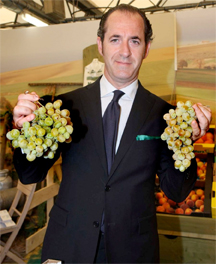
It’s already been a big week for Italy’s agriculture minister Luca Zaia, left (note the signature black tie and the green pocket square, both very powerful and provocative symbols for a public minister who’s role is to protect the best interests of the entire country).
His recent and controversial call to arms, exhorting Italians to drink only Italian sparkling wine on New Year’s eve, has been the subject of a tide of chatter in the Italian blogosphere. I agree with Franco when he writes that the self-proclaimed prince of Prosecco is a servant to self-serving provincialism and his “despotic” exhortation reeks of the same self-serving italianità that prevailed in another era in his country when the trains ran on time.

Zaia was also the subject of a wonderfully satiric but ultimately poignant post by the Italian Wine Guy, “The Mark of Zaia.” IWG’s insights are invaluable here and his overview tracing the trajectory of Zaia’s meteoric rise is as frightening it is revelatory.

But the biggest news to arrive from Zaialandia this week was the breaking however much anticipated story that he has received the nomination from separatist, secessionist, racist, and xenophobic political party Lega Nord (Northern League) as its candidate for soon-to-be vacant governorship of the region of the Veneto. He even has a shiny new Facebook fan page for his candidacy.

As Franco pointed out in a recent post, the news is good and bad: on one level, many observers, including those of us who sell and promote Italian wine abroad, will be happy to see the Venetophilic pol leave a position he had no business occupying in the first place (I’ve been told that Zaia started his professional career as a nightclub bouncer); on another level, the news is bad since, in the light of the fact that Zaia will probably win the election and become governor of the Veneto, he will be the leader of one of Italy’s richest and most important wine-producing regions (home to some of Italy’s most important exported wines, namely, Prosecco and Amarone).

The news inevitably fills me with sadness. Ultimately, Zaia’s tenure as the steward of Italian agriculture and the Italian wine industry, was the product of political posturing and maneuvering. An ambitious and able politician, Zaia clearly had set his sights on higher political office and when Berlusconi appointed him agriculture minister, it was not because Zaia was the best man for the job but rather as a political payback to the Lega Nord for their support in Berlusconi’s 2008 bid to reattain the prime minister’s office.

Photo courtesy Alexnews.

Sadly — for Italy, Italians, Italian winemakers, and foreign lovers and promoters of Italian wines — Zaia has presided over one of the greatest crises in the history of contemporary Italian winemaking. And it was all much ado about nothing.

His frequently updated blog has never even made note of the recent news that a new adulteration scandal has surfaced in Tuscany.

In Lombardy, there’s a self-effacing, ironical joke that the intellectuals tell about the peoples of northern Italy, based on a folkloric paradox, probably uttered by an old man on the streets of Milan not so many years ago: Rasista mi? Ma se l’è lü che l’è negher! [You’re calling] me a racist? But he’s the one who’s black! (In an essay he published after Berlusconi’s famous gaffe calling Obama “tan” following the 2008 elections, Umberto Eco cites this phrase as an example of northern Italians lack of self-awareness.)

I can’t help but be saddened to think that the Veneto (my beloved Veneto!) will be governed by a racist, xenophobic man who has asked Italians to boycott Chinese restaurants, to avoid eating pineapple, and to open only Italian bubbles on New Year’s eve (Prosecco perhaps?), a man would almost certainly tell the above joke without the self-effacing irony.

But for him to achieve such self-awareness and to grasp its irony would be like the teapot calling the kettle black.

An orange, natural wine from the Veneto (and my very own mimetic desire)

Above: One of my favorite places in the world, a scene from Petrarch’s house in the hilltop town of Arquà in the heart of the Colli Eugenei (the Euganean Hills) in the province of Padua. One of my mentors, Professor Vittore Branca, believed that Petrarch spoke with a northern cadence, even though he was born to Tuscan parents in Arezzo. Petrarch spent most of his life in southern France, Milan, and Arquà. (Photo courtesy Padova Cultura.)

Nearly every Italian who’s ever heard me speak Italian will remark that I speak Italian with a simpatico Veneto accent. Some will place it in Padua, others (when I’ve got a belly full of wine) in Treviso (non è vero, Briciole?). But the many years I spent of study and touring with my Italian-based band in the Veneto profoundly informed and shaped my “Italian” identity.

When I saw that Franco had posted about what must be a truly wonderful orange, natural wine from my beloved Euganean Hills outside Padua, I couldn’t resist the mimetic desire it stirred in me.

Were they not the site of countless Sunday evenings spent with friends eating roast pollastro and patatine fritte, accompanied by side-splitting joke-telling in Veneto dialect and carafes of Malvasia and Cabernet Franc! Were they not the home to some of the most unique, distinct, and distinctive wines produced in the Veneto! Did they not abound with a dolce aura, a sweet air, and immense beauty!

The Euganean Hills would still hold a special place in my heart for it is there that my beloved Petrarch spent the last years of his life, under the protection of the Carraresi family, the lords of medieval Padua, and it is there he finished the final notes of the transcription of his autograph and idiograph version of the Rerum vulgarium fragmenta (Fragments of Vernacular Things), his song book, his 366 poems devoted to the blond-haired and fair Laura (a laical breviary, with a poem for every day of the year and a proemium). Today, that beautiful book — singular also for its humanist script and the unusual binding format — resides in the Vatican Library (Codex Vaticanus 3195). It was the subject of my doctoral thesis: I have examined it myself, I have held it in my hands and run my fingers across its vellum leaves and scrutinized their pores, and I have felt its aura.

O to see those hills again! Someday, I’ll take Tracie B to visit them and and breath in their dolce aura, to see Petrarch’s house, and to taste the wines.

And I will tell my sweet Tracie B (my Laura and my dolce aura, with her fair skin as white as ivory, her eyes as blue as the fresh, clear water that flows in the streams of trans-Alpine lands)… I will tell her the same thing the vecchiette, the little old ladies, in Monselice at the foot of the Colli Euganei say as you begin your ascent to Arquà: non dimenticare di salutare la gatta del Petrarcadon’t forget to say hello to Petrarch’s cat

Above: The famous “gatta del Petrarca,” Petrarch’s female feline, who, as Modenese poet Alessandro Tassoni wrote in the 17th-century epic poem, The Rape of the Bucket, still bars the tops from crossing the dotta soglia, the erudite threshold. (Photo by Arquà Petrarca.)

Someday Tracie B will see it, too. In the meantime we can only dream of natural skin-contact Garganega and roast poissons.

Click here to read my translation of Franco’s post.

Buona domenica a tutti!

Chiantigate? News of a new controversy breaks in Italy

When the first dispatch arrived in my inbox this morning with my nearly daily dose of WineNews.it, I just didn’t want to believe it was true. But then, after lunch, when Franco’s post appeared in my feed, I knew there was no ignoring it: Italian authorities believe that roughly 10 million liters of current-release Chianti and Toscana IGT and purportedly smaller amounts of Brunello and Rosso di Montalcino have been “cut” with inferior wines not in accordance with appellation regulations. News of the authorities’s investigation and their subsequent request for a preemptive seizure of wine was widely reported today in the Italian news media. Seventeen persons and forty-two wineries, including some of the big players (according to the reports), are under investigation.

What can I say? It literally makes me feel sick: I love Italy, I love Italian wine, I have more good friends in Italy than I can count, and the majority of Italian winemakers I know personally (and I know a lot) are honest, earnest, hard-working folks. And I will continue to buy, drink, enjoy, love, and write about Italian wines. But the news of yet another controversy makes me feel sick. Franco has stated openly that he no longer wants to write about the Brunello controversy or any other Italian wine controversy for that matter. But as a chronicler of the world Italian wine, he felt obliged today to repost the story for the sake of “the completeness of information.” And, so, as his colleague, friend, and partner, I, too, feel obliged to report it here.

When I was a child my family went through a crisis that was reported by the media. And whenever there was a story in the papers, my mother taught me to be the one to tell my friends — so that they would hear it from me and not from a stranger. It was one of the best lessons she ever taught me.

Well, here I am again, and my “family” is in trouble. And I want you to hear it from me. So be it. Surely, it is the saddest form of wine writing.

Ne nuntium necare.

Amphora-aged Primitivo, pozoles and old Rioja, and a Texas wine I liked

Above: This week, Tracie B and I attended our first holiday party of the year at the home of Texas “natural treasure,” author, radio personality, blogger and all-around delightful host, Mary Gordon Spence.

Man, has it been a crazy week — between work, Tignanello triage, the new Amarone DOCG, and the holidays upon us!

Above: Everyone who knows me knows that I rarely eat sweets. But homemade flan? Mary Gordon found my weakness!

Tracie B and I are headed to La Jolla for the weekend, a good thing since snow is expected today in Central Texas!

I’m working on my “interesting wines coming out of Tuscany these days” post and I received a lot of great recommendations from a bunch of Italian wine professionals and bloggers. Thank you, all. I’ll post them next week.

Above: George O brought this bottle of what I’m guessing is a dried-grape red wine from the Texas Hill Country made by Tony Coturri at the La Cruz de Comal winery. It was a great pairing for the flan.

If you haven’t seen it already, please check out this wonderful post authored by Franco (and translated by yours truly) on the amphora wines made by Vittorio Pichierri in Sava (Manduria, Apulia). Amphora wine is all the rage these days. Gravner started making wine in amphora in the late 1990s? Pichierri has been aging his wines in interred amphora since the 1970s and beyond (he uses an ancient format called capasone).

Above: We were joined by the inimitable Bill Head, whose tall Texas tales alone are worth the price of admission (seated next to Tracie B), his lovely SO Patricia, and George O. Jackson (right), photographer and author of a photo collection I am dying to see, Essence of Mexico 1990-2002, images of folklore he captured traveling through rural Mexico.

Dinner at Mary Gordon’s was just the excuse I’d been waiting for to open some older López de Heredia that a client gave me. The 1990 Tondonia white was stunning, as was the 1991 Bosconia. We opened both bottles as we sat in Mary Gordon’s living room and munched on jícama and chips and salsa: I couldn’t help but think about how great these oxidative wines are with food. The 2000 Bosconia Reserva was great with Mary Gordon’s excellent pozoles.

The conversation turned from tales of larger-than-life Charlie Wilson from Bill’s years in Washington to Mary Gordon’s memories of working for President Lyndon B. Johnson, to George O’s adventures in rural Mexico. I spent the whole evening on the edge of my seat. Maybe it’s because I live here now but it always impresses me how Texas often finds itself at the center of the American collective consciousness and American iconography.

Thanks again, Mary Gordon, for such a wonderful evening! And happy holidays to all ya’ll!

Reaction to news of the new Amarone DOCG

jeremy parzen

Above: One of these things is not like the other things. One of these things just doesn’t belong here. Photo by Tracie B.

In the wake of the post by Franco and me yesterday at VinoWire reporting the Italian government’s approval of the new Amarone della Valpolicella and Recioto della Valpolicella DOCGs, the enoblogosphere is reeling with tweets, retweets, pings, and posts.

First and foremost, Italian Wine Guy reacted quickly with an update of his Best Italian DOCG List post.

I also saw a lot of responses to a group message I did from the VinoWire Facebook group: it seems there are a lot of people out there, studying for their Master Sommelier exams, who find this info extremely useful.

There were also a number of retweets from top sommeliers like Jonathan Honefenger of Tony’s in Houston and Master Sommelier Jesse Becker of Wine to Match.

Those of you who follow the Italian enoblogosphere may have noted an absence of reaction. It’s my sense that the move to create the DOCGs for Amarone and Recioto was more a gesture of vanity by producers than a marketing coup and really just the result of political back scratching by the inimitable agriculture minister Luca Zaia.

As wine writer Tom Hyland noted in his comment to our VinoWire post: “Let’s face it, Amarone is so famous that it doesn’t even need it. But given how many wines are now DOCG, it probably would have been embarrassing if it had never received this classification.”

You would think that Zaia and those who market Italian wines in the U.S. would wake up and smell the coffee: a definitive, officially sanctioned list of Italian appellations and detailed descriptions of regulations and production standards would be a no-brainer at this point. Americans love precision and they love technical details (California producers often write exact percentages of blends on the labels of their wines, for example). As it stands, Alfonso aka Italian Wine Guy’s list is the most comprehensive if not exhaustive list.

I understand why Italians don’t really care about the DOC and DOCG classification system at this point — especially in light of the recently implemented Common Market Organisation reforms. But in terms of marketing Italian wines to consumers in the U.S., an official list of DOCs and DOCGs would be an excellent tool for wine educators and wine professionals in this country (and would certainly help sales).

Dear minister Zaia, if you’re looking for a translator, I’m your man! (I even speak Trevigiano dialect!)

In other news…

There has also been a lot of reaction to my Tignanello post on Monday. I wanted to thank everyone for the comments: in the next day or so, I’ll do a post on what I think are the most interesting wines coming out of Tuscany these days. Please send me your comments, favorite appellations, thoughts, suggestions, by emailing me here.

In the comment section to the post, Cristiano pointed out rightly that “the father of the Tignanello is Giacomo Tachis, and not Renzo Cotarella.” (Renzo has overseen winemaking at Antinori for more than a quarter of a decade and was recently called the “father of Tignanello” by L’espresso writer Laura Rangoni.)

In other other news…

The photo above? Just for fun…