
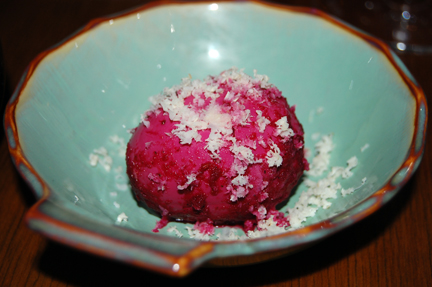
Our meal at the amazing St. Vincent in San Francisco — conceived and directed by Daedalian sommelier and wine writer David Lynch — began with two eggs: one bathed in beet and horseradish, the other in curry and turmeric. If only for their Technicolor, I knew that I wouldn’t be disappointed by the food and wine that would follow.

Had I the means, I would gather all the young wine and restaurant professionals in the U.S. and take them to San Francisco to see how it is superbly done by David Lynch, one of the leading sommeliers in the nation right now (as always), veteran of some of the most storied venues in the contemporary history of American restaurateurship.
Granted, David knows me and my palate, and so when I asked him to pick out a wine for us, I wasn’t surprised when he swiftly delivered the Clos du Papillon Savennières above, “not as extreme” as our beloved Joly, he noted, but no less nuanced or thrilling (and perhaps more graceful and focused).
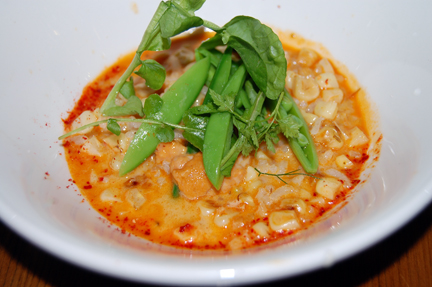
I was equally impressed by the deft hand of chef Bill Niles, to whom David graciously attributed sole authorship of the menu. The “She Crab” (actually lobster in the current season) was adorned with a dollop of sea urchin liver, Carolina rice, and corn chowder. I ate every last drop.
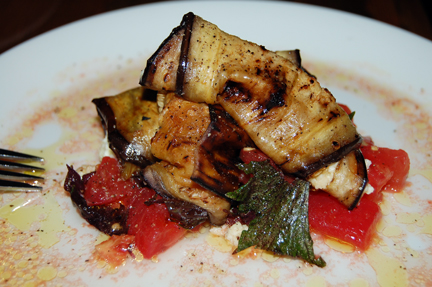
The eggplant roulades, alone, would be worth a return trip. I loved that chef Niles peels his tomatoes for this dish and I’d be remiss in not noting that this was possibly the best tomato I’ve tasted all year.
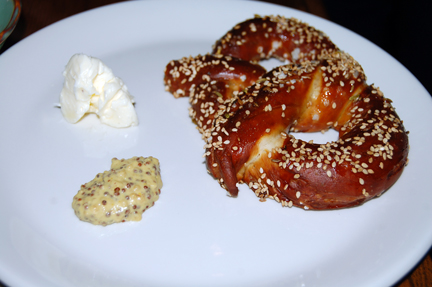
Chef Niles may draw from a Technicolor palette of culinary experiences and techniques but he also seems to love some of life’s simplest “street-food” pleasures, like this classic pretzel. I dug the juxtaposition of the elegance of his eggplant and the sheer pedestrian delight of the pretzel.
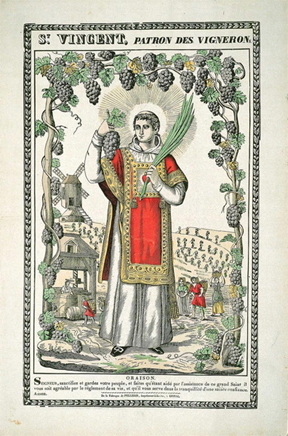
David named his new restaurant (opened just a few months ago) after St. Vincent of Saragossa, one of the patron saints of grape-growers, often invoked by wine- and vinegar-makers.
(Of course, I couldn’t help myself from reading up on why St. Vincent is considered patron of wine and vinegar.)
He is often depicted (St. Vincent, not David) with vines or grape bunches. Although there’s no element in hagiography that would associate him with grapes or grape-growing, his feast day, January 22, is celebrated in wine-growing France as the beginning of the vegetative cycle.
There are a number of French sayings uttered on that day, like quand Saint Vincent est beau, abondance pour le tonneau (when [the weather on] Saint Vincent is fair, there will be [an] abundance [of wine] for the casks).
Like so many examples of pseudo-Catholic folklore, his association with wine is purely arbitrary and can be attributed to the date of his commemoration (in the Greek Orthodox Church, he is remembered on November 11).
There’s nothing arbitrary about the way David runs his new restaurant and it was fantastic to watch him in his habitat (as the Italians say), greeting a guest, explaining a menu item, and serving a Savennières to a very happy wine blogger…
Image via La Chouette.


 David Lynch is one of our country’s top sommeliers and wine writers and just one of the nicest (and funniest) folks I know in this dog-eat-dog business. His intro to Italian wine seminar is one of the most popular at the Aspen Food & Wine Classic. Check out


 As Eric mentions in his post, the vineyards on the volcanic island of Santorini are a sight to behold (I’ve never been but have seen photographs): the vines are trained in “bushes” (or baskets, as enologist Antigoni Karamvali called them). Bush training helps to protect the vines from strong winds (the same training methods are used in Sicily and Apulia). The bush training also allows the vine to “migrate”: Antigoni showed me images of vineyards originally planted in perfectly straight rows, where the vines had crept — at slightly different rates — to more humid parts of the vineyard. Drinking this wine, you really get that sense of place, that sensation that this wine could have been made no were else in the world.
  Do Bianchi