
Please consider giving to Unicef’s Ukraine child refugee fund. This link takes you straight to the donation page.
 “The requirement to test for Covid before flying to the United States,” reported the Times yesterday, “is hated by many travelers and the U.S. travel industry. But the government shows no sign of getting rid of it.”
Like every other American traveler returning from a work trip to Europe, I needed to receive a negative Covid test before boarding a plane from Munich to Houston last Thursday.
In my experience, the best place to check on current travel requirements is the U.S. Embassy in Rome’s website.
As of May 16, 2022 (the last time the Covid info page was updated),
- all air passengers 2 years or older (citizens of all nationalities, including U.S. citizens, whether vaccinated or unvaccinated) with a flight departing to the US from a foreign country, are required show a negative COVID-19 viral test result taken no more than 1 day before travel, or documentation of having recovered from COVID-19 in the past 90 days, before they board their flight.
(Please be sure to check with the embassy of your destination country and the CDC for the most recent updates and requirements.)
To my knowledge, there are two testing kiosks at the Malpensa airport in Milan where my trip began and ended.
One is the MED MXP testing site: https://www.medairport.it/
I’ve never used that one.
The other is DocVG: https://docvg.it/
I’ve used that one now a few times and recommend it. When I used it last Wednesday, the day before my flights back, I had the results of my rapid test in five minutes. The cost was €50. It was the same experience as during my previous trip to Italy last year.
One thing super important to note is that “the 1 day before travel” begins 24 hours before your departing flight leaves for the U.S. In other words, if you have a connecting flight in Europe, you need to wait until 24 before your U.S.-bound leg.
Usually, I connect in Frankfurt, Germany to board a flight back to Houston. But because my Frankfurt flight from Milan was abruptly cancelled and I was rerouted through Munich, I had a short layover there. Because I was worried I wouldn’t make my flight and be stuck in Germany for the night, I took a Covid test at the airport in the international departures area (a kind of nowhere land where you have already gone through the passport checkpoint). Depending on how much you were willing to pay, you could get the test results as quickly as 30 minutes. I got mine in about 60 minutes for €45.
The bottomline is that there are ample opportunities to get tested at the airport. Sometimes they are challenging to find online. But they are there. Europeans have different sensibilities than ours when it comes to customer service, response times, etc. So don’t be alarmed if it takes a minute to receive confirmation emails etc.
Be sure to check with your embassy in the country where you are traveling. And also look out for your airlines “travel ready center” for info on requirements and even links for testing sites.
One new element emerged on my last trip: before you take your test, you now need to register for lodging in case you test positive.
In order to complete my registration for the test, I had to indicate where I would stay in case I tested positive and could not return to the U.S.
There were only two options for quarantine lodging. And neither — let me just put it this way — were the Ritz.
That was when it really hit me. I’ve been extremely fortunate during my three trips to Italy since Covid reshaped the way we travel. But if I were stuck in Italy for a quarantine, it would really throw our family’s work and schooling schedules into a tailspin.
It’s not clear to me how long I would have had to isolate in a hotel room. It seems like the CDC allows you to travel after five days following a positive test as long as you are not symptomatic. Here’s the page on quarantines I was able to find on the CDC site.
I have to go to Italy for work (I was teaching last week at Slow Food U). If I didn’t, I probably would consider postponing my trip until the testing and quarantine requirements are lifted. We’re planning to take the girls to Italy next summer because they have been begging to go back. But just think if we had gone this summer and got stuck in Italy?
Travel safe and enjoy wherever you are going. Please be sure to check in with official channels on requirements and testing etc.
 Stanley Tucci is one of the few issues that brings division to the Parzen family household.
 Above: the list and food at Felix Trattoria in Venice, California blew one Italian wine blogger completely away. Wine director Matthew Rogel has created what is possibly the best Italian list in the country right now. Its depth and thoughtfulness are going to be hard to match.
  Above: a friend treated me to a super bottle last night at the wonderful Ferraro’s Kitchen Restaurant and Wine Bar in North Miami. In terms of its drinking window, that wine was as perfect as it could possibly be. What a bottle! And great menu by chef/owner Igor Ferraro. Even a decade ago, you wouldn’t have expected to find such a gem and such excellent wine service in the U.S. outside of New York.
 Anyone who’s ever spent a significant time around the legendary grape grower and winemaker Aleš Cristančič (above) knows that he loves to talk about sex and sexuality. (I’ll never forget the time my band played a crazy wild gig at his winery, Movia, below. But that’s another story for another time.)
 It’s a conversation that was presaged not so many years ago in an article by Slow Food founder and essayist Carlo Petrini where he bemoaned Piedmontese growers who are grubbing up less lucrative, lesser known grape varieties and replanting their vineyards entirely to more bankable Nebbiolo.
  Happy Mother’s Day, Tracie P!
 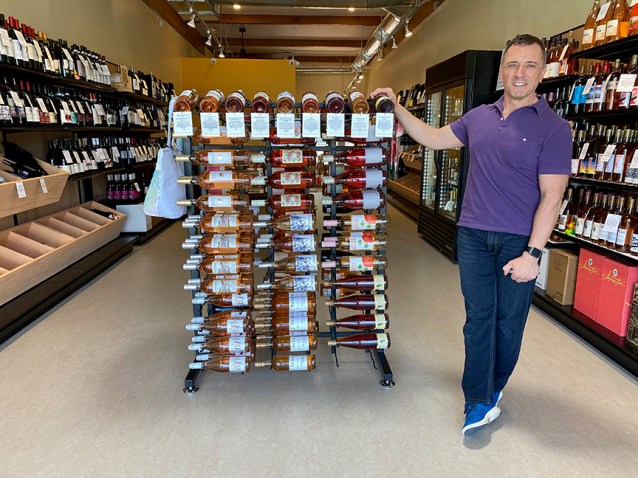 Just had to give a shout-out this week to John Libonati (above) and his awesome natural-focused wine shop
  Guest post by Davide Camoni.
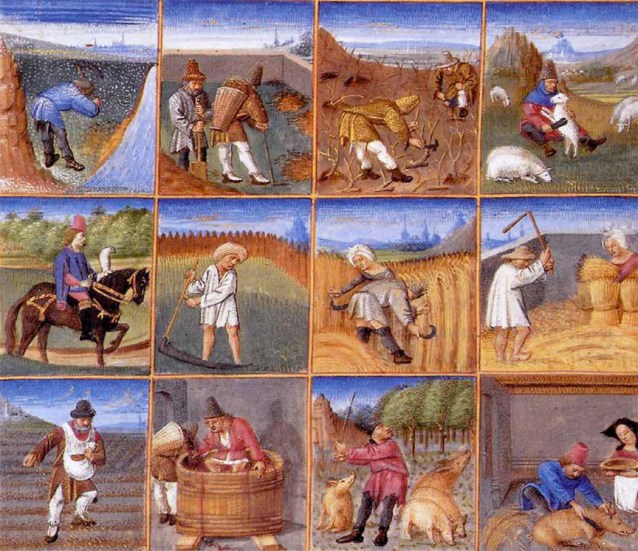 Above: an agricultural calendar from a “painted book” (circa 1309) of Pietro de Crescenzi’s treatise on farming, possibly executed in his lifetime. There numerous extant 13th and 14th century manuscripts of his book Ruralia Commoda and translations of his work became instant best sellers in the 15th and 16th centuries in Europe. Note the October panel where the figure is crushing grapes. Image via
 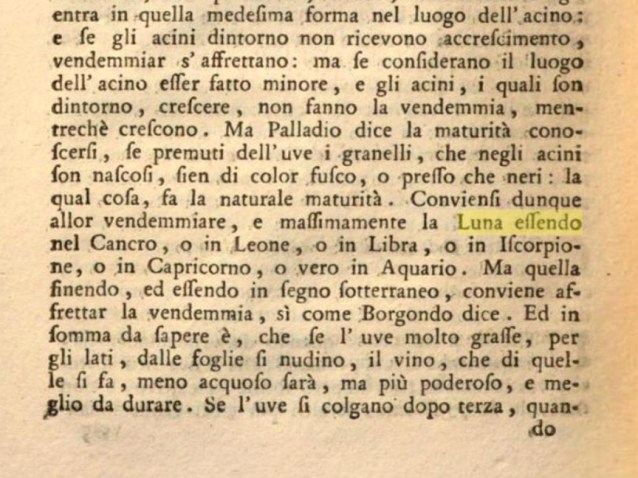 Above: a folio from a 1784 Italian translation of the Ruralia. The work’s popularity only began to wane in the modern era.
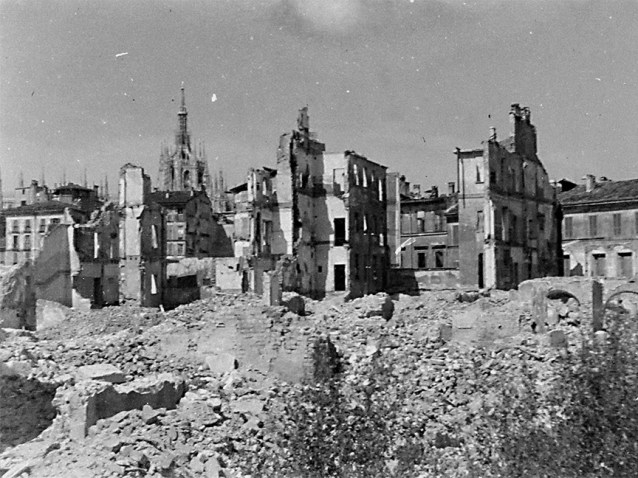 Above: an image captured in Milan in 1943. Note the Duomo in the background. Image via
  Do Bianchi
