Alpine mountain high: tasting with Italian wine great Luca D’Attoma.

One of the most exciting things about my professional life this year has been the opportunity to interact with Luca D’Attoma, one of Italy’s genuine “rock star” winemakers.

Luca first began making a name for himself and his work about 20 years ago when he began to land some astronomical scores from the top Italian wine writers.

I first met him in Bolgheri in 2008 when he was making wine for my friend Cinzia Merli of Le Macchiole. Their partnership helped to launch her brand into the stratosphere. Today, the average U.S. retail price for her 100 percent Merlot, Messorio, is around $250… if you can find it.

Tua Rita and Fattoria Le Pupille are just two of the iconic estates for whom he has made wine.

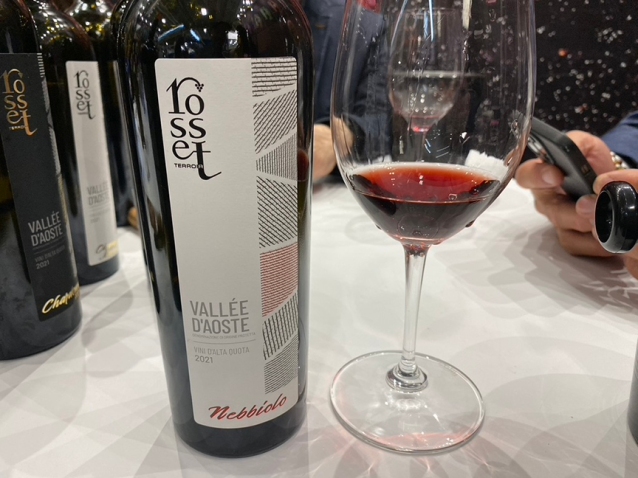
So, it was with some degree of surprise that I agreed to meet Luca at the stand of his Val d’Aosta client, Rosset, at Vinitaly this year.

Luca D’Attoma, the rugby player turned enologist, of Super Tuscan fame, in the Italian Alps? I thought to myself as I scratched my head.

I loved the wines, their focus, and the electric energy that seems to be the red thread in Luca’s work. The Nebbiolo was a stand-out, as was the Moscato. Super wines.
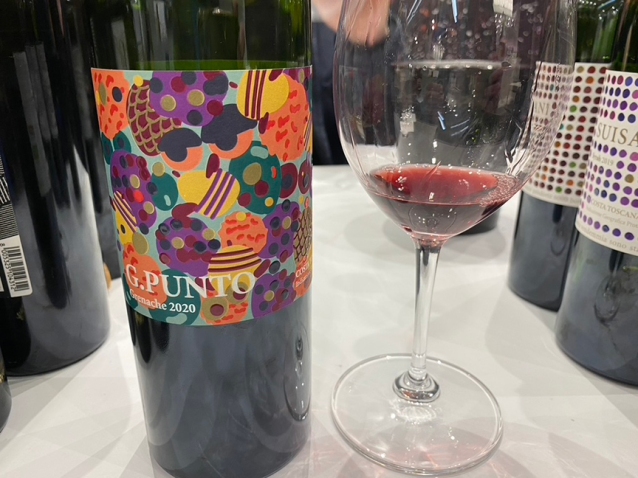
Next we tasted Luca’s personal project, Duemani, the Tuscan coastal estate he and his business partner recently sold to a major Italian winery group.

If the Alpine wines were electric, these wines were electrified!

Hyperbole aside, there is a vibrance to the fruit in Luca’s wines that makes them stand apart from the crowd. The Grenache by Duemani was outstanding, extremely fresh and lithe yet also rich and complex. The whole line up… these are wines meant for food. It was as if I could taste the cacciucco (a dish the Tuscan typically pair reds with).

Beyond the sale of his own winery, Luca has been in the news recently thanks to an interview by Gambero Rosso where he talked about his mixed feelings on Natural (with a capital N) wine.

On the one hand, he feels that the movement has become a marketing tool for lesser quality wines. But on the other, he spoke at length to the interviewer (my friend Lorenzo Ruggeri) about how Natural wine has impacted the greater world of wine in extremely positive ways.

Luca began as a conventional farmer. Today, he works exclusively with biodynamic growers, for example.

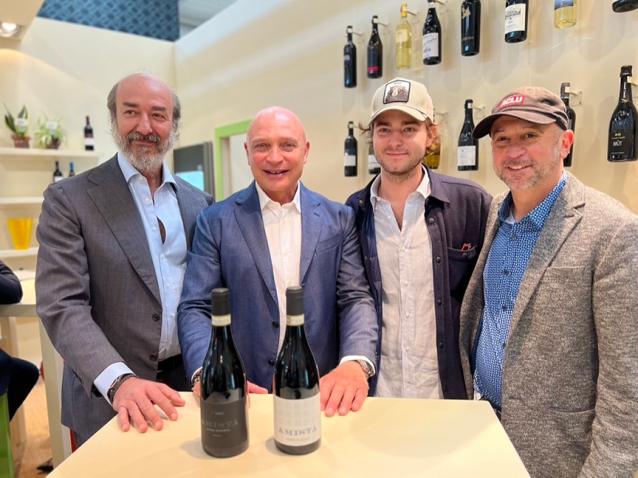
I know this to be the case because Luca and I share a client, Nizza producer Amistà.

That’s Luca (below, second from left), with Amistà owner Michele Marsiaj (far left), Michele’s son Iacopo, and me (far right).

I couldn’t be more thrilled to be working on such an exciting project. And getting to interact with Luca has been the icing on the cake.

Hopefully, I’ll be accompanying Luca to NYC in early 2024 for some special tastings. I can’t wait!
Je t’aime. Moi Nous non plus. Jane Birkin and how our band got its name.

On Sunday, two days after Bastille Day (and my birthday), the legendary actor and singer Jane Birkin passed away. See the Times obituary.
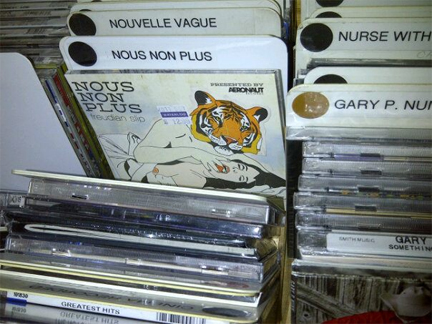
I first became aware of her work when I saw Antonioni’s 1966 film “Blow Up” when I was a grad student at U.C.L.A.

But it was many years later that I discovered that she was the female voice in Serge Gainsbourg’s epic 1969 song, “Je t’aime.” (Brigitte Bardot was the singer on the original first version of the track. But a second track, the one that was released commercially was produced with Birkin; read the Wiki on the song.)

Serge Gainsbourg was arguably the greatest inspiration for my band. Our songs, nearly all in French, are mostly about sex and the dialectics of amour (I’ll just euphemize it like that) — à la Gainsbourg.

In 2005, after we kicked one of the singers out of the band, we were forced to change the name thanks to a federal court trademark case. Yes, it’s where the expression comes from: he made a federal case about it.

After what seemed like endless discussion and parsing of potential band names, it was Jean-Luc (aka Dan), I believe, who suggested we borrow it from the title of Gainsbourg cut where Birkin appears.

She moans (and feigns orgasm) as she says “je t’aime” (“I love you”).

He responds not by saying “moi aussi” (“me, too”) as one would expect.

Instead he tells her, “moi non plus” (“me neither”).

To French speakers, the malapropism is immediately apparent. And in many ways, it captured the newly unbound culture of sexuality of the era, of which Gainsbourg and Birkin were both icons in their own rights.

And so, in an allusion and nod to our music heroes, we called the band Nous Non Plus (“us/we neither”). The paronomasia also reflects the fact that we could no longer call our band the original name — neither do we, so to speak.

Rest in peace, Jane. Your life was an inspiration to so many of us and your work brought joy and thought to so many of our artistic pursuits!

Stop calling Barbera the “wine of the people”! We no longer live in a classist wine society!

Above: Barbera was featured as one of Italy’s greatest grape varieties in Giorgio Gallesio’s landmark work of ampelography, published in the early 19th century.

It’s hard to believe in this day of growing wine awareness, appreciation, and enthusiasm.

But it’s still not uncommon to encounter wine professionals, including wine industry institutions, who continue to call wine made from Barbera the “wine of the people.”

Roughly a quarter century after the Italian wine renaissance began (1998 is the year, in my view, of the shot heard round the world), it’s unfathomable and entirely unacceptable that we continue to divide wine lovers into “haves” and “have-nots.”

Let’s put it this way, if Barbera were in fact the “wine of the people,” are other wines reserved, intended, or conceived exclusively for nobility and the managerial classes? If that were the case, shouldn’t the classist-minded among us call it the “wine of the proletariat”?

Joking aside, haven’t we outgrown this caste-driven view of the wine world?

Historically, Italy’s aristocracy and haute bourgeoisie preferred French wines. Cavour, the Piedmont noble and first prime minister of Italy, wrote that he didn’t believe Italian grape varieties could reach the same heights as Pinot Noir. The Incisa della Rocchetta family, also Piedmont nobility, famously planted Cabernet on their horse ranch on the Tuscan coast. The producers of what would become Sassicaia drank Bordeaux-style wines while the local Tuscan cowboys drank Sangiovese, or so the legend goes.

In the early 19th century, Ligurian botanist Giorgio Gallesio devoted ample space to Barbera in his landmark work of ampelography and Italian botany Pomona italiana. Only the fig tree received more face time. Nebbiolo is a footnote by comparison.

Gallesio’s love of Barbera was echoed loudly in another seminal work of ampelography, Ampélographie universelle, by the great French viticulturalist Alexandre Pierre Odart, who describes Barbera as one of the best grape varieties in Italy. With evident and warm enthusiasm, Odart quotes Gallesio’s work and points to Barbera as a variety that growers, French and otherwise, should know.

Before you call Barbera the “wine of the people,” please remember that we — rich or poor — are ALL people. It’s just that only some people know how good Barbera can be.

An Amarone that has “haunted” me.

Have you ever heard the word “haunted” used in winespeak?
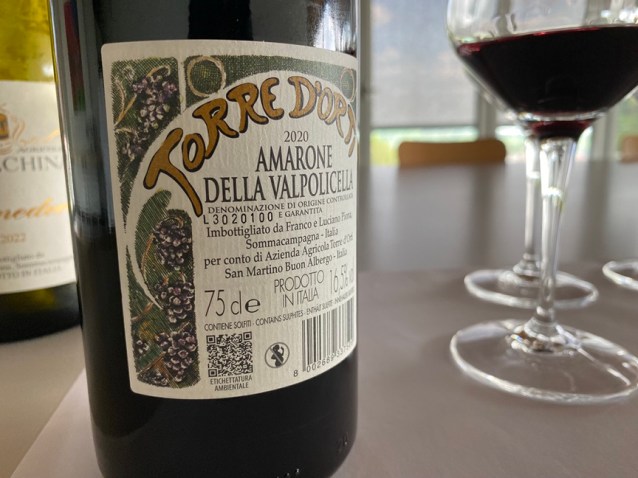
As in the sentence, the wine that continues to haunt me is….

Wine professionals occasionally seem to use that expression when they are talking about a wine that they can’t stop thinking about, that they can’t get off their mind

For me personally, once such wine has been the Amarone by Torre D’Orti, a farm in Valpolicella Orientale (eastern Valpolicella).

The wine is actually made by a famous producer of Custoza, Cavalchina (fantastic white wines btw, really super and worth checking out if you don’t know them), about 30 minutes to the west by car.

The name, as I understand it, comes from a place name, a guard tower outside Montorio castle in the San Martino Buon Albergo commune. It’s the “tower of the gardens,” so to speak, probably known in another era for the high quality crops grown there.

The soils in eastern Valpolicella are a blend of the classic limestone (found farther to the west) and the volcanic soils that you find further east. It’s no surprise that the land there produces richly flavored crops.

The area is known for its leaner, more taut style of Amarone and Valpolicella.

In my view, this wine is the result of a top growing site combined with the aesthetic and viticultural approach of the Piona family whose legacy in Custoza gives them a “white wine” sensibility.

Their Amarone, which I retasted in June during a visit to Valpolicella, is extremely elegant and keeps its hefty alcohol in check with impressive balance and finesse.

Its flavors were a blend of delicately juicy fruit and minerality, with a lithe texture that danced on the palate.

I loved this wine and highly recommend it, especially for those curious to travel outside of Valpolicella Classico to the west where some of more famous wines are made.

It beguiled, it bewitched, it enchanted, it dazzled, it spellbound… It was that damn good.

Feeling grateful for community, blessed for family. Happy summer, everyone!

What an incredible year it’s been already!
From Lucciola in New York City to The Wine Country in Long Beach, California; from Pasta And… in Margate, Florida to Cry Wolf in Dallas and Davanti in Houston.

Over the last six months, I’ve had the opportunity to interact with some of the brightest and best people in our business.

Just this month, I presented wines in Florida (at the amazing Vinya wine shop in Key Biscayne), in California (at The Wine Country), and here in Houston where I hosted a trade and media dinner for 25 of my colleagues (at Davanti).

And I just found out that I’ll be the moderator for this year’s Boulder Burgundy Festival in October and I’ll be teaching a seminar for the Abruzzo consortium in November in Abruzzo.

I couldn’t feel more grateful for the community, the solidarity, and the support I’ve received.

The wine world is small and close-knit and I feel truly fortunate to be part of such a vibrant scene.

Between my trip to Italy to teach at Slow Food U and my domestic travels this month, I’ve been on the road nearly non-stop.

And so now it’s time to take a break and be with Tracie and the girls. I’ll be taking the next week off and we’re all looking forward to date nights with Tra and our fun escapades with the girls.

I couldn’t feel more blessed.

Have a great summer, everyone! I’ll see you week after next. Thanks for being here.

Piedmont growers welcomed much needed rain in late May and June.

Notes on much needed rainfall in Piedmont, from my recent trip to Slow Food U, today on the Boulder Wine Merchant blog.

Thanks for checking it out!

Stay cool out there. Buon weekend a tutti.

At Allegra Angelo’s wonderful Vinya in Miami, the hegemony of the tasting note is disrupted.

From my colleague Nicola Perullo at the Slow Food University of Gastronomic Sciences in Piedmont to leading sommelier and author Pascaline Lepeltier in New York City, wine thinkers across the world are trying to forge a new language — a new dialectic — to describe the tasting experience.

If ever the twain were to meet, I doubt they would agree on much — except for one thing: the hegemony of the 20th-century tasting note (and score) must be disrupted for Westerners to continue to evolve as tasters.

For an international and youthful wine community where wine and wine culture have long moved past the idols of the last quarter of the 1900s, it’s hard to believe that the tasting descriptor canon created nearly 50 years ago continues to be the predominant medium for wine communications.

In the light of these highfalutin and literally epistemological issues being faced by the current wine intelligentsia, I drew a deep breath of fresh air when I walked into Allegra Angelo’s extraordinary wine shop and wine bar last night in Key Biscayne (Miami), Florida.

Allegra, one of the most brilliant wine communicators I’ve ever met, has dispensed with nearly every one of the stodgy conventions of wine retail that have dominated our industry for far too long.

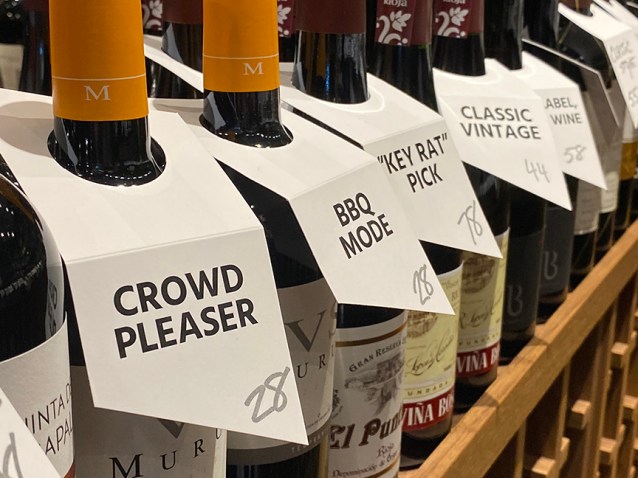
Just take a look at her shelf talkers, above!

It was amazing to watch her customers browse her shelves and confidently purchase and select wines using her unique and innovative system.

When I commented that she had devised an entirely new way of thinking about and communicating wine, with a user-friendliness that imbues the whole shop with her exhilaration for the wines she loves, she wondered out loud whether her approach was too “whimsical” at times.

No, I said, it’s just what our world of wine needs: fresh, energetic, creative thinking to an age-old problem. She an original and an inspiration and I can’t recommend her lovely shop to you highly enough (check out the link to get a taste of her aesthetic and approach to wine retail).

Happy Juneteenth! Here’s a book that totally changed my perspective on the holiday and its meaning in Texas and beyond.

Above: one of the earliest celebrations of Juneteenth at Emancipation Park in Houston in 1880. The park was created especially by local business leaders to serve as a gathering place for future Juneteenth celebrations. That tradition continues today in Houston. Image via the John Marshall Center (Creative Commons).

Happy Juneteenth, everyone!

It’s so awesome to see people celebrating this year, two years after it became an official U.S. holiday.

Houston has a deep connection to the holiday because it was first observed here in our city not long after the earliest celebrations in Galveston.

For anyone who wants to learn more about the holiday, I highly recommend Annette Gordon-Reed’s wonderful book, On Juneteenth, a memoir of her growing up in Texas (not far from where we live), published a few years ago. It’s a great read and it totally changed my perspective on the holiday and its meaning in Texas and beyond.

Happy Juneteenth! Enjoy the holiday!

Houston wine folks: I need you! And so does Abruzzo. Dinner Monday, June 26 at Davanti.

Houston wine trade and media folks, I need you to join me on Monday, June 26 for a classic Abruzzo menu paired with Abruzzo wines at Davanti, Chef Roberto Crescini’s casual Italian on Wesleyan.
It’s my first event for the consortium of Abruzzo wines and we’ve just got a couple of spots to fill to knock this one out of the park.

Chef Roberto is closing the restaurant just for our party that night. It’s going to be a great one! And I PROMISE: no boring speeches to sit through or videos to watch. Just great food and wines.

The flight of wine is forthcoming. But in the meantime, here’s the menu that Chef Roberto has created especially for our group.

antipasto
pizza rustica abruzzese

primo piatto
ravioli alla teramana

secondo piatto
agnello alla neretese

dolce
parrozzo abruzzese

The dish agnello alla neretese is lamb braised with tomato, sweet and hot peppers. Sound good?

This event is open only to trade and media and again, we just have a few spots to fill at this point.

Please DM me via jparzen [at] gmail.com to RSVP. There is no cost to guests and only a business card is required to attend.

Please feel free to share with any members of trade or food and wine-focused media.

Thank you for the support and solidarity and hope to see you on Monday, June 26! Buon weekend a tutti!

Wine writing as ekphrasis.

For many years now, I’ve pondered the notion of “wine writing” as a self-referential exercise.

Whenever you describe a wine, you’re not actually describing the wine but rather your experience tasting the wine (or experiencing the wine). Even when you tell the “story” of a wine, you are ultimately describing your own story.

Students of 20th-century critical theory will remember Gertrude Stein’s 1933 book The Autobiography of Alice B. Toklas. It is an “autobiography” not written by the subject but rather by her partner.

Many before me have called the work a “new paradigm” in Western narrative where the author (in this case, Stein) explores her own perceptions and experiences by purporting to be the subject and author. In doing so, she presaged one of the great conundra of the post-war Deconstruction movement where critical theorists like Barthes and Derrida declared that the “author was dead” (until Eco decided the author was actually still alive).

Stein’s book is one that comes up in my seminars on wine communications in the grad program at the Slow Food University of Gastronomic Sciences in Piedmont.

Reading through the examples of the “tyranny of the tasting note” in Eric Asimov’s “memoir and manifesto” How to Love Wine (2012), it’s abundantly clear that the writers in question are not describing wine but rather their experience tasting the wine in a given sitting. And my analogy here is that Stein is not describing the life of Alice B. Toklas but rather her perception of that life.

In writing a tasting note for a given wine, instead of saying “this is what the wine tastes like,” it would be more precise to say “this is what the wine tasted like to me when I tasted it that day.” The infamous case of Matt Kramer a wine writer from the 2000s saying [updated March 4, 2024] that Bartolo Mascarello tasted like “wet dog” “a warm room with two dogs in it” comes to mind in this context [updated March 4, 2024]. Instead of saying “this is what the wine tastes like,” he should have said, “this is what the wine tasted like to me on the day that I tasted it.”

[As Mr. Kramer recently pointed out to me, it was not him but rather a colleague of his at the time that wrote the note. For more on the episode of the wine that tasted like “a warm room with two dogs in it,” see this post by Craig Camp.]

But it wasn’t until recently that I realized that wine writing isn’t just an exercise in Deconstruction. It finally occurred to me that wine writing is actually ekphrastic in nature. The Greek term ekphrasis denotes the art of describing a work of art. And that is exactly what happens when we describe a wine.

Not only do we not tell our own story — our own experience as opposed to an empirical evaluation of the wine — but we perform that story. Along the way, we can’t help but compete against our peers and even ourselves as we try to excel as wine communicators.

Or do we?

I’m still working it out. Thanks for following along as I do…