The following is my translation of Franco Ziliani’s tribute to the great Italian partisan, journalist, anti-globalizationist, lover and connoisseur of Nebbiolo, Giorgio Bocca, who died Sunday in Milan…
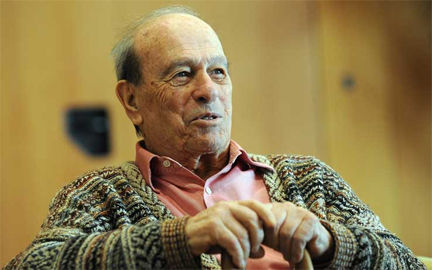
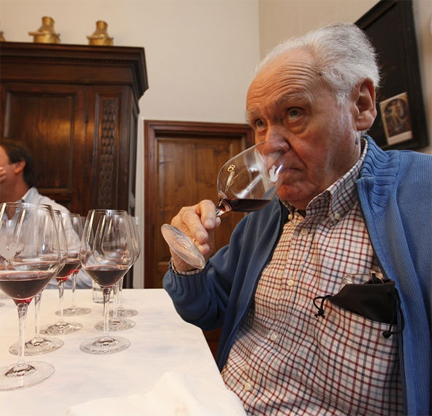
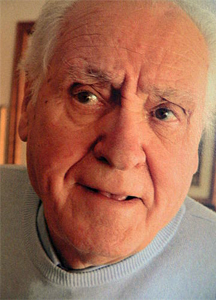
Photo via Il Journal.
He was allergic to any form of rhetoric and he was truly un-Italian in his respect: Italian journalist, partisan, and essayist Giorgio Bocca, 91 years old, died in Milan on Sunday. He deserves to be remembered with a dry eye and not without a touch of irony.
For this reason, I’ve decided to remember this surly, free-thinking, independent man from Piedmont not as a maestro of Italian journalism (which he was, indisputably, regardless of your political leanings) but rather as the great (and demanding) connoisseur of wine whom I had the pleasure to interview twice in his home on Via Bagutta in Milan.
One wine, above all others, was often cited in his books: Barolo, a wine for which he reserved great passion, a wine he drank only when produced by a few carefully selected and trusted producers.
And so, as I think of how Bocca has left us, it’s only natural to evoke the name of another great man from Langa, whose dry, ironic personality was intimately familiar to Bocca. When ever the writer was in the area, he’d go visit this man and they had much more in common than their love of wine: they shared a keen interest in culture, politics, and, of course, in Barolo.
I’m thinking of Bartolo Mascarello, an indisputable leftist like Giorgio Bocca, leftist but not sectarian, enlightened and enlightening, rigorous in his being in favor or against something or someone but not intolerant, perhaps not open to dialog with those whose ideas he opposed but always willing to listen.
And so as I reflect on this goodbye to the great journalist from Cuneo, Giorgio Bocca, I’d like to think that somewhere — in some corner of the imagination, I don’t know where — Bartolo Mascarello is waiting for Giorgio. He’s sporting one of his ironic, amused smiles and of course, he’s speaking in the noble dialect of Langa. He’s opening a buta — a bottle — of a special wine intended to welcome Giorgio to this truly special parlor…
Bartolo, pop open a buta! Giorgio is here!
—Franco Ziliani
The following profile appeared yesterday on the English-language version of the ANSA website.
(AGI) Milan – Giorgio Bocca died on Christmas day in Milan at 91 years of age. He had been a wartime partisan, journalist, founder of the newspaper ‘La Repubblica’ and a long-time collaborator of the Fininvest TV networks. News of his death was released by Feltrinelli, a publishing company who published several of his books and that recalled him as “a great journalist, a great combatant and a great friend”. “Since the partisan war of resistance up to these last few days of the Italian and global crisis – the publishing company continues in a note – he witnessed, observed and told the history of our Country through seven decades. Giorgio Bocca’s enquiries, short polemic articles and books have accompanied and nourished the building of civil society through many generations of Italians”. In January, Feltrinelli will pubish his latest book: ‘Grazie no, 7 idee che non dobbiamo piu’ accettare’ (‘No, thanks: 7 ideas we can no longer accept’). In the past, in addition to his journalistic activities, Bocca – who was born in Cuneo on the 28th of August 1920 – wrote several essays and his having fought with the “Giustizia e Liberta'” Partisan division often led him to tackle the issue of fascism and resistance although he also wrote books on terrorism during the ’70s, on journalism and on the problems of the South of Italy.
During the last few months, some of his comments on the ‘Meridione’ had placed him at the center of controversy after he defined Naples as ‘flea-bag’ with ‘unhealable areas’ or Palermo as a city “stinking rotten, with monstruous people gushing out of slums”. A skilled polemicist, during the last few years, he had often delved into the condition of journalism in Italy: in 2008, in an interview on the ‘Le invasioni barbariche’ TV show, he said that while the journalists of his generation “were driven by ethics” today “truth is no longer of interest” and “publishers are always on the payroll of advertisers”. Among the last recognitions awarded to him was the 2008 Ilaria Alpi Prize for his Life-Long Achievements: “All those that go into journalism do so because they hope they might reveal the truth: even if it’s difficult, I call on them and encourage them to continue along this road”.

 When Italy’s top wine blogger