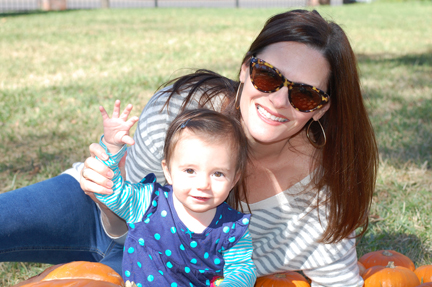
if you’ve never touched a rainbow
then you’ve never seen her smile
if you’ve never heard the snow fall
then you’ve never seen her cry

if you’ve never touched a rainbow
then you’ve never seen her smile
if you’ve never heard the snow fall
then you’ve never seen her cry
From my band’s new album, le sexe et la politique…
To borrow a phrase from my good friend Charles Sicolone (whose wife, Michele Scicolone, happens to be one of the best cooks in New York City and one of our nation’s leading cookbook authors), I am truly blessed: my wife, Tracie P, is an amazing home chef. Last night, at Mrs. & Rev. B’s house in Orange, Texas, she made us all pizza for dinner. Here’s her recipe.
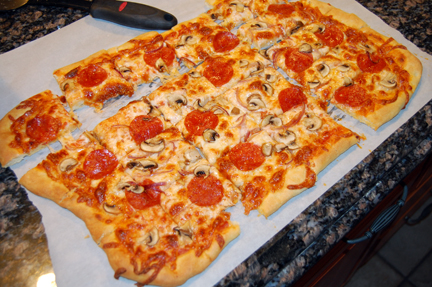
Tracie P notes that “the great thing about this recipe is the short rising time and [the fact that] you can also freeze the dough” to use later with great results.
Be sure to have your toppings ready beforehand so that you can quickly top the dough after heating the pizza stones.
Makes 2 large pizzas or 4 small. These quantities can also be used to make 4-6 calzoni.
1½ cup water, about 100°
1 package baker’s yeast
4 cups unbleached all-purpose flour, plus extra for flouring
1½ tsp. kosher salt
1 tbsp. extra-virgin olive oil
Heat your oven with the pizza stone to 500° for an hour. If you don’t have a pizza stone, use a pan and simply preheat the oven without the pan.
In a mixing bowl, dissolve the yeast in the water, stirring with a spoon. Let it sit until it becomes foamy.
Combine the flour and salt in a food processor and, then, with the blade running, slowly add the water in a thin, even stream and then add the olive oil. Pulse until the dough comes together.
Turn the dough out onto a lightly floured pastry board and knead for approx. 2-3 minutes until the dough becomes smooth and less tacky.
At this point, you can freeze the dough balls that you don’t want to use. Just put the unrisen dough into a plastic freezer bag. When you want to use it, take it out in the morning and place it in an oiled bowl and place it on the counter. It’ll be ready and risen by the afternoon.
Grease 2 medium-sized mixing bowls with olive oil. For 2 large pizzas, divide the dough into 2 balls and transfer to the mixing bowls. (Divide into 4 for 4 smaller and slightly thinner pizzas.) Cover each with a dish towel and then set aside until the dough has risen, doubling in size (about 45 minutes).
Remove the stones from the oven, distribute the dough on the stones and top quickly (using whatever toppings you like).
Bake the at 500° F. for 7-10 minutes or until the crust becomes golden brown.
We paired last night with a salty Santorini Thalassitis by Gaia. Utterly delicious…

Georgia P’s had a great time visiting with her nanna and pawpaw while her daddy was in Italy and on the road here in Texas. But now it’s time to head back to the River City (that’s Austin, for all you folks who ain’t never been to Texas)…
Buon weekend, yall!
Today’s post is devoted to my translation of an article written and published today by my good friend Giovanni Arcari on the Italian wine blog Intravino. It was edited by Alessandro Morichetti, one of Italy’s leading wine bloggers.

Above: Umberto D.
“How To Not Get Things Done in Italy”
A case study in vineyard registration in Alta Langa.
Premise: A love for classic method wines and for the Langhe Hills inspired me to partner with a Monforte d’Alba producer who wanted to produce Alta Langa [sparkling wines]. Unfortunately, nothing is ever as easy as it seems and the story that follows is as simple as it is demoralizing. There are appellation regulations to be observed and we followed them to the letter. The producer acquired land; he planted the right grapes (7,500 Pinot Nero and Chardonnay vines in Serravalle Langhe); and then he applied for the authorization to label the vineyard “Alta Langa.” From that point forward, the process was disastrous.
A week later, a message arrived in the form of a cold shower: “registration of vineyards for the production of Alta Langa is closed,” wrote the Classic Method Alta Langa Producers Association.
We asked for an explanation and resigned ourselves to our fate.
But then, by chance, we came across this brilliant declaration on September 5 of this year: “… the association is working to expand the planted surface area intended for the production [of Alta Langa]. This process will be carried out through a ‘targeted’ authorization of new vineyards in the growing zone. Its scope is that of favoring those projects where grape production already has a specific destination that will not inflate the grape market. The goal is to have more bottles on the market that make an even greater difference.”
Well, you might call this good news, especially in the light of the fact that we were asking for authorization for a sole hectare. We already have a project and the “destination” for our roughly 100 quintals of grapes is very clear: a fine, artisanal classic method sparkling wine. Case closed.
Nothing doing! We hear nothing from the producers association but on October 24, we discover that it has been taking applications when we read an announcement on the Coldiretti website. [Coldiretti is Italy’s national growers confederation.] Coldiretti isn’t exactly known for its lightening speed: the application process was opened on August 2 and today [November 30] is the last day.
But that’s not the real problem here.
Do you want to know the criteria by which surface area planted to vine will be expanded? In short, if you sell your grapes to commercial bottlers, you’ll be fine. But if you by land, plant it and sow the seeds of your dreams there, you’re screwed.
Authorization is granted on a points-based model. And it’s not entirely clear how you obtain “points, rights, and priority.” To have the maximum number of points, seven, you need to be a “professional agricultural entrepreneur who already produces and/or sells classic method sparkling wine or owner partner in a cooperative winery that already produces classic method sparkling wine.”
To obtain five points, you need to be a “professional agricultural company or entrepreneur that already owns vineyards with agricultural-environmental characteristics in conformity with the Alta Langa DOCG appellation regulations (but that are not suited for authorization) and that has an at least five-year contract for the transformation [vinification] of the fruit into Alta Langa DOCG that guarantees the total application of the grapes.”
Three points are award to a “professional agricultural company or entrepreneur who has obtained [land] rights, plants new vineyards intended for the production of Alta Langa DOCG, and who possesses an at least five-year contract for the transformation [vinification] of the fruit into Alta Langa DOCG that guarantees the total application of the grapes.”
And for a “professional agricultural company or entrepreneur different from the points above,” the association grants only one miserable point.
It sends a chill down your spine, doesn’t it?
Obviously, we were given only one point. Translation? A new winery CANNOT produce Alta Langa.
Why isn’t the grape market regulated so as to encourage the entry of new players who could enrich the appellation? Why is there such interest in Alta Langa to purchase grapes and not to have anyone else get in your way? Who profits from this?
This system stinks.
—Giovanni Arcari (via Intravino)
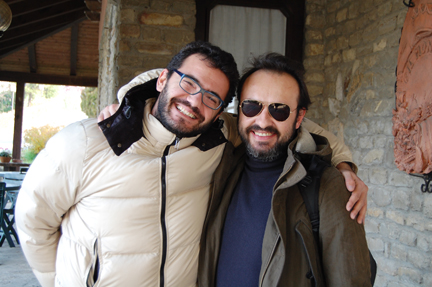
Above: Alessandro (left), Giovanni (right), and I had breakfast in Alta Langa on Sunday morning.

Last night, I had the great fortune to be invited to speak at Tony’s in Houston, the namesake and flagship restaurant of my good friend and client Tony Vallone.
He had billed the event as the “dinner of dinners” for 2012 and he didn’t disappoint.
After the welcome wine, we paired 2001 Barolo by Bartolo Mascarello with Alba truffles over tagliarini, my first truffles in this year of drought-impacted foraging.
The 2001 Bartolo Mascarello is simply one of the greatest wines I’ve ever tasted and has many, many brilliant years ahead of it. It had been opened a few hours prior and while it wasn’t entirely generous with its fruit, its elegance and balance are unrivaled.

But the wine that really wowed me was the 1998 Brunello di Montalcino by Poggio di Sotto. I’d been very lucky to taste this wine many times in the past and I was surprised when I saw Antonio Galloni’s tasting note in which he advised that it was in decline. (Antonio’s my favorite Italian wine writer, btw, and while his word is not sacrosanct, I do find his palate to align nearly perfectly with mine when it comes to traditional-style wines.)
This wine had what the Italians call grinta, real grit and spunk… Beautiful acidity and the vibrant dark fruit that you expect from classic expressions of the Castelnuovo dell’Abate subzone of Montalcino.

Tony and his general manager Scott Sulma paired with this medley of guinea hen and Taleggio-stuffed tortellini in brodo.
And wow, I just feel like I need to add a chorus of dayenu as I recount this epic meal. As if the previous two dishes weren’t enough to make his guests swoon, Tony thrilled the room (which reacted with a unanimous gasp as the beef enter the room) with a platter of nearly two-month-aged prime rib.

Dessert — sweet zeppoli stuffed with torchon de foie gras (how’s that for fusion!) paired with 1990 Recioto della Valpolicella by Quintarelli…
I like to joke that Tony’s is an oil moguls commissary. On any given night, you’ll a handful of billionaires in his restaurant — at the very least.
How I ever found my way to a seat at that table, I still don’t really know.
As I sit this afternoon, on the outskirts of Houston in a Starbucks using the free wi-fi and listening to Christmas music as I type and type and type at the keyboard for my clients, I can’t help but take a deep breath and contemplate the extraordinary counterpoints of life.
It’s coming on Christmas
They’re cutting down trees
They’re putting up reindeer
And singing songs of joy and peace
How I ever got here, I’ll never really know. But I sure am thankful for the many gifts life has given me…
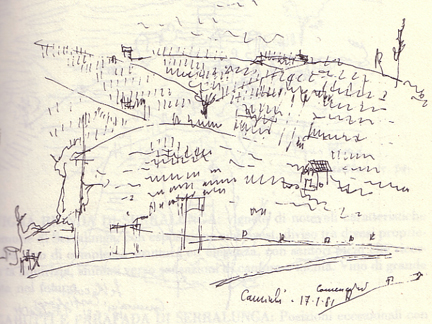
Above: A drawing of “La collina dei Cannubi” (“Cannubi Hill”) by Eugenio Comenicini, 1981 (reproduced from Martinelli’s monograph Il Barolo come lo sento io, 1993).
When Giovanni and I visited the home of Maria Teresa Mascarello and David Berry Green on Saturday for lunch, conversation was dominated by two topics: the primary elections for Italy’s center-left Democratic Party (held on Sunday) and the Marchesi di Barolo’s continued efforts to redefine which vineyards in Barolo can be called “Cannubi.”
For some time now, Marchesi di Barolo has been trying expand the designation, to include adjacent vineyards. Its application to extend the historic vineyard’s reach was thwarted when a group of eleven producers and owners of rows Cannubi successfully petitioned to block the move in June of this year. (Walter Speller delivered this excellent post on the events that lead up to the showdown.)
As Marta Rinaldi — daughter of Giuseppe Rinaldi, one of the eleven wineries who contested the redesgination — reported in this moving post on Intravino, it took a court order to stop the Marchesi di Barolo, whose motive to remap appellation subzones is rooted in desire to exploit the most recognizable crus of Barolo for financial gain.
Cannubi is considered by many to be one of Barolo’s greatest vineyards and one of its most historically significant growing sites. This fact, coupled with foreigners’ ease in pronouncing the toponym (kahn-NOO-bee), have made it one of the most popular (and lucrative) vineyard designations in the appellation.
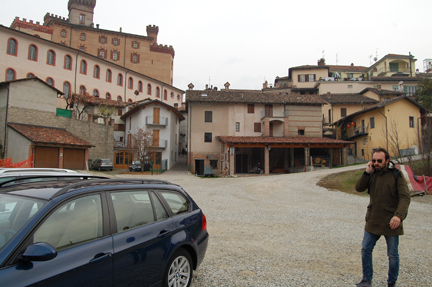
Above: Giovanni and I drove from Brescia to Barolo on Saturday morning.
In October of this year, the Marchesi di Barolo filed an appeal with the court to lift the injunction against them. And its outcome is uncertain.
“On the ground” in Barolo, there is even greater concern regarding the vineyard’s future because the Ceretto and Damilano wineries recently partnered with James Suckling to make a documentary about Cannubi (it was shot during harvest this year). And the movie is to be incorporated, Maria Teresa told me, in a marketing campaign to promote the sale of wines labeled “Cannubi” in the ever growing Asian market, where the thirst for high-end wines seems to know no bounds.
As an owner in Cannubi and one of its most well known producers, Maria Teresa was approached by marketers to participate in the program.
“A campaign like this shouldn’t move forward until the question has been resolved,” she told me. “I’m not going to partner with my quote-unquote enemy… the Marchesi di Barolo in a promotion like this,” noting that the Marchesi di Barolo is planning to be part of the campaign.
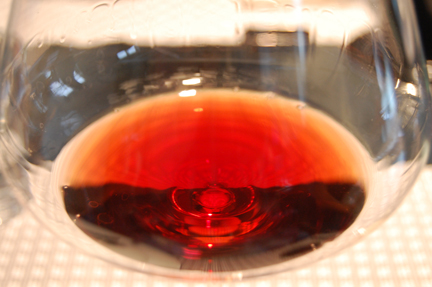
Above: Will the color of traditional Barolo be sullied by the green of avarice?
It’s not clear when the court will rule on the Marchesi di Barolo’s appeal and the stakes are extremely high.
As David wrote on his blog last year, “Ernesto Abbona, President of heavyweight Barolo producer Marchesi di Barolo (1.6million bts), is cast in the Machiavellian role making a final desperate grab for vineyard rights. Pitted against him are a band of small growers – let’s call them partisans! – defending the honour of an historical site, Cannubi, row by row, bunch by bunch.”
I’ll be following along closely and will report news as it arrives from Langa. In the meantime, a Google image search for “Cannubi” will deliver a number of photos and maps of this historic vineyard if you’re interested in learning more.
I’ve got so much to tell about my recent trip to Italy, including more on my lunch with Maria Teresa and David. But this was most urgent. Stay tuned…
I know, it’s insane. But I had to make a short trip to italy this weekend for a new client. I was super bummed to miss thanksgiving with our family but there are hungry mouths to feed back in texas. :)
This photo is a preview of one of the meals shared with giovanni.
I’m heading home today and have some important news to share with lovers of nebbiolo. Will do asap.
The trip back to texas is always tough but there’s a sweet reward waiting for me at the end of this road. I can’t wait to get back to my girls.
Stay tuned!

Posted with WordPress for BlackBerry.
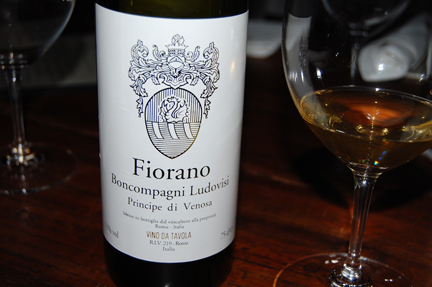
Above: Some may be turned off by the oxidative quality of the Fiorano whites. I think they’re super groovy. This 1994 Sémillon was made when the old Prince Boncompagni was still on this earth. It had solid acidity and its dried stone fruit flavors and aromas were lively and rich.
One of the coolest things about what I do for a living is that collectors of Italian wine often invite me to taste their wines with them.
There is no one who does more to foster the Austin wine and food scene than the lovely Diane Dixon, whose Keeper Collection produces a series of events here each year, focusing on and featuring young sommeliers and chefs.

Above: Of all the Gaja wines from the 1990s, my favorite has always been the Conteisa, named after the “highly contested” (conteisa in Piedmontese) parcel where it is grown. There’s more Barbera in this wine than his other Langhe Nebbiolo (and unlike the more famous ones, it was never classified as Barbaresco). Great acidity, brilliant fruit.
She and her husband Earl are just really cool folks who recognize the importance of supporting our food and wine community.
On Friday night we convened at my favorite Austin wine bar where the owner graciously let Diane open a few bottles.
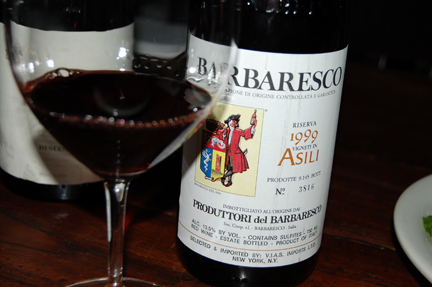
Above: Here’s my tasting note… !!!!! So youthful, so powerful, this wine is going through a “closed” period and while ungenerous with its fruit, it lavished my palate with its nobility and grace. I’m hoping Diane will let me taste it again in five years or so. What a stunning wine!
With every wine that was poured, Diane asked me to talk to our small group about each one. The story of the Prince Boncompagni and his moldy casks; Gaja and the reclassification of his Langhe wines at the end of the last century; Produttori del Barbaresco and how many Langaroli now call 1999 (and not 1996) the greatest vintage of the decade.
Somewhere between the Gaja and the Produttori del Barbaresco, I realized that Diane had thoughtfully created this flight just for me. It’s one of the coolest things about what I do for a living and it’s one of the coolest things about being part of the Austin wine and food scene.
Diane and Earl, what a thoughtful flight you put together for me! Thanks for everything you do for all of us…

I’ll take you with me everywhere I go.
I’ll put you in my pocket. Who will know?
Right next to my heart at every show.
I’ll take you with me everywhere I go.
 Do Bianchi