Alice’s restaurant & Natural salsa (?), gig 2nite in NYC on LES

The Nous Non Plus (my band) gig tonight at Fontana’s on the Lower Eastside NYC starts early tonight. We take the stage at 9 p.m. Please come to the show!

ostertag riesling

Carrying on a tradition that stretches back to my years living in the City (1997-2007), I spent the first evening of my NYC sojourn at Alice’s restaurant, where she prepared what will be the most wholesome meal of my trip (a good way to start a week of eating and tasting my way through the city; a lot of crazy restaurants lined up).

Alice gave the Ostertag Riesling the thumbs up. I thought it was pretty nifty, too.

alice soup

The main event was a vegetable-stock based soup (Alice doesn’t eat meat). The food at her house is always great but I really go for the kibitz.

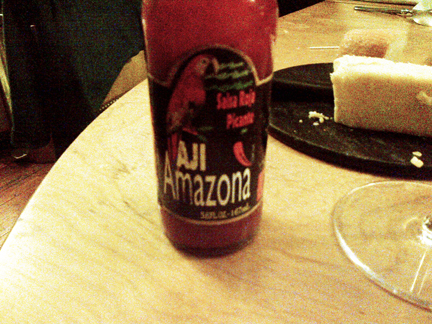
amazona salsa roja aji

She recommended raising the heat with some salsa. Natural salsa? Probably not but delicious nonetheless.

clos roche blanche

Main course was accompanied by an old favorite, a wine that Alice turned me on to many, many years ago…

Stay tuned for NYC stories and please come see the show tonight if you’re in the city!

The Whaling Bar, temple to political incorrectness & backdrop of my childhood, to close

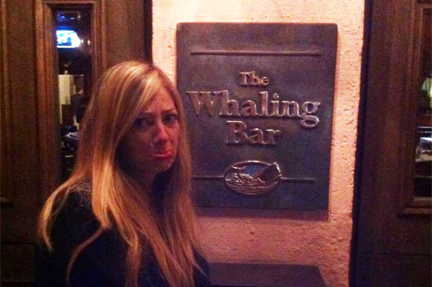
whaling bar la valencia

Above: Friend Jayne Battle of Jayne’s Gastropub in San Diego shares our pain in saying goodbye to the beloved Whaling Bar at La Valencia hotel in La Jolla, where I grew up.

With the thought of its closing burning it my mind, it’s painful for me to explain the role that the Whaling Bar played in my life.

It was the setting of my childhood, the place where we went to eat with my grandparents who lived in La Jolla and my grandparents who came from Indiana to visit with us.

It’s the one restaurant where my grandma Jean (my mother’s mother) loved to go. And it was the restaurant where, as a six-year-old, I watched in amazement as my zaidi, Rabbi Parzen (my father’s adoptive father), ordered every dessert on the menu, including “Baked Alaska” and “Napoleon.”

whaling bar mural

Above: The theme of the Whaling Bar is — you guessed it — is whaling. Click the image (take from the hotel’s website) to enlarge. The entrance is decorated with a handsome collection of carved and engraved whale tusks. Can you think of anything more politically incorrect? Well, yes, I know, you can. But they sure don’t make them like this anymore.

It’s where Mrs. Lipschitz — grandmother of Marc Lipschitz, a Hebrew school friend of mine — eats dinner every night (she lives in the hotel).

And it’s one of the first places where I took Tracie P the first time I brought her to La Jolla.

It’s also where Raymond Chandler drank during one of his most productive periods (I grew up in the house next door to the house where he lived, although he was long gone by the time my family moved to San Diego).

Here’s what my friend David Klowden, a San Diego-based writer, posted on his Facebook the other day:

    Dear Friends–Please join me on Saturday, Feb. 2nd for cocktails at 8pm at the venerable Whaling Bar in the Hotel La Valencia in La Jolla on the last night of its existence. This bar is where the greatest hard-boiled noir writer of them all, Raymond Chandler, hung out a lot during the 1940s & 50s during the time he wrote The Long Goodbye, Little Sister & Playback. Famous folks like Gregory Peck & Dr. Seuss liked drinking in here. Its well-preserved & always empty dining room has been one of my favorite secret writing spots for years. I hope you can be there to help me give the gorgeous little bar a proper send-off before it heads to oblivion so Ray Chandler can have a gimlet there once again.

And here’s one of the many photos he’s posted recently:

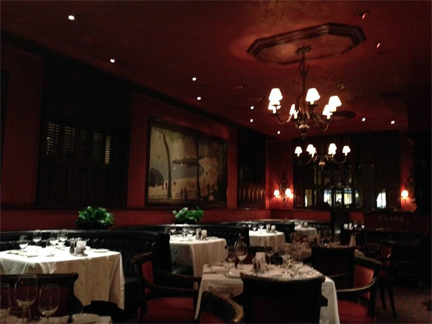
whaling bar la jolla

If you happen to make your way to La Jolla before it closes, be sure to pop in and see the room for yourself and have a cocktail.

It’s one of those wonderful rooms, a trace of another era in Americana…

Why @NousNonPlus is huge in Slovenia (warning: contains nudity, profanity & rock ‘n’ roll)

A song I co-wrote, one of my favorites, from our 2005 self-titled album was used for a 2007 Mobitel campaign. When we performed in Ljubljana, the kids literally ate us up. It was fantastic.

In the fall of 2005, the album was a top 10 college radio record for four weeks, peaking at #6.

One of the things that gives me the greatest reward in life is when kids make videos to our songs. This is one of my favorites (and it is REALLY raunchy so be advised).

Come see my band play in NYC (Jan. 26), Austin (Feb. 9), LA (Feb. 14), or SF (Feb. 15). Click here for details.

brigitte bardot

Dolcetto and Brigitte Bardot’s lover

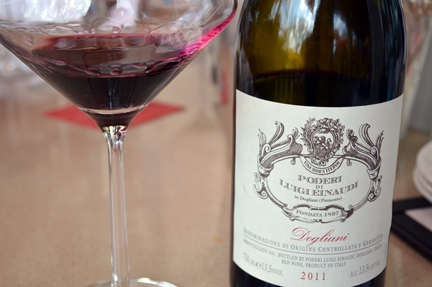
docletto color wine grape

Above: Note the bright purple hue of the wine in the glass, a classic expression of traditional style Dolcetto. Click image for a higher resolution version of the photo.

Conversation yesterday afternoon with Einaudi scion Matteo Sardagna began with a tasting of his family’s wines but ended with topics of much loftier import.

As it turns out, before he became a family man, Matteo spent some years living in Buenos Aires with Gigi Rizzi, the legendary Italian 1960s playboy who became tabloid fodder after he had a much publicized liaison with Brigitte Bardot.

gigi rizzi brigitte bardot

Image via Gigi Rizzi’s MySpace.

How did we get from Dolcetto di Dogliani to Brigitte Bardot and Gigi Rizzi?

When I learned that Matteo would be in NYC this weekend, I invited him — of course — to see our show there (my band Nous Non Plus is playing at Fontana’s on the Lower East Side this Saturday, Jan. 26).

He asked me what kind of music we play. And when I told him yé-yé pop and indy rock inspired by 1960s France, he proudly announced that he was an intimiate friend of Gigi (and I have to confess that I was captivated by his tales of Gigi; Céline Dijon and I are already working on a song about Gigi, whom, according to Matteo, also slept with Alain Delon’s wife during the — ahem — peak of his fame).
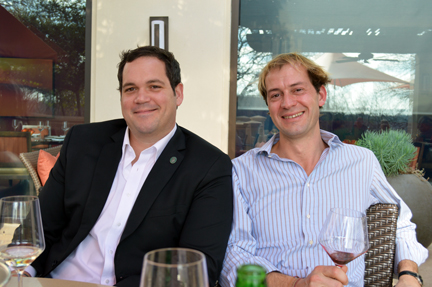
mark sayre sommelier

Above: My buddy and top Austin sommelier Mark Sayre (left) and Matteo yesterday at Trio where Mark runs one of our favorite local wine programs.

Matteo was in town to promote his wines (and was nearly devoured by the Austin ladies who received him the night before at a dinner in his honor; “they were a little aggressive,” he said with a modestly wry smile).

As we tasted his wines (and before I discovered his association with Gigi Rizzi, whose name alone could be the subject of a doctoral thesis on 1960s sexuality), I grilled Matteo with questions about his great-grandfather, Luigi Einaudi, the second president of the Italian Republic, iconic twentieth century economist, anti-fascist, and winemaker.

His interest in winemaking, said Matteo of Luigi, was borne out of a childhood of poverty.

“My great-grandfather wanted to own land,” he told me. When he was in his twenties, “you were no one if you did not own land.”

In the years that followed the second world war, Luigi fulfilled his dream and started a farm and winery on his estate.

But he never managed to obtain a parcel in the famed Cannubi vineyard in Langa that he so coveted.

“He tried to buy [a parcel] in Cannubi,” recounted Matteo, “but when they found out that a president was behind this purchase, they raised the price.”

Ultimately, in the late 1990s, the family did purchase a substantial holding in Cannubi (and produces a vineyard-designated Barolo made from Cannubi).

(Einaudi is one of the wineries who are battling the Marchesi di Barolo’s misguided attempt to expand the designation.)

Matteo concurred when I noted that Einaudi’s wines fall somewhere in the middle of the modern-traditional spectrum.

My favorite in the flight was the entry-level Dolcetto (above), classic in style, low in alcohol and with bright fruit and acidity, juicy and food friendly (such a great hamburger and fries wine).

You never know what to expect when you meet someone like Matteo, a winery CEO from one of Italy’s most famous families (whose fortune comes from the industrial piping business his grandfather founded).

Dolcetto and Brigitte Bardot? I’ll drink to that any day of the week…

Come see my band play in NYC (Jan. 26), Austin (Feb. 9), LA (Feb. 14), or SF (Feb. 15). Click here for details.

brigitte bardot

A DOC/G resource and fascinating historic document on Prosecco @ItalianWineGuy @Bele_Casel

italian wines 1960sAlfonso’s English-language posts on the evolving state of Italian DOCGs remain the top resource for the most up-to-date list of officially sanctioned and guaranteed appellations in Italy.

I highly recommend it to you (and his excellent blog in general).

This morning I came across a DOC/G resource that I’d never seen before and wanted to share it here.

It’s called QuattroCalici.it (Four Chalices). Although it’s cumbersome and a bit clunky, it is a fantastic Italian-language resource for the DOC/G system and includes dates of creation and amendments as well as links to overviews for each disciplinare (appellation regulation). I’m not sure if it’s as up-to-date as Alfonso’s list but I’ve found it to be really useful.

Here’s the link.

It appeared in a Google search this morning as I was looking for historic information on the Prosecco DOC/G.

I was working on a post for winemaker Luca Ferraro’s blog, where I have posted my transcription of an excerpt from a wonderful and fascinating document entitled “A Description of Venetian Wines Given by Professor Italio [sic] Cosmo at a Cafe Royal Italian Tasting, 1959.”

This delicious nugget has been gleaned from T.A. Layton’s Wines of Italy (1961).

Here’s the link.

Buona lettura!

i know it’s only orange wine but i like it

best orange wine

Man, I had the shittiest day yesterday. People can be so fucked up sometimes.

There are moments when you’re on the road for a client, missing your wife and your daughter so damned much, and you’re like, wtf, I’m busting my ass for this shit?

By the time I got back to Austin from Houston, I was tired and depressed (AND I had to go out again to cover an event for another client).

Luckily, I made it home in time to kiss Georgia P goodnight: one smile and one kiss from her made it all worthwhile.

And when I finally got home around 9 p.m. and could finally take off my jacket and dress shoes and wash Houston’s swamp off of my skin, all I wanted was a groovy glass of wine.

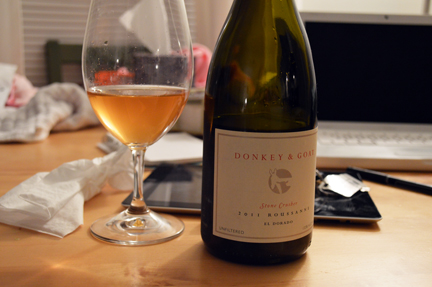
And so we opened the 2011 Roussanne Stone Crusher by Donkey & Goat: Natural, orange, oxidized, crunchy, salty, and tannic (paired with roast chicken).

I couldn’t help but think of all the people who have been hating on orange wines over the last few weeks. (Richard Betts writing for Forbes.com quoting the Hose Master? Give me a fucking break.)

Why people get so freaked out about Natural wine, about orange wine, about wine that the rest of us like to drink… I’ll never understand.

I don’t go about telling the rich people how much their wine sucks.

Yesterday, someone tried to impress me with a bottle of The Prisoner and I simply replied, “well, it’s not really my speed.”

To the haters, I say, I know, it’s only orange wine, but I like it.

If I could win ya, if I could sing ya
A love song so divine
Would it be enough for your cheating heart
If I broke down and cried? If I cried?

Checking in with 07 Barbaresco & Samantha’s unbelievably delicious roasted salsa

best roast salsa recipe

Saturday night dinner at our house began with a nosh inhalation of homemade roast salsa that had been generously sent to us by one of my all-time favorite wine bloggers, Samantha Sans Dosage.

If you don’t know her excellent blog, check it out. Not only do I entirely dig and follow her writing, I also feel a blogging kinship with her: we don’t really write wine blogs per se; we write blogs about our lives, our families, our loves, our fears… the stuff we drink and the stuff we eat… our music and our dreams… And for her family, as for ours, wine is nearly always a centerpiece of the dinner table.

Her salsa arrived via UPS on Friday (yes, it’s legal to ship salsa to Texas!) and by Sunday morning it was gone. It was THAT good.

Central Texas is a chili pepper and salsa mecca and I’m proud to say that this entry from my home state kicked some serious flaming salsa ass… Thanks again, Samantha! We LOVED it! And it paired brilliantly with a glass of 2011 Roussanne Stone Crusher by Donkey and Goat, orange and Natural and just slightly oxidative.

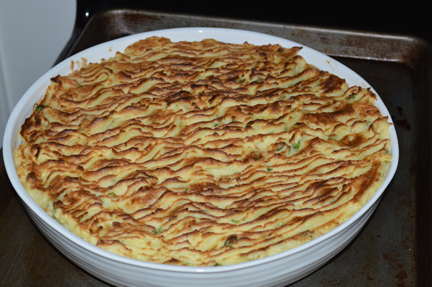
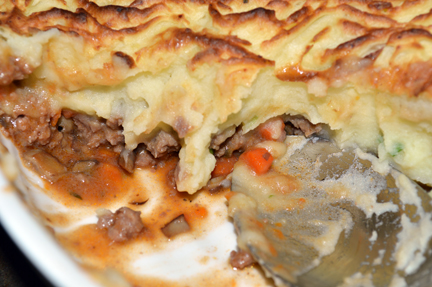
shepherd pie with beef

Tracie P, who’s eating for two these days, had a hankering for shepherd’s pie (which she made with ground beef instead of lamb).

best shepherd pie recipe

It’s been really chilly down here in Texas and the dish filled the house with snuggly warmth and cozy aromas.

Georgia P scarfed it down like there was no tomorrow!

produttori del barbaresco 2007

Italian Wine Geek’s recent post on a visit to the winery had me hankering for some Produttori del Barbaresco and so I decided to open a bottle of the 2007 classic Barbaresco.

If you follow along here, you know what huge fans we are of the winery and the wines, the collectibility and the affordability.

But I have to report that the wine is going through a very closed phase right now. Its tannin dominated its fruit and its earthiness, however delicious and satisfying, was dark and concentrated.

I never recommend not to open a given wine and I’m always thrilled to taste anything by Produttori del Barbaresco. But it’s time to put the 2007 classic Barbaresco back in the cellar and let it chill out for a while.

The fact that its so tight right now is a great sign, in my view (I saved two glasses for Sunday night and it was just as closed). This is going to be a spectacular wine. It’s just really restrained right now. This is typical for these wines (which I have followed for nearly fifteen years now): they have an initial period of brightness and then shut down. There’s no doubt in my mind that all of that dark earth and tannin will become a savory complement to the wine’s fruit once it begins to emerge again.

Anyway, that’s all I have to report from a quiet weekend at home here in the River City. Happy inauguration day, everyone!

Glera, “the name is horrible but…” #Prosecco

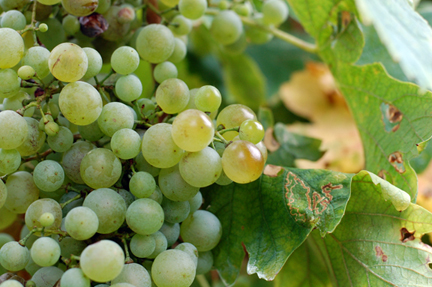
best prosecco glera

Jancis Robinson’s Wine Grapes (Robinson, Harding, and Vouillamoz, Ecco [HarperCollins], London-New York, 2012) is an oenographic watershed, an unrivaled ampelographic achievement.

And it’s also an expression of the Zeitgeist.

One of the more stunning contributions of Robinson’s new book is the authors’ impressive scholarly approach to the origins of grape names.

We, the oeno-aware, are part of a generation that pays more attention to ampelonyms (grape names) than any that came before us.

Here on my blog, as I have tried to debunk the many erroneous folk etymologies for Italian grape names that appear over and over in wine books, wine journalism, and wine blogging (e.g., Sangiovese and Aglianico, among many others).

Most of these folk etymologies can be attributed to spotty scholarship and the lack of interest in ampelography beyond the world of viticulture.

The bottom line is that until our generation, the wine world — grape growers, winemakers and bottlers, and ampelographers — weren’t particularly interested in the origins of grape names.

But that doesn’t stop us from wanting to know the why and where of grape names.

As Nietzsche wrote (particularly in The Twilight of the Idols), human nature drives us to attribute meaning to every sign around us (he was a precursor to post-Modernism in this regard). We are compelled to align the signified and the signifier. We need to understand why things have their names. This is one of the reasons that we find so much pleasure in etymology, even when faced with the hard fact that etymology and philology are intrinsically inexact science.

As wine has played an increasingly important role in popular culture, our interest in the origins of grape names has grown accordingly.

I have been particularly impressed with the Wine Grapes entry for “Prosecco” (pp. 853-854).

Here’s an excerpt of what the editors, who do not refrain from editorializing, have to say:

Prosecco, “[t]he dominant, rather neutral grape for Prosecco sparkling wine, probably Istrian,” they write in the entry’s subtitle. “Misleadingly renamed Glera for commercially protective reasons.”

    As part of the promotion of Prosecco di Conegliano-Valdobbiadene to DOCG status and the enlargement of the Prosecco DOC zone in 2009, the Prosecco Consorzio set in motion an official name change so that this principal grape variety is known as Glera, its supposed Friulian synonym, and Prosecco is reserved for the designation of origin, effectively preventing producers from other regions or countries taking advantage of the name Prosecco to designate any old sparkling wine…

    This amendment is both confusing and misleading: Glera is a generic name applied to several distinct varieties in the province of Trieste, and recent studies have shown that Glera in fact usually refers to Prosecco Lungo and much less frequently to Prosecco (Tondo) and other local varieties from the Karst region such as Vitovska, or the non-cultivated Aghedone and Mocula.

With this entry fresh in my mind, I asked Prosecco producer Luca Ferraro (whose English-language blog I curate) to share his thoughts on Glera.

“The name ‘Glera’ is horrible,” he told me, “But…”

Click here to read what he had to say.