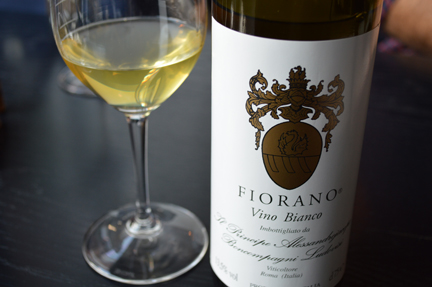
Above: The 2010 Fiorano Bianco is made mostly from Viognier, which dominates its aromatic profile. I thought the wine was stunning, with great balance, acidity, and nuanced stone fruit flavor. The wines are not yet available in the U.S. but I recently tasted a bottle that had been brought here by Philadelphia-based wine professional Jason Malumed, who had bought them in Rome.
Few members of the New York fine wine scene — myself included — will forget Eric “the Red” Asimov’s excellent 2004 article “An Italian Prince and His Magic Cellar” for the New York Times.
The piece described the long-lived white wines of Roman prince Alberico Boncompagni Ludovisi and Eric’s visit to his mysterious and magical cellar with its large-format casks covered by foamy mold.
It was such an important moment for Italian wine in New York and the nation. The Italian wine renaissance was just beginning to take shape here and Eric’s essay was one of the first to be devoted exclusively to one of Italy’s great white wines.
In those years, when Friuli was just beginning to emerge as a leading producer of fine white wine and you could still find Verdicchio in a fish-shaped bottle at the super market, most looked to Italy only for reds.
But Eric’s tale — and the subsequent arrival of the wines in the U.S. — spoke loudly to many of us, especially because it took note of Italian whites. Eric was already a champion of Italian wine (he often writes about his passion for the category today) and the story bolstered our belief that Italian wine would be delivered from the dusty obscurity rendered by its 1970s marketing blunders.
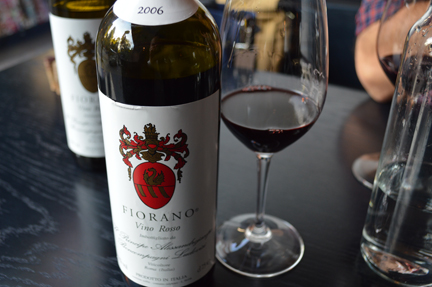
Above: The 2006 red, a Bordeaux blend in which Cabernet Franc dominated the tasting profile, was also excellent, with earthy and goudron notes on the nose and vibrant acidity and austere red fruit in the mouth. I’d love to revisit this still youthful wine in another 5-10 years. I can’t thank Jason enough for sharing them with me.
A few weeks ago, Eric wrote about the wines again in an article entitled “Fiorano Wine Estate in Italy Making a Comeback.”
Have a look at his piece for the background on the estate but to sum it up briefly here, it’s an Italian story as classic as it is tragic: after the prince died, some of the historic vineyards became the property of his son-in-law Piero Antinori and the winery, trademark, and other vineyards went to a biological heir, “Alessandrojacopo Boncompagni Ludovisi, a cousin of the prince, who had been living on the property and who had bought several parcels on the estate from the prince.”
Again, see Eric’s piece for background and see also Charles Scicolone’s excellent post on his recent visit with Alessia Antinori (the prince’s granddaughter) who now manages the vineyards and is planning to relaunch the wines under a new Fiorano label.
I had the good fortune to taste the wines made by Alessandrojacopo on my recent trip to the east coast (thank you, again, Jason!). And I thought they were excellent.
They had been purchased at Trimani, the famous wine shop in Rome.
I was told that the owners of Trimani believe that Alessandrojacopo’s wines represent the prince’s true legacy.
Many in the Italian wine trade believe that the prince attempted to destroy his vines before his passing because he feared that Antinori would use them to make a modern-style wine.
It’s probably true (see the translation below) but does it really matter anymore? When the prince — a pioneer of chemical-free farming in Italy — died in 2005, Italian wine was at a crossroads and it appeared that modernism (note the -ism) would prevail over the classic. But today, that trend has been reversed.
The only thing I know for certain is that it makes for a great story.
Here’s my translation of Luigi Veronelli’s 2001 interview with the prince…
Since 1934, when I [Prince Alberico Boncompagni Ludovisi] was sixteen years old, the use of industrially produced chemicals in land management has never seemed wise to me.
The Fiorano estate began to produce wine around 1930 using local grape varieties. In 1946, when I received the property from my father, I judged the wine to be inferior and consulted with Dr. Giuseppe Palieri who was producing wine on the Maccarese estate about 20 kilometers southwest of Rome. Dr. Palieri suggested that I graft Cabernet and Merlot to my vines for the reds, 50% of the one and the other, and Malvasia di Candia and Semillon for the whites. I continued to rely on Dr. Palieri for the rest of his life. Dr. Tancredi Biondi Santi subsequently became my enologist and continued to work with me until his passing.
I pulled out almost all of my vines because of advanced age and poor health and the advanced age of the vines. But I still produce a small amount of wine from Cabernet and Merlot grapes, blended in equal amounts.
My three granddaughters [Albiera, Allegra, and Alessia] have inherited their interest in wine not from me but from their father Piero [Antinori], an eminent producer of fine wine.






 Do Bianchi