Italy’s sexiest (?) winemaker pronounces Friulian grapes

sexiest winemaker italy

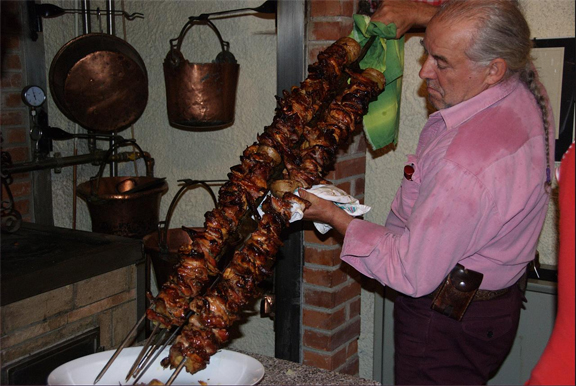
Above: is Mario Zanusso Italy’s sexiest winemaker? (image via Brunellos Have More Fun).

Mario Zanusso (above) of I Clivi is giving Francesco De Franco (pronouncer of Gaglioppo) a run for his money as the sexiest contributor to the Italian Grape Name and Appellation Pronunciation Project, my personal quest to capture native speakers on video as they pronounce their region’s enonyms and designations.

Today’s contribution comes via Marie Tyler, who works with I Clivi’s U.S. importer, Oliver McCrum.

See Oliver’s excellent page on I Clivi here and see also Hawk Wakawaka’s superb post on a tasting that she and I attended with Mario a few years ago.

I’m always looking for new entries: just be sure that I don’t already have the grape name or appellation covered and note the format that I use (the grape name or appellation, pronounced three times, clearly, in a normal speaking voice).

Hizzoner’s Falanghina: Mustilli’s Bill de Blasio label

bz C156696

Above: British mapmaker and illustrator David Atkinson’s label for Mustilli’s “Bill de Blasio” Falanghina.

The tiny, picturesque medieval hamlet of Sant’Agata dei Goti, in the heart of Campania’s wine country in Benevento province, has gone a little Bill-de-Blasio crazy since he was elected mayor of New York in November of last year. (See this piece in the New York Times; the slideshow is priceless.)

De Blasio’s grandparents lived in Sant’Agata before they immigrated to the U.S. in the early twentieth century.

Across Italy, De Blasio’s election has been a source of great pride and Forkgate has been closely followed by Italians and Italian food and wine writers (although the Italians were a bit baffled by the episode that launched the scandal).

Honestly, I can’t remember the Italians getting so excited about Rudy Giuliani (whose grandparents came from Montecatini, Tuscany). But then again, Giuliani was a republican.

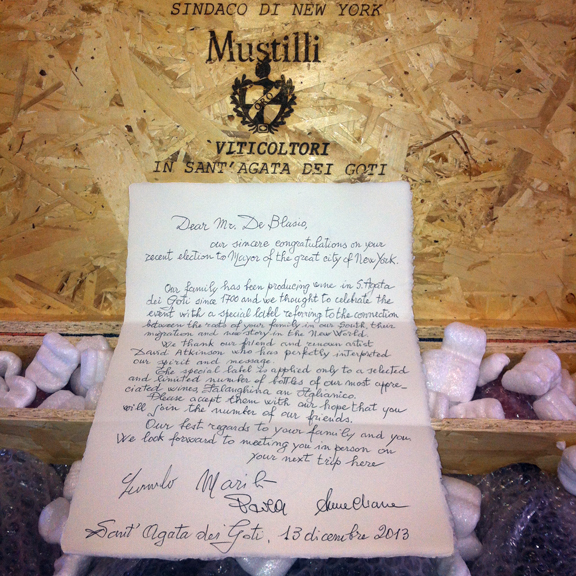
A few days ago, I received the following note and a few images from Paola Mustilli, whose family makes some of my favorite expressions of native Campania grapes. She’s dedicated two labels to the new mayor.

*****

The idea for a wine dedicated to Bill de Blasio came about when he was elected mayor [of New York] and we decided to commission a label that represented the connection between Little Italy and Sant’Agata [dei Goti], the town where his grandparents lived before they immigrated to America in the 1920s.

We produced a limited edition of these labels, 50 each for two of our wines that we bottle in magnum, Falanghina and Aglianico. We sent him a wooden case with 4 magnums.

The artist who designed the label is Londoner David Atkinson, who has worked and continues to work with Château Latour, Decanter, Grants of St. James’s, the Wine Society, etc.

—Paola Mustilli

Mustilli letter

Mighty mighty Prosecco: record-breaking sales in 2013

best prosecco new york

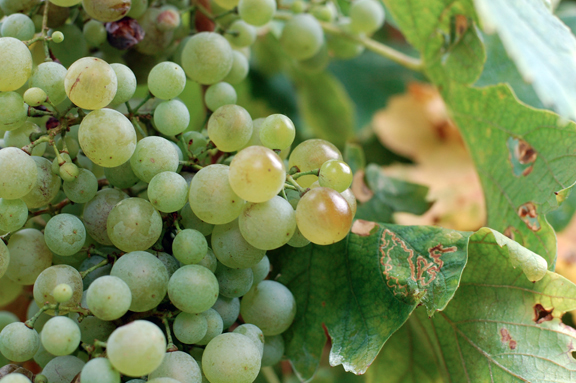
Above: the Glera grape, mighty mighty and letting it all hang out.

When I started out in this business in 1998, Prosecco was a wine known by few outside of northeastern Italy.

Back then, when someone handed party guests a glass of Prosecco in the U.S., it wasn’t uncommon that they would respond gleefully, “Champagne!”

Today, it’s not uncommon for the exact opposite to occur. And in many corners, Prosecco — in part thanks to its price-quality ratio and in part thanks to its ubiquity — has become the sparkling wine by antonomasia.

According to data published on Friday by the Italian wine trade publication Corriere Vinicolo and ISTAT (Italy’s national institute of statistics), Prosecco sales grew by 30% in 2013 and led Italian sparkling wine sales to a record high.

While Italian sparkling wine sales fell in Germany, a historically reliable market for the category, U.S. and U.K. sales were so strong that winemakers still managed to set new records. 2013 also saw nearly 80% growth in Italian sparkling wine sales in China.

It’s incredible to think that none of this was even conceivable fifteen years ago when a handful of Prosecco négociants set out to conquer the world.

I’ve posted an excerpted translation of the report on the Bele Casel blog. I hope you’ll find it as interesting as I did.

Mighty, mighty Prosecco, the little wine that could.

How many Master Sommeliers does it take to open a bottle of wine?

hans wirsching

Above: Hans Wirsching 2009 Sylvaner is what we drank to get us started. Put enough Master Sommeliers under one roof together and something delicious and geeky is bound to be opened.

Saturday night “happened” to find me at Mark Sayre’s newly renovated bar at Trio in the Four Seasons in downtown Austin, where the board of the Court of Master Sommeliers “happened” to be staying for a Court meeting.

I wasn’t exactly invited to the party that ensued. But some how I ended up in a hotel room where I was the only lay person, so to speak. Having five Master Sommeliers and one Master of Wine offering to pour me wine was — how can I put it? — a unique experience.

It was really interesting to meet MS Geoff Kruth, director of operations for the Guild of Sommeliers, and learn that he speaks Italian fluently and is an unabashed fan of the often forgotten Italian region of Molise. He had recently returned from a visit there and was raving about the venues where stayed and ate. His Italian and his knowledge of Italy are impressive, to say the least.

My conversation with MS Shayn Bjornholm, the court’s examination director, was also intriguing. He had a lot to say about the legacy of the 2012 film Somm (in which he appears) and how it has reshaped awareness of the court and its mission. Dialog was candid and he spoke of his personal investment in making hospitality, rather than wine connoisseurship, the primary focus of the court’s evolving curriculum.

It was also great to catch up with MS Bret Zimmerman, whom I know from my years in New York. He affirmed my conviction that Boulder, Colorado, where he runs the excellent Boulder Wine Merchant, is one of the (not so) new epicenters of North American enogastronomy.

And it was equally rewarding to hear MS (and Austinite) Craig Collins, wine director for the ELM Restaurant Group, talk about plans to develop a new Italian concept restaurant in Austin. He’s on his way to Rome, Chiantishire, and Montalcino for research.

The next morning, when Tracie P gently roused me from bed (after generously letting me sleep in), we couldn’t help but laugh about a comment a good friend and high-profile wine writer made when I told her I was moving to Austin five years ago.

“What will you drink?” she asked, deeply and genuinely concerned for my enogastronomic health.

Looking back now, “What won’t you drink?” would have been more to the point.

Brescian rotisserie (a translation) and Gily’s legal aid fund

spiedo bresciano

Above: a traditional “spiedo bresciano” must be roasted slowly for a minimum of four hours (image via M@rcello;-)’s Flickr, Creative Commons).

Click here for a fun translation that I posted today for my client Barone Pizzini in Franciacorta.

It’s culled from the “official designation” of Brescian rotissere according to the Oglio, Franciacorta, Lago d’Iseo Slow Food chapter.

And please click here for for Maurizio Gily’s legal aid fund.

If you haven’t read about Maurizio’s legal battle and the suppression of his freedom of speech, please click here.

He’s trying to raise €16,000 to cover his legal costs as he prepares his appeal.

I am just one of (literally) scores of Italian wine trade observers and wine lovers who have reposted the link on social media.

Neapolitan journalist and wine blogger Luciano Pignataro has posted the entire text of the judgment here (in Italian; as Luciano suggests, skip over the legalese and read the judge’s decision at the end).

Buon weekend

When wine writing really gets ugly: the sad truth about the Gily-Tessardi affaire

maurizio gily

Above: Wine writer, journalist, educator, publisher, blogger Maurizio Gily visited the Tonnellerie Chassin in Burgundy in 2011 (image via Tonnellerie Chassin). He reported his notes from the visit in an essay entitled “France and its Wooden Treasure: from forest to barrique, a heritage managed sustainably and safeguarded by the French government.”

Italian enonauts continue to reel in the wake of news that beloved Italian wine writer Maurizio Gily has been ordered to pay €5,000 to so-called journalist Paolo Tessardi for damage to the latter’s reputation in a blog post published in 2008.

The bottom line: Tessardi’s reporting of an Italian government investigation into wine adulteration in 2008 was inaccurate and sensationalistic; and Gily’s attempt set the record straight was vindicated by the fact that Tessardi’s claims proved to be untrue.

As Antonio Tomacelli noted on the popular wine blog Intravino today, Tessardi was censured by his editors at the time. The title of Antonio’s post: “Whisper the truth, shout the lie.”

Even the judge who presided over the case noted that Gily’s facts were correct. But Gily should have “shown more discretion” in “attacking” a colleague, he wrote.

Dulcis in fundo, here’s the icing on the cake: Tessardi only read Gily’s blog post three years later when everyone had forgotten about this sad episode in the annals of yellow-tinged Italian journalism!

I remember Tessardi’s piece well (as do many Italian wine trade observers). News of the Brunello controversy had just broke and the Italian wine trade fair, Vinitaly, had just begun.

The shocking and now infamous “Velenitaly” (Poisoned Italy) cover was on every newsstand. There was hysteria in the air. There were rumors that Italian paramilitary forces had stormed the fair and confiscated wine. With echoes of the 1986 methanol scandal, the damage to consumers’ perceptions of Italian wine was palpable.

Gily and his blog were Davids to Tessardi’s Goliath: L’Espresso, the magazine that published Tessardi’s sloppy reporting, is one of Italy’s top glossy weeklies, akin to Newsweek except for the liberal depictions of the female body in the former.

Maurizio is a wine writer, publisher of an excellent trade magazine and blog, Mille Vigne (A Thousand Vines), editor of numerous works devoted to Italian enology, an educator and lecturer, a scholar, a wine industry consultant, and one of the sweetest people you’ll ever meet in the world of Italian wine writing.

I have traveled and tasted with him and I have the utmost respect for his integrity and his professionalism.

And this whole thing just makes me sick…

umberto d

Above: that’s what I am feeling right now. Who is that man? It’s Umberto D.

Leading Italian wine writer convicted of defamation, forced to pay €5,000

velenitalyIn what is widely viewed as an egregious travesty of justice, leading Italian wine writer Maurizio Gily has been convicted of defamation in a case brought against him by Italian investigative reporter Paolo Tessardi. In a sentence handed down today, a judge in northern Italy ordered Gily to pay Tessardi €5,000 for damage to his reputation.

The case dates back to 2008 when Paolo Tessardi published his now infamous “Velenitaly” cover stories for L’Espresso, a popular glossy news magazine. Velenitaly is an amalgamation of veleno, meaning poison in Italian, and Vinitaly, the Italian wine industry’s annual trade fair held in Verona.

In Tessardi’s stories, he reported that hundreds of thousands of liters of Italian wine had been found to contain “poison.” He also claimed that Brunello producers were aware of the presence of toxins in their wine. The story appeared just a few days after news of the Brunello controversy of 2008 broke, when, in fact, a handful of Brunello producers had been accused of allegedly adding unauthorized grapes to their wines.

Tessardi’s articles appeared during the 2008 Vinitaly gathering.

Not long after, Gily — one of the country’s most respected wine writers — published a blog post on his Mille Vigne blog in which he contested Tessardi’s claims. Ultimately, none of Tessardi’s claims proved to be true.

In the judge’s ruling today, he noted that although Gily’s facts were correct, he had damaged Tessardi’s reputation.

In an interview posted by SlowFood today, Gily ascribes the urgency and vehemence of his blog post (subsequently removed) to the fact that Tessardi’s inaccurate reporting caused inestimable damage to consumers’ perceptions of Italian wine.

Tessardi only discovered Gily’s post three years later (thanks to an internet search). And he filed his complaint against Gily in the wake of his discovery, long after any memory of the Velenitaly story or Gily’s editorial had faded from public discourse.

Today on his blog, another leading Italian wine writer, Luciano Pignataro, remembered how Tessardi’s editor at the time, Enzo Vizzari, was so dismayed by the tide of criticism of Tessardi’s coverage, that he removed Tessardi’s blog from the magazine’s website.

As news of the sentence spread through Italian social media, scores of Italian wine trade members and observers have expressed their dismay and disgust.

“Well articulated lies and incontinent truths. This is Italy unfortunately. Solidarity for Maurizio Gily,” wrote Italian winemaker Marilena Barbera on her twitter today.

She was referring to the judge’s comment that Gily should have used “continence” (decorum or discretion) in his “personal attack” on Tessardi.

Gily has not yet decided whether or not to appeal the ruling.

Sources: SlowFood.it and Luciano Pignataro Wine Blog.

Angelo Gaja: Spain is our greatest competitor

angelo gaja winery

Above: Angelo Gaja in the Gaja tasting room in Barbaresco (photo taken in 2010).

The following is my translation of Angelo Gaja’s most recent “open letter,” posted today on Luciano Pignataro’s Wine Blog.

As the elder statesman of Italian wine, Angelo Gaja often shares his insights into future trends in Italian wine and the challenges faced today by Italian winemakers.

I hope you find his op-ed as interesting as I do. Buona lettura

*****

We need to remember that we Italians are not the only ones who produce wines made from historical/indigenous grape varieties.

Spain is the other country that has its own grape varieties and its grapes are different from ours.

Just to name a few, the following are some of the most well known varieties.

Reds: Tempranillo (in its different classifications as Tinto), Bobal, Garnacha Tina, Monastrell, Carinena, Mencia.

Whites: Airèn, Pardina, Macabeo, Palomino, Albarino, Godello, Verdejo.

Spain doesn’t have as many as Italy. But like Italy, it has a wealth of grape varieties. As in Italy, Spain’s international grape varieties represent a minority.

There’s no doubt that foreign consumers and lovers of native/indigenous grape varieties view Italy and Spain as the leaders.

Official data on Spanish wine production are still not available.

According to estimates, the 2013 harvest in Spain should be around 46 million hectoliters. If that number were to grow — and we will find out in a few months — Spain could become the leading producer of wine in the world and would overtake Italy by a hair.

In terms of volume sold abroad, Spain is in second place not far behind Italy.

The average price of a liter of exported Spanish wine is less than half of the average price in Italy, where prices are already relatively low. As a result, in foreign markets, Spanish wines are seen as an excellent value for their quality. Spain is also able to offer the lowest prices for bulk wine.

Continue reading

Op-ed: “It’s time for Chianti Classico subzones,” says Roberto Stucchi

chianti subzones

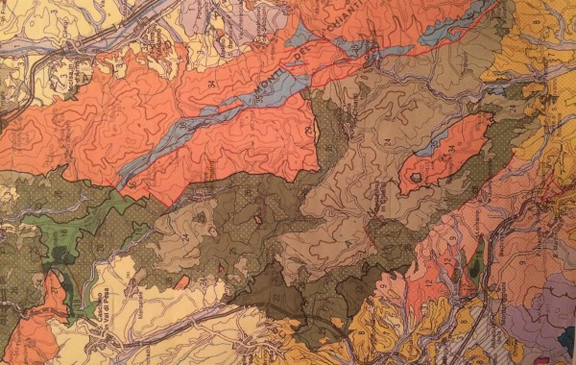
Above: a geological survey of the Chianti Classico DOCG was presented by a group of leading grape growers and winemakers in Florence in December, 2013.

Yesterday, Italian wine writer and wine professional Andrea Gori published his notes from a Chianti Classico subzone held in Florence in early December 2013.

(Even if you don’t speak Italian, I highly recommend watching this video, included in Andrea’s post, in which enologist Maurizio Castelli — “heir to the Giulio Gambelli legacy,” as Andrea calls him — presents his overview of Chianti and its subzones.)

The conference, organized by Sangiovese activist Davide Bonucci, was as controversial as it was significant.

Many in the Chianti DOC oppose subzoning and even though the list of presenters included some of the appellation’s top names (Maurizio Castelli, Niccolò Montecchi, Roberto Stucchi, Sebastiano Capponi, Tommaso Marrochesi Marzi), the Chianti Classico consortium was loudly absent from the proceedings.

Yesterday, winemaker Roberto Stucchi sent me the following essay.

*****

The Evolution of Chianti Classico
by Roberto Stucchi

The time has arrived for Chianti Classico to evolve towards its natural future, by recognizing, describing, and communicating (and possibly regulating) the local communal and village appellations that compose this beautiful territory.

This zone is too large and diverse to remain locked in the current DOCG regulations, which make no distinction between the extremely diverse expressions of Sangiovese in its original territory.

The first natural level of evolution above the simple “Chianti Classico” appellation would be naming the Comune [township] of origin of the grapes for wines that truly represent their territory.

Continue reading

Blues people: Amiri Baraka poet, scholar, & playwright dies at 79

amiri baraka

Above: Amiri Baraka in 2007 (image via the Wiki).

When the email arrived yesterday, it hit me in the chest like a brick: Amiri Baraka, poet, scholar, musicologist, dramatist, and one of the greatest artists of our generation, died yesterday in New Jersey.

I had the opportunity to hear him speak and recite his works on many occasions. He was a close friend of my dissertation advisor Luigi Ballerini.

Continue reading