Arrivederci, Austin, thanks for the memories & #bbq @StilesSwitchBBQ

best bbq austin texas

On Sunday night, we hosted the last dinner party at our house in Austin at the corner of Alegria and Gr[o]over.

The Rosenberg cousins and a smattering of Levy cousins stopped by for Stiles Switch bbq and white Chinon (we also served some Grüner Veltliner, Soave, and Langhe Nebbiolo).

We lived for four years in that wonderful little house.

We conceived one of our girls there and brought both of them home there.

My band wrote and tracked a record there in my office/studio (including one of my favorite tracks of all time, Nadia).

We had so many great parties and opened so many unforgettable bottles of wine there.

Those four years and that house saw us build a new business, dig ourselves out of debt, and start a beautiful family.

We lived, we loved, we laughed, and we cried tears of joy there.

Arrivederci, Austin… You are truly the “groover’s paradise.”

Wish us luck for our move to Houston tomorrow! I’ll be taking the next few days off from blogging. See you on the other side! And thanks for all your support over the last four years. It means the world to us.

How to order wine in a restaurant (without feeling like an idiot)

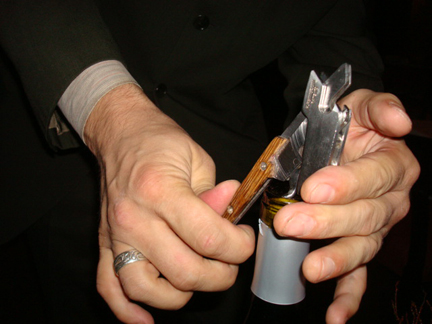
cork screw best wine key

Tracie P and I feel so lucky to to belong to the international wine professional community.

We can travel to LA, San Francisco, New York, Langa, Siena, Rome, and even Paris, and our industry friends and colleagues always welcome us with professional courtesy.

But I also know what it’s like to feel the cold shoulder of the trade when I visit an unfamiliar venue.

It’s sad but it’s true: we all know that feeling of being seated at the “kids table” in a restaurant where there’s no previously established relationship.

In my post today for the Houston Press, I am brutally honest when I write that I’ve been treated like shit by snotty sommeliers (the exception to the rule, no doubt, but unfortunately something that happens more often that you’d like to think).

I’ll never forget the snooty sommelier in NYC who refused to pour me a 96 Poderi Colla Barolo Dardi Le Rose because she thought it was “too tannic for someone like me.”

I’ll never forget the absurdist sommelier in Chicago with a tongue pierce who refused to even consider that a 95 Grivot Clos de Vougeot was corked (there wasn’t even an offer of something by-the-glass as he turned to lecture the table next to mine on Sagrantino).

I’ll never forget the holier-than-thou sommelier at a Michelin 3-Star in Padua who lectured me on Rio Sordo after pouring me a über-barriqued, cherry-cough-syrup-flavored wine from my least favorite producer of the cru, even after I had told him that I like traditional-style Nebbiolo. Why bother telling him that my wife and I slept at the top of Rio Sordo on our honeymoon at the Cascina delle Rose?

This type of thing happens to the best of us.

And it happens to the little people like me, too.

Here’s my post today for the Houston Press on “How to order a bottle of wine in a restaurant (without feeling like an idiot).”

Is @WineEnthusiast biased when it comes to Italian whites? Time to cast off stereotypes

bonci verdicchio

Above: in November of last year, Steven Wildy poured this 1998 Bonci Verdicchio dei Castelli di Jesi for Paolo Cantele, 1WineDude, and me. Here’s what 1WineDude had to say about it: “This was a stupidly good bottle of wine; earthy, oily, unctuous, citric, spicy, alive, piquant. ‘Tired’ is not a word that seems to have entered its vocabulary at any point in the last fifteen years. As impressive as how well it wore its age was the fact that its round, toasty, nutty finish felt like it was going to last another fifteen years…”

Last week, the editor of the SlowWine guide, Giancarlo Gariglio, posted an editorial entitled, “The destiny of Italian whites? Pessimist! The sink, according to Wine Enthusiast” (“Il destino dei bianchi italici? Pessimist! Per Wine Enthusiast il lavandino”).

“It wasn’t easy to keep our comments in check after we read a special edition like the one that appeared in the February issue of Wine Enthusiast,” writes Gariglio. “It included ‘The World’s Greatest Vintage Chart’: the list of the best vintages across the world. Well, if it were a joke, they could have told us on the cover, which trumpets the chart in block capitals. We purchased a copy at the San Francisco airport and we began laughing and didn’t stop until we reached Chicago, after four hours in the air.”

Gariglio goes on to lament the fact wines like Soave (“one of Italy’s greatest whites”) are broadly dismissed by the magazine’s editors as “undrinkable” beyond six years of age: “How can they write that the whites of the Veneto — as if the were all the same — are ‘in decline, maybe undrinkable’ from 2008 and beyond? This is terrible!”

The only explanation, he posits, noting that “it’s not an excuse,” is that the editors have not tasted a sufficient number of aged Italian whites.

(Click here for the Wine Enthusiast post where the editors present the list.)

borgo tiglio ronco chiesa

Above: I drank this 1999 Borgo del Tiglio Ronco della Chiesa back in October of 2013. It was one of the best wines I’ve ever had in my life.

“All those over-the-hill whites?” asks Avellino producer Lello Tornatore of Tenuta Montelaura in a comment. “Tell me where they are and I’ll go fetch them!”

It’s hard not to share Gariglio’s disbelief and frustration.

Think of all the incredible Italian whites with immense aging potential like those from Friuli, Veneto, Campania, and Marche, not to mention wines like Fiorano from Lazio or Valentini from Abruzzo.

How could I forget a bottle of 1988 Bucci Verdicchio dei Castelli Jesi Riserva that I drank back in 2007 in New York? It was stunning.

1999 Borgo del Tiglio Ronco della Chiesa (above)? 1994 Gaia e Rey that I tasted with Angelo and Gaia in Barbaresco in 2010? I’ll never forget how Angelo was so thrilled with the results of that terribly difficult, rainy vintage, “a surprise,” he said.

venica 1989

Above: 1989 was a superb year in northern Italy, as this gorgeous bottle of Venica Tocai demonstrated a few years ago when Tracie P and visited our good friends Giampaolo and Chiara Venica.

For the most part, the Wine Enthusiast vintage chart aligns with conventional wisdom and experience — even in regard to Italy.

But the sweeping brushstrokes that elide the great Italian whites represent a lacuna — I can’t think of a better word to describe it — in the editors’ attention to Italian viticulture.

In all fairness to them, the Italians’ marketing focus in the 1990s and 2000s was on big, American-friendly red wines.

As one (very high-profile) commenter to Gariglio’s post notes, Italians haven’t done the greatest job of marketing their white wines to English-language media.

France is uniquely positioned when it comes to its dominance in the realm of white wine. And historically, Italy has always played the part of the white step-child, even as its reds have begun to compete on an international level with the best of the French.

In his 1980 Vino, Burton Anderson compared the wines of Valentini to some of the greatest expressions of Montrachet.

But therein lies the rub: many English-language writers feel obliged to compare Italian wines to French when it comes to describing their greatness.

It’s time for English-language media to cast off the stereotypes and bias of past generations.

Thanks for reading…

Italy mourns the loss of pioneering Basilicata chef Frank Rizzuti

cucina del sud basilicata potenza

Above: Chef Frank Rizzuti (image via Dissapore).

Today, Italy’s wine and food community mourns the loss of pioneering Basilicata chef Frank Rizzuti, who has died of an unspecified illness.

Across the Italian enogastronomic blogosphere, Chef Rizzuti — the first Basilicata chef to receive a Michelin star — is being remembered today for drawing international attention to the burgeoning fine dining circuit in Basilicata, a region seldom visited by foreigners and often overlooked by the Italian food media.

Click here to continue reading…

Panic in Montalcino over a reported seizure (a false alarm)

mt amiata

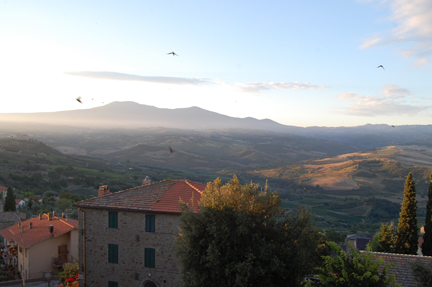
Above: a view of Mt. Amiata from Castelnuovo dell’Abate in the southeastern subzone of Montalcino.

On Friday, the Italian news agency ANSA (akin to our UPI or Associated Press) reported that 445 hectoliters of wine had been confiscated at a “noted” winery in Montalcino. It did not name the winery in question but claimed that the wine had been seized by the Italian forest service and by the anti-adulteration arm of the national police because of “hygienic and sanitary” infractions.

The title of the post was “Massive confiscation of wine in Montalcino.”

Over the weekend, the story was picked up by numerous mastheads, including some of Italy’s leading dailies.

The Brunello consortium responded swiftly with a blog post.

The seizure, says consortium President Fabrizio Bindocci in the post, had nothing to do with “issues related to appellation oversight,” although neither he nor the consortium specify what charges have been filed against the winery owner or why the wine was seized.

A source in Montalcino, who asked to remain anonymous because of the delicate nature of the report, has informed me that the seizure had nothing to do with adulterated wine or sanitary issues. It stemmed, in fact, from the winery owners’ failure to obtain required permits for a recently completed facility on the estate.

Tragically, Italy’s arcane and often heavy-handed bureaucracy, combined with its long-standing tradition of yellow journalism, has dealt another blow to consumers’ perceptions of Brunello di Montalcino, where memories of the 2008 adulteration controversy are still fresh and wounds still raw.

The saddest thing, in my view, is how no one on the ground in Montalcino has the courage to “get in front” of stories like this and embrace transparency over obfuscation.

This is an instance, no doubt, where transparency could lead to more veracity in reporting of events there.

The winery in question — a lower-end, commercial producer of Brunello, whose wines make it to the U.S. – should have taken responsibility for the “brand damage” and issued a statement itself.

Italian Winery Designations Project: masseria #TermOfTheDay

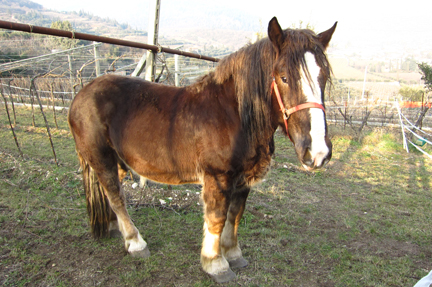
Masseria (suggested by Shelley Lindgren) is the latest entry in my ever expanding Italian Winery Designations Project. If you have a winery-related term that you’d like me to include, please let me know in the comment section.
italian horse

masseria, country house, estate, from the post-classical Latin mansus, mansum, mansa, meaning dwelling, house, homestead, or manor (from the Latin manere, to remain), akin to the French mas and the English manse.

The term masseria (pronounced mahs-seh-REE-ah) is used primarily in southern Italy and most widely in Puglia to denote a country estate.

*****

azienda, landed property, estate, domestic work, from the Spanish hacienda, from the Latin facienda meaning things to be done from facere, to do.

The term azienda means business and is used to denote a company or firm in Italian. An azienda agricola is a farming business; an azienda vinicola is a winery (a wine business).

ca’, see entry for casa.

cantina, literally cellar or cool place to store perishable goods and by extension tavern, probably from the Italian canto meaning angle or corner from the Greek kampthos, bend or angle.

The word cantina has a wide variety of applications in Italy (often used for restaurants and food stores, as well as wineries) and can be found across Italy to denote wine cellar.

casa, literally, a building, house, or habitation, from the Latin casa, a small house, cottage, hut, cabin, shed.

The term casa is used throughout Italy as a winery designation and is often abbreviated as ca’, as in Ca’ del Bosco (it’s important to note that it’s often erroneously abbreviated as Cà [using the accent grave diacritic], when in fact the inverted comma [‘] denotes the elision of the final two letters, often derived from a dialectal locution). A casa vinicola (pronounced KAH-sah vee-NEE-koh-lah) is a winery/négociant.

cascina, farm house or other structure used to house livestock or farm tools, from the late Latin capsia meaning case or receptacle.

It can also denote a structure used to store cheese and other dairy products. The term is used primarily northern Italy and especially in Piedmont to denote a farmhouse or winery or dairy farm.

fattoria, farm, from the Latin factore, literally maker, from facere meaning to do.

You find usage of fattoria generally in Tuscany where it can denote a winery or a farm, keeping in mind that most wine-producing estates in Tuscany also grow olives and other crops.

podere, country estate with farm house (according to the Zingarelli dictionary), akin to the Italian potere, meaning can or to have the ability to do, from the late Latin, potere, from the Latin possum, meaning to be able, have power.

The term is used today primarily in Tuscany where it denotes, literally, a seat of [agricultural] power, hence the late Latin origin of the word, potere, literally power or possession (who also share kinship with the Latin etymon). According to the Cortelazzo etymological dictionary, the word first appears in the Middle Ages in northern Italy.

poggio, hill, from the Latin podium, meaning an elevated place, a height.

As Virgil wrote famously, Bacchus amat colles, Bacchus loves hills. The usage of poggio in Tuscany is documented dating back to the thirteenth century and the term appears in Dante. There are many related words like poggiolo, poggiuolo, and poggione.

ronco, literally a growing site on a hill used for farming, from the Latin runco, meaning to weed out, root up; to weed, clear of weeds, akin to the Friulian dialectal term ronc.

To my knowledge, ronco is used exclusively in Friuli. Akin to the Italian roncola or pruning hook, it probably comes from the past participle of the Friulian runcar (to clear of weeds, runcà, in other words, a site cleared for planting.

tenuta, a [land] holding or property, past participle of the Italian tenere, from the Latin teneo, meaning to hold, have, or keep.

Tenuta is a term that you see applied across northern and central Italy. Its relation to the pre-industrial age, when land ownership denoted nobility, is clear.

vignaiolo (plural vignaioli), vine tender or grape grower, derived from the Italian vigna, meaning vine, from the Latin vinea, vineyard, from the Latin vinum, wine.

Pronounced VEEN-y’eye-OH-loh (plural VEEN-y’eye-OH-lee), vignaiolo is used to denote a winery that uses estate-grown fruit in the production of its wines.

Carbonara: a clue to understanding its origins?

best carbonara recipe

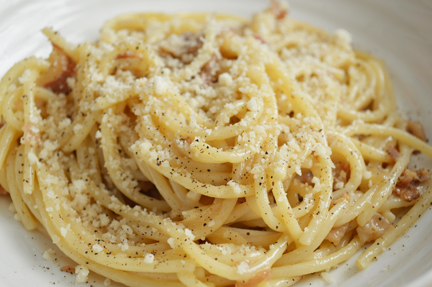
Above: My wife Tracie P’s Carbonara. As Charles Scicolone would say, I am truly blessed.

Italian cuisine is a world cuisine.

Even in its most perverse expressions (Olive Garden?), it is immediately and unmistakably recognizable.

And while French haute cuisine remains one of world’s benchmark for fine dining, Italian gastronomy is perhaps the world’s most widely embraced culinary tradition. Consider the fact that pan-Asian cookery is only now beginning to find a solid foothold in Europe whereas pseudo-Italian restaurateurship and Italian food products have been wildly popular in Asia for decades now.

One of Italian gastronomy’s greatest strengths is its ability to assimilate other culinary traditions and foods.

Where would Italy be without tomatoes, a New World fruit that first made it to the country during the Renaissance and only became popular after the second world war?

Where would Italy be without corn, a New World grain that became widely cultivated there during the nineteenth-century famines?

Where would Italy be without Norway’s salt cod, a food stuff that came into fashion in Italy during the Renaissance when land-locked principalities needed readily available fish to meet the Church’s rigid dietary restrictions (which prohibited meat on many days of the year)?

Continue reading

How Italians eat hamburgers (Italy’s hamburger mania)

italian hamburger

Above: as far as Italian hamburgers go, my personal favorite can be found at Vittorio Fusari’s amazing Dispensa Pani e Vini in Franciacorta, where the Brescians’ already healthy appetite for beef has been augmented by the burger craze. Vittorio’s is unconventional but utterly delicious.

It seems that Italy has come along way since Katie Parla’s often fruitless search for a great burger in Rome in 2011.

If, like me, you follow Italian food blogs like Dissapore, Puntarella Rossa, or Scatti di Gusto (whose editor Massimo Bernardi also pulls the strings at Dissapore), you know that the last two years have seen an explosion in Italians’ maniacal passion for hamburgers (#NotHyperbole).

best hamburger italy

Source: Puntarella Rossa.

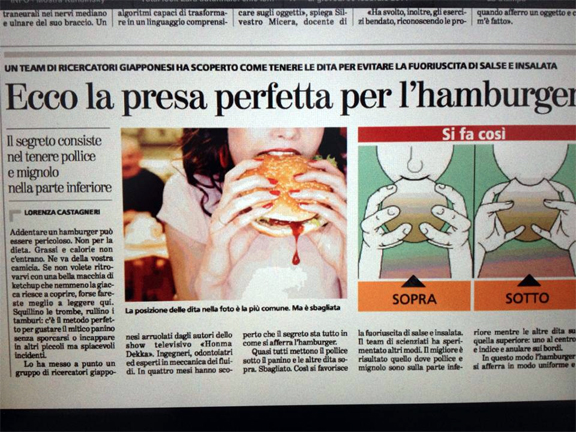
Just when we though we’d never hear another lament about Italy’s hamburger obsession from Joe Bastianich (who has complained that hamburgers are the only thing that guests at his newish restaurant, Orso in Friuli, ever talk about), the Italian hamburger mania has reached a new zenith with an article on “how to sink your teeth [addentare] into a hamburger” and the “perfect hold” for a hamburger, published yesterday by the Italian national daily La Stampa.

Continue reading

Houston, we have a wine storage problem…

best wine storage houston texas

From the petroleum-set dick-waggers to the average punters, wine storage is big business in Texas, where the out-sized Texas heat is not the only issue that wine lovers need to deal with.

The larger problem is the bi-polar temperature swings that we have here (excuse the pun). On Tuesday, for example, our day started at roughly 30° F. and by mid-afternoon, the temperature in my home office, where the sun beats down as the day progresses, was 75° F.

My post today for the Houston Press offers some basic rules-of-thumb and our not-so-unique approach to dealing with our home wine storage issues (we keep our long-term aging lots in a wine storage facility in San Diego where rental lockers cost a lot less thanks to milder weather and there is greater accessibility for the middle class thanks to a more demotic wine culture).

The post is Texas-specific but I think you’ll find that the observations/recommendations are universal, especially if you’re an average punter like me.

Houston, we have a problem…

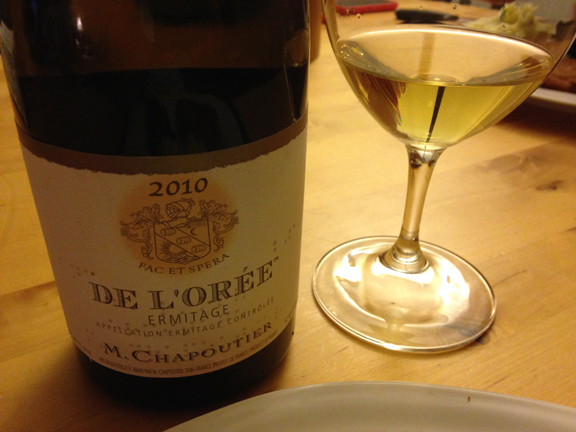
No regrets, coyote: great wine is for drinking & Ermitage de l’Orée is what we drank for our anniversary

chapoutier oree hermitage

I can’t stop thinking about the wine that Tracie P and I drank on Friday night for our fourth wedding anniversary: Chapoutier 2010 Ermitage de l’Orée (a heartfelt thanks, once again, to the overly generous collector who gave us this stunning bottle).

It was so rich and decadent in its texture, so unctuous in its dried stone fruit flavors, but equally vibrant with zinging acidity.

What a thrilling bottle of wine!

I was reminded of the bottle last night when a wine friend from Chicago, a high-powered attorney, messaged me asking me last-minute advice on where to take a client for dinner in Austin (they ended up at Trio, for the record).

“Contemplating infanticide of the 06 [Rougeard] Poyeux,” he wrote.

I love and deeply respect my friend and his superb wine knowledge and experience.

But I loathe the word infanticide (and I know that he was egging me on in camaraderie): I believe that wines are for drinking and that their potential (their “drinkability zenith,” as it were) is defined more by the company and the occasion than an abstract notion of when this wine will “drink” at its best.

Our exchange reminded me of an image in my mind from many years ago. I was in the home of a Siena baker (Contrada della Chiocciola) when he was visited by a wealthy Milanese businessman who had a second home in Montalcino. When the gentleman arrived, the baker — so moved by the presence of such an illustrious visitor — opened a bottle of current vintage Biondi Santi on the spot and poured it for us in bistro glasses. It was tannic and tight, frugal with its fruit, and it never tasted better…

best fried chicken austin texas

Yes, you can chart the linear development and evolution of wine but if you don’t enjoy it, what’s the point?

The De l’Orée certainly could have had many fine years ahead of it.

But on Friday night it paired magically with Tracie P’s breaded and fried chicken cutlets, garlic mashed potatoes, and wilted spinach drowned in extra-virgin olive oil.

After dinner, we lingered over the last glass, trading notes on the aromas, which seemed to intoxicate us more than the flavors or alcohol in this expression of 100% Marsanne.

I could have stashed this bottle away. Or I could have decanted it and expedited it.

But all I wanted to do was to drink it with you, Tracie P, my gorgeous wife and mother to our beautiful daughters.

Our fourth anniversary and the close of the year of marriage that delivered our second child merited a truly special bottle.

There was nowhere else I wanted to be. And I can’t stop thinking, joyfully, about that moment.

No regrets, coyote…