Chianti, a new theory on the choronym’s origins

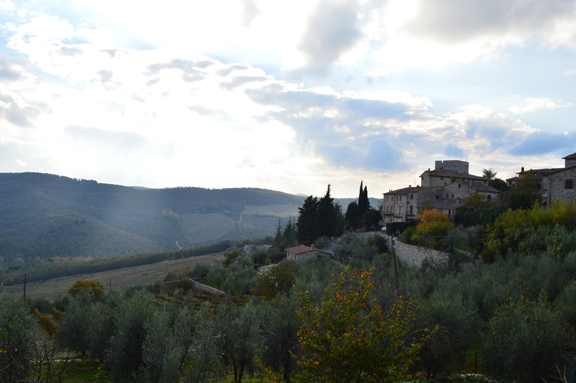
vertine village tuscany chiantiAbove: the village of Vertine in the heart of Chianti Classico.

I’ve spent the better part of my day reading up on all the literature devoted to the origins of the place name Chianti.

Chianti is what is known in toponomastics (the study of place names) as a choronym (Greek for chorus name), in other words, a place name that refers to a number of different places in the same general area.

In the early twentieth century, two theories as to its origins emerged.

On the one hand, scholars have speculated that it came from the Etruscan clante or clanti (the Etruscans were the ancient people who inhabited Italy before the rise of the Roman Empire).

Click here to continue reading my post today for La Porta di Vertine’s blog…

Grillo and Zibibbo as spoken by Antonino Barraco (and bonus track)

antonino barraco marsala grillo zibibboAbove: who better to “speak” Zibibbo and Grillo than winemaker and grape grower Antonino Barraco? He and I connected at the Vini Veri fair last month in Cerea (Verona province).

Here’s the latest installment of the Italian Grape Name and Appellation Pronunciation Project: Grillo and Zibibbo as pronounced by Antonino Barraco (a super cool dude, whom I met for the first time this year at Vini Veri).

While the pronunciation of Grillo (GREEL-loh) is relatively straightforward, the scansion of Zibibbo is not as intuitive as some may think.

In Italian grammar, words that come from Arabic (like Zibibbo) are pronounced with a stress on the first syllable — even when there is a stress on the syllable that follows.

Zibibbo, which comes from the Arabic zabib, is an example of this. Note how Antonino gives equal stress to the first and second syllable in his scansion.

Zabib means dried grape or raisin in Arabic. And it’s one of the many words that found their way into Sicilian during the height of Arabic culture in the Middle Ages, when, for example, Arabic mathematicians and philosophers were welcomed at the court of Holy Roman Emperor Frederick II in Palermo.

As a bonus track, I’ve included Antonino’s pronunciation of zbib, the Sicilian dialectal inflection of zabib.

Thanks again, Antonino!

Vittorio has left the building: Franciacorta icon heads to Milan to cook at Pont de Ferr

vittorio fusari pont de ferrIt felt like the end of an era: when Giovanni, Arianna, and I connected at the Dispensa Pani e Vini in the heart of Franciacorta on my second night in Italy last month, we were all a little blue because we knew that it was one of Vittorio Fusari’s last nights in the kitchen there.

I ate at the Dispensa for the first time not long after it opened in 2008. It was the same day that I met Giovanni for the first time. He would become one of my best friends and the accomplice in many of my capers.

In 2013, when Tracie P was pregnant with Lila Jane, she, Georgia, and I ate at the Dispensa three times in the course of 36 hours (although one of those meals was a to-go repast shared in our hotel).

THAT’s how much I love this restaurant and Vittorio’s cooking.

A few days before I arrived in Italy last month, Vittorio had announced that he had accepted a position as executive chef at the Michelin-starred Pont de Ferr in Milano.

“It’s a big commitment and although my family supports my decision,” he told me that night, “it’s going to be hard for all of us.”

It’s going to be hard on Franciacorta, too.

I wrote about our conversation and what it will mean for Franciacorta today for the Franciacorta, the Real Story blog.

I’ll be heading back to Franciacorta in a few weeks and I’ll visit the Dispensa for sure. After all, it’s the ideal location for Franciacorta visitors and franciacortini to congregate over a glass of sparkling wine. And I’m sure that the kitchen and verve of Vittorio’s cooking will continue to thrive there even as he oversees his staff from a distance.

But in the meantime, Vittorio has left the building…

Italian wine blogger Maurizio Gily absolved of wrongdoing in defamation case

maurizio gily journalist wine italyAbove: venerated Italian wine writer, blogger, and winery consultant Maurizio Gily (right) was toasted by members of the Italian Federation of Independent Grape Growers at Vinitaly last month.

In the days leading up to Vinitaly, Italy’s annual wine trade fair Verona, Maurizio Gily — one of the country’s most respected wine writers — announced that an appeals court had overturned a December 2013 ruling that required him to pay a €5,000 fine in a defamation suit brought against him.

The case stretches back to Vinitaly 2008, when Espresso contributor Paolo Tessardi published his sensationalist feature on “Velenitaly” or “poisoned Italy” (a play on Vinitaly). In it, he implicitly admonished Italian wine lovers to avoid consumption of Italian wines. And he implied that many commercially produced Italian wines contained life-threatening toxins.

Not long after, Gily — one of the country’s most respected wine writers — published a blog post on his Mille Vigne blog in which he contested Tessardi’s claims. Ultimately, none of Tessardi’s claims proved to be true.

In the judge’s ruling in 2013, he noted that although Gily’s facts were correct, he had damaged Tessardi’s reputation.

Gily ascribed the urgency and vehemence of his blog post (subsequently removed) to the fact that Tessardi’s inaccurate reporting caused inestimable damage to consumers’ perceptions of Italian wine.

Tessardi only discovered Gily’s post three years after its publication (thanks to an internet search). And he filed his complaint against Gily in the wake of his discovery, long after any memory of the Velenitaly story or Gily’s editorial had faded from public discourse.

After the initial ruling had been handed down — I remember well — Gily wondered if it would be easier to simply pay the fine and move on.

Instead, he decided to crowd-fund the financial resources needed to fight the judgement. Ultimately, he raised €15,000.

Just a few days before thousands of Italian wine professionals gathered in Verona for the fair this year, Gily made the announcement on his blog: “We have won and Italian wine as won.”

“I am happy and I don’t want to hide it,” he wrote. “At least today, at least here, in a tiny part of the world, justice has been served.”

Maurizio, thank you for standing up for all of us. Thank you for standing up for Italian wine!

Today’s post is just the first — and perhaps the most urgent — in my Vinitaly 2015 highlights. Stay tuned for my top tastes and other juicy nuggets!

The cycle of life: hag sameach and happy Easter to all

recipe shank passover beefAbove: in preparation for Erev Pesach tomorrow, I roasted a beef shank early this morning. I rubbed the shank with kosher salt and then extra-virgin olive oil. Then I roasted it in a 450° F. oven for 30 minutes to get it brown and crispy on the outside and finished for another 30 minutes at 350°. And yes, wow, whole wheat matzot! I could have never imagined that when I was a kid…

“Meet Annia Lucilla, our easter lamb, a true Roman,” wrote my friend Hande yesterday in a post on her Facebook. She’s a top Italian wine educator who grew up in Turkey and now lives and works in Rome. “Getting to know my meat before it hits my plate reminds me of the sacrifice feasts of my childhood.”

I thought of her post early this morning, Texas time, when I got up before the girls so that I could roast a beef shank for our Passover seder tomorrow night.

Of course, I didn’t get to meet the cow whose shank I bought yesterday at a local market. And we’re going to be having Jewish-style brisket for our main course tomorrow night: the shank serves solely as a symbolic component — the centerpiece — of our seder plate.

But her note and my own “sacrificial lamb” remind me of how the Passover, Easter, and the renewal and rebirth of spring are ancient traditions that bind us together in our humanity.

This year, Erev Pesach (the first night of the Passover) falls on Good Friday. The confluence reminds us that Easter has its roots in the Passover (most agree that Jesus’ “Last Supper” was a Passover celebration).

And Passover — as Jewish scholars widely acknowledge — has its roots in ancient pagan celebrations of spring.

In the Passover legend, the z’roa is a symbol of the Pesach sacrifice, a lamb that was offered by the ancient Jews in the Temple of Jerusalem on the first night the Passover festival. But the expiatory sacrifice of a lamb in springtime dates back to the Romans and beyond.

Just think of it: in a time before monotheism, the arrival of spring and warmer temperatures and the renewal of the vegetative cycle were gifts from the gods.

(On Saturday, btw, my client Bele Casel in Asolo posted an image of first bud break on its blog.)

It’s not hard to imagine why they were inspired to slaughter a lamb as an offering.

Here at the Parzen household, we’ll be celebrating the Passover tomorrow night with my mother, who’s flying in for the holiday. And then we’ll be heading to Orange in East Texas to paint Easter eggs and celebrate the holiday with Tracie P’s family.

I’ll be taking a break from the blog and from work until next week as I reconnect with family and recharge my spirits: it’s a time for renewal and rebirth.

O and we’ll be pairing 2013 Cirelli Montepulciano d’Abruzzo with our brisket tomorrow night.

Hag sameach — happy festival — and happy Easter to all! See you next week…

Happy 50th anniversary Tony!

jeremy parzen wifeThink how different the world was in 1965 when my friend and client Tony Vallone (above, right, with Tracie P) opened his first restaurant, Tony’s, in Houston.

President Johnson signed the Voting Rights Act into law that year.

It was the year of the Watts Riots.

The British Invasion was in full swing and the Beatles played their historic Shea Stadium concert that year.

And it was two years before Shell Oil hired Houston developer Gerald Hines to construct its new downtown headquarters.

I wasn’t born yet.

But that was the year that Tony headed down to the bait shops to buy calamari because no Houston fish mongers sold them.

It was the year that Tony fed his rented refrigerators with $7 in quarters every day (because he had no established credit).

I love that picture, above, taken in December 2010, a few years after I moved to Texas and a month shy of our first wedding anniversary.

It reminds me of all that I cherish in my relationship with Tony: he loves to talk about Italy, he loves to talk about food, he loves to talk about history… and he loves to talk about all the things that make us human.

Today marks the 50th anniversary of his restaurant and Houston Mayor Annise Parker has declared April 1 “Tony Vallone Day” (click here for the proclamation; guess who wrote it!).

Tony, you’ve cooked for eight presidents… you’ve cooked for nearly every celebrity or luminary who’s visited Houston.

And you’ve also cooked some of the most thoughtful and wonderful meals that my family and I have ever enjoyed.

You’re a gastronomic pioneer and a true mensch who’s always ready to lend support in times of need.

It’s been nearly four years that we’ve been working together and I’ve loved every minute of it — every taste, every meal, every anecdote, and every insight into the world of the culinary arts.

You’re an original, you’re a classic, and you’re a visionary.

Happy anniversary! I love you…

Balancing act: notes and photos from the IPOB tasting in Houston

jason drew pinot noirCalifornia wine isn’t my thing.

But I have to admit that I was geeked to attend the In Pursuit of Balance tasting yesterday in Houston — the first time the event was held outside San Francisco or New York.

There were a number of iconic wineries there that I had never taste before.

One discovery was Drew. That’s Jason Drew, above. A number of Houston sommeliers mentioned that his wines were among their favorites and I liked them a lot.

Check out my write-up of the event for the Houston Press today.

ipob pursuit balance houston parador

A California dream team in Houston for In Pursuit of Balance

in pursuit of balance houstonThe stars came out for the In Pursuit of Balance preview dinner last night at Paulie’s, one of Houston’s most popular casual restaurants and the other half of its favorite wine bar, Camerata.

Above, from left, that’s winemaker Sashi Moorman, winemaker Pax Mahle, Houston energy exec (and investor in Sashi and Raj Parr’s Domaine de la Côte) Mark Stevenson, winemaker Steve Matthiasson and his son Kai, winemaker John Faulkner who works with Sashi, and San Francisco Chronicle wine columnist Jon Bonné.

Holy California wine celebrity, right, Batman?

It was great to see such a impressive wine brain trust gathered here: today, they’re pouring their wines for trade and consumers at the IPOB tasting and seminars. It’s the first time the event has been held in a U.S. city outside of San Francisco and New York.

raj parr houstonThe ever affable Raj Parr (left), IPOB co-founder, had been delayed by a travel glitch but he managed to make it in time for an excellent dinner prepared especially for the occasion by Houston Chef (and our good friend) Felipe Riccio.

And, of course, IPOB co-founder Jasmine Hirsch was there. She has such a great energy about her. She just lights up the room when she walks in.

It’s always interesting to be around wine superstars like these folks. And it was fascinating to talk to Steve about the ideological differences between European and American approaches to chemical-free grape growing.

He jumped right in when I asked him if organic farmers in California see their work as a “civic duty” like their counterparts in Italy and France, for example.

“The price of land is so high in California,” he said, “organic farming is really only happening at the highest end of winemaking there.”

“Except for the Sierra Foothills, there’s really nowhere you can make a $22 bottle of organically farmed wine. And so there’s really no one who’s saying f*%$ you to big commercial wine the way European wineries are doing.”

He said that he’s working on releasing an under-$25 organically farmed wine soon.

It was really interesting to talk to him and he’s a super cool guy (I really love his wines, btw; they should be available in Texas for the first time soon, he told me).

felipe riccio chef houstonChef Felipe’s food was outstanding and Pax, in his remarks, had high and well deserved praise for the wonderful and thoughtful pairings.

But the dish that really blew me away was the angel hair pasta, served cold with roast lemon, bottarga, and cured clams.

What a fantastic dish! It paired beautifully with a macerated but not oxidative Sauvignon Blanc by Piedrasassi. A very “geeky” wine as Sashi remarked.

All in all, it was a pretty great evening and happy crowd last night here in Houston, where, more and more, we’re seeing marquee-name winemakers roll through town.

Bring it on, California!

menu wine list camerata houston