Waiter, waiter: please don’t put the cork on my table!

A restaurant professional recently told me that she had been instructed by a Master Sommelier (as in the Court of Master Sommeliers) to always place the cork on the guest’s table after extracting it from the bottle. She had been attending a seminar in the Society of Wine Educators “Certified Specialist of Wine” program.

I was really surprised to hear this. And so I looked up the Court of Master Sommeliers Service Standards wherein it is clearly states that the cork should be presented. But it also clearly states that the cork should be placed on an “under-liner” before being placed to the right of the guest on the table. In other words, it should be presented on a small tray.

The bottle is also supposed to be placed on an under-liner. And the last step of “standard service,” according to the document, is to ask the guest if the cork may be removed.

One of my pet peeves in casual wine service today is when servers: 1) smell the cork at the table before placing it on the table; 2) place the cork on the table without an under-liner; and 3) leave the cork on the table throughout the meal, sometimes accumulating more than one cork that can roll around precariously as the meal is served.

In casual wine service today, presentation of the cork is often an affectation of a practice that has little or no bearing on the guest’s enjoyment of the wine or confidence in the server’s ability and performance.

In another era, the cork was presented to the guest as evidence of the bottle’s provenance. Especially when serving older, rare, and expensive wines, authenticity is vital and the cork and the branding and/or printing on the cork are key elements in determining its provenance (I often get emails from auctioneers who ask me to review the text on corked pulled from rare bottles of Italian wine, for example; and btw, by branding I mean that the text is literally branded on the cork using a hot iron in some instances).
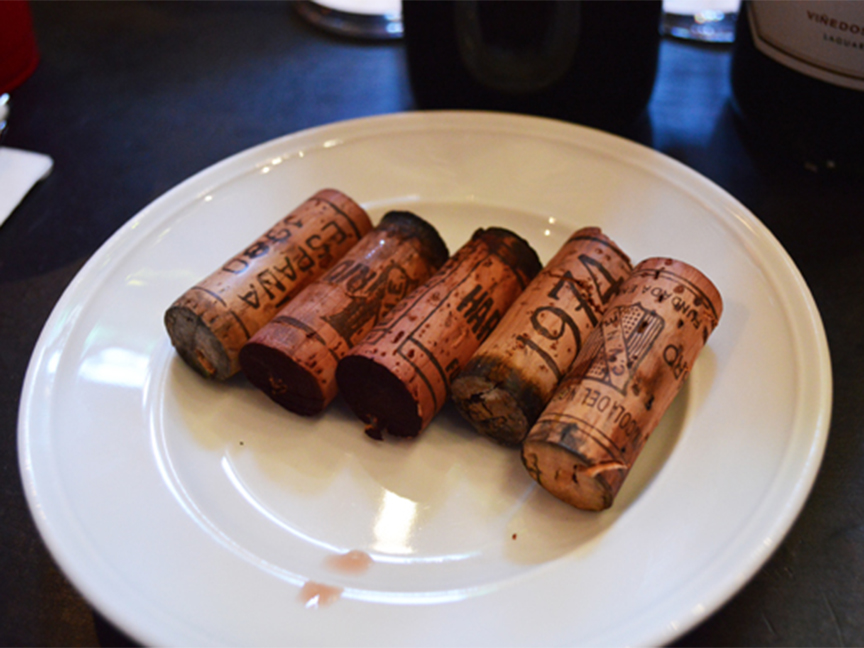
In the photo above, you can see the corks extracted from a flight of rare Italian wines at a lunch I attended in New York a few years ago. After the sommelier opened the bottles, he placed them on an under-liner and presented them to our party. After we examined them, he removed and reserved them in case we wanted to revisit them.

But when a sommelier is removing a cork from a bottle of young, fresh Cerasuolo di Vittoria or a current-release Bardolino, the question of provenance or authenticity is generally inconsequential. Over the course of a shift, a server or sommelier will remove a number of corks from youthful, inexpensive wines and the question of provenance should be resolved — in my view — before the bottle is presented to the table. When’s the last time you remember a guest in a casual restaurant inspecting a cork and saying, excuse me but this bottle of Pinot Grigio has a counterfeit cork in it?

The cork can tell you something about the fitness of the wine. But this generally only holds true when it comes to older wines.

More importantly, and this is one of the greatest misunderstandings about cork presentation in my experience, smelling the cork doesn’t reveal whether or not the wine is corked or otherwise defective or damaged. Just because a cork smells rotten doesn’t mean that the wine is corked. In fact, wine can be corked even when the cork is in perfect shape and vice versa, the wine can be in good health even when the cork is in bad shape. As I wrote yesterday, you determine the fitness of the wine by smelling the wine (and if needed, by tasting it). Not by smelling the cork.

I agree with the Court of Master Sommelier’s steps of standard service and I have the utmost respect for the court’s over-arching level of professionalism and the generally high caliber of its educational components.

But when it comes to wine service in casual restaurants and the presentation of young, fresh wines where the question of provenance and authenticity has little bearing, I believe that the cork shouldn’t be presented unless the guest expressly asks to examine it. And when it is presented, it should be presented exclusively on a small tray and the server should ask to remove it once the guest has inspected it.

The guest is always right, as the saying goes. And if a diner feels compelled to challenge the provenance of her/his current-vintage by-the-glass Pinot Grigio, then fair enough. But this anachronistic and — in my view — affected practice has no place when everyday wines are concerned.

Can a screw-cap wine be “corked”? Corkiness isn’t just cork taint.

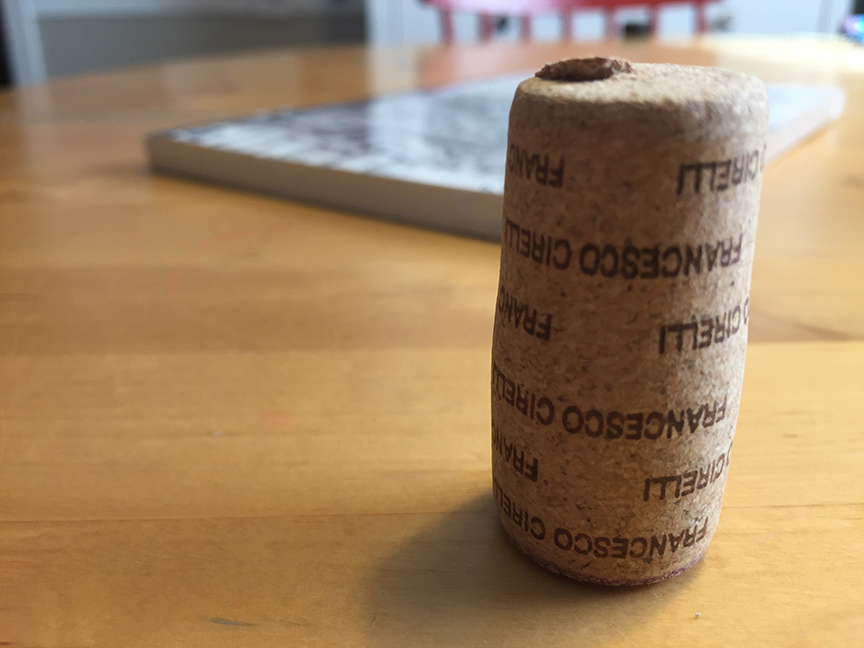
Francesco Cirelli’s entry-tier Trebbiano d’Abruzzo is one of our all-time favorite wines. Whenever the Texas allocation lands, the rep always jokes with our wine merchant: “Please let Jeremy and Tracie know. They’re thirsty!”

We buy it by the case and we serve and drink it as both an everyday wine and our Saturday night wine. That’s how much we love it. It’s varietally expressive and classic in style. And it’s one of the most wholesome wines you can drink in the under-$20 category.

But the other night we opened a bottle that was corked. We know this wine so well and drink it so often, that it’s easy for us to discern when it’s not right.

But how can a screw-cap wine like this be corked, when there is no cork involved?

Many years ago, one of my wine mentors and friends, Nicola Marzovilla, taught me that corkiness isn’t only about cork taint, in other words, the presence of the nefarious chemical compound TCA.

As Nicola put, corkiness can be about cork taint. But the more important telltale sign of a corked wine is the absence of fruit — even when there is no cork taint.

To borrow a line from another wine mentor and friend, Darrell Corti, wine is made from fruit and it should smell and taste of fruit. When it doesn’t, it’s likely that the wine is off.

The fruit aromas and flavors of a wine can be muted or even eclipsed entirely by cork taint. But there many other factors that can kill the fruit in a wine.

When I was first working in the wine trade in the early 2000s in New York, it was rare to see a bottled sealed with screw cap. Today, it’s commonplace. In some ways, you could say that it’s anachronistic to call a wine like this “corked.” But what would the contemporary wine lexicon be if not a metachronistic compendium of bygones?

One of the early problems facing winemakers who bottled their wines with screw-caps was that the seal would often break when the cases were stacked on top of one another. The weight and pressure of the bottles on top would compromise the seals on the bottles below. A lot of progress has been made in ensuring the sturdiness and integrity of screw-cap seals. But just a slight fissure, even invisible to the eye, can allow oxygen to be introduced into the bottle.

The same thing holds with cork because the tree bark used to make corks is a porous material that can allow small amounts of oxygen to be introduced into the bottle. And different types of taint — even TCA — can come into contact with the wine without affecting the cork itself. That’s why a cork-sealed bottle can be corked even when the cork doesn’t smell tainted.

Screw-caps have undeniably helped to deliver more robust fitness in wine today. But as I see it, opening a bottle of wine is always a gamble. It’s a wager that can reward the drinker with ineffable joy or disappoint with a broken and unfulfilled promise.

You win some and you lose some: this bottle is destined to donate its sugar for the sake of a salsa al pomodoro for pasta and to deglaze more than one sauté pan for chicken breasts and pork chops al vino bianco.

When food writing becomes a bully pulpit…

Last week, a prominent Houston food writer penned one of the most scurrilous posts I’ve ever read. In it, he upbraided a leading Houston legacy restaurateur with a venom generally reserved for the missives of jilted lovers.

In a world where content comes increasingly cheap and where even full-time food editors are paid barely livable wages, why is that the content creators employ such vitriol and stinging hostility in their writing? What’s to be gained other than clicks, ill will, and a degradation of the food community at large when a writer attacks a restaurateur or chef with such churlishness?

And why do the content creators have such little regard for the impact that their writing will have on the restaurateurs and their employees?

After all, it’s not a matter of defending or questioning President Trump’s wisdom in exiting the Paris Accord or imposing a travel ban on Muslims. Evidently, the stakes are higher.

The episode made me think back to my early years in New York when William Grimes — a writer I admire greatly — became the restaurant reviewer at the Times in the wake of Ruth Reichl’s departure in 1999.

In one of his earliest reviews, he panned the newly opened Colina at ABC Carpet, a high-concept and high-profile “rustic” Italian, giving it the paper’s lowest rating of “satisfactory” (“A Rural Italian Stage, a Complicated Script”).

A few short months later (and this was a few years before the Tragedy of the Twin Towers, when the New York restaurant scene was still booming and growing rapidly), the restaurant closed and all of its employees and investors were sent packing. Millions of dollars and years of planning down the drain.

By November 1999, Grimes had downgraded the rating for some of the city’s most beloved dining destinations.

“Mr. Grimes gave three stars to Daniel Boulud’s $10 million reincarnation of Restaurant Daniel,” wrote Frank DiGiacomo for the Observer at the time, “compared to the four stars that Mr. Boulud had been given by Mr. Grimes’ predecessor in the job, Ruth Reichl. On Oct. 20, Mr. Grimes demoted Charlie Palmer’s Aureole down to two stars from the three that The Times‘ Bryan Miller gave Mr. Palmer in 1991. In between, Mr. Grimes has awarded a flurry of one-star reviews — which have long represented mediocrity in this town — to such luminaries as restaurateur Drew Nieporent and Michael Lomonaco, chef of Wild Blue and Windows on the World.”

No one, it seemed, would be spared Grimes’ critical ire. And it was a watershed moment for food writing and restaurant reviews in the U.S.

Grimes told DiGiacomo:

    “Ruth hated the star system and was on record as not believing in it and therefore did an end run around it,” Mr. Grimes said of Ms. Reichl, now editor of Gourmet magazine. “Basically, one star had been abolished, and all sorts of restaurants were getting two stars, and the whole thing became sort of meaningless.”
    Mr. Grimes said one of his New Year’s resolutions was “to reinstate a valid star system in which the stars meant what they said and said what they meant. The one star’s purpose in life is to reward the good, solid neighborhood restaurant that’s operating at a high level, but is never going to be a Daniel.” At one point in the conversation, he characterized himself as “administering tough love.”

Grimes’ “tough love” ushered in an era of the self-righteous and morally puckered food critic in our country, when writers seemed to feel charged with and empowered by an ethical responsibility to unmask mediocrity to readers who couldn’t recognize it on their own.

But the waning of print media and the rise of the blogosphere and user-generated content in the years that followed the financial crisis marked the onset of winter for such high-handed arbiters of culinary excellence.

Scarcely a decade after Grimes’ review of Colina, Adam Martin wrote for The Atlantic: “the role of food critic has morphed from the kind of job one holds for decades, with increasing local power and seniority, to the kind of job one holds for a few years, before going off and doing something else.”

(I highly recommend Martin’s piece, “The End of the Career Food Critic,” to any aspiring food writer. It gives much needed historical perspective on the rapid evolution of food writing over the last two decades.)

In a world where there is no career for the “career food critic” as Martin put it, why do content creators still cling to such self-righteousness and self-fulfilling and self-propelled pseudo-moral authority?

What was there to gain when the Houston writer so aggressively assailed the restaurateur with little regard for journalistic standards or integrity? What purpose does food writing as a bully pulpit serve?

The answer beats me — literally and figuratively. And it’s one of the topics I’ll be covering for my seminars on food writing across the web at the University of Gastronomic Sciences next month in Piedmont.

There’ll always be an England while there’s a busy street…

Our souls shudder, our hearts ache, and our prayers go out today for our beloved sisters and brothers in England…

I give you a toast Ladies and gentlemen
May this fair land we love so well
In dignity and freedom dwell
While worlds may change and go awry
There’ll always be an England
While there’s a country lane
Wherever there’s a cottage small
Beside a field of grain
There’ll always be an England
While there’s a busy street
Wherever there’s a turning wheel
A million marching feet
Red, white and blue
What does it mean to you?
Surely you’re proud
Shout it loud
Britons awake!
The Empire too
We can depend on you
Freedom remains
These are the chains
Nothing can break
There’ll always be an England
And England shall be free
If England means as much to you
As England means to me

“There’ll always be an England,” song by Ross Parker and Hughie Charles.

Image via Michael Jeffries’ Facebook.

California wine on my mind: a study in two extremes…

Last week, over the course of 24 hours on the ground in Southern California (my dolce natio loco), it felt like I spanned the extremes of viticulture there.

On Tuesday evening, I tasted some of the extraordinary Santa Barbara-grown wines of Scott Sampler, a show business veteran who has been buying and bottling fruit since the 2012 vintage there under the Central Coast Group Project label.

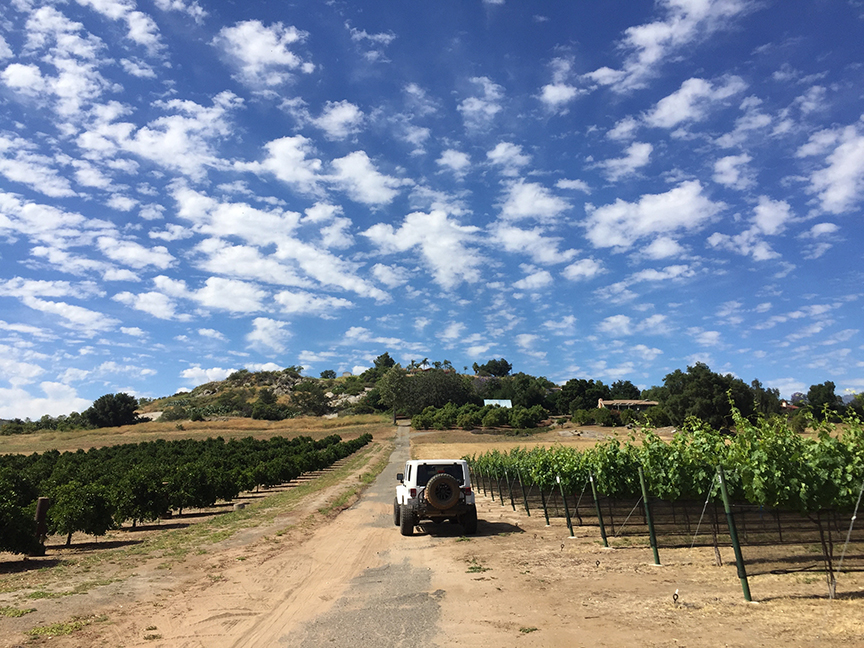
On Wednesday afternoon, I toured vineyards in Valley Center (not far from where I grew up in San Diego) with winemaker and grape grower Chris Broomell whose family has been farming there for five generations.

Chris’ family started growing grapes, he said, in the era after the Second World War when ongoing drought made viticulture more lucrative.

Scott abandoned a robust career in entertainment to become a full-time winemaker.

Chris vinifies delicious, moreish, and highly affordable monovarietal wines for his family’s Triple B Ranches winery. I especially loved his gorgeous Vermentino.

Scott employs extended maceration times to make brilliant, jaw-droppingly beautiful expressions of Rhône Valley grape varieties that cost more than I can afford and sell out as soon as he releases them. I was blown away by his 2013 Grenache, Mourvèdre, and Syrah blend below and its ballerino’s balance despite its muscular alcohol.

Meeting and tasting with both winemakers was an exhilarating and eye-opening experience for me. In part because they each represent distinct and powerful voices in the new wave of California winemaking and in part because they share a vision of transparency in winemaking. And by transparency, I mean clarity and sincerity of fruit in their wines.

Chris and I talked a lot about the historic disconnect between California grape growers and winemakers. California is a great place to grow fine wine grapes, he explained (and we all know this to be true), but until the current generation, Californian winemakers have focused more on their work in the cellar than in the vineyards. When he returned from a year working in vineyards and wineries in Australia early on in his career, he said, he was nonplussed by the way California winemakers interpreted the fruit delivered to their cellar doors by local farmers.

Similarly, Scott seems to belong to a growing number of California winemakers who see their role as custodians or guardians of their fruit. He works with growers who deliver superb grapes to his cellar door and like Renaissance master Pietro Bembo meticulously transcribing the idiograph Italian poems of Petrarch, he appears (at least to me) more as a protector and defender of the berries than their interpreter or manipulator.

Both winemakers have looked abroad for inspiration. And both are making delicious and — in my view — thought-provoking wines, both for their historical perspective and their wholesome deliciousness.

And both of them have me thinking big thoughts. I’ll have a lot more California on my mind this month and the months to follow. Thanks fo reading and stay tuned…

The best tortellini west of Bologna: scenes from the new Rossoblu in LA (where I’m writing the wine list)

Perhaps the greatest compliment came from my friend Barbara in Emilia-Romagna, the region that inspired the menu at Chef Steve Samson’s new downtown LA restaurant, Rossoblu where I am writing the wine list.

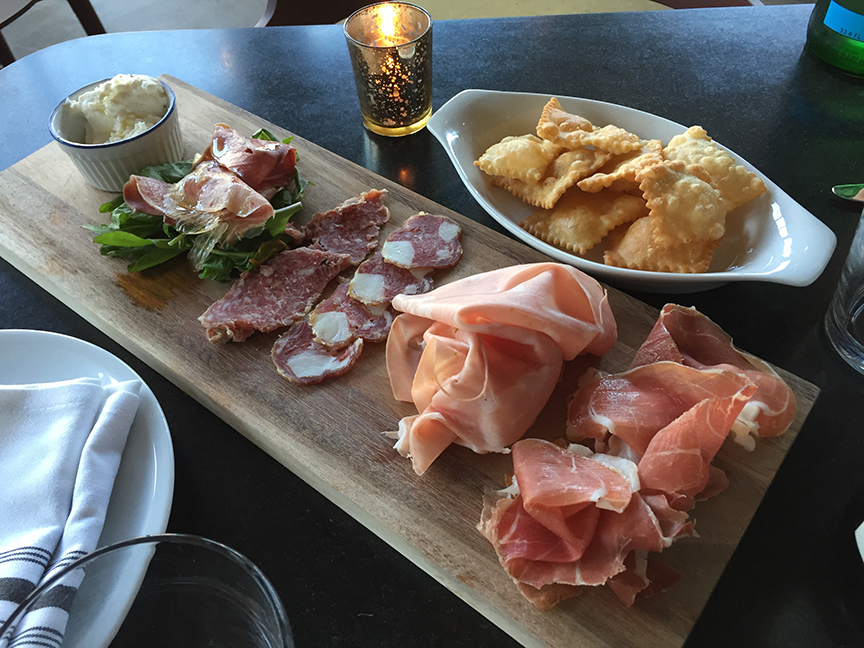
When she saw that I had posted this image of the Rossoblu salumi board on my social media, she commented, “are you in Modena?”

I’m biased, of course: not only has Chef Steve been my friend for nearly 30 years (we met on our junior year abroad in Italy), but he’s also the chef/owner of the popular LA restaurant and pizzeria Sotto, where I’ve also been writing the wine list for the last six years.

I couldn’t have been more geeked to try the new restaurant and menu, which is based on recipes from his mother, who’s from Bologna, and the summers he spent their as a kid.

The recipe for the eggplant above comes from the kitchen of signora Valbruna, who still lives down the street from where Steve’s mom’s family lived in San Donnino in Bologna. I’ve sat at Valbruna’s table many times over the years! I even took Tracie P to eat with their family on our honeymoon: that’s how good her cooking is…

And that’s the big secret about Emilian cookery. There are many great restaurants in Emilia and most of the best ones are in the countryside. But nothing comes close to the home cooking. That’s where the real deal culinary magic happens.

I’ll never forget an evening from a couple of years ago when Steve previewed some dishes from the future Rossoblu menu at Sotto. His mother was in attendance, of course. She said she liked the tortellini but “mine are better,” she said (cue Jewish mother/Italian mother jokes here).

Steve’s tortellini were incredible last week. I’ve never had tortellini that good outside of Emilia. It was a sort of litmus test for him and he passed with rosso and blu flying colors, the red and blue of his beloved Bologna soccer club. Complimenti, Steve!

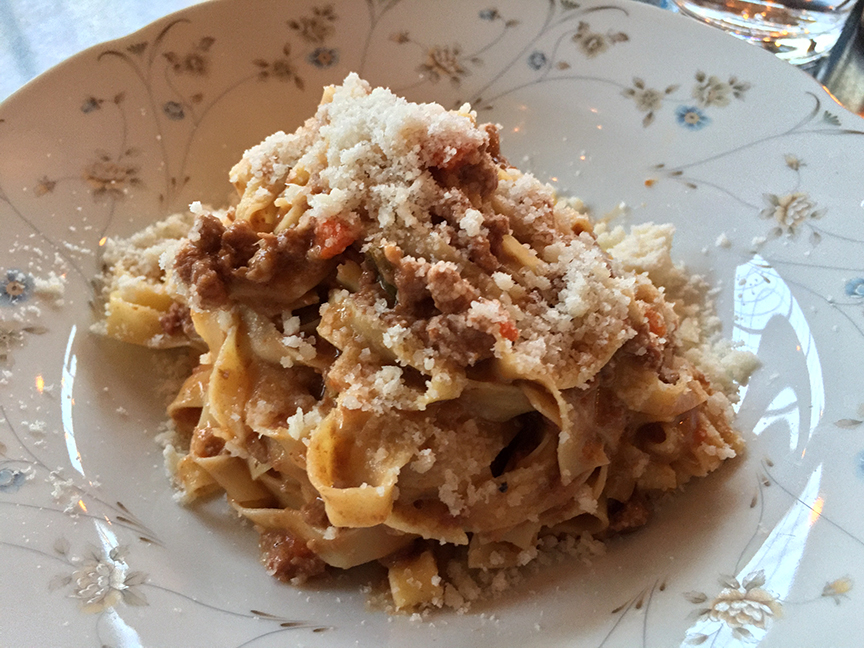
But as much as I was impressed with the tortellini, it was the tagliatelle al ragù that really wowed me.

The dish is the non plus ultra of great Emilian food and I have never — never ever — had tagliatelle this good outside of homes where I’ve eaten in Parma, Reggio Emilia, Modena, and Bologna.

What a great night and great meal at the new Rossoblu, which is still in the “friends and family” phase of opening. The official launch will happen next week.

Need a reservation? I know a guy who knows a guy…

The website is still a holding page but check out the Instagram and Facebook for updates and images.

Barbaresco Montestefano 04 drinking young, ungrafted grapes from Faenza, and the tree that fell on our house

When it comes to Montestefano (pronounced MOHN-teh-STEH-fah-noh), one of the top crus in Barbaresco, you often hear the Langhetti say that the wine baroleggia. In other words, it resembles, evokes, or aspires to be Barolo-like in character.

This microaggression against Barbaresco as an appellation is misguided and unwarranted in my opinion and experience: it would seem to imply (or one may infer from it) that Barbaresco is the inherently inferior among the two designations.

But there is a distinctive earthy and savory note that sets Montestefano apart from many of the other expressions of Barbaresco, which tend to be more lithe and less austere than their counterparts in Barolo to the south.

The 2004 vintage is remembered by many as classical growing cycle, with an even and balanced progression of the seasons that some compare to the supreme 1989 harvest in Langhe.

When we opened this bottle on Sunday night for a couple of special guests in our home, this 13-year-old wine guarded its fruit jealously, with rich tannin that only slowly began to reveal the wine’s gorgeous dark red fruit and umami flavors. The tannic character and the electric acidity in this wine make me believe that it has many years — even decades — ahead of it before it reaches maturity. What a wine, people!

Earlier in the evening we also opened this bottle of Centesimino, a native grape of Faenza (Romagna), a variety I had never tasted before.

According to ampelographic reports I could find, the vines used to make this wine are ungrafted. In other words, they are the descendants of plants that were not affected by the phllyoxera epidemic of the 19th century (because they were not impacted the louse, they were never grafted to phylloxera-resistant vitis labrusca from the New World). Evidently, the vines’ ancestors were cloistered in a palace courtyard in Faenza proper and were spared from the scourge.

The “A” by Villa Venti, a rigorously natural winemaker (meaning organic farming practices, spontaneous fermentation, and minimal interventionism), was bright, with eye-popping berry fruit and zinging acidity in the mouth. We all enjoyed it immensely.

The bottle that found its way to our home arrived clandestinely. But I hear that it might be making it to Texas via legitimate channels soon.

A truly original and compelling wine and a reminder of the awe-inspiring breadth of Italian viticulture.

In other news…

A tree fell on our house early Monday morning!

Intense winds on our street in southwest Houston brought down a number of old trees and caused havoc on our block, leaving nearly 200 homes without power. Miraculously, the damage to our roof was minimal and our landlords were swift to have the 25-year-old tree removed and the damage repaired.

But, man, what a fright to wake up and find that this mighty trunk had fallen in our backyard!

The funny thing was that no one in our family heard it fall: did it make a sound?

Thanks for all the well wishes. We are all safe and all is right in our home.

Dulcis in fundo…

Georgia P (age 5) and Lila Jane (age 3) had their dance recital on Sunday afternoon. They both took the stage confidently and with gusto. And while their performances may not have been impeccable, the looks on their faces and glowing smiles that appeared when they saw me and Tracie P in the audience were priceless.

They are my heart, my love, and my joy. I’m so blessed that Tracie gave them to us and I have so much fun being their dad.

Writing from the road today in California as I embark on a new editorial project and adventure. Stay tuned… 

Thoughts and prayers for the families of Manchester

It’s been heart-wrenching to hear the reports and accounts of yesterday’s bombing in England.

Our hearts, thoughts, and prayers go out to the families of Manchester today.

G-d bless Britain…

Image via the Wiki.

La dolce vita and the last day of preschool in #TrumpAmerica

To most Americans, the iconic Italian expression la dolce vita means the sweet life (its literal translation) or the easy life.

Its English-language connotation with glamor and carefree living comes from the famous film by the same name, Federico Fellini’s 1960 masterpiece.

In interviews that he gave in the years that followed its release, the Italian director repeatedly said that its meaning was widely misunderstood.

The title, he explained, came from the final sequence of the movie when the main character, Marcello (played by Marcello Mastroianni), sees the little girl, Paola, whom he’d met earlier in the story. It’s daybreak and he’s on the beach outside of Rome, following a night of hard partying with his jet-set friends. He’s coming to terms with the fact that the world around him, the milieu bourgeois to which he belongs, is morally bankrupt and devoid of purpose other than self-serving personal fulfillment.

But the sight of the beautiful, innocent child brings a smile to his face as he remembers — in Fellini’s telling — the inherent, abiding, and irrepressible sweetness of life itself.

Watch the sequence here. You don’t need to understand Italian to follow the narrative.

I was reminded of that scene yesterday when Tracie P and I went to pick up Georgia P (above) on her last day of preschool. She’ll start kindergarten in September and she’ll turn six in December. Tracie and I both shed a tear as we reflected on this last day in this chapter of her life.

She’s too little to understand words like “special counsel” or “collusion” or “impeachment” or “locker room talk.” She’s too young to ask questions about why the president of our country boasts of his electoral college results or the size of his hands. She simply wouldn’t be able to wrap her mind around why the president told the director of the FBI to go home or why the Senate majority leader has called for a little less “drama” from the White House.

The buffoonery of the 2016 presidential nominating process and election has now carried over into the running of our country and the direction of our nation — there is no doubt about it, no matter where you stand.

To you Trump supporters and loyalists, I ask: how do you explain this to your children? How do you explain that you voted for and support a man who’s irreparably degraded civil discourse in this country? How do you explain your faith in a man whose administration — running our country — is in a “downward spiral,” as a leading Republican Senator put it this week?

What’s a downward spiral, daddy?

Was all of this worth the wall on the border, the travel ban, the repeal of greater access to health care? How do you explain your embrace of moral bankruptcy for the sake of lower taxes for the wealthy and deregulation of big business? Smaller government and state’s self-determination are fair game in the political world. And I respect that. But how can you respect yourselves when you euphemize the Faustian deal you made with Trump to achieve those goals?

My oldest child is only five years old and I still don’t have to explain to her the choice that so many of my fellow Americans have made when they voted for Trump. Maybe they believed that Trump would act differently in the White House. That clearly isn’t going to happen at this point. Maybe they believed that he would act as he has for his whole life and that was okay with them. Maybe moral rectitude is no longer an aspiration we should instill in our children.

Tracie and I have a few more years ahead of us before we will have to explain Trump America to our children. In the meantime, the tears we shed remind us that there is a sweetness to life that no one, not even Donald Trump, can destroy.

Chef Steve and his Rossoblu in the LA Times: the new Los Angeles restaurant where I’m writing the wine list

Above: the mural in the main dining room at Rossoblu, which will “hard” open in just a few weeks in downtown Los Angeles.

What a thrill to see my friend Steve Samson profiled this week in the LA Times for the opening of his new downtown restaurant (where I’m writing the wine list).

“Los Angeles is poised for some major restaurant openings in 2017,” writes Hillary Eaton for the paper. “Perhaps one of the most anticipated is chef Steve Samson’s Rossoblu, set to open in downtown’s gorgeous new City Market South development on May 17.”

    While Samson has earned a following for his perfectly blister-flecked, wood-fired pizzas at Sotto, his Southern Italian restaurant in Pico-Robertson, you will not find a single pie on the menu at Rossoblu. Instead, Samson’s newest project will allow him to flex other muscles, crafting a menu that reads as an ode to the Italian cuisine of the Emilia-Romagna region in Northern Italy.
    Samson’s connection to Emilia-Romagna runs deep. The region is home to his favorite soccer team, F.C. Bologna, referred to by fans as rossoblu (after the team’s red and blue colors). It’s also the place he spent his childhood summers with his mother’s family. Each summer he grew more enamored with the food and culture that would one day drive him to abandon a prospective career as a doctor to become a chef.

Click here to read the rest of the article.

Steve and I first met back in 1987 — 30 years ago! — when we were both juniors at the University of California (I was at UCLA and he at UCSD) and we were both spending our year abroad in Italy.

Even though he was studying in Venice and I was in Padua, we became fast friends and it didn’t take long before he took me with him to Bologna, where he spent summers as a kid: his dad studied medicine on the GI Bill at Bologna where he met Steve’s mom. She grew up in the city’s San Donnino neighborhood.

It was such a great experience for me, during my first year in Italy, to experience Bologna and Steve’s family’s life and circle of friends there. Dindo, one of Steve’s best friends growing up, is still one of my best friends, too (here’s a song I wrote for him).

Seven years ago, when Steve was getting ready to launch his first restaurant in LA as chef/owner, I had just moved back to California from New York where I had spent a decade working as a translator, wine and food writer, and musician. He had always said that he wanted me to write the wine list at his restaurant and even though I had picked up and moved to Texas to marry Tracie P by the time he opened, he insisted that I be the restaurant’s wine director.

We’ve been going strong together ever since and I couldn’t more thrilled to be part of the new project and more proud to be Steve’s friend and colleague: it’s so wonderful to see someone you love thrive like this and achieve a lifelong dream.

Congratulations to Steve and his wife and partner Dina on this new gastronomic adventure! I am so stoked to be a part of it.

As soon as the restaurant officially opens next month, we’ll begin planning our first wine dinners and tastings etc. In the meantime, if you happen to be in LA next week, I’ll be leading a tasting of Campania wines at Sotto, Steve’s other restaurant, on Tuesday, May 23 (click here for details and reservations). Please join me!

Thanks for your support, everyone. I feel so blessed to do what I do for a living and so lucky to be surrounded by so many talented and gifted people like Steve and Dina.